

Tobacco-free lifestyle wellness guide for UK women

TL;DR:
- The Lesser Evil Oral Mister provides a discreet, tobacco-free nicotine delivery option that requires no inhalation. It is a water-based gel spray designed for easy, on-the-go use, especially suitable for professional women seeking a less conspicuous alternative. Regulatory and environmental benefits include no e-waste and a legal status outside medical approval.
If you want nicotine without the smoke, the vapour, or the bulk of a device, Lesser Evil Oral Mister is the product to know about. This guide covers how sublingual nicotine gel fits into a discreet, tobacco-free daily routine for urban professional women in the UK.
- What it is: a sublingual nicotine gel spray placed under the tongue, absorbed via the oral mucosa. No combustion. No inhalation.
- Key differences from smoking and vaping: you don’t breathe anything in, there’s no visible vapour, and no battery to charge or dispose of.
- Practical benefits: fits in a pocket, leaves no smell on clothes, and produces no e-waste.
- Regulatory note: oral nicotine products are consumer goods in the UK, not medicines. The Committee on Toxicity (COT) and Action on Smoking and Health (ASH) both note that they are not regulated as NRTs. ONS data from 2022 puts adult smoking prevalence at 12.9% (around 6.4 million people), with vaping tracked separately and growing.
Table of Contents
- What is oral nicotine gel and how does it differ from smoking and vaping?
- How to use oral nicotine gel: placement, timing, and dosing
- Everyday habit strategies to lower your nicotine intake
- What’s the UK regulatory position on oral nicotine products?
- Discreet use at work, in social settings, and while travelling
- Environmental and cost considerations versus vaping
- How to choose an oral nicotine product: what actually matters
- Lesser Evil Oral Mister: what it is and who it suits
- What changes when you go tobacco-free beyond the product itself
- What happens when you stop smoking: common physical responses
- How oral nicotine gel fits within broader stop-smoking support
- Long-term wellness after nicotine: what to build next
- Key takeaways
- Why oral nicotine gel is the product category the industry ignored
- Lesser Evil Oral Mister is available now for UK pre-order
- Useful sources and further reading
What is oral nicotine gel and how does it differ from smoking and vaping?
Oral nicotine gel is a sublingual product: you place it under your tongue or along the gum line, and nicotine absorbs through the oral mucosa. No flame. No battery. No vapour cloud drifting across a meeting room.
Here’s how it stacks up against the alternatives:
- Smoking: combustion produces thousands of chemicals you breathe directly into your lungs. Gel has no combustion at all.
- Vaping: a device heats liquid and you inhale the vapour. Gel skips inhalation entirely.
- Pouches: sit against the gum and can cause soreness over time. Gel is a spray format, more discreet and with minimal odour.
One thing worth being clear about upfront:
Oral nicotine products are consumer goods, not medicinal products. They do not undergo the clinical testing required for nicotine replacement therapies. The COT notes they lack the combustion toxins found in smoking but are not ‘risk-free’. ASH similarly states current research suggests fewer harmful chemicals than cigarettes, while calling for more independent studies.
For a deeper look at how sublingual delivery works, the mechanics are straightforward once you’ve tried it once.
How to use oral nicotine gel: placement, timing, and dosing
Place the gel under your tongue or along the inner gum. That’s the core instruction. Everything else is about building a routine that works for you.
- Wash your hands before use, especially if you’re out and about.
- Apply the gel under your tongue or along the lower gum line as directed on the product.
- Hold for the recommended time — typically a few minutes — to allow absorption through the oral mucosa.
- Avoid eating or drinking immediately before or after, as this can affect absorption.
- Space uses out — leave a gap between applications rather than stacking them back to back.
- Track your daily count using a notes app or a simple tally so you stay aware of your intake.
| Strength band | Typical per-use amount | Suggested spacing |
|---|---|---|
| Low dose | Small measured spray | around one hour between uses |
| Standard dose | Standard measured spray | around one hour between uses |
Figures are general guidance only. Follow the specific product instructions on your Lesser Evil Oral Mister pack.
Pro Tip: Keep a note on your phone of the time you last used. It takes about three days before spacing becomes automatic, and having a timestamp removes the guesswork entirely.
Everyday habit strategies to lower your nicotine intake
Habit change works best with small, repeatable substitutions rather than willpower alone. Swapping a smoke break for a gel use is a start; building a routine around it is what makes it stick.
Practical routines that help:
- Set use windows — decide in advance when you’ll use (morning commute, post-lunch, mid-afternoon) rather than responding to every urge.
- Pair gel use with a short ritual — a glass of water, a short walk, or a few minutes outside. The ritual replaces the cigarette break structure.
- Delay by five minutes when you feel the pull. Often the urge passes or reduces, and you end up using less.
- Log your daily count in a notes app. Seeing the number matters.
Common triggers worth knowing: coffee, commuting, social breaks, and stress spikes. For each one, having a pre-decided alternative (the gel, a walk, a cold drink) means you’re not making a decision under pressure.
HMRC-commissioned market research found a clear subgroup of younger adults choose discreet nicotine delivery systems as a lifestyle choice, not solely to stop smoking. That’s a useful reframe: this is about control, not deprivation.
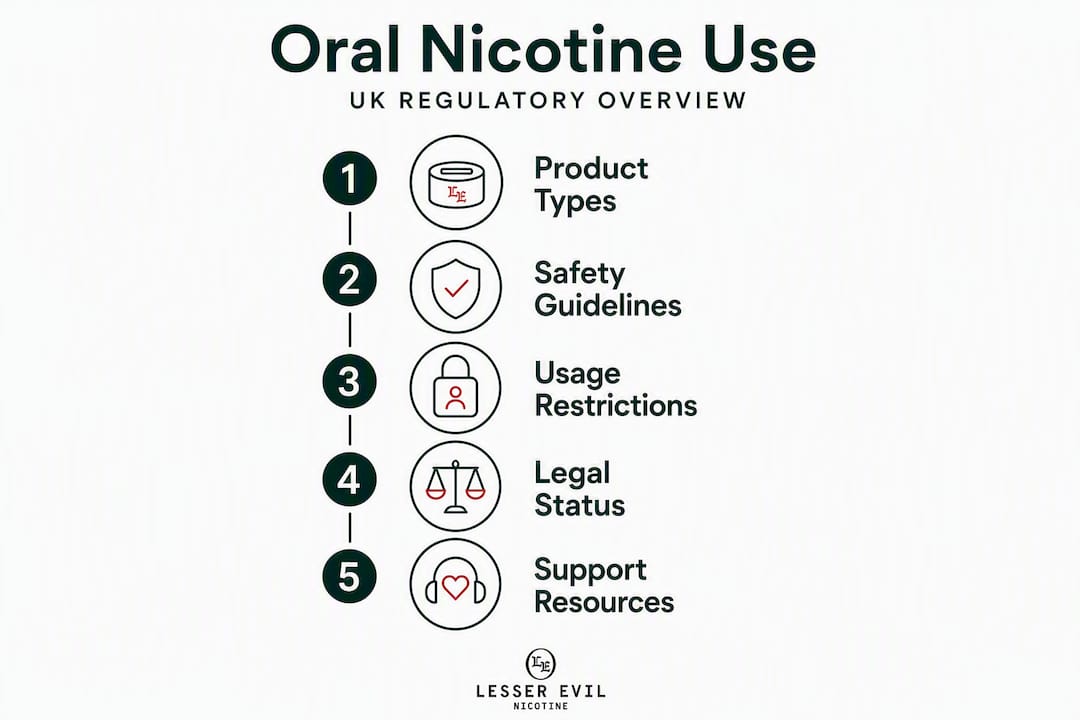
What’s the UK regulatory position on oral nicotine products?
Oral nicotine products are not medicines. They are not overseen by the MHRA and carry no clinical dosing guidance. That means you manage your own intake using the product instructions and ingredient list as your primary guide.
The Tobacco and Vapes Act introduces an age of sale of 18 for nicotine products (including pouches and gels) from later in 2026. A ban on certain advertising and sponsorship is expected to follow in 2027, subject to further consultation. The Act also gives the Government powers to restrict packaging and product content going forward. — ASH
The ONS 2023 update tracks smoking and vaping trends alongside the Government’s smokefree England target of 5% or lower by 2030. Oral nicotine gels sit outside the NRT category entirely, which means different rules apply compared with patches or gum.
A few things to keep in mind on safety: oral health considerations are real. Prolonged gum contact with any nicotine product can cause soreness or ulcers in some people. There are no standardised clinical dosing guidelines for non-medicinal oral nicotine products, so product instructions are your baseline. For a breakdown of how consumer oral nicotine products differ from NRTs, the distinction matters practically, not just legally.
Discreet use at work, in social settings, and while travelling
You can integrate oral gel into a working day with almost no disruption. No stepping outside. No visible device. No smell on your jacket.
Practical etiquette tips:
- Use in private moments — a bathroom break, a quiet corner, or a moment between meetings. It takes seconds.
- Store it discreetly — a small pouch or inner bag pocket works well. The product is compact by design.
- Manage aftertaste — a sip of water after use keeps things fresh. Mint flavours (like Peppermint) help here naturally.
- Handle questions simply — “it’s an oral nicotine gel” is a complete answer. Most people won’t press further.
- Travelling: gel products are generally fine in hand luggage (no liquid volume concerns at standard pack sizes, but check current airport rules). No batteries means no device restrictions.
For more on discreet nicotine use in professional settings, the workplace context is worth reading before your first week of use.
Environmental and cost considerations versus vaping
Battery-free is the headline. No device to charge, no coil to replace, no disposable pod ending up in landfill. ASH’s 2025 factsheet estimates around 5.5 million adults vape in Great Britain — that’s a significant volume of devices, batteries, and pods cycling through the waste stream.
With oral gel:
- No e-waste: no batteries, no coils, no pods.
- No device cost: you buy the product, not the hardware. No starter kit, no replacement parts.
- Compact packaging: smaller physical footprint than most vape setups.
Cost varies by product and usage frequency. Check current pricing and subscription options directly on the Lesser Evil site, as these can change around launch windows. For a broader look at battery-free nicotine options, the environmental case is made clearly there.
How to choose an oral nicotine product: what actually matters
Start with fit, not brand. The right product is the one you’ll actually use consistently and comfortably.
Checklist for choosing:
- Clear dosing information on the pack
- Full ingredient list with no vague “flavouring” catch-alls
- Natural sweeteners rather than high sugar content
- Flavour options that suit your palate (mint, fruit, neutral)
- Compact, discreet packaging
- Age verification at point of sale (required from October 2026)
- Transparent returns and customer support policy
Red flags to avoid:
- Any product making medical or cessation claims (it’s not regulated for that)
- Vague or incomplete ingredient lists
- Sellers without age verification
- Opaque return policies
For a broader overview of oral nicotine product types before you decide, it’s worth understanding the full category.
Lesser Evil Oral Mister: what it is and who it suits
Lesser Evil Oral Mister is a sublingual oral nicotine gel spray. Tobacco-free, battery-free, water-based formulation with natural flavours and natural sweeteners. Precision dosing per spray. No inhalation required.
Flavours: Peppermint, Black Grape, Green Apple.
Who it suits:
- Urban professional women who need discreet, low-profile use during a working day
- Anyone who wants nicotine without breathing in vapour or smoke
- People who want to reduce visible waste and ditch the device
- Those who prefer natural ingredients over synthetic flavourings
| Product fact | Detail |
|---|---|
| Delivery method | Sublingual gel spray (under the tongue / oral mucosa) |
| Tobacco content | None |
| Battery required | No |
| Flavours available | Peppermint, Black Grape, Green Apple |
| Formulation | Water-based, natural flavours, natural sweeteners |
| Dosing | Precision spray |
Lesser Evil Oral Mister is available via the product page ahead of the UK launch in 2026. Check there for current availability, pack sizes, and pre-order details.
What changes when you go tobacco-free beyond the product itself
Removing tobacco from your routine has effects that go well beyond the nicotine delivery method. Combustion-related exposure drops immediately when you stop smoking. Your lungs aren’t processing smoke. Your clothes, hair, and breath don’t carry the smell. Social situations that felt awkward around smoking become simpler.
Longer term, people who stop smoking report improvements in cardiovascular function, lung capacity, skin condition, and sleep quality. These are well-documented outcomes across public health literature. The financial side is also real: the average UK smoker spends significantly on cigarettes annually, and removing that cost adds up fast.
A tobacco-free lifestyle also tends to shift social habits. Smoke breaks disappear from the day’s structure, which some people find freeing and others find disorienting at first. Building replacement rituals (a short walk, a coffee, a moment outside) helps fill that gap without the tobacco.
What happens when you stop smoking: common physical responses
When the body stops receiving combustion-related compounds, it recalibrates. Some people sail through this. Others find the first week or two genuinely uncomfortable.

Common physical responses include: irritability, difficulty concentrating, disrupted sleep, increased appetite, and a persistent urge to smoke. These are normal and typically peak within the first few days, then ease over two to four weeks for most people.
Coping approaches that work: physical activity (even a 10-minute walk) reduces the intensity of urges. Keeping hands busy helps. Staying hydrated matters more than most people expect. Reducing caffeine in the first week can help with sleep disruption.
Using an oral nicotine product during this period means you’re still managing nicotine intake, which addresses the physiological side. The behavioural side, the rituals and triggers, takes a bit longer to rewire.
How oral nicotine gel fits within broader stop-smoking support
Oral nicotine gel is a consumer product, not a medicine or a formal cessation therapy. That said, it can sit alongside other approaches without conflict.
NHS Stop Smoking Services offer free support including behavioural counselling and access to licensed NRTs (patches, gum, inhalers). These are clinically regulated products with dosing guidelines. If you’re using a consumer oral nicotine product alongside a formal programme, be transparent with your stop-smoking adviser about your total nicotine intake across all sources.
Apps like the NHS Quit Smoking app track smoke-free days and savings. Combining that kind of tracking with deliberate gel use spacing gives you a clearer picture of your overall intake. The goal is awareness, not perfection.
Long-term wellness after nicotine: what to build next
Once nicotine is out of the picture entirely, the work shifts to maintaining the habits that replaced it. The risk at this stage is substitution: replacing nicotine with excess caffeine, sugar, or alcohol. Worth watching for.
What tends to work long-term: regular physical activity (even moderate exercise significantly reduces urge intensity and improves mood), consistent sleep patterns, and social environments that don’t centre on smoking. Telling people in your life that you’ve stopped reinforces the identity shift.
The financial saving from stopping smoking is worth calculating and redirecting deliberately. Whether that’s a gym membership, better food, or simply saving it, having a visible destination for that money makes the change feel concrete rather than abstract.
Key takeaways
Oral nicotine gel is a tobacco-free, battery-free sublingual product that delivers nicotine without combustion or inhalation, making it a genuinely discreet option for urban professional women who want to move away from smoking or vaping.
| Point | Details |
|---|---|
| No combustion, no inhalation | Gel absorbs under the tongue via the oral mucosa — you don’t breathe anything in. |
| Not a medicine | Oral nicotine gel is a consumer good, not an NRT; manage intake using product instructions. |
| UK regulation changing | Age of sale of 18 applies from later in 2026 under the Tobacco and Vapes Act. |
| Habit strategy matters | Planned use windows and trigger logging reduce automatic, cue-driven use more reliably than willpower. |
| Lesser Evil Oral Mister | Tobacco-free, battery-free sublingual gel spray in three natural flavours; available to pre-order ahead of UK launch. |
Why oral nicotine gel is the product category the industry ignored
The nicotine pouch market has been almost entirely male-coded in its branding, its flavour profiles, and its retail placement. Walk into most vape shops and the pouch display looks like it was designed for a football changing room. That’s not an accident, and it’s not neutral.
What’s been missing is a product built around the actual experience of a professional woman who vapes and wants something less conspicuous, less chemical, and less wasteful. Not a patch. Not a piece of gum. Something that fits in a jacket pocket, tastes decent, and doesn’t require explaining to a colleague.
The gel format solves this practically. No device to pull out. No vapour cloud. No smell. And the natural flavour and sweetener formulation means you’re not trading one set of questionable ingredients for another. The environmental argument is real too: battery-free means no contribution to the e-waste problem that disposable vapes have made genuinely serious in the UK.
The conventional wisdom in harm reduction has been “get people onto NRTs.” That’s a medicalised frame that doesn’t fit how most people actually make decisions about nicotine. Consumer products that are honest about what they are, well-formulated, and designed for the people who actually use them are a different and arguably more realistic route for a large chunk of the adult nicotine-using population.
Lesser Evil Oral Mister is available now for UK pre-order
No device. No vapour. No tobacco. Just a precise, natural-flavoured gel that sits under your tongue and gets on with it.

Lesser Evil Oral Mister launches in the UK in 2026, available direct via the Lesser Evil store. Three flavours: Peppermint, Black Grape, and Green Apple. Battery-free, tobacco-free, water-based formulation with natural ingredients. Pre-order now to secure your first pack and check the product page for current pricing, pack sizes, and shipping details.
Want more before you buy? These guides cover the practical detail:
- Oral nicotine vs smoking: what’s actually different
- Switching cigarettes to oral nicotine: your 2026 guide
- Examples of discreet nicotine use: a 2026 guide
Questions? Customer support details are on the product page. Returns policy is listed at checkout.
This guide is general information, not medical or health advice. For personal health decisions around nicotine use, consult a qualified healthcare professional or your GP.
Useful sources and further reading
- Committee on Toxicity (COT): statement on oral nicotine pouches — the primary UK scientific advisory body assessment of nicotine bioavailability and toxicological risk from oral nicotine products.
- ASH: nicotine pouches — covers regulatory status, the Tobacco and Vapes Act timeline (October 2026 age-of-sale change), and harm context for oral nicotine products.
- ONS: adult smoking habits in Great Britain (2022) — prevalence data including the 12.9% adult smoking rate.
- ASH: use of vapes among adults in Great Britain (2025) — the 5.5 million adult vapers estimate and vaping trend context.
- HM Government: understanding the vaping market — HMRC-commissioned research on why younger adults choose discreet nicotine delivery systems.
- Tobacco and Vapes Act 2026 — primary legislation covering age of sale, packaging powers, and advertising restrictions for nicotine products.
- UK vape regulations in 2026: what you need to know — accessible overview of the regulatory changes affecting vapes and nicotine products this year.