

Nicotine and dental health: what women need to know

Nicotine is genuinely bad for your teeth and gums, and if you’re a woman, the risks are compounded in ways most dental advice completely ignores. The core problem is biological: nicotine constricts the blood vessels that feed your gum tissue, starving it of oxygen and nutrients while simultaneously suppressing the immune cells that would normally fight off bacterial infection. Heavy smokers face nearly twice the risk of general tooth loss and over six times the risk of losing teeth specifically to periodontal disease compared to non-smokers. Women face an additional layer of vulnerability because hormonal fluctuations across the menstrual cycle, pregnancy, and menopause alter how oral tissues respond to that damage.
Here’s the short version of what nicotine does to your mouth:
- Reduces blood flow to gum tissue, masking early signs of infection
- Suppresses immune defences, letting harmful bacteria take hold
- Disrupts saliva composition, shifting the oral microbiome toward pathogenic species
- Slows healing after dental procedures and increases implant failure rates
- Interacts with oestrogen and progesterone, amplifying inflammatory damage in women
- Accelerates bone loss around teeth, particularly after menopause
Nicotine’s vasoconstrictive action doesn’t just damage gum tissue directly. It masks the bleeding that dentists rely on to detect early gum disease, meaning women who smoke or vape often present with more advanced periodontitis than they realise, precisely because the warning signs were chemically suppressed.
How nicotine damages your gums and drives periodontal disease
Periodontal disease is not just “bad gums.” It’s a progressive bacterial infection that destroys the bone and connective tissue holding your teeth in place. Nicotine accelerates every stage of that process.
The primary mechanism is vasoconstriction. Nicotine reduces blood flow to gingival tissue and suppresses the immune response, which means your body is slower to detect infection and slower to fight it. The result is a gum environment where pathogenic bacteria thrive with less resistance than they’d normally face.
Saliva is your mouth’s first line of defence, and nicotine disrupts it. Smoking alters salivary calcium levels and pH, shifting conditions in favour of the bacteria associated with periodontitis. The oral microbiome, which in a healthy mouth is a balanced community of hundreds of species, tips toward a more pathogenic profile. Anaerobic bacteria like Porphyromonas gingivalis and Tannerella forsythia become more dominant, and the tissue damage compounds over time.
The clinical data is stark. Smokers carry twice the risk of gum disease compared to non-smokers, and that risk scales with how much and how long you smoke. Treatments are also less effective in people who smoke, because the same vasoconstriction that caused the damage also impairs the tissue’s ability to respond to intervention.
| Periodontal risk factor | Smokers | Vapers | Non-users |
|---|---|---|---|
| Gum disease risk | Twice that of non-users | Elevated vs non-users | Baseline |
| Tooth loss (periodontal cause) | Over 6x higher (heavy smokers) | Elevated, less data | Baseline |
| Treatment response | Significantly impaired | Partially impaired | Normal |
| Bone loss progression | Accelerated | Some evidence of acceleration | Slower |
Pro Tip: Tell your dentist you use nicotine before any periodontal assessment. Nicotine suppresses gum bleeding, so clinical probing scores can underestimate the true severity of your gum disease. Your dentist needs the full picture to give you an accurate diagnosis.
Key mechanisms at a glance:
- Vasoconstriction reduces oxygen and nutrient delivery to gingival tissue
- Immune suppression lowers neutrophil activity, the white blood cells that patrol gum pockets
- Altered saliva pH and calcium levels create a more hospitable environment for harmful bacteria
- Reduced bleeding on probing masks early disease, delaying diagnosis
- Nicotinic stomatitis and smoker’s melanosis are visible oral signs of heavy smoking-related mucosal changes
Smoking vs vaping: how do the oral health risks actually compare?
The honest answer is that vaping is not safe for your mouth. It’s a different kind of harmful.
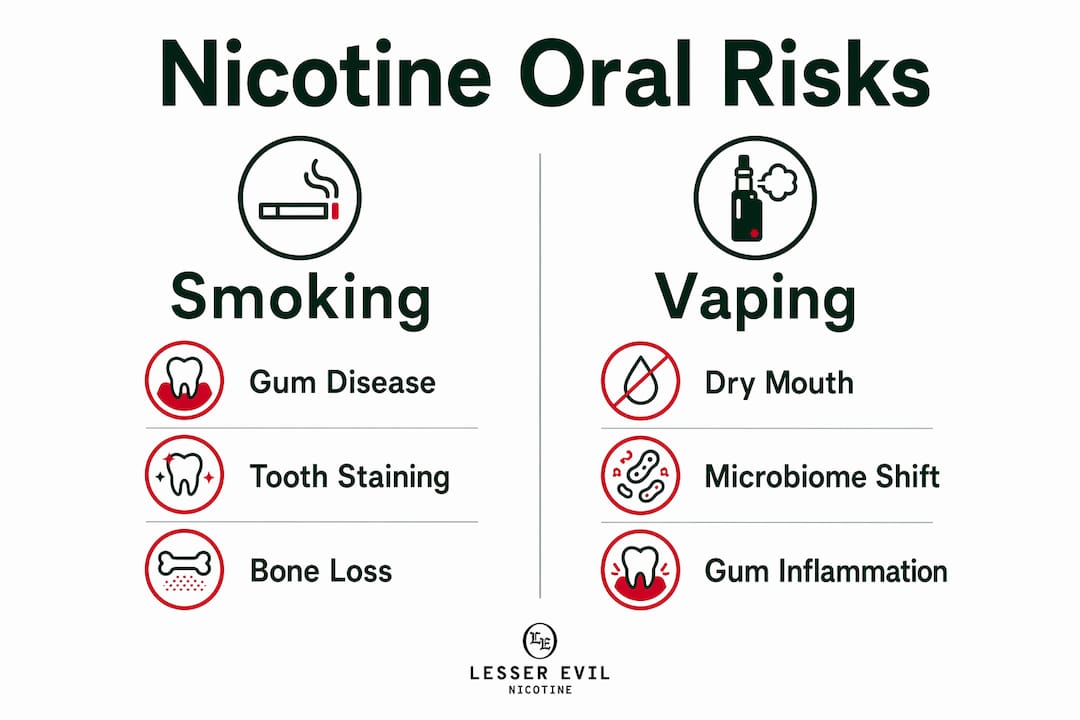
Smoking delivers tar, carbon monoxide, and thousands of combustion byproducts directly onto your oral tissues. That’s what causes the heavy staining, the nicotinic stomatitis, and the severe gum disease associated with long-term cigarette use. Vaping heats liquid and you inhale the vapour, so you avoid combustion products. But the nicotine is still there, doing the same vasoconstrictive and immunosuppressive damage to your gum tissue.
The oral health effects of vaping include dry mouth, altered microbiome composition, and impaired gum tissue health, even without the tar. Propylene glycol in vape liquid is hygroscopic, meaning it draws moisture from oral tissues and contributes to xerostomia (dry mouth), which itself increases the risk of tooth decay and gum disease. There’s also growing evidence that vaping disrupts the oral microbiome in ways that parallel smoking, though the long-term data is still catching up.
| Oral health effect | Smoking | Vaping |
|---|---|---|
| Tooth staining | Severe (tar-based) | Mild to moderate |
| Gum disease risk | Doubled vs non-users | Elevated, less severe |
| Healing impairment | Significant | Present |
| Oral cancer risk | Well established | Under investigation |
| Microbiome disruption | Confirmed | Emerging evidence |
| Dry mouth | Moderate | Often more pronounced |
What vaping does not do is eliminate the nicotine-related risks. Gum blood flow is still reduced. Immune defences are still suppressed. Healing after dental procedures is still compromised. The absence of tar is a real difference, but it doesn’t make vaping neutral for your oral health. For a more detailed breakdown of what changes when you move away from smoking, the oral nicotine vs smoking comparison on the Lesser Evil Nicotine blog covers the key distinctions.
Key points on relative risk:
- Vaping removes combustion products but retains nicotine’s direct tissue effects
- Dry mouth from vaping can accelerate tooth decay independently of nicotine
- Neither smoking nor vaping is safe for periodontal health
- The harm reduction argument for vaping is real but limited in the oral health context
Why nicotine makes dental procedures harder to recover from
If you’re planning any dental work, nicotine use is one of the most significant factors affecting how well you’ll heal. This isn’t a minor caveat. It’s a clinically documented problem that affects everything from a simple extraction to dental implants.
Healing requires blood. Specifically, it requires the capillary network in your gum tissue to deliver oxygen, growth factors, and immune cells to the wound site. Nicotine constricts those capillaries. The result is slower clot formation, reduced collagen synthesis, and a wound environment that’s more susceptible to infection. Smoking impairs healing and increases implant failure rates through exactly this mechanism, compromised blood flow combined with reduced immune function.
Bone structure lost to periodontitis does not regenerate spontaneously. Nicotine-induced bone loss in postmenopausal women, in particular, requires clinical intervention to restore dental stability, because the body cannot rebuild that architecture on its own.
The good news is that the damage isn’t entirely permanent. Gums can begin healing after nicotine use stops, with improved response to periodontal treatment and reduced inflammation. Bone loss, however, may require surgical intervention to address.
Practical guidance if you use nicotine and need dental treatment:
- Tell your dentist and dental hygienist about your nicotine use before any procedure
- Ask specifically about implant success rates and whether your nicotine use affects candidacy
- Understand that healing timelines may be longer than those given to non-users
- Follow post-procedure care instructions more strictly than you might otherwise
- Discuss with your dentist whether reducing nicotine use before a procedure is advisable
How hormones make nicotine’s effects on your teeth worse
This is the part most dental advice skips entirely. Women’s oral health is not just “the same as men’s, but smaller.” Hormonal fluctuations across the menstrual cycle, during pregnancy, and through menopause fundamentally alter how your gum tissue responds to bacterial challenge and how your body manages inflammation.

Oestrogen plays a direct role in maintaining bone density, including the alveolar bone that anchors your teeth. Postmenopausal women who smoke show reduced bone density and lower oestrogen levels, which dramatically increases the risk of periodontal disease and tooth loss. Nicotine compounds this by independently reducing oestrogen production, so you get a double hit: the hormonal decline of menopause plus the nicotine-driven suppression of the hormones that would otherwise protect your bone.
The menstrual cycle matters too. Research shows that hormonal phases influence nicotine use patterns in women, with higher oestrogen during the follicular phase associated with increased smoking and greater difficulty reducing use. Progesterone during the luteal phase tends to reduce nicotine intake. This cycling means your oral health risks from nicotine aren’t constant throughout the month. Gum tissue is also more prone to inflammation during the luteal phase and during pregnancy, when progesterone levels are elevated.
Nicotine interacts with steroid hormone systems to produce varied inflammatory responses, which is part of why two women with identical smoking histories can have very different periodontal outcomes. Genetic variation in hormone receptor sensitivity adds another layer of unpredictability.
Pro Tip: When you see a new dentist, mention your hormonal status alongside your nicotine use. Whether you’re perimenopausal, on hormonal contraception, or pregnant, that context changes your risk profile and should inform how frequently you’re seen for periodontal monitoring.
Women-specific risk factors to discuss with your dental team:
- Menopausal status and whether you’re on hormone replacement therapy
- Use of hormonal contraceptives, which can double smoking rates and affect nicotine use patterns
- Pregnancy, which amplifies gum inflammation even without nicotine
- Family history of osteoporosis, given the overlap with alveolar bone loss
- Menstrual cycle phase if you notice cyclical gum sensitivity
For a deeper look at how female hormones shape nicotine habits, the female nicotine habits guide from Lesser Evil Nicotine covers the biology in plain terms.
How to protect your teeth and gums if you use nicotine
You can’t fully offset nicotine’s effects on your oral health, but you can reduce the damage significantly with consistent, targeted habits. The basics matter more than most people realise.
Brush twice daily with a fluoride toothpaste, and floss every day. This sounds obvious, but nicotine users often have more plaque accumulation and deeper gum pockets, so the standard advice applies with greater urgency. Professional cleanings every three to four months, rather than the standard six, are worth discussing with your dentist if you use nicotine regularly.
Hydration is underrated in this context. Nicotine and vaping both contribute to dry mouth, and saliva is your primary defence against the bacteria that cause both decay and gum disease. Drinking water throughout the day, particularly after using nicotine, helps maintain salivary flow and dilutes the acidic environment that pathogenic bacteria prefer.
If you’re looking at nicotine delivery methods that don’t involve inhaling anything, that removes the combustion or vapour exposure from the equation. Lesser Evil Nicotine’s sublingual gel, for example, is placed under the tongue and absorbed through the oral mucosa. You don’t breathe it in, there’s no vapour, no tar, and no e-waste. It’s tobacco-free and uses natural flavours and sweeteners. That doesn’t make it neutral for your oral health, since the nicotine itself still has vasoconstrictive effects, but it does remove the additional insults that smoking and vaping add on top.
Practical oral health habits for women who use nicotine:
- Brush for two minutes, twice daily, with fluoride toothpaste
- Floss daily, paying attention to the gum line where pockets form
- Book professional cleanings every 3–4 months rather than every six
- Stay hydrated to counteract dry mouth from nicotine and vaping
- Use an alcohol-free mouthwash to avoid further drying oral tissues
- Disclose your nicotine use and hormonal history to your dentist at every appointment
- Ask your dentist to check for early signs of oral cancer at each visit
What nicotine does to your oral microbiome
Your mouth contains hundreds of bacterial species living in a carefully balanced ecosystem. Nicotine disrupts that balance in ways that go beyond simple gum irritation.
Research shows that smoking shifts the oral microbiome toward a more pathogenic profile, increasing the relative abundance of anaerobic bacteria associated with periodontal disease. Species like Porphyromonas gingivalis, Treponema denticola, and Fusobacterium nucleatum become more prevalent, while the beneficial bacteria that compete with them are suppressed. This isn’t just a cosmetic change. These species produce toxins that directly damage gum tissue and trigger the inflammatory cascades that destroy bone.
Women may be particularly susceptible to microbiome disruption because oestrogen and progesterone both influence the composition of the oral microbiome. During pregnancy, for instance, elevated progesterone promotes the growth of certain anaerobic bacteria, which is why pregnancy gingivitis is a recognised clinical phenomenon. When nicotine use is layered on top of hormonal shifts, the microbiome disruption compounds. The result is a gum environment that’s harder to stabilise and more prone to rapid disease progression.
Vaping also alters the oral microbiome, though the specific changes differ from those caused by smoking. The propylene glycol and vegetable glycerin in vape liquid create a different substrate for bacterial growth than tobacco combustion products, but the net effect is still a shift away from a healthy microbial balance.
Do your genes affect how nicotine damages your teeth?
Yes, and this is an area where the science is genuinely interesting. Not everyone who smokes for twenty years loses their teeth. Genetic variation in immune response, inflammatory signalling, and hormone receptor sensitivity all influence how severely nicotine affects your periodontal tissues.
Specific gene variants affecting the interleukin-1 (IL-1) cytokine family have been associated with more aggressive periodontal disease in smokers. IL-1 is a key mediator of the inflammatory response in gum tissue, and people with certain IL-1 gene polymorphisms produce more of it in response to bacterial challenge. When nicotine suppresses the immune response while simultaneously allowing more bacteria to colonise gum pockets, those with pro-inflammatory gene variants can experience faster and more severe tissue destruction.
Epigenetic factors add another dimension. Smoking causes measurable changes to DNA methylation patterns in oral epithelial cells, altering gene expression in ways that persist even after nicotine use stops. Some of these epigenetic changes affect genes involved in immune surveillance and tissue repair, which may partly explain why ex-smokers retain elevated periodontal risk for years after stopping. In women, the interaction between nicotine-induced epigenetic changes and the hormonal regulation of immune genes is an active area of research, and the picture is more complex than it is for men.
Nicotine and the medications many women take: what clashes?
This is a practical issue that rarely gets discussed in standard dental advice. Several medications commonly prescribed to women interact with nicotine in ways that affect oral health.
Hormonal contraceptives are the most relevant example. Women using oestrogen-containing contraceptives already have an altered hormonal environment that affects gum tissue sensitivity. Nicotine’s suppression of oestrogen production interacts with this, and the combination can produce more pronounced gum inflammation than either factor alone. There’s also evidence that women on hormonal contraceptives have higher smoking rates, which compounds the oral health risk further.
Bisphosphonates, prescribed for osteoporosis and increasingly relevant for postmenopausal women, carry their own oral health implications. Medication-related osteonecrosis of the jaw (MRONJ) is a rare but serious complication associated with bisphosphonate use, and smoking is a recognised risk factor for it. Women who are both on bisphosphonates and using nicotine need to inform their dentist before any invasive dental procedure.
Antidepressants and anxiolytics, which are prescribed at higher rates in women than men, commonly cause dry mouth as a side effect. Combined with nicotine’s own contribution to xerostomia, the result is a significantly reduced salivary flow that accelerates both decay and gum disease. If you’re on any medication that causes dry mouth, your oral health risk from nicotine is meaningfully higher than the baseline.
The long-term oral cancer risk from nicotine use in women
Oral cancer is the consequence that sits at the end of the risk spectrum, and it’s one that women who use nicotine need to take seriously. Smoking is the single largest risk factor for cancers of the mouth, tongue, throat, and lips. The carcinogens in tobacco smoke cause direct DNA damage to oral epithelial cells, and the immunosuppressive effects of nicotine reduce the body’s ability to detect and destroy early malignant cells.
Women who smoke experience higher risks of oral cancer, and those risks interact with other female-specific factors. Women experience greater health risks from smoking than men across multiple cancer types, and oral cancer follows that pattern. The combination of tobacco carcinogens, nicotine-driven immune suppression, and hormonal influences on cellular repair creates a risk profile that’s genuinely distinct from men’s.
Vaping’s relationship to oral cancer is less established, because the products haven’t been in widespread use long enough to generate long-term incidence data. What is known is that vape aerosol contains compounds including formaldehyde and acrolein that are classified as potential carcinogens, and that nicotine itself promotes cell proliferation in ways that could facilitate tumour growth. The absence of long-term data is not the same as evidence of safety.
The practical implication is straightforward: ask your dentist to screen for oral cancer at every check-up. Early-stage oral cancer is highly treatable. Late-stage is not. Women who use nicotine should be seen at least annually for a full oral cancer screening, and any persistent ulcer, white patch, or red lesion that doesn’t resolve within two weeks warrants immediate investigation.
The stress and social factors driving nicotine use in women
The science of why women use nicotine is genuinely different from why men do, and that difference has direct implications for oral health outcomes.
Research shows that women smoke more in response to stress and environmental cues than to the direct pharmacological effects of nicotine. The sight, smell, and ritual of smoking or vaping maintain the behaviour more than the nicotine hit itself. This is partly why standard nicotine replacement approaches are less effective for women: they replace the chemical but not the cues. It also means that stress-driven nicotine use tends to cluster around high-pressure periods, which are often the same times when oral hygiene routines slip.
The psychosocial dimension matters for oral health in a specific way. Women who use nicotine for stress management often report that dental anxiety is itself a barrier to seeking care. The combination of knowing that nicotine has damaged their gums and feeling embarrassed about it creates a cycle where the people who most need regular dental monitoring are the least likely to attend. Dental professionals who understand this dynamic can make a real difference by creating a non-judgmental environment and framing check-ups around monitoring and prevention rather than criticism.
Social support is a genuine factor in outcomes. Women who reduce or stop nicotine use with structured social support show better oral health recovery than those who try to manage it alone. If you’re thinking about changing your nicotine habits, that context matters.
Key takeaways
Nicotine damages women’s oral health through vasoconstriction, immune suppression, and microbiome disruption, with hormonal factors amplifying the risk at every life stage.
| Point | Details |
|---|---|
| Gum disease risk doubles | Smokers carry twice the risk of periodontal disease compared to non-users, with treatment less effective in those who smoke. |
| Hormones amplify the damage | Postmenopausal women who smoke face reduced bone density and lower oestrogen, dramatically increasing tooth loss risk. |
| Vaping is not a safe alternative | Vaping removes combustion products but retains nicotine’s vasoconstrictive and immunosuppressive effects on gum tissue. |
| Healing is genuinely impaired | Nicotine compromises blood flow and immune function after dental procedures, increasing implant failure rates. |
| Oral cancer screening is non-optional | Women who use nicotine should request a full oral cancer screening at every dental check-up, not just an annual one. |
Why Lesser Evil Nicotine takes a different approach

If you use nicotine and you’re thinking about what you’re actually putting in your body, Lesser Evil Nicotine is worth knowing about. It’s a sublingual nicotine gel, placed under the tongue and absorbed through the oral mucosa. You don’t breathe it in. No vapour, no tar, no combustion products landing on your gum tissue.
The formulation is tobacco-free, uses natural flavours and sweeteners, and comes in three options: Peppermint, Black Grape, and Green Apple. It’s battery-free, so there’s no e-waste. The nicotine is still there, and nicotine still has vasoconstrictive effects, but using this instead of smoking or vaping removes the additional oral health insults that come with inhaling anything.
Lesser Evil Nicotine is preparing for its UK launch in 2026. If you want to know more about the product or explore what oral nicotine options look like, the details are at lesserevil.store.