

Female nicotine habits explained: what women need to know

TL;DR:
- Women metabolize nicotine faster due to hormonal factors and use it mainly for stress and emotional regulation. Their habits include frequent, small puffs and non-tobacco products, with health risks like lung cancer and pregnancy complications being higher. Tailored harm reduction approaches and better public health messaging can address their unique biological and behavioral needs.
Female nicotine habits are defined by a distinct set of biological, behavioural, and psychological patterns that differ significantly from those seen in men. Women metabolise nicotine faster, use it more frequently as an emotional coping tool, and face higher health risks per cigarette smoked. Despite this, most public health messaging and nicotine products are built around male usage data. If you are a woman aged 25–40 trying to make sense of your own relationship with nicotine, this is the breakdown you have not been given before.
How do women typically use nicotine differently from men?
Women and nicotine use do not follow the same script as men. Women vape more frequently and take smaller, quicker puffs per session. That pattern means more frequent nicotine hits spread across the day rather than fewer, larger doses.
This matters because it changes how dependence forms. The ritual of reaching for a vape every 20 minutes becomes as load-bearing as the nicotine itself. Women report using nicotine primarily to manage stress, regulate emotions, and navigate social situations, rather than purely for the chemical reward. That is a fundamentally different driver than the one most cessation tools are built around.
Female vaping habits also skew towards non-tobacco nicotine products at a higher rate than male habits. Oral gels, vapes, and nicotine pouches are all part of the picture. The challenge is that these products deliver nicotine at different speeds and doses, making it harder to track actual intake across a day.
Key behavioural patterns specific to women:
- Smaller, more frequent puffs rather than longer, less frequent sessions
- Nicotine use tied to emotional regulation and social bonding, not just chemical need
- Higher uptake of non-tobacco products including vapes and oral formats
- Ritualistic use woven into daily routines such as morning coffee, commuting, and work breaks
- Greater difficulty separating the behavioural habit from the nicotine dependence itself
Pro Tip: Track when you reach for nicotine across a full day. Note the trigger each time: stress, boredom, social pressure, or habit. Most women find the pattern is far more behavioural than they expected.
What biological factors affect nicotine metabolism in women?
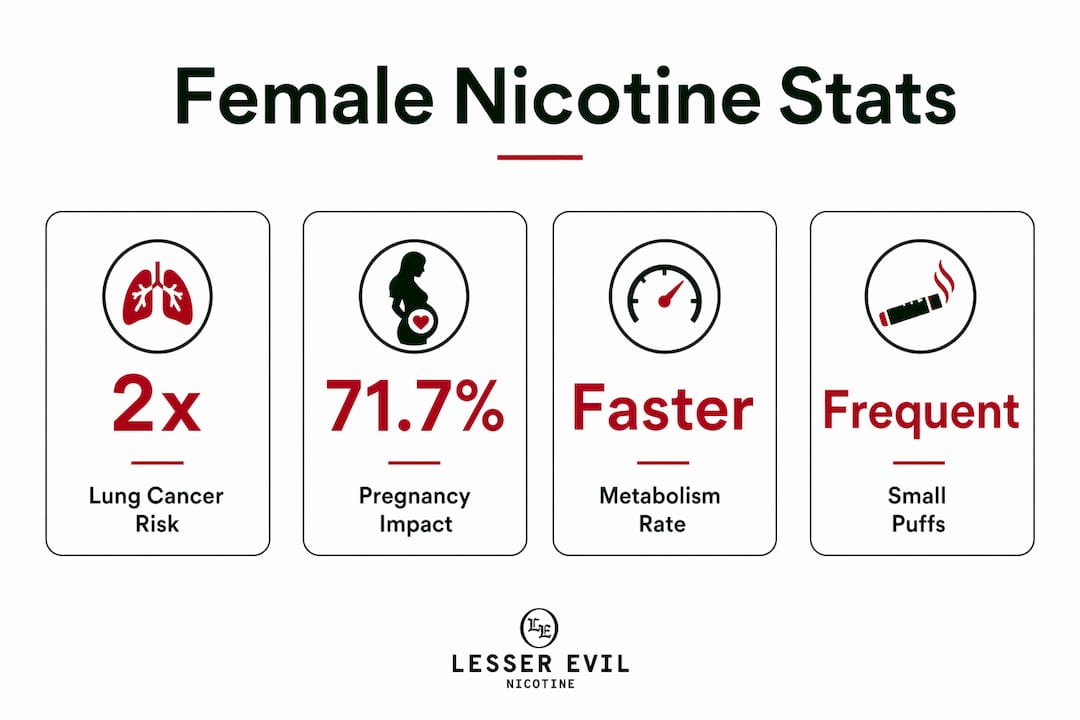
Biology is not neutral when it comes to nicotine. Oestrogen and oral contraceptives accelerate nicotine metabolism in women, meaning the body clears nicotine faster. Faster clearance means the gap between doses feels shorter, which drives more frequent use.

This has a direct knock-on effect for anyone trying to reduce their intake. Standard nicotine replacement doses are calibrated around male metabolism data. They often underestimate how quickly a woman’s body processes nicotine, leaving a gap that the body reads as a signal to use again sooner.
Hormonal cycles add another layer. Nicotine cravings tend to intensify during the luteal phase of the menstrual cycle, the two weeks before a period, when oestrogen drops. That is not a coincidence or a lack of willpower. It is a measurable physiological shift that affects how the brain responds to nicotine.
| Biological factor | Effect on nicotine use |
|---|---|
| Higher oestrogen levels | Speeds up nicotine clearance, increasing use frequency |
| Oral contraceptive use | Further accelerates metabolism, shortening time between doses |
| Luteal phase hormone drop | Intensifies cravings in the two weeks before menstruation |
| Female brain chemistry | Stronger emotional and stress-related nicotine response than in men |
Pro Tip: If you notice your nicotine use increases at a specific point in your cycle, that is biology, not weakness. Adjusting your approach during that window is a practical response, not a failure.
What are the health risks of nicotine use specific to women?
The health risks of nicotine use are not evenly distributed between sexes. Women are twice as likely to develop lung cancer from cigarette smoke compared to men, despite lower overall smoking rates. That is a significant disparity that does not get nearly enough attention in public health conversations.
Pregnancy introduces a separate and serious category of risk. Non-tobacco nicotine products are associated with a 71.7% increased risk of preterm labour, a 43.2% increased risk of miscarriage, and a 34.2% increased risk of ectopic pregnancy. These are not risks confined to cigarettes. Vapes, pouches, and oral nicotine products all carry them.
Mental health risks extend into the postpartum period. E-cigarette use during pregnancy is associated with increased odds of postpartum depression symptoms, with an odds ratio of 1.52. That is higher than the odds ratio of 1.34 associated with combustible cigarettes. Dual use of both raises the risk further to an odds ratio of 1.63.
A critical gap in clinical care compounds these risks. Many pregnant women do not identify vaping or nicotine pouches as tobacco use when asked by a clinician. That means their actual nicotine exposure goes unrecorded, and the risks go unaddressed.
| Risk category | Key finding |
|---|---|
| Lung cancer | Women face twice the risk of men from equivalent cigarette smoke exposure |
| Preterm labour | Non-tobacco nicotine products linked to 71.7% increased risk |
| Miscarriage | 43.2% increased risk associated with non-tobacco nicotine products |
| Postpartum depression | E-cigarette use in pregnancy linked to odds ratio of 1.52 |
| Clinical under-reporting | Women often do not classify vaping as nicotine use in health screenings |
How do psychological and social factors shape female nicotine use?
Nicotine addiction in women is rarely just about the chemical. Psychological and social drivers including stress relief, emotional regulation, and cultural identity play a primary role in how women use nicotine. Women report using it to manage negative emotions and social situations far more than men do.
Cultural and social expectations also shape female nicotine habits in ways that are easy to underestimate. In some communities, smoking carries a specific cultural symbolism tied to femininity, independence, or social belonging. In professional environments, the vape break has replaced the cigarette break as a social ritual that doubles as a stress valve.
The ritualistic dimension is where many women get stuck. Nicotine use becomes threaded through the structure of a day: the morning vape with coffee, the one after a difficult call, the social smoke at a Friday night out. Removing the nicotine does not automatically remove the ritual. That gap is where most generic approaches fall short.
Behavioural barriers specific to women include:
- Using nicotine as a primary stress management tool amid competing pressures of career and caregiving
- Social smoking or vaping as a bonding mechanism that feels difficult to opt out of
- Fear of weight gain, which research consistently identifies as a stronger barrier for women than men
- Internalising difficulty reducing use as a personal failing rather than a structural challenge
- Lack of cessation tools designed around high-frequency, emotionally driven use patterns
Successful approaches require addressing both the physical and the deeply integrated behavioural aspects of use. Treating it as purely chemical dependence misses most of what is actually going on.
What does harm reduction look like for women who use nicotine?
Harm reduction for women starts with understanding that not all nicotine products carry the same risks. Smoking delivers nicotine alongside thousands of combustion by-products. Vaping removes combustion but still involves inhaling vaporised chemicals. Oral nicotine products, including sublingual gels, deliver nicotine through the oral mucosa without any inhalation at all. You do not breathe it in.
Standard nicotine replacement doses often underestimate women’s needs because they are calibrated for cigarette smoking rather than high-frequency vaping. A woman vaping 30 or 40 times a day is getting a very different nicotine load than the standard dosing model assumes. Products designed with calibrated, lower doses that can be used more frequently are a better fit for that pattern.
There is also a psychological dimension to product choice. A sense of autonomy around nicotine use can mask actual dependence. Adjusting puff frequency or nicotine concentration can create a false sense of control without reducing overall intake. Tracking actual use, rather than relying on how controlled it feels, gives a more accurate picture.
Practical harm reduction approaches for women include understanding oral nicotine delivery as a factually different category from smoking or vaping, and using that difference deliberately. Substituting a behavioural ritual with a non-inhaled alternative addresses both the physical and the habitual side of use at the same time.
Pro Tip: Identify the two or three moments in your day where nicotine use feels most automatic. Those are the rituals worth substituting first. Replacing the delivery method while keeping the moment intact is far more sustainable than trying to eliminate the moment entirely.
Key takeaways
Female nicotine habits are shaped by faster metabolism, emotional and behavioural drivers, and product risks that generic health advice consistently fails to address.
| Point | Details |
|---|---|
| Biology drives frequency | Oestrogen and oral contraceptives speed up nicotine clearance, pushing women to use more often. |
| Behaviour is half the habit | Women use nicotine primarily for stress and emotional regulation, not just chemical dependence. |
| Pregnancy risks extend to all products | Non-tobacco nicotine products carry serious pregnancy complications, including 71.7% higher preterm labour risk. |
| Standard dosing undershoots women | NRT calibrated for male cigarette use does not account for high-frequency female vaping patterns. |
| Harm reduction requires product knowledge | Switching to non-inhaled oral nicotine removes combustion and vapour exposure while preserving the ritual. |
What the conversation around female nicotine use is still getting wrong
I have spent time looking at how women’s nicotine use gets discussed in public health spaces, and the gap between what the research shows and what women are actually told is striking. Most messaging still treats nicotine dependence as a single, universal experience with a one-size approach bolted on top. That does not hold up.
The biology alone should change how we talk about this. Faster metabolism, hormonal cycles, and the specific risks tied to pregnancy are not edge cases. They are central to how a significant portion of nicotine users actually experience the habit. Ignoring them in product design and public health messaging is not neutral. It actively leaves women without the information they need.
What I find more interesting, and more honest, is acknowledging that nicotine often functions as a load-bearing habit for women managing genuinely complex lives. Career pressure, caregiving, social expectation. Nicotine sits at the intersection of all of it. Telling someone to simply stop, without addressing what the habit is actually doing, is not a strategy. It is a dismissal.
The most useful shift I have seen is when women stop framing their nicotine use as a moral failure and start treating it as a practical problem with practical levers. Understanding your biology, your triggers, and your actual intake gives you something real to work with. That is where progress actually starts.
— Luke McLeod
Lesser Evil Nicotine: a different option for how you use nicotine
If you have read this far, you already know that how you use nicotine matters as much as how much you use. Lesser Evil Nicotine is a tobacco-free, sublingual nicotine gel that sits under your tongue and absorbs through the oral mucosa. You do not breathe it in. No vapour, no combustion, no battery, no e-waste.

It comes in three natural flavours: Peppermint, Black Grape, and Green Apple, with natural sweeteners and no tobacco. The low-dose formulation is designed for people who use nicotine frequently throughout the day, which fits the female usage pattern better than products built around a single large dose. If you want to use nicotine without frying your lungs or contributing to a pile of dead vapes, the Lesser Evil Oral Mister is worth a look. A nicotine mouth spray is also coming soon for those who want an even faster format.
FAQ
Why do women get addicted to nicotine faster than men?
Women metabolise nicotine faster due to oestrogen and oral contraceptive use, which shortens the time between doses and reinforces more frequent use. Emotional and behavioural drivers also accelerate dependence by tying nicotine use to stress management and daily rituals.
Are vaping risks during pregnancy different from smoking risks?
Yes. E-cigarette use during pregnancy is associated with higher odds of postpartum depression than combustible cigarettes, with an odds ratio of 1.52 versus 1.34. Non-tobacco nicotine products also carry significant pregnancy complications including increased risks of preterm labour and miscarriage.
Why do standard nicotine products not work as well for women?
Standard NRT doses are calibrated for cigarette smoking patterns, which do not reflect the high-frequency, smaller-dose vaping habits common in women. This mismatch means women often receive less nicotine than their body expects, making the approach less effective.
What is the difference between behavioural and chemical nicotine dependence?
Chemical dependence is driven by the body’s need for nicotine. Behavioural dependence is the habitual, ritualistic use tied to specific moments, emotions, or social contexts. Women typically show stronger behavioural dependence, which means addressing the ritual is as important as addressing the dose.
Does nicotine affect women’s mental health differently?
Nicotine use in women is more strongly linked to emotional regulation and stress management than in men. During pregnancy, e-cigarette use raises the risk of postpartum depression symptoms, and responsible nicotine use guidance increasingly recognises these mental health dimensions as central, not secondary.