

Responsible nicotine use: a guide for urban professionals

Responsible nicotine use is defined as managing your nicotine intake to reduce health risks while acknowledging both the chemical and behavioural nature of dependence. If you vape, use pouches, or rely on nicotine replacement therapy (NRT) to cut back, understanding what is responsible nicotine use is the difference between harm reduction and quietly making things worse. The core principle is simple: control your total daily dose, choose lower-risk delivery methods, and treat the habit, not just the craving. This guide covers dosage limits, gender differences, harm reduction rankings, and practical daily strategies built for busy professionals who want to manage their habit without the rubbish.
What is responsible nicotine use and how does dosage work?
Responsible nicotine consumption starts with knowing your numbers. Keeping total daily intake under 30–40 mg is the current clinical upper limit for adult non-combustible users. That figure represents the threshold above which cardiovascular and metabolic effects become a genuine concern.
The FDA-approved ceiling for nicotine patches sits at 21 mg per day. For lozenges, the approved limit is up to 20 units daily. These figures exist because regulators have mapped the dose at which nicotine stops being a management tool and starts being a problem in its own right.

Most people get this wrong. Users focus on unit count rather than total milligrams consumed. That is how someone ends up overdosing on a combination of a patch, two pouches, and a vape session before lunch. Track milligrams, not moments.
How to track your daily nicotine intake
- List every product you use and note its nicotine content in milligrams per unit.
- Count your daily units for each product type.
- Multiply and add to get your total daily milligram figure.
- Compare against the 30–40 mg ceiling and adjust downward if needed.
- Keep the dose consistent. A low, steady nicotine level prevents withdrawal better than high-dose spikes.
| Delivery method | Typical nicotine per unit | Approved daily limit |
|---|---|---|
| Nicotine patch | 21 mg | 1 patch per day |
| Nicotine lozenge | 2–4 mg | Up to 20 per day |
| Nicotine gum | 2–4 mg | Up to 24 pieces per day |
| Nicotine pouch | 9–12 mg (some up to 150 mg total pack) | No approved limit |
| Vape (e-cigarette) | Variable | No approved limit |
Pro Tip: Set a daily milligram budget before you reach for your first hit of the day. Decide the ceiling, then work backwards across your products. Consistency beats willpower every time.
How do gender differences affect responsible nicotine use?
Responsible female nicotine use requires a different approach than the standard advice, and the science backs this up. Women metabolise nicotine faster than men, which means standard NRT doses often leave women underdosed. Underdosing increases cravings, which increases relapse. The standard patch or gum protocol was largely built on male physiology.
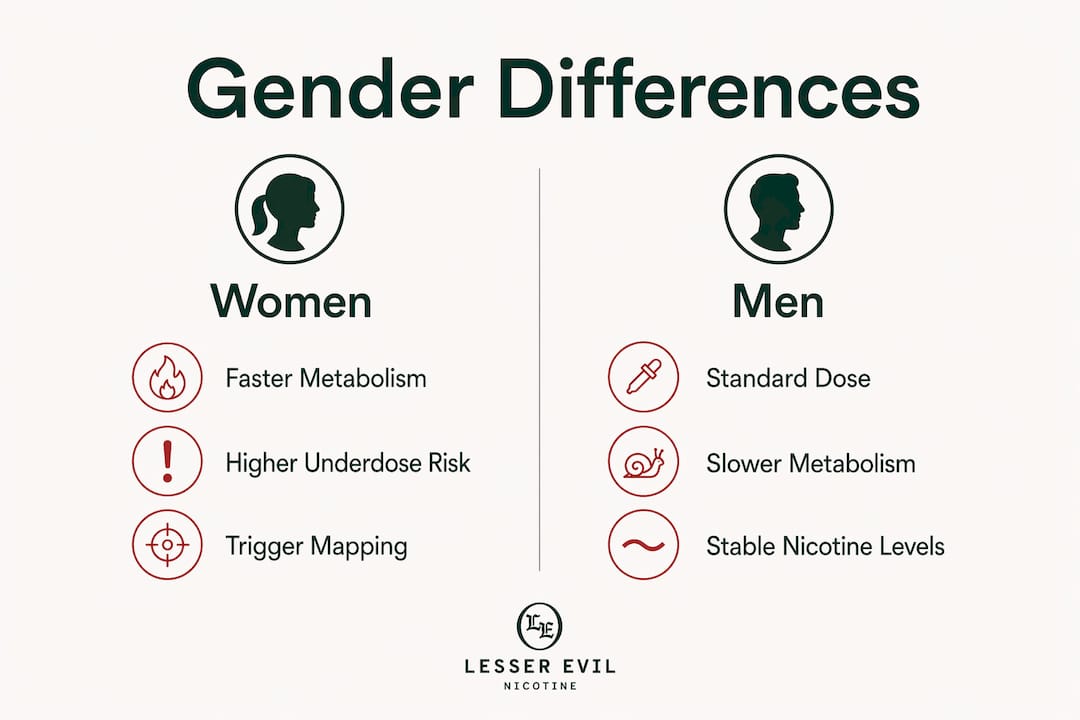
The behavioural picture is equally distinct. Women’s nicotine use is driven more by stress, rituals, and social cues than by pharmacological craving alone. A man might reach for a vape because his body is screaming for nicotine. A woman is more likely to reach for it because she is stressed, because it is part of her morning routine, or because everyone around her is doing it. That distinction matters enormously for how you manage the habit.
The practical implication is this: if you are a woman using NRT and it does not feel like it is working, the dose may genuinely be too low. Women need tailored NRT and support that addresses both the chemical and the behavioural side of dependence. A patch alone rarely cuts it.
- Women often experience stronger cravings in social settings compared to men.
- Stress is a primary trigger for female nicotine use, not just physical withdrawal.
- Ritualistic behaviour (morning coffee plus a vape, for example) sustains use independently of addiction.
- Standard NRT doses may be insufficient due to faster female nicotine metabolism.
- Combined chemical and behavioural treatment produces better quit outcomes for women.
Pro Tip: If you are a woman trying to cut back, map your triggers before you adjust your dose. Write down the last five times you reached for nicotine and note what was happening. Stress, boredom, and social situations will show up more than physical craving. Address those first.
What are the most effective harm reduction strategies?
Harm reduction is not about declaring nicotine safe. It is about reducing disease and death by promoting less harmful delivery methods. The hierarchy of harm is clear and evidence-based.
| Delivery method | Harm level | Notes |
|---|---|---|
| Combustible cigarettes | Highest | Smoke contains thousands of toxic compounds |
| Cigars and pipes | Very high | Similar combustion risks to cigarettes |
| Heated tobacco | High | Fewer toxicants than combustion, still significant |
| Vaping (e-cigarettes) | Moderate | No combustion, but chemical inhalation risk remains |
| Pharmaceutical NRT | Lowest | Safe for continuous use up to 5 years |
Pharmaceutical NRT, including patches, gum, lozenges, and sprays, sits at the bottom of the harm table. That is the clinical consensus. If your goal is responsible nicotine consumption, moving towards NRT and away from combustion or inhalation is the single most impactful step you can take.
The lifestyle marketing of nicotine pouches deserves a specific warning. Nicotine pouches are being marketed as lifestyle enhancers in professional environments, which risks normalising continuous daily use and deepening addiction. Some pouches contain 9–12 mg per unit. Using several throughout a working day pushes total intake well above safe thresholds without the user realising it.
Pro Tip: Pair any switch to a lower-harm product with a behavioural strategy. Changing the delivery method addresses the chemical side. Changing the ritual addresses the psychological side. You need both to make it stick.
How to apply responsible nicotine use in daily life
Practical habit management starts with structure, not willpower. These steps work for urban professionals who need to manage cravings across a full working day without losing focus or productivity.
- Set a daily dose ceiling. Decide your milligram limit before the day starts, based on the 30–40 mg guideline for non-combustible users.
- Use the park-and-chew method for gum. Chewing nicotine gum like regular gum causes you to swallow the nicotine-rich saliva, which reduces absorption and increases nausea. Chew briefly, then park the gum between your cheek and gum to absorb through the buccal membrane.
- Identify your top three triggers. Stress, boredom, and social situations account for the majority of unplanned nicotine use. Name them, then plan a non-nicotine response for each.
- Schedule your doses. Reactive dosing leads to overdosing. Planned dosing keeps your total intake predictable and your withdrawal symptoms manageable.
- Avoid nicotine if you are under 25. Nicotine impairs brain development in people under 25, affecting learning, impulse control, attention, and memory. Neurological development continues until approximately that age.
Managing cravings at work is one of the trickier parts of responsible use. The office environment is full of triggers: deadline pressure, back-to-back meetings, and the social pull of a vape break with colleagues. A structured approach to managing cravings at work makes the difference between controlled use and reactive use.
One thing worth knowing: no universal safe dose exists for non-smokers using nicotine for cognitive enhancement. The idea that nicotine sharpens focus is not supported by clinical trials. Using it for that reason, rather than for cessation or harm reduction, adds risk without a proven benefit.
Pro Tip: Replace the ritual, not just the substance. If your 3pm vape break is really about stepping away from your screen, replace it with a five-minute walk. The craving is often more about the pause than the nicotine.
Key takeaways
Responsible nicotine use requires tracking total daily milligrams, choosing lower-harm delivery methods, and addressing behavioural triggers alongside chemical dependence.
| Point | Details |
|---|---|
| Know your daily dose | Keep total nicotine intake under 30–40 mg per day to avoid cardiovascular risk. |
| Choose the safest delivery method | Pharmaceutical NRT is the lowest-harm option and is safe for up to five years of continuous use. |
| Women need a tailored approach | Faster metabolism and behavioural triggers mean standard NRT doses often underserve women. |
| Track milligrams, not units | Counting pouches or puffs misses the point; total daily milligrams is what matters. |
| Combine chemical and behavioural strategies | Switching products without addressing triggers leads to relapse. |
The uncomfortable truth about “responsible” nicotine at work
I have spoken with a lot of urban professionals who believe they are using nicotine responsibly because they have switched from cigarettes to pouches or from cigarettes to vaping. That switch is genuinely better. But it is not the whole story.
The part most people miss is the behavioural layer. Nicotine addiction is not purely pharmacological. The 3pm pouch, the post-meeting vape, the morning ritual with a coffee: these are habits wired into your day independently of what your body chemically needs. Swapping the delivery method does not unwire the habit. It just makes the habit slightly less harmful.
What I find particularly concerning is the lifestyle framing of nicotine pouches in professional settings. Products positioned as productivity tools or stress managers are exploiting the exact triggers that make nicotine hard to quit. Women in particular are being underserved here. The male-coded pouch market does not speak to the stress, social, and ritual drivers that dominate female nicotine use.
The most honest version of responsible nicotine use I have seen combines a clear dose ceiling, a lower-harm product, and genuine attention to what is actually triggering each use. That combination is rare. Most people do one of the three. All three together is where real control lives.
— Luke McLeod
Lesser Evil Nicotine: built for controlled, conscious use

Lesser Evil Nicotine was built specifically for the professional who wants to manage their habit without breathing garbage or contributing to e-waste. The Lesser Evil Oral Mister is a patent-pending oral nicotine gel in a discreet, battery-free format. It delivers a consistent, measured dose in three natural flavours: Peppermint, Black Grape, and Green Apple. No vaporised chemicals. No tobacco. No rubbish ingredients. The low-dose formulation is designed to keep your intake predictable and your habit manageable. If you want nicotine on your terms, the Lesser Evil store is where to start.
FAQ
What is responsible nicotine use?
Responsible nicotine use means managing your total daily intake to minimise health risks, choosing lower-harm delivery methods, and addressing both the chemical and behavioural aspects of dependence. The clinical guideline for non-combustible adult users is a maximum of 30–40 mg of nicotine per day.
Is nicotine use safe for non-smokers?
No universal safe dose exists for non-smokers. Clinical evidence does not support using nicotine for cognitive enhancement, and the risks of dependence and cardiovascular effects apply regardless of why you start.
How does responsible female nicotine use differ from male use?
Women metabolise nicotine faster than men, which means standard NRT doses often leave women underdosed and more prone to relapse. Women are also more strongly driven by stress, social cues, and rituals, so effective management requires both dose adjustment and behavioural strategies.
What is the safest nicotine delivery method?
Pharmaceutical NRT, including patches, gum, lozenges, and sprays, is the lowest-harm option. It sits at the bottom of the harm hierarchy and is considered safe for continuous use for up to five years.
At what age is nicotine use considered unsafe for brain health?
Nicotine is contraindicated for anyone under 25. Brain development continues until approximately that age, and nicotine use during this period can impair learning, impulse control, attention, and memory.