

How to manage nicotine cravings at work in 2026

Nicotine craving is the intense urge to use nicotine, triggered by stress, routine, or environmental cues, and it is the primary reason professionals lose focus during the workday. The good news: most cravings peak and fade within 5–10 minutes, which means you do not need willpower alone to manage nicotine cravings at work. You need a plan. The NHS, Mayo Clinic, and specialist cessation platforms like Quit Nic all recommend the same core toolkit: delay tactics, controlled breathing, physical substitutes, and social habit redesign. This article gives you all of it, in a format built for a busy desk job.
What tools and immediate actions help relieve nicotine cravings at your desk?
The fastest way to ride out a craving is to occupy the habits that smoking feeds: the oral fixation, the hand movement, and the breathing ritual. Sugar-free gum, cold water, and fidget objects are the primary physical replacements for these habits. Keep them within arm’s reach so you never have to think about it when a craving hits.
Here is your desk-based emergency kit:
-
Sugar-free gum or mints — replaces the oral habit without adding calories or nicotine
-
A cold bottle of water — drinking slowly mimics the hand-to-mouth motion and reduces tension
-
A stress ball or fidget ring — occupies the hand that would otherwise reach for a cigarette
-
A notepad — writing down a thought or task shifts mental focus instantly
-
Your phone timer — set it for 10 minutes and commit to doing something else until it goes off
The 10-minute delay method is recommended as standard protocol for intense cravings. The science behind it is simple: cravings are not permanent states. They are waves. If you delay action for 10 minutes, the wave usually passes on its own.
When the craving is particularly sharp, add a breathing sequence. Inhale slowly through your nose for 4 seconds, then exhale through your mouth for 6 seconds. Repeat 5 rounds of this sequence. This shifts your nervous system out of the stress response without anyone at the next desk noticing a thing.

Pro Tip: Pre-load your desk drawer at the start of each week. Treat it like a first-aid kit. If you have to go looking for gum when a craving hits, you have already lost half the battle.
How to redesign your work breaks to support craving management
Smoking at work is rarely just about nicotine. It is about the ritual: the walk outside, the five minutes away from the screen, the chat with a colleague. Maintaining break timing while replacing the cigarette with a non-nicotine activity is one of the most effective strategies for cravings at the office.
The mistake most people make is skipping the break entirely. That creates isolation, and isolation spikes cravings. The social bond built around smoke breaks is real. Cutting yourself off from it does not help. Instead, redesign the ritual:
-
Keep the same break times — your body expects a pause at 11am and 3pm. Give it one.
-
Join colleagues outside with gum or water — you stay in the social loop without lighting up
-
Change the spot slightly — standing two metres from your usual smoking spot interrupts the conditioned cue
-
Use a short script — “I’m cutting back, but I’ll still come out for the fresh air” removes awkwardness instantly
-
Plan a 60–120 second reset — a brief breathing or stretching sequence signals to your brain that the break has happened
Ritual redesign and intentional social substitution reduce the cravings linked to social cues far more effectively than avoidance. The cue is not always the nicotine. Often it is the timing, the location, and the company.
A planned daily reset break, even on low-craving days, builds a consistent pattern. Consistency is what makes the new behaviour feel normal rather than forced.
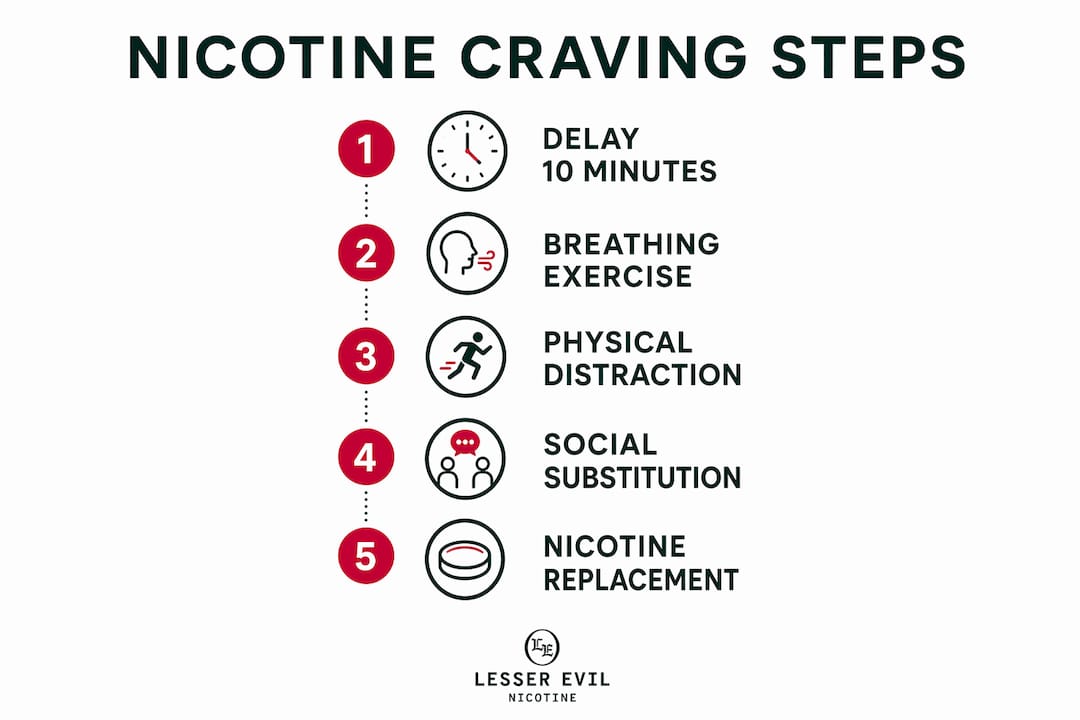
Pro Tip: Use the same script every time someone offers you a cigarette. Repetition makes it automatic. After a week, you will not even think about it.
What are effective mental and physical strategies to overcome cravings during high-stress moments?
Cravings during a deadline or a difficult meeting feel different because they are layered on top of existing stress. But the biology is the same. Cravings follow a wave pattern, peaking and subsiding within minutes. Knowing this changes how you respond to them.
The most useful mental shift is self-acknowledgement without surrender. When a craving hits, say to yourself: “This is a craving. It will pass in a few minutes.” That single thought interrupts the automatic reach for a cigarette.
“Treating urges as short-lived waves rather than permanent states is the most effective mental approach during high-pressure moments.” — Quit It Web
Here is a practical emergency protocol for high-stress cravings:
-
Acknowledge it — name the craving out loud or in your head. Do not fight it.
-
Breathe — 4 seconds in through the nose, 6 seconds out through the mouth, 5 rounds.
-
Move — stand up, stretch, or take a brisk 2-minute walk to the kitchen or bathroom.
-
Hydrate — drink a full glass of cold water slowly.
-
Contact — text a quit-buddy or a supportive colleague if the urge is still strong.
Physical distractions like brisk walks and desk stretches measurably reduce craving intensity during work stress. They also reset your posture and blood flow, which helps with focus.
Here is the part most people get wrong about stress and smoking. Stress relief from smoking is actually relief from nicotine withdrawal, not from nicotine itself. Once you are free from the cycle of withdrawal, your baseline stress tolerance genuinely improves. You are not giving up a stress tool. You are removing the thing that was creating the stress in the first place.
Pro Tip: Before a high-stakes meeting, do your 5-round breathing sequence in the corridor. It takes 50 seconds and it works better than a cigarette for calming pre-meeting nerves.
Which nicotine replacement options work best in an office environment?
Nicotine replacement therapy (NRT) is the clinical term for products that deliver controlled doses of nicotine without tobacco or combustion. NRT options like gum and lozenges provide steady or rapid nicotine release, helping manage withdrawal symptoms during the workday.
For office use, discretion matters. The most practical NRT formats are:
-
Nicotine gum — fast-acting, widely available, easy to use at a desk
-
Nicotine lozenges — dissolve slowly, no chewing required, very discreet
-
Nicotine mouth sprays — fastest acting of the three, absorbed through the mouth lining in seconds
Lesser Evil produces an oral nicotine gel that sits in a different category. It is tobacco-free, uses natural flavours and natural sweeteners, and comes in Peppermint, Black Grape, and Green Apple. Customers report using less nicotine overall compared to vaping or smoking, with no vaporised chemicals and no battery waste.
One category worth approaching with caution is nicotine pouches. Substituting with nicotine pouches can lead to rapid escalation of intake and serious oral health risks including gum lesions and recession. Some workplaces, particularly in the tech sector, have started offering pouches as a productivity perk. Health experts are clear that this swaps one dependency for another.
| NRT option | Advantage | Disadvantage |
|---|---|---|
| Nicotine gum | Fast-acting, widely available | Visible chewing, jaw fatigue |
| Nicotine lozenge | Discreet, no chewing | Slower release than spray |
| Nicotine mouth spray | Fastest absorption, very discreet | Higher cost per use |
| Oral nicotine gel (e.g. Lesser Evil) | Tobacco-free, natural ingredients, low dose, Discreet | Newer format, less familiar |
| Nicotine pouches | Discreet | Oral health risks, dependency escalation |
NRT is a tool, not a cure. It reduces the intensity of withdrawal symptoms so that your behavioural strategies have a chance to work. The goal is to use less of it over time, not more.
Pro Tip: Talk to your GP or a pharmacist before starting any NRT. A personalised plan that combines NRT with behavioural tactics has a significantly higher success rate than either approach alone.
Key takeaways
Managing nicotine cravings at work requires a combination of physical substitutes, breathing techniques, social habit redesign, and appropriate NRT, not willpower alone.
| Point | Details |
|---|---|
| Use the 10-minute delay | Set a timer and distract yourself. Most cravings pass before it goes off. |
| Keep a desk craving kit | Stock gum, cold water, and a fidget object so you never scramble when a craving hits. |
| Redesign your break ritual | Keep the same break times and join colleagues. Change the activity, not the social bond. |
| Reframe stress and smoking | Smoking relieves withdrawal, not stress. Breaking the cycle improves genuine stress resilience. |
| Choose NRT carefully | Gum, lozenges, and mouth sprays work well at a desk. Avoid pouches due to oral health risks. |
What I have actually learned about cravings and the office
Working with people who are trying to cut back on nicotine, the pattern I see most often is this: they try to white-knuckle it through the workday and then wonder why they cave at 4pm. Willpower is a finite resource. It runs out faster under deadline pressure, in back-to-back meetings, and after a difficult conversation with a manager.
The professionals who succeed are not the ones with the most resolve. They are the ones who have made the right choice the easiest choice. Their desk drawer is stocked. Their break routine is already redesigned. They have a script ready for when a colleague offers them a cigarette. Preparation beats willpower every single time.
The social element is the piece most quit guides underestimate. Losing the smoke break is not just losing nicotine. It is losing a ritual, a community, and a reason to step away from the screen. Replacing that with something intentional, even something as simple as a walk outside with a bottle of water, preserves the psychological benefit while cutting the lung tax.
One more thing: slips are data, not failure. If you cave on a Thursday afternoon after a brutal week, that tells you something specific about your triggers. Use it. Adjust the plan. The goal is not perfection. It is a pattern that gets better over time.
— Luke McLeod
Lesser Evil: a discreet option for cravings at your desk
If you want something that fits quietly into your workday without the smell, the smoke, or the trip outside, Lesser Evil is worth a look.
The Lesser Evil Oral Mister is a tobacco-free, low-dose nicotine mouth spray with natural flavours and no vaporised chemicals. It works fast, fits in a jacket pocket, and does not require a trip to the car park. It complements the behavioural tactics in this article rather than replacing them. Pair it with the 10-minute delay method and your desk craving kit for a genuinely practical approach to reducing cigarette breaks at work. Available in Peppermint, Black Grape, and Green Apple at lesserevil.store.
FAQ
How long do nicotine cravings last at work?
Most nicotine cravings peak and ease within 5–10 minutes. Using the 10-minute delay method gives your brain enough time for the urge to pass on its own.
Does smoking actually relieve work stress?
No. Smoking relieves nicotine withdrawal, not stress itself. Once you break the dependency cycle, your ability to handle stress without nicotine improves significantly.
What is the best NRT to use discreetly at a desk?
Nicotine lozenges and mouth sprays are the most discreet options for office use. Nicotine gum and lozenges are widely recommended as fast-acting tools for managing withdrawal during the workday.
Are nicotine pouches safe to use at work?
Health experts warn that nicotine pouches carry oral health risks including gum lesions and recession, and can escalate dependency. They are not a safe substitute for smoking.
How do I handle smoke breaks without isolating myself socially?
Keep your break timing and join colleagues outside with gum or water instead of a cigarette. Maintaining the social ritual without the nicotine is more effective than skipping the break entirely.