

The role of gel in nicotine delivery: 2026 guide

Gel-based nicotine delivery is defined as the use of semi-solid formulations to transport nicotine through the skin or mucosal membranes at a controlled, sustained rate. This approach sits within a broader category of nicotine replacement therapy (NRT) systems that includes patches, sprays, and lozenges, but gel formats offer something the others struggle to match: steady plasma levels without the peaks and troughs that make cravings unpredictable. Technologies like nanogels, thermoresponsive hydrogels, and polymer-based carriers are reshaping how nicotine reaches the bloodstream. The role of gel in nicotine delivery is not just a formulation detail. It is the difference between white-knuckling a craving and actually managing one.
How do nicotine gel delivery systems work compared to patches and sprays?
Nicotine gels deliver their payload through two main routes: transdermal absorption through the skin and mucosal absorption through oral or nasal tissue. Both routes bypass the digestive system, which means nicotine enters the bloodstream faster than it would from a lozenge or gum. The gel matrix controls how quickly that happens.

Patches work through a fixed diffusion gradient. The patch maintains a steady pressure of nicotine against the skin, and absorption stays relatively constant throughout the wear period. Gels work differently. They rely on the permeability of the specific skin site and the viscosity of the formulation itself. Transdermal nicotine gels offer faster initial uptake and more site flexibility than patches, but produce more variability in plasma nicotine levels over time. That variability is a trade-off worth understanding before choosing a format.
Nasal gel systems take a different approach entirely. Thermoresponsive hydrogels, such as formulations combining Kolliphor P 407 and chitosan, remain liquid at room temperature and undergo a sol-gel phase transition when they contact body temperature tissue. This phase change is what makes them stick. Thermoresponsive hydrogels achieve controlled, biphasic nicotine release intranasally with reduced mucosal irritation compared to conventional sprays. The gel clings to the mucosal surface, extending contact time and slowing release.
Nanoscale gel systems add another layer of control. Cubosomal nanogels encapsulate nicotine within a structured lipid matrix, releasing it through diffusion-controlled kinetics rather than simple dissolution. This is why nanogel formats can sustain delivery for extended periods without a sudden spike.
- Patches: steady diffusion, low variability, limited site flexibility
- Sprays: fast onset, high mucosal irritation, poor retention
- Transdermal gels: faster onset than patches, more site flexibility, higher variability
- Nasal hydrogels: biphasic release, strong mucosal retention, reduced irritation
- Nanogels: diffusion-controlled, sustained release, high encapsulation efficiency
Pro Tip: If you are comparing gel formats, the site of application matters as much as the formulation. Forearm skin absorbs differently from inner wrist or behind the ear. Rotating sites reduces variability and keeps absorption more consistent.
What are the advantages and challenges of using gels in nicotine delivery?
The biggest advantage of gel-based delivery is the sustained release profile. Steady nicotine exposure reduces the peak-and-trough effect that makes cravings spike and mood dip between doses. That steadiness is what separates a manageable habit from a reactive one.
Gels also win on flexibility. You can apply them to multiple body sites, adjust the dose more easily than a fixed-dose patch, and remove them if side effects occur. Sprays cannot offer that level of control once absorbed. Mucosal gel systems reduce the irritation that nasal sprays cause because the controlled release rate means the tissue is never hit with a concentrated bolus of nicotine at once.
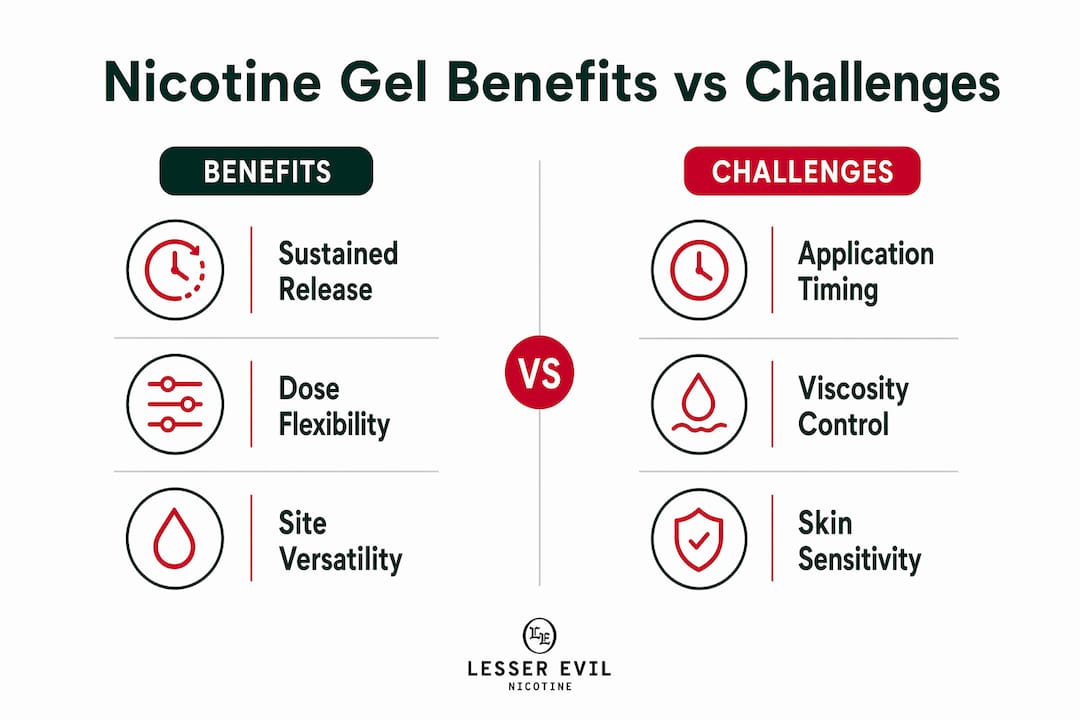
The challenges are real, though. Absorption variability arises because skin permeability changes with physical activity, temperature, and hydration. A gel applied before a workout will absorb faster than the same gel applied at rest. That inconsistency requires careful attention to dosing and site rotation.
Adherence is another practical issue. Gels require the person to apply them correctly and consistently. A patch stays put. A gel needs to be rubbed in, allowed to dry, and kept away from water for a period after application. For people who want a set-and-forget solution, that friction adds up.
- Advantages: sustained release, site flexibility, dose adjustability, reduced mucosal irritation, removable if needed
- Challenges: absorption variability with activity, application discipline required, site rotation needed, drying time after application
Pro Tip: Apply transdermal nicotine gel to clean, dry, hairless skin and avoid washing the area for at least an hour. Covering the site loosely with clothing rather than tight fabric also reduces friction that can wipe the gel off before it absorbs.
What formulation science underpins nicotine gel development?
The chemistry behind nicotine gels is more deliberate than it looks. Every ingredient earns its place by solving a specific problem in delivery, stability, or user experience.
Gelling agents are the backbone of any gel formulation. Carbopol, polymer systems, and alginate are carefully balanced in concentration to achieve target viscosity and prevent leakage. Carbopol creates a high-viscosity network that holds the formulation in place on skin. Polymer-based systems like poloxamers are thermoresponsive, meaning they flow at room temperature and gel at body temperature. Alginate provides a natural, biocompatible matrix suited to mucosal applications. Each agent controls not just how the gel feels, but how fast nicotine diffuses out of it.
Viscosity is the key physical variable. Too thin and the gel runs, reducing contact time and dose accuracy. Too thick and absorption slows to the point where onset is delayed beyond usefulness. Formulators tune viscosity by adjusting gellant concentration, which also affects how the gel behaves across different environmental temperatures.
Nanoscale encapsulation takes precision further. Nicotine-loaded nanogels can deliver nicotine sustainably for up to 6 hours with an entrapment efficiency of 90.71%. A viscosity of 12,358 cps and a pH of approximately 6.52 make the formulation suitable for topical use with diffusion-controlled release kinetics. That entrapment efficiency figure matters because it tells you how much of the active ingredient is actually locked inside the carrier rather than sitting free in solution.
| Gelling agent | Primary function | Typical application |
|---|---|---|
| Carbopol | High viscosity, skin adhesion | Transdermal gels |
| Poloxamer (polymer) | Thermoresponsive sol-gel transition | Nasal and mucosal gels |
| Alginate | Biocompatible mucosal matrix | Oral and nasal gels |
| Chitosan | Mucosal retention, bioadhesion | Nasal hydrogels |
Thermoresponsive hydrogels represent the most sophisticated end of the formulation spectrum. Sol-gel transitions triggered by body temperature improve mucosal nicotine retention and patient adherence compared to less-retentive sprays. The gel forms in situ, meaning it conforms to the mucosal surface rather than being applied as a pre-formed solid. That conformity extends contact time and improves bioavailability without requiring the person to hold anything in place.
How do gel nicotine delivery systems support smoking cessation and cognitive function?
Gel delivery systems support smoking cessation by removing the spikes. Combustible tobacco delivers nicotine in sharp peaks that train the brain to associate smoking with rapid reward. Gels flatten that curve. The result is craving management that feels less like fighting and more like maintenance.
Steady plasma nicotine levels support mood and focus without the jitteriness common in rapid-onset oral products. That matters practically. Someone using a gel during a stressful workday is not riding a nicotine rollercoaster. They are maintaining a baseline that keeps withdrawal symptoms quiet without overshooting into side-effect territory.
The benefits extend beyond cessation. Topical nicotine has clinical potential in cognitive support and recovery from inflammatory conditions, with less stigma than traditional nicotine addiction portrays. Research on transdermal patches has shown enhanced cognitive performance, and gel systems offer the same steady delivery mechanism with added site flexibility. This is not a fringe idea. It is an area of active clinical interest.
- Steady nicotine levels reduce withdrawal-driven mood dips during cessation
- Gel delivery avoids the combustion byproducts that damage lung tissue
- Cognitive support potential makes gels relevant beyond just quitting smoking
- No vaporised chemicals means no lung exposure to heated carrier substances
- Battery-free, waste-free formats reduce environmental impact compared to disposable vaping devices
Oral nicotine gels, like the formulation Lesserevil has developed, sit at the intersection of these benefits. They deliver nicotine through the oral mucosa without burning, vaping, or producing waste. That is a meaningful step away from combustion and a step toward something that does not cost your lungs.
What future trends are shaping nicotine gel development?
The direction of travel in nicotine gel development is clear: less waste, more control, and better user experience. Sustainability is driving a shift away from disposable liquid cartridges toward semi-solid gel formulations. Patent trends highlight manufacturing efficiency and environmental motivations as primary drivers of gel format innovation. Gel products also simplify flavour formulation because flavour compounds do not affect viscosity the way they do in liquid e-cigarette systems.
Thermoresponsive gel systems are moving from nasal applications toward oral and buccal delivery. The same sol-gel transition that works in the nose can work in the mouth, creating a formulation that flows on application and then sets against mucosal tissue for sustained release. That technology is not hypothetical. It is in active development and patent filing.
Personalised dosing is the next frontier. Current gel products offer fixed concentrations, but the formulation science already exists to create variable-dose systems that adjust to individual absorption profiles. Combined with site rotation guidance and digital tracking, gel-based delivery could become the most precise NRT format available.
- Sustainability: gel formats produce less disposable waste than cartridge-based vaping systems
- Flavour flexibility: gel matrices accept flavour compounds without viscosity disruption
- Thermoresponsive oral gels: sol-gel transitions in buccal delivery are in active development
- Personalised dosing: variable-concentration gel systems are a near-term formulation target
- Battery-free delivery: no heating element means no electronic waste and no vaporised chemicals
Key takeaways
Gel-based nicotine delivery provides sustained, controlled release that reduces cravings more effectively than rapid-onset formats by eliminating the peaks and troughs that drive reactive smoking behaviour.
| Point | Details |
|---|---|
| Sustained release is the core benefit | Gel formulations maintain steady plasma nicotine levels, reducing withdrawal spikes and mood dips. |
| Formulation science determines performance | Gelling agents like Carbopol, poloxamer, and alginate control viscosity, stability, and release rate. |
| Variability is the main challenge | Absorption changes with skin site, activity level, and hydration, requiring consistent application habits. |
| Thermoresponsive gels improve mucosal delivery | Sol-gel transitions at body temperature extend contact time and reduce irritation versus sprays. |
| Sustainability favours gel formats | Gel products generate less waste than disposable cartridge systems and simplify flavour manufacturing. |
Why I think gels are the format the nicotine industry has been avoiding
Most NRT development over the past two decades has chased speed. Faster onset, quicker craving relief, more immediate reward. That logic makes sense on paper, but it replicates the very mechanism that makes combustible tobacco so hard to quit. Fast onset trains dependence. Steady delivery breaks it.
Gels have been sitting in pharmaceutical research for years, delivering controlled release for hormones, pain relief, and anti-inflammatory drugs. The science is not new. What is new is the application to nicotine in formats that people actually want to use. The oral gel space, in particular, has been underserved. Most oral NRT products are lozenges or gum, both of which require active use and produce inconsistent absorption depending on saliva and chewing behaviour.
What I find genuinely interesting about where this is heading is the combination of thermoresponsive chemistry and oral delivery. A gel that flows on application and then sets against mucosal tissue removes the compliance problem entirely. You apply it, it stays, it releases steadily. No patches to forget, no sprays to mistime, no gum to chew correctly.
The challenge the industry needs to address honestly is variability. Gels are not as predictable as patches in every user. That is a real limitation, not a marketing footnote. The answer is better site guidance, lower doses, and formulations tuned for oral mucosal delivery where variability is lower than transdermal routes. That is the direction worth watching.
— Luke
Lesserevil: a gel-based nicotine option worth knowing about

Lesserevil has built what it describes as the world’s first low-burn oral nicotine gel, with a patent-pending formulation designed for palatability and controlled release. The Lesserevil Oral Mister delivers nicotine through the oral mucosa without combustion, vaporised chemicals, or electronic components. It comes in three flavours: Peppermint, Black Grape, and Green Apple, all using natural flavours and natural sweeteners. There is no battery, no cartridge, and no e-waste. Customers report using less nicotine overall and appreciating the discrete, controlled format. For anyone researching gel delivery as a genuine alternative to smoking or vaping, the Lesserevil store is a practical next step.
FAQ
What is the role of gel in nicotine delivery?
Gel formulations control the rate at which nicotine is absorbed through the skin or mucosal tissue, producing steady plasma levels that reduce cravings without sharp peaks or troughs. This sustained release profile makes gels more effective for craving management than rapid-onset formats like sprays or gum.
How does nicotine gel work compared to a patch?
Nicotine gel absorbs through skin or mucosal membranes and offers faster initial uptake and more site flexibility than a patch, but produces more variability in plasma levels over time. Patches maintain a fixed diffusion gradient; gels depend on skin permeability, which changes with activity and hydration.
What are the main nicotine gel benefits for quitting smoking?
The primary benefits are sustained nicotine release, reduced mucosal irritation compared to sprays, and the absence of combustion byproducts. Steady plasma levels support mood and focus during cessation without the jitteriness associated with rapid-onset oral nicotine products.
What gelling agents are used in nicotine gel formulations?
Carbopol, poloxamer-based polymers, alginate, and chitosan are the most common gelling agents. Each controls viscosity, stability, and release rate differently, and formulators balance their concentrations to achieve the target delivery profile for a given application site.
Are nicotine gels better for the environment than vaping?
Gel-based nicotine products generate significantly less waste than disposable vaping cartridges and require no battery or heating element. Patent trends confirm that sustainability and manufacturing simplicity are active drivers of gel format development in the nicotine industry.