

Oral nicotine vs smoking: what's actually different?

TL;DR:
- Oral nicotine products deliver nicotine through the mouth’s mucosal membranes without burning tobacco, unlike cigarettes which produce harmful toxins through combustion. They provide a slower, gentler nicotine absorption than smoking, reducing the immediate reinforcement and some health risks. While they lower exposure to toxicants, nicotine remains addictive, and long-term safety data is still limited.
Oral nicotine products are defined as tobacco-free formats that deliver nicotine through the mouth’s mucosal membranes, without burning anything. That single fact sits at the heart of every oral nicotine vs smoking comparison worth having. Smoking burns tobacco, and that combustion produces tar, carbon monoxide, and thousands of chemical byproducts. Oral nicotine formats, including pouches, gels, and sprays, skip combustion entirely. The nicotine still reaches your bloodstream. The lung tax does not apply.
How does nicotine delivery differ between oral nicotine and smoking?
Smoking delivers nicotine to the brain faster than almost any other method. You inhale, the vapour hits your lung tissue, and nicotine enters the bloodstream within seconds. That rapid hit is a big part of why cigarettes are so hard to put down.

Oral nicotine works differently. Products like pouches and sublingual gels absorb nicotine through the mucosal lining of the mouth. JAMA reports that this absorption is slower, closer in speed to a nicotine lozenge than a cigarette. The onset is gentler, and the peak is lower.
That slower curve matters for how you experience the product. You do not get the sharp spike that cigarettes deliver, which means the sensation feels different, not absent. For people switching from smoking, this takes some adjustment. The nicotine is there. The urgency is quieter.
Pro Tip: If you are used to cigarettes, give an oral nicotine product at least a week before judging it. Your body is recalibrating to a different absorption curve, not a weaker one.
Nicotine replacement therapies like patches and gums also use mucosal or transdermal absorption. Oral nicotine products sit in a similar pharmacokinetic bracket, but they are consumer products rather than medicines. That distinction matters for how they are sold, regulated, and used. The role of gel in nicotine delivery is a useful read if you want to go deeper on how sublingual formats specifically work.
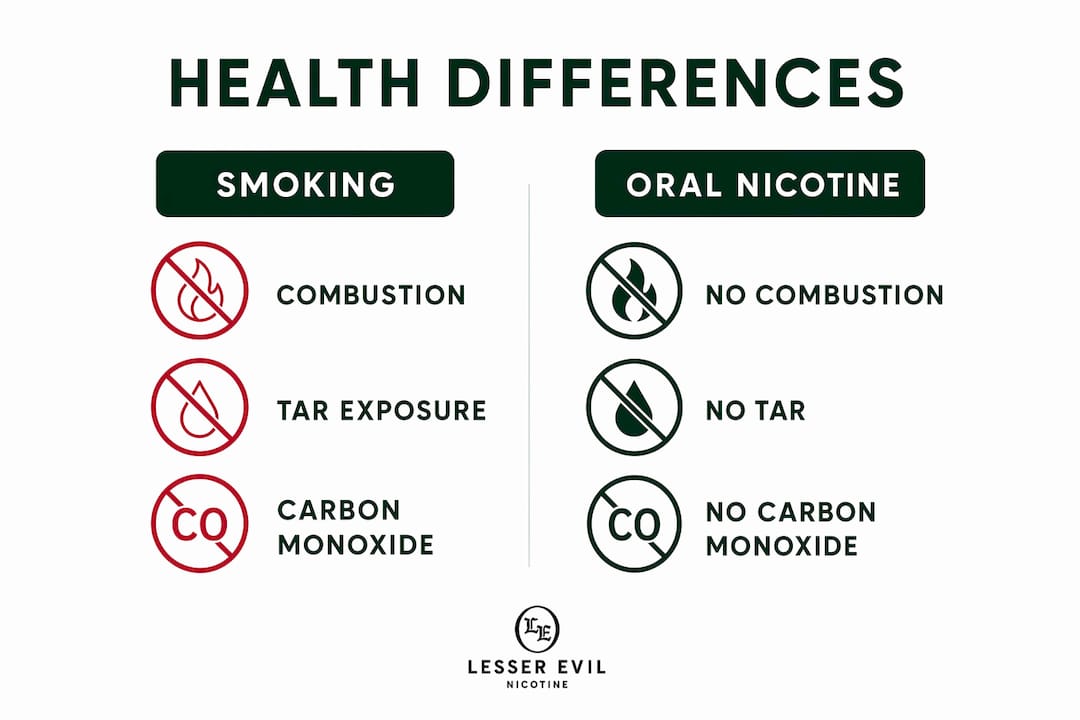
What are the health differences between oral nicotine and smoking?
The biggest health difference comes down to combustion. Burning tobacco produces tar, carbon monoxide, and a catalogue of carcinogens. Oral nicotine products produce none of these because nothing is burned. The FDA states that completely switching from cigarettes to pouches reduces exposure to harmful chemicals. The key word is completely. Dual use, where you smoke and use oral nicotine, undermines the benefit.
Biomarker research backs this up. Studies show that exclusive nicotine pouch users have much lower levels of tobacco alkaloids like anabasine and anatabine compared to exclusive smokers. Nicotine exposure remains elevated, but the overall toxicant burden is substantially lower. That is a meaningful difference in exposure profile.
“The continuum of risk in nicotine products focuses on combustion toxicants as the greatest harm source, not nicotine alone.” — FDA, Relative Risks of Tobacco Products
The picture is not entirely clean for oral nicotine, though. A 2026 review in Frontiers in Oral Health notes that mild mucosal irritation is the most commonly reported side effect. Long-term data on oral cancer risk does not yet exist. Researchers are clear that monitoring needs to continue as these products become more widely used.
| Factor | Smoking | Oral nicotine |
|---|---|---|
| Combustion | Yes | No |
| Tar exposure | Yes | No |
| Carbon monoxide | Yes | No |
| Tobacco alkaloids | High | Much lower |
| Mucosal irritation | Possible | Mild, reported |
| Long-term cancer data | Extensive | Limited |
The honest summary: oral nicotine removes the combustion toxicants that cause the most documented harm. It does not make nicotine risk-free. Anyone telling you otherwise is selling something harder than a gel.
How do addiction and dependence compare between oral nicotine and smoking?
Nicotine is addictive regardless of how it enters your body. That is not up for debate. What does vary is how the delivery method shapes the pattern of dependence.
Cigarettes deliver nicotine fast. That rapid spike reinforces the habit loop quickly and intensely. JAMA’s analysis confirms that slower absorption from oral products changes how dependence develops. The intensity of the pull is different, even if the underlying addiction mechanism is the same.
Here is what that means practically:
- Faster delivery equals stronger reinforcement. Cigarettes condition the brain to expect an immediate reward. Oral products do not replicate that spike.
- Slower onset may reduce compulsive use. Without the sharp hit, the urgency to reach for the next one can be lower.
- High nicotine strengths in some pouches carry their own risk. UK regulators warn that high nicotine content and rapid absorption in certain products raise dependence concerns, particularly around youth uptake.
- Dual use is a real trap. Using oral nicotine alongside cigarettes does not reduce your overall nicotine dependence. It adds to it.
Pro Tip: Pay attention to the nicotine strength you choose. Starting lower and adjusting is smarter than starting high and building tolerance fast.
The regulatory picture is evolving. UK authorities are actively reviewing flavour restrictions and nicotine caps to balance adult harm reduction against the risk of new users, especially younger ones, picking up a habit they did not have before. That is a legitimate concern, and it applies to all oral nicotine formats.
What practical factors shape the choice between oral nicotine and smoking?
The practical differences between smoking and oral nicotine are where most people actually make their decisions. Health data matters, but so does what it feels like to use a product in real life.
- No smoke, no smell. Oral nicotine products produce nothing you breathe in and nothing that clings to your clothes, hair, or the people around you. That is a significant social shift.
- Discreet use. A gel or pouch used under the tongue is invisible in a meeting, on a train, or at a dinner table. A cigarette is not.
- Flavour variety. Products like Lesser Evil Nicotine’s oral gel come in Peppermint, Black Grape, and Green Apple. That variety, combined with no smoke smell, increases social acceptability compared to cigarettes.
- No battery, no e-waste. Unlike vaping, oral nicotine gels and pouches require no device. Lesser Evil Nicotine’s format is battery-free, which means no charging, no coils, and nothing to throw in landfill.
- Cost. Research shows oral nicotine products have a toxicant profile similar to NRT but typically cost around half as much. Compared to cigarettes at current UK prices, the maths can work in oral nicotine’s favour over time.
Lesser Evil Nicotine’s sublingual gel delivers nicotine through the oral mucosa. It is tobacco-free and uses natural flavours and natural sweeteners. You place it under the tongue. You do not breathe it in. That is the core factual difference from both smoking and vaping, and it is worth understanding before you make any switch.
For people managing their habit at work or in social settings, the practical guide to nicotine at work covers the real-world logistics in detail.
Key takeaways
Oral nicotine products remove combustion from the equation, and combustion is the primary source of the most documented harms in smoking.
| Point | Details |
|---|---|
| Combustion is the core difference | Smoking burns tobacco and produces tar and carcinogens; oral nicotine does not. |
| Slower absorption changes the experience | Oral nicotine absorbs through the mouth, not the lungs, giving a gentler and slower nicotine curve. |
| Lower toxicant burden, not zero risk | Biomarker studies show far fewer toxicants in oral nicotine users, but nicotine remains addictive. |
| Complete switching matters | Dual use of cigarettes and oral nicotine undermines any reduction in harmful chemical exposure. |
| Long-term data is still limited | Oral cancer risk from pouches and gels lacks long-term evidence; ongoing research is needed. |
My honest view on where oral nicotine actually sits
By Luke McLeod
I have spent a lot of time looking at how people actually use nicotine products versus how researchers and regulators talk about them. The gap is real.
The science on combustion is settled. Burning tobacco is where the serious harm comes from. Oral nicotine removes that entirely. That is not a marketing claim. It is the basis of how the FDA and UK regulators frame their own risk assessments. The products are not risk-free, and anyone who tells you they are has skipped the part about nicotine’s addictive nature.
What I find genuinely interesting is the absorption curve argument. The slower onset from oral products is often framed as a weakness, as if it is a lesser experience. I think that framing is backwards. A lower-intensity, slower-building nicotine delivery is arguably a more sustainable relationship with the substance. You are not chasing a spike. You are managing a level.
The part that does not get enough attention is dual use. People often add oral nicotine to their existing smoking habit rather than replacing it. That completely misses the point. The benefit only materialises when you actually stop burning things. That requires a genuine decision, not a supplement.
The evidence on long-term oral effects is genuinely incomplete. I would not dismiss that uncertainty. Researchers are right to flag it. But comparing incomplete long-term data on oral nicotine to the very complete and very grim long-term data on smoking is not a fair equivalence. One of these has decades of evidence on what it does to your lungs, heart, and life expectancy. The other does not, yet.
— Luke McLeod
Lesser Evil Nicotine: tobacco-free, combustion-free, no rubbish
If you have read this far and you are thinking about what an actual switch looks like, Lesser Evil Nicotine is worth knowing about.

The Lesser Evil Oral Mister is a nicotine mouth spray launching in the UK in 2026. The oral gel format delivers nicotine sublingually, through the oral mucosa, with no tobacco, no combustion, and no battery. Flavours are Peppermint, Black Grape, and Green Apple, all made with natural flavours and natural sweeteners. Nothing is inhaled. No e-waste is generated. Lesser Evil Nicotine is not a cessation product or a medicine. It is a tobacco-free alternative to smoking and vaping, built for people who want to manage their nicotine without breathing garbage.
FAQ
Is oral nicotine safer than smoking?
The FDA states that completely switching from cigarettes to oral nicotine products reduces exposure to harmful chemicals. Oral nicotine is not risk-free, but it removes combustion toxicants, which are the primary source of smoking-related harm.
Does oral nicotine still cause addiction?
Yes. JAMA confirms that nicotine is addictive regardless of delivery method. Oral products absorb more slowly than cigarettes, which may alter the pattern of dependence, but does not eliminate it.
What are the side effects of oral nicotine products?
The most commonly reported effects are mild mouth irritation and soreness at the site of use. A 2026 review in Frontiers in Oral Health notes no established long-term oral cancer data exists yet for pouches and gels.
Can I use oral nicotine at the same time as smoking?
Dual use does not reduce your exposure to combustion toxicants. The FDA is clear that the benefit of switching only applies when you stop smoking completely.
How does oral nicotine compare to vaping?
Both avoid tobacco combustion, but vaping still involves inhaling heated vapour and its chemical byproducts. Oral nicotine products like gels and pouches are not inhaled at all, removing lung exposure from the equation entirely.