

The role of gel in nicotine delivery: 2026 guide

Gel-based nicotine delivery is defined as the use of semi-solid formulations to control how nicotine enters the body, producing steadier blood levels than patches, sprays, or combustible tobacco. The core technology relies on gelling agents, nanogels, and thermoresponsive hydrogels to manage the rate at which nicotine is released. Unlike transdermal patches, the most clinically interesting gel formats today work sublingually or via mucosal membranes, where absorption is faster and more controllable. Lesser Evil Nicotine has built its entire product around this principle, using a patent-pending oral gel that delivers nicotine without burning anything, vaporising anything, or leaving a pile of dead batteries behind.
How do nicotine gel delivery systems work?
Gel delivery systems control nicotine release by trapping the molecule inside a semi-solid matrix, then releasing it at a rate determined by the formulation’s physical properties. The two main mechanisms are diffusion-controlled release, where nicotine migrates through the gel matrix at a predictable rate, and phase-transition release, where the gel changes state in response to body temperature or pH.
Sublingual and mucosal gels absorb nicotine through the soft tissue lining of the mouth. This route bypasses first-pass metabolism in the liver, which means more nicotine reaches the bloodstream per dose compared to swallowed formats. The mucosa is highly vascularised, so onset is meaningfully faster than a transdermal patch stuck to your arm.
Thermoresponsive hydrogels, such as those combining Kolliphor P 407 and chitosan, work differently. They exist as a liquid at room temperature and transition to a gel at body temperature. This sol-gel transition improves mucosal retention and produces a biphasic nicotine release profile, which reduces the irritation associated with conventional nasal sprays.
Nanogels add another layer of control. Nicotine-loaded nanogels can sustain release for up to 6 hours with an entrapment efficiency of 90.71%. That figure matters because it means very little nicotine is wasted before it reaches the target tissue.

Pro Tip: If you are comparing gel formats, look for entrapment efficiency figures in product documentation. Higher efficiency means more consistent dosing per application.
What are the advantages and challenges of gel nicotine systems?
Gel formulations offer several genuine advantages over patches and sprays, but they are not without trade-offs.
The benefits:
- Faster onset than patches. Mucosal and sublingual gels absorb nicotine more quickly than transdermal patches, which rely on slow diffusion through intact skin.
- Steady exposure without the spike. Nicotine gels provide steady exposure that reduces the peak-and-trough effect common in oral nicotine products like gums and lozenges. Fewer peaks mean less jitteriness and better mood stability.
- Reduced mucosal irritation. Thermoresponsive hydrogels release nicotine gradually, which is gentler on mucosal tissue than the sharp chemical hit of a nasal spray.
- Site flexibility. Gels can be applied or used sublingually, nasally, or topically, giving formulators more options than a patch, which is limited to skin.
- No combustion, no vapour. Oral gels produce no smoke, no aerosol, and no vaporised chemicals. That is the whole point.
The challenges:
- Absorption variability. For transdermal gels specifically, uptake depends on skin permeability and physical activity, which varies between people and across body sites. Sublingual formats reduce this variable significantly.
- Dosing discipline. Gels require consistent application technique. Too much product or inconsistent placement affects how much nicotine is absorbed.
- Site rotation. For any topical application, rotating sites prevents localised irritation and maintains consistent absorption over time.
Pro Tip: For sublingual gels, hold the product under your tongue for at least 30 seconds before swallowing. This maximises mucosal contact time and improves absorption.
What formulation science underpins nicotine gel development?
The physical properties of a nicotine gel are not accidental. Every variable, from viscosity to pH, is tuned deliberately to control release rate, stability, and user comfort.
Gelling agents and viscosity control
Gelling agents are the backbone of any nicotine gel formulation. Carbopol, poloxamer, and alginate are the most widely used. Each one behaves differently under shear stress and temperature change. Poloxamer, for example, is the key ingredient in thermoresponsive systems because it undergoes a reversible sol-gel transition at body temperature. Gelling agents like Carbopol and poloxamer are balanced in concentration to achieve target viscosity and prevent leakage, which is critical for both user experience and dosing accuracy.
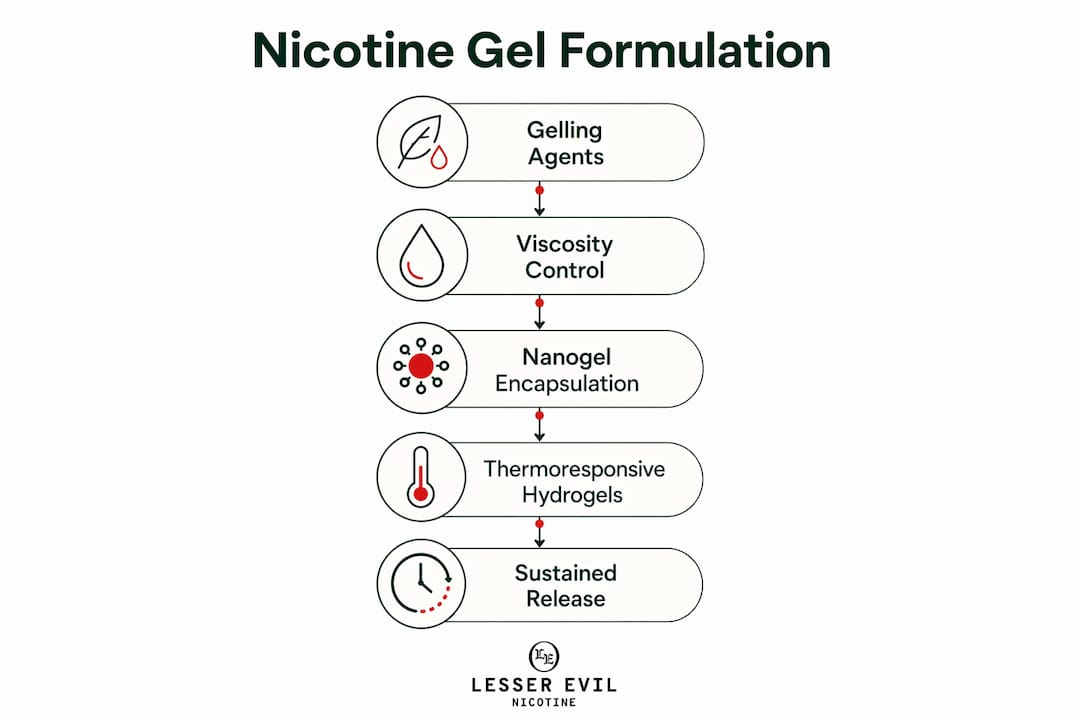
Viscosity is measured in centipoise (cps). A nicotine nanogel formulation with a viscosity of 12,358 cps and a pH of approximately 6.52 sits within the range suitable for topical and mucosal use. That pH figure is important because it is close to the natural pH of oral mucosa, reducing irritation on contact.
Nanogel encapsulation
Nanogel encapsulation traps nicotine molecules inside a polymer network at the nanoscale. The polymer shell controls how quickly nicotine diffuses out. This produces diffusion-controlled release kinetics, meaning the release rate is predictable and consistent rather than dependent on external variables like skin hydration.
The table below summarises the key formulation parameters from published nicotine nanogel research.
| Parameter | Value |
|---|---|
| Entrapment efficiency | 90.71% |
| Viscosity | 12,358 cps |
| pH | ~6.52 |
| Sustained release duration | Up to 6 hours |
| Release mechanism | Diffusion-controlled |
Thermoresponsive hydrogels
Thermoresponsive hydrogels are the most clinically interesting development in gel nicotine delivery. They are liquid at room temperature, which makes them easy to dose, and they gel at body temperature, which keeps them in place at the absorption site. Thermoresponsive hydrogels improve mucosal retention and patient adherence compared to conventional liquid sprays. The sol-gel transition is triggered by the warmth of the mouth or nasal cavity, not by any external action from the person using the product.
How do gel systems support cessation and cognitive function?
The functional case for gel-based nicotine delivery goes beyond just replacing cigarettes. Steady nicotine levels support craving management without the jitteriness that comes from rapid-onset oral products. When your blood nicotine level does not spike and crash, your mood and focus stay more consistent throughout the day.
Steady plasma levels are beneficial for cognitive function and craving management. This is not a minor point. One of the main reasons people relapse is that nicotine replacement products do not satisfy cravings quickly enough, or they overshoot and cause nausea. A well-formulated gel sits between those two failure modes.
The cognitive angle is also worth taking seriously. Topical nicotine has clinical potential in cognitive support and recovery from inflammatory conditions, with less addiction stigma than traditional nicotine use. Studies show enhanced cognitive performance with nicotine patches, and the same steady-exposure principle applies to sublingual gels. This does not make nicotine a health supplement, but it does reframe the conversation around harm reduction.
For people moving away from vaping or smoking, the practical benefits stack up:
- No lung exposure to vaporised chemicals
- No combustion products
- Discreet use in any setting
- Consistent dosing without the ritual of lighting up or charging a device
- No contribution to e-waste from disposable cartridges
What future trends are shaping nicotine gel products?
The direction of travel in nicotine gel development is clear. Sustainability, manufacturing simplicity, and user-centric design are all pushing the category toward gel formats.
Patent trends highlight manufacturing efficiency and environmental motivations as primary drivers of the shift from liquid cartridges to semi-solid gel formulations. Liquid e-liquid cartridges create disposal problems and flavour-loading limitations because adding flavour compounds changes the viscosity of the liquid. Gels do not have this problem. Flavour compounds can be incorporated without destabilising the delivery matrix.
The key trends shaping the next generation of nicotine gels include:
- Reduced waste. Semi-solid formats generate less disposable packaging and no battery waste compared to vaping devices.
- Personalised dosing. Gel matrices can be tuned to deliver different nicotine concentrations from the same base formulation, making personalised step-down programmes more practical.
- Expanded delivery sites. Sublingual, buccal, and nasal gel formats are all in active development, each targeting different absorption profiles and use cases.
- Thermoresponsive systems at scale. As manufacturing costs for poloxamer-based gels fall, thermoresponsive formats will move from clinical research into consumer products.
Lesser Evil Nicotine’s patent-pending oral gel is already positioned within this trend. It is battery-free, tobacco-free, and formulated with natural flavours and sweeteners. That is not a marketing claim. It is a direct response to what the formulation science makes possible.
Key takeaways
Gel-based nicotine delivery is the most controlled, least harmful route to steady nicotine exposure available today, combining formulation science with real-world usability.
| Point | Details |
|---|---|
| Sustained release | Nicotine nanogels deliver up to 6 hours of controlled release with 90.71% entrapment efficiency. |
| Steady blood levels | Gel formats reduce peak-and-trough effects, supporting mood stability and craving control. |
| Formulation science | Gelling agents like Carbopol and poloxamer control viscosity, pH, and release rate precisely. |
| Thermoresponsive gels | Sol-gel transitions at body temperature improve mucosal retention and reduce irritation. |
| Sustainability advantage | Gel formats reduce e-waste and simplify flavour loading compared to liquid cartridges. |
Why I think gels are the format the nicotine category has been waiting for
I have spent a lot of time looking at how people actually use nicotine replacement products versus how they are supposed to use them. Patches get forgotten. Sprays get avoided because they sting. Gums get chewed wrong and cause hiccups. The adherence problem in nicotine replacement is not about willpower. It is about products that are annoying to use.
Gels solve a different set of problems. The sublingual format is discreet, fast enough to feel satisfying, and gentle enough that people actually keep using it. The formulation science is genuinely impressive, but what matters at the point of use is that it works without making you feel like you are doing something medical.
The cognitive support angle is underreported. The research on nicotine and cognitive function is not fringe. It is peer-reviewed and it is growing. Steady nicotine exposure from a clean gel format is a very different proposition from smoking or vaping. We are not there yet in terms of public perception, but the science is ahead of the conversation.
My prediction is that the gel category will grow fastest among people who are already motivated to reduce harm but have found every existing product either too slow, too harsh, or too inconvenient. That is a large group. The products that win will be the ones that take formulation seriously and do not treat the user as an afterthought.
— Luke McLeod
Lesser Evil Nicotine: gel delivery without the rubbish
Lesser Evil Nicotine was built on exactly the science covered in this article. The oral nicotine gel uses a patent-pending low-burn formulation that delivers steady nicotine sublingually, with no tobacco, no vapour, and no battery. It comes in Peppermint, Black Grape, and Green Apple, sweetened with natural sweeteners and flavoured naturally.

If you are done breathing vaporised chemicals and want a format that actually respects your body, this is the next step. Lesser Evil Nicotine launches in the UK in 2026, positioned for people who are serious about reducing harm without giving up nicotine entirely. Read more about the science behind the product and get on the list before the London launch.
FAQ
What is the role of gel in nicotine delivery?
Gel formulations control the rate at which nicotine is released and absorbed, producing steadier blood levels than patches, sprays, or combustible products. The semi-solid matrix traps nicotine and releases it via diffusion or phase-transition mechanisms.
How does a nicotine gel work sublingually?
Sublingual nicotine gel dissolves under the tongue, where nicotine absorbs directly through the mucosal membrane into the bloodstream. This bypasses first-pass liver metabolism, producing faster onset than swallowed formats.
Are nicotine gels better than patches for cessation?
Gels offer faster onset and more site flexibility than patches, but transdermal gels can show more absorption variability due to differences in skin permeability. Sublingual gels reduce this variability by using the more consistent mucosal route.
What gelling agents are used in nicotine gel formulations?
Carbopol, poloxamer, and alginate are the most common gelling agents. Poloxamer is particularly useful in thermoresponsive systems because it transitions from liquid to gel at body temperature, improving mucosal retention.
Do nicotine gels produce any waste?
Semi-solid gel formats generate significantly less waste than vaping devices. They require no battery, no heating element, and no disposable liquid cartridge, which aligns with the sustainability drivers now shaping nicotine product development.