

Female nicotine withdrawal explained: a guide for women

TL;DR:
- Women experience higher relapse rates within 24 hours of quitting nicotine due to hormonal influences and emotional triggers. Managing withdrawal effectively involves gradual reduction, cycle tracking, trigger identification, and alternative stress relief strategies. Recognizing biological and behavioral factors helps women plan and reduce nicotine dependence successfully.
Nicotine withdrawal is defined as the set of physical and psychological symptoms that occur when a person reduces or stops nicotine use after a period of regular consumption. For women, this process is shaped by biology in ways that standard advice rarely acknowledges. Hormonal fluctuations across the menstrual cycle directly influence symptom intensity and relapse risk. A 2026 cross-national study across 12 countries found that women show higher rates of relapse during the first 24 hours after quitting compared to men. That single statistic reframes the entire conversation around female nicotine withdrawal. Understanding why it happens is the first step toward doing something about it.
What are nicotine withdrawal symptoms in women?
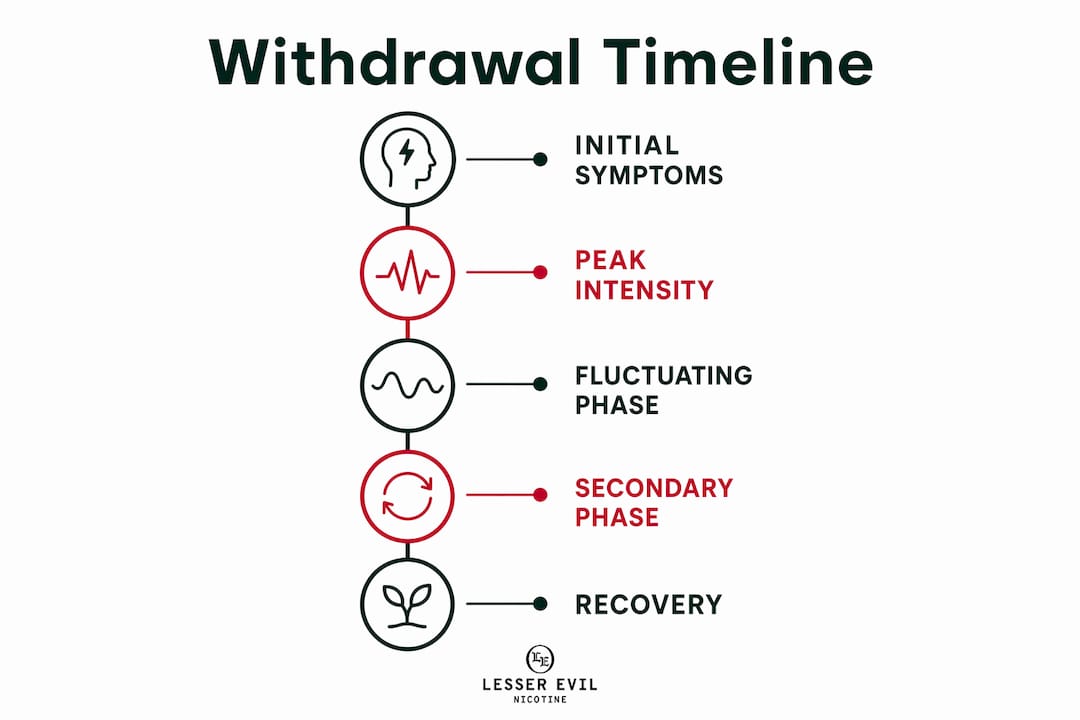
Nicotine withdrawal symptoms typically start within 4–24 hours of stopping, peak at 2–3 days, and taper over 2–4 weeks. The most common symptoms include irritability, anxiety, intense cravings, mood disturbances, difficulty concentrating, and disrupted sleep. For women, the emotional symptoms tend to be more pronounced than the physical ones.
What most guides miss is that symptoms do not follow a neat, linear decline. Withdrawal symptoms fluctuate based on stress, fatigue, and environment, which means a bad day at week three does not mean you are back at square one. Anxiety and low mood are biological reactions to a brain recalibrating its dopamine system. They are not signs of weakness or failure.
There is also a secondary phase worth knowing about. Around week six, many women report a subtle emotional flatness where acute physical cravings have eased but something still feels slightly off. This stage is real, it is common, and it passes.
| Symptom type | Typical onset | Typical duration |
|---|---|---|
| Irritability and mood changes | Within 4–24 hours | 1–4 weeks |
| Anxiety and restlessness | Within 4–24 hours | 2–4 weeks |
| Intense nicotine cravings | Within 4–24 hours | 2–4 weeks, then occasional |
| Sleep disruption | Day 1–3 | 1–3 weeks |
| Difficulty concentrating | Day 1–3 | 1–2 weeks |
| Emotional flatness | Around week 6 | Variable, weeks to months |
Pro Tip: Naming your symptoms out loud or writing them down helps your brain categorise them as temporary and biological, rather than permanent and personal. That small shift reduces the emotional weight significantly.
How do hormonal cycles affect nicotine cravings and withdrawal?
Oestrogen and progesterone do not just regulate your cycle. They actively modulate how your brain processes nicotine and how intensely you feel its absence. Oestrogen in the first half of the cycle increases craving intensity and raises relapse risk. Progesterone in the second half provides a natural buffer, making cravings somewhat easier to manage.

This means your experience of nicotine reduction is not consistent month to month. It shifts with your cycle. Women who track this pattern often report that the week before their period is the hardest, with cravings spiking alongside premenstrual symptoms. Early withdrawal can also temporarily shorten cycle length and intensify PMS as hormones recalibrate. That is not a sign something is wrong. It is your body adjusting.
Here is what the hormonal picture looks like in practice:
- Follicular phase (days 1–14): Rising oestrogen heightens craving intensity and emotional sensitivity.
- Ovulation: Oestrogen peaks. This is often the most difficult point for managing urges.
- Luteal phase (days 15–28): Progesterone rises and partially buffers cravings, but PMS symptoms can overlap with withdrawal symptoms, making them harder to separate.
- Premenstrual window: Progesterone drops sharply. Cravings and mood symptoms intensify together.
- Cycle disruption: Some women notice a shorter cycle or heavier premenstrual symptoms in the first one to two months of reducing nicotine.
Tracking your menstrual cycle alongside your symptom patterns gives you real data to work with, not guesswork.
Pro Tip: If you are planning to reduce your nicotine use, starting in the early luteal phase (just after ovulation) gives you progesterone’s natural buffering effect during the hardest first few days.
What psychological factors make withdrawal harder for women?
Nicotine addiction in women is not purely pharmacological. Nicotine functions as a behavioural coping tool for stress and social bonding in women, meaning the habit is woven into emotional routines, not just chemical dependency. Stress and social cues drive use more than the nicotine hit alone. That distinction matters enormously when you are trying to stop.
Think about when you actually reach for a vape or cigarette. After a difficult meeting. When a friend lights up. During a moment of boredom or low mood. These are behavioural triggers, and they do not disappear when the chemical dependency fades. Women’s nicotine use is strongly shaped by emotional and social cues, which is why addressing behaviour alongside chemical reduction produces better outcomes.
Here is a practical process for identifying and managing your behavioural triggers:
- Log your urges for one week. Note the time, location, emotional state, and who you were with. Patterns will emerge quickly.
- Identify your top three triggers. For most women, these cluster around stress, social situations, and specific times of day.
- Create a specific substitute for each trigger. Not a generic distraction. A specific one. A five-minute walk for the post-meeting urge. A non-nicotine oral substitute for the social situation.
- Redesign the environment. Remove nicotine products from the spaces where you use them most. Friction reduces automatic behaviour.
- Build a stress response that does not involve nicotine. Breathwork, a short walk, or even a cold glass of water can interrupt the stress-to-nicotine loop if practised consistently.
The goal is to replace the function nicotine was serving, not just remove the substance. That is the part most standard advice skips.
What practical strategies help women manage nicotine reduction?
Gradual reduction outperforms cold turkey for most women, particularly because the first 24 hours carry the highest relapse risk. Consistency matters more than perfection. A slip on day four does not erase three days of progress.
Managing workplace-triggered cravings deserves specific attention, since professional stress is one of the most common triggers for women in their late twenties and thirties. Structured breaks, a brief walk outside, and keeping your hands occupied all reduce the automatic reach for nicotine. The benefits of reducing nicotine gradually compound over time, even when progress feels slow.
For women who want to reduce without inhaling chemicals, oral nicotine delivery offers a practical alternative. Sublingual products deliver nicotine via the oral mucosa without combustion, vapour, or tobacco. That means no lung tax and no e-waste.
| Strategy | Best for | Practical note |
|---|---|---|
| Gradual reduction plan | Chemical dependency | Reduces severity of acute symptoms |
| Cycle-aware quit timing | Hormonal sensitivity | Start in early luteal phase for natural buffer |
| Trigger logging | Behavioural dependency | One week of data reveals clear patterns |
| Oral nicotine alternatives | Avoiding inhalation | Delivers nicotine without breathing anything in |
| Stress management routines | Emotional triggers | Breathwork or walking interrupts the stress-to-nicotine loop |
| Symptom normalisation | Emotional distress | Reduces self-blame and lowers relapse risk |
Pro Tip: Reframe a slip as data, not failure. Ask what triggered it, adjust your plan, and keep going. The women who succeed long-term are not the ones who never slip. They are the ones who do not let a slip become a stop.
Key takeaways
Female nicotine withdrawal is shaped by hormonal cycles, behavioural triggers, and a critical 24-hour relapse window that makes the first day the hardest and most important to plan for.
| Point | Details |
|---|---|
| Symptoms peak at 2–3 days | Acute withdrawal eases within 2–4 weeks, though emotional adjustment can continue longer. |
| Hormones shift craving intensity | Oestrogen raises cravings in the first half of the cycle; progesterone buffers them in the second half. |
| First 24 hours are highest risk | Women relapse more than men in this window, making the first day the one to plan most carefully. |
| Behavioural triggers outlast chemical ones | Stress, social cues, and emotional habits drive use and must be addressed alongside chemical reduction. |
| Normalising symptoms reduces relapse | Recognising anxiety and irritability as biological reactions, not personal weakness, lowers emotional distress. |
What I have learned watching women navigate this
by Luke McLeod
The thing that strikes me most is how often women blame themselves for struggling with withdrawal when the biology is working against them in ways nobody warned them about. You are not weak because week three felt harder than week one. You are not failing because a stressful Tuesday undid a calm Monday. Your hormones are genuinely shifting the difficulty level, sometimes week to week.
What I have found is that the women who do best are not the ones with the most willpower. They are the ones who treat this like a project. They track their cycle. They map their triggers. They plan the first 24 hours like it matters, because research confirms it does. They also give themselves permission to take longer than the standard two-week timeline suggests.
The secondary emotional flatness around week six is the part I wish more people talked about. Physical cravings ease, and then this quieter, greyer feeling arrives. It is not depression. It is your brain finishing its recalibration. Knowing it is coming makes it far less alarming when it does.
One more thing. The research on oxytocin’s role in modulating stress-related cravings is genuinely interesting. It points toward future gender-specific approaches that go well beyond what is currently available. We are not there yet, but the science is catching up to what women have been reporting for years.
— Luke McLeod
A cleaner way to get your nicotine
If you are reducing your nicotine use and want to stop breathing it in, Lesser Evil Nicotine offers a practical alternative worth knowing about.
The Lesser Evil oral gel sits under the tongue and delivers nicotine via the oral mucosa. No vapour. No tobacco. No battery. No e-waste. It comes in three flavours: Peppermint, Black Grape, and Green Apple, all made with natural flavours and natural sweeteners. For women who want more control over their nicotine without the lung tax that comes with vaping, it is a straightforward swap. Lesser Evil Nicotine is launching in the UK in 2026. Visit lesserevil.store to find out more.
FAQ
What are the first signs of nicotine withdrawal in women?
The first signs typically appear within 4–24 hours of stopping and include irritability, anxiety, intense cravings, and difficulty concentrating. Mood changes and sleep disruption usually follow within the first two days.
Why is quitting nicotine harder for women than men?
Women face higher relapse rates in the first 24 hours after quitting, partly because oestrogen amplifies craving intensity and partly because nicotine serves a stronger emotional and social coping function for women. Both factors require specific planning to manage.
How long does nicotine withdrawal last for women?
Acute physical symptoms peak at 2–3 days and ease over 2–4 weeks. A secondary phase of emotional adjustment can continue around week six, with occasional cravings persisting during high-stress periods or specific points in the menstrual cycle.
Does the menstrual cycle affect nicotine cravings?
Yes. Oestrogen in the first half of the cycle intensifies cravings, while progesterone in the second half provides a partial buffer. The premenstrual window, when progesterone drops sharply, is typically the most difficult point for managing urges.
What is the best way to manage nicotine withdrawal symptoms as a woman?
Gradual reduction, cycle-aware quit timing, trigger logging, and stress management routines all reduce symptom severity. Addressing behavioural triggers alongside chemical reduction produces better outcomes than chemical reduction alone.