

The role of oral nicotine at work: a professional's guide

TL;DR:
- Oral nicotine is a smokeless, tobacco-free method marketed as a discreet stimulant for professionals. It provides short-term focus benefits but carries addiction and oral health risks, requiring responsible, structured use. Growing workplace adoption is driven by demand for discreet alternatives to smoking and vaping, despite ongoing health safety concerns.
Oral nicotine is defined as a tobacco-free, smokeless nicotine delivery method that releases nicotine through the oral mucosa without combustion or vapour inhalation. Its role at work is growing fast, particularly among professionals in high-pressure urban environments who want a discreet stimulant that doesn’t mean stepping outside for a smoke. Unlike cigarettes or vapes, sublingual delivery means no burning, no breathing in vaporised chemicals, and no disruption to the people around you. The conversation has shifted from “should you use nicotine at work” to “how are people already doing it, and what does that mean for focus, health, and workplace culture?”
How does oral nicotine affect focus and cognitive performance at work?
Nicotine stimulates nicotinic acetylcholine receptors in the brain, which directly influences attention, memory, and cognitive processing speed. Studies show enhanced focus and cognitive function shortly after nicotine administration. That short-term lift is real, and it’s why professionals reach for it during long sprints of deep work.

The mechanism is worth understanding. When nicotine enters the bloodstream via the oral mucosa, it reaches the brain quickly. The result is a sharper sense of alertness and, for many people, a reduction in mental fatigue during sustained tasks. This is not placebo. The biochemical pathway is well documented.
The risks, however, are equally real. Nicotine is addictive, and addiction potential is not reduced simply because the delivery method is tobacco-free. Health authorities are clear: nicotine is not harmless regardless of how it arrives. Some users also report impaired impulse control with regular use, which is the opposite of what most professionals are chasing.
The key distinction from smoking and vaping is the absence of combustion. You don’t fry your lungs. You don’t breathe garbage into your airways. But you are still consuming an addictive substance, and that requires honest self-awareness.
- Short-term benefits: Improved attention, faster cognitive processing, and reduced mental fatigue during demanding tasks.
- Risks to weigh up: Addiction potential, possible impaired impulse control with heavy use, and oral health effects with prolonged contact.
- Delivery advantage: Sublingual absorption via the oral mucosa means no smoke, no vapour, and no combustion byproducts.
- Dose matters: Lower doses carry less dependency risk. Starting low and staying low is the sensible approach.
Pro Tip: Time your use to the start of a focused work block rather than using it reactively when you feel distracted. This gives you the cognitive lift when you actually need it, rather than chasing a hit to recover from a slump.
Why are urban professionals adopting oral nicotine at work?
The trend is real and it’s accelerating. Adoption of oral nicotine in workplaces is rising, with some offices going as far as stocking “nic fridges” and vending machines for employees. This is not fringe behaviour. It’s a cultural shift in how professionals think about stimulants.
The motivations vary, but a few themes come up consistently:
- Focus and ADHD management. Professionals in high-stress tech sectors report using oral nicotine specifically to manage attention and sustain concentration across long working days. Some consume multiple doses daily for this purpose.
- Discreet consumption. Unlike smoking, oral nicotine requires no outdoor break, no lingering smell, and no visible paraphernalia. You can use it at your desk without anyone noticing.
- Stimulant substitution. Coffee is socially accepted. Oral nicotine is increasingly treated the same way by a growing cohort of professionals, even though the risk profiles differ meaningfully.
- Avoiding vaping indoors. For people who already use nicotine, oral formats offer a way to get through a meeting or a long afternoon without stepping outside to vape.
“Nicotine-fuelled productivity is emerging as the new coffee culture in tech, but experts caution this normalises use of an addictive substance with greater risks than caffeine.”
The comparison to coffee is seductive but misleading. Experts warn against equating nicotine’s safety profile to that of caffeine, despite similar productivity use cases. Coffee doesn’t rewire your reward pathways. Nicotine does.
Pro Tip: If you’re navigating HR or social dynamics at work, keep your use desk-bound and personal. Workplace policies on oral nicotine vary widely, and the pragmatic move is discreet, private consumption until your workplace has a clear position.
What are the health and safety considerations for oral nicotine at work?
Oral nicotine is not a safe product. It is a less harmful format compared to smoking, but “less harmful” is not the same as “harmless.” Health organisations are consistent on this point: nicotine is addictive regardless of delivery method, and that addiction carries real consequences.
The oral health angle is one that doesn’t get enough attention. Swedish dental reports note deep gum lesions exposing tooth roots in regular pouch users. That’s a serious adverse effect, and it’s linked to prolonged contact between the product and gum tissue. Format matters here. Products that sit against the gum for extended periods carry more localised risk than sublingual gels that dissolve quickly.
The table below compares common nicotine delivery methods across key health and workplace factors.
| Delivery method | Tobacco present | Combustion | Vapour inhaled | Discreet at desk | Known oral health risk |
|---|---|---|---|---|---|
| Cigarettes | Yes | Yes | Yes | No | Yes (systemic) |
| Vaping | No | No | Yes | No | Moderate |
| Nicotine pouches | No | No | No | Yes | Yes (gum lesions) |
| Sublingual nicotine gel | No | No | No | Yes | Lower (no prolonged gum contact) |
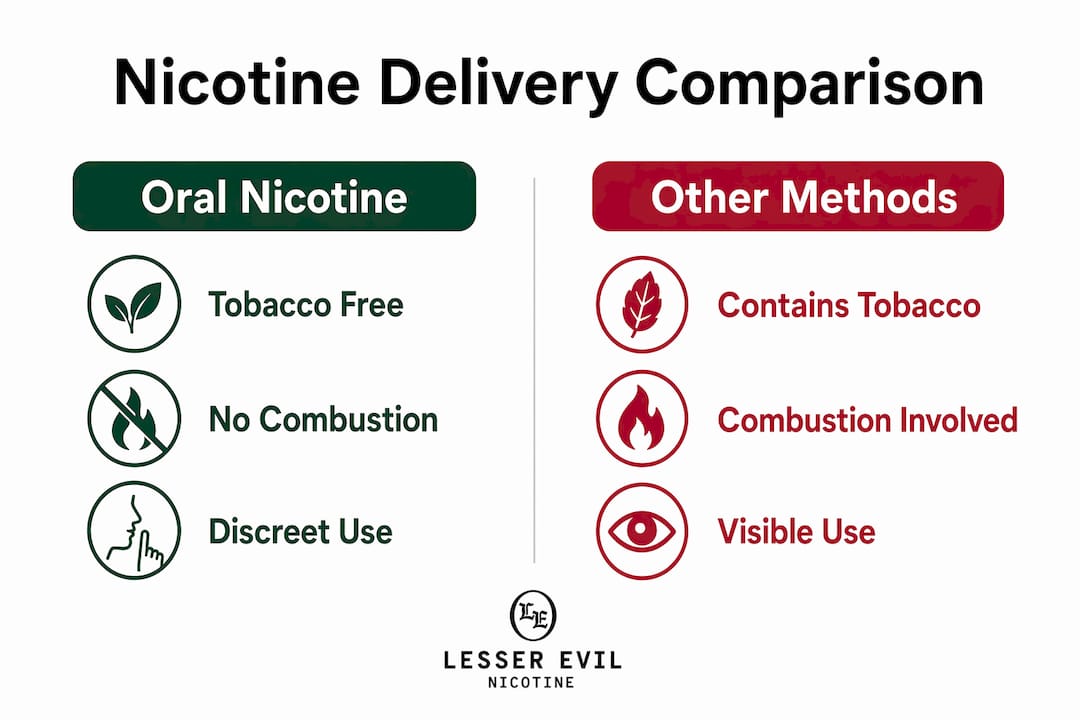
The tobacco-free and combustion-free nature of oral nicotine does remove some of the most serious risks associated with smoking. You aren’t inhaling combustion byproducts. That matters. But the addiction risk remains, and informed choice requires acknowledging both sides of that equation.
Pro Tip: If you’re considering a natural nicotine product switch from vaping or smoking, look at the ingredient list carefully. Top clean ingredient nicotine products use natural flavours and natural sweeteners rather than synthetic additives. That distinction matters for what you’re putting in your body every day.
How can professionals manage oral nicotine within workplace habits?
Managing the role of oral nicotine at work well comes down to intention. Using it reactively, without structure, is how dependency creeps in. Using it deliberately, within a defined routine, is how professionals get the focus benefits without the downsides.
Practical strategies that actually work:
- Set a daily limit before you start. Decide how many doses you’ll use that day and stick to it. This is the single most effective way to stay in control.
- Pair use with specific tasks. Use oral nicotine at the start of a deep work block, not during meetings or social time. This conditions your brain to associate it with focused output rather than general comfort.
- Keep it off the communal radar. Employees often keep usage confined to personal desks or breaks. That’s sensible. It avoids awkward HR conversations and keeps your habit your business.
- Complement it with other focus tools. Oral nicotine works alongside good sleep, structured breaks, and physical movement. It doesn’t replace them. Professionals who treat it as one tool among many tend to use less of it over time.
- Know when to step back. If you’re reaching for it out of anxiety rather than for focus, that’s a signal worth paying attention to. Switching to an oral nicotine format doesn’t automatically address the behavioural habit underneath the use. Complementary strategies matter.
For professionals who want to manage their nicotine use more actively, the guide on managing nicotine at work covers practical approaches beyond the product itself.
Key takeaways
Oral nicotine delivers real short-term cognitive benefits at work, but those benefits come with genuine addiction risk that requires deliberate, structured use to manage responsibly.
| Point | Details |
|---|---|
| Sublingual delivery is distinct | Oral nicotine absorbs via the oral mucosa with no combustion, smoke, or vapour involved. |
| Cognitive lift is real but limited | Nicotine stimulates attention and memory short-term; addiction risk rises with unstructured use. |
| Gum health is a genuine concern | Prolonged gum contact from pouches links to serious lesions; gel formats reduce this risk. |
| Workplace use is rising fast | Tech sector offices are actively stocking oral nicotine as a productivity tool for employees. |
| Structured use beats reactive use | Setting a daily limit and pairing use with focused tasks reduces dependency risk significantly. |
The stimulant shift no one’s quite ready to talk about
I’ve watched the stimulant conversation in professional culture evolve over the past decade, and oral nicotine is the most interesting development in it. Coffee became normalised so gradually that nobody noticed. Oral nicotine is moving faster, and the industry isn’t ready for the policy questions that follow.
What strikes me most is the honesty gap. Professionals who use oral nicotine at work often know exactly what they’re doing and why. They’re not confused about the risks. They’ve made a calculated trade-off, the same way someone decides to have a third coffee on a deadline day. The problem is that nicotine’s addiction profile is steeper than caffeine’s, and that calculation gets harder to make clearly once dependency sets in.
The natural ingredient angle is where I think the market is genuinely moving. The top clean ingredient nicotine products are pulling away from synthetic additives and artificial sweeteners, and that matters when you’re using something daily. Lesser Evil Nicotine’s approach, with natural flavours and natural sweeteners in a sublingual gel, reflects where thoughtful consumers are heading. Not because it makes nicotine safe, but because it removes unnecessary rubbish from the equation.
My honest view: oral nicotine at work is here to stay. The question isn’t whether professionals will use it. It’s whether they’ll use it with enough self-awareness to stay on the right side of the dependency line. That requires better information, not more moralising.
— Luke McLeod
Lesser Evil Nicotine: a cleaner option for the working day
If you’ve read this far, you’re probably already thinking about what you put in your body at work. Lesser Evil Nicotine was built for exactly that kind of thinking.

The Lesser Evil Oral Mister is a sublingual nicotine gel. Tobacco-free. Battery-free. No e-waste. It uses natural flavours and natural sweeteners, so you’re not adding synthetic junk to your daily routine. Available in Peppermint, Black Grape, and Green Apple, it’s discreet enough for desk use and designed for people who want control over their habit without the rubbish that usually comes with it. If you’re thinking about a natural nicotine product switch, this is worth a proper look.
FAQ
What is the role of oral nicotine at work?
Oral nicotine delivers nicotine via the oral mucosa without smoke or vapour, giving professionals a discreet stimulant option for focus during demanding tasks. Its role at work is primarily as a productivity tool, though it carries genuine addiction risk.
Does oral nicotine actually improve focus?
Nicotine stimulates nicotinic acetylcholine receptors and produces short-term improvements in attention and cognitive processing. The effect is real, but it comes with addiction potential that increases with unstructured or heavy use.
Is oral nicotine safer than smoking at work?
Oral nicotine removes combustion, tobacco, and vapour inhalation from the equation, which reduces exposure to many harmful byproducts. It is not harmless: nicotine remains addictive regardless of delivery method, and some formats carry oral health risks including gum lesions.
How do professionals use oral nicotine discreetly at work?
Most professionals keep use desk-bound and personal, avoiding communal or visible consumption to sidestep HR conversations. Sublingual gel formats are particularly discreet because they leave no smell and require no device.
What should I look for in a clean ingredient oral nicotine product?
Top clean ingredient nicotine products use natural flavours and natural sweeteners rather than synthetic additives. Tobacco-free and battery-free formats also reduce both health exposure and environmental impact compared to vaping or traditional pouches.