

Palatable nicotine for women: what it is and why it matters

TL;DR:
- Palatable nicotine products for women feature sweet flavors, smooth oral delivery, and discreet formats aligning with female habits and hormonal patterns.
- These products emphasize taste and experience over dose, addressing women’s unique sensory and behavioral preferences for stress relief and social cues.
Palatable nicotine for women is defined as nicotine delivery products formulated with sweetened flavours, smooth sensory profiles, and discreet formats that align with female behavioural and hormonal nicotine use patterns. The industry term for this category is “sensory-optimised nicotine,” and it sits at the intersection of flavour science and harm reduction. Most nicotine products on the market were built around male use patterns, which means the majority of women using them are working with tools that were never designed for them. That gap is exactly what makes palatability so relevant right now.
What is palatable nicotine for women, and how does it differ from standard products?
Palatable nicotine, in the context of female users, means products where taste, texture, and discretion do as much work as the nicotine itself. Standard nicotine products prioritise delivery speed and dose. Sensory-optimised products prioritise the full experience, because for women, that experience is the point.

Women’s nicotine use is more driven by stress relief, social cues, and sensory experience than by pharmacological reward alone. That is a meaningful distinction. It means a product that tastes harsh, smells chemical, or feels conspicuous is going to fail a female user even if the nicotine dose is technically correct.
The sensory bar for women is simply higher. Products that clear it tend to share three characteristics: a sweet or fruit-forward flavour profile, a smooth delivery method that does not irritate the mouth or throat, and a format discreet enough to use in a meeting or on a commute without drawing attention. Oral gels, mouth sprays, and low-dose pouches with natural sweeteners all fit this description. Products that burn, taste bitter, or require a device do not.
How do women’s nicotine preferences differ biologically and behaviourally?
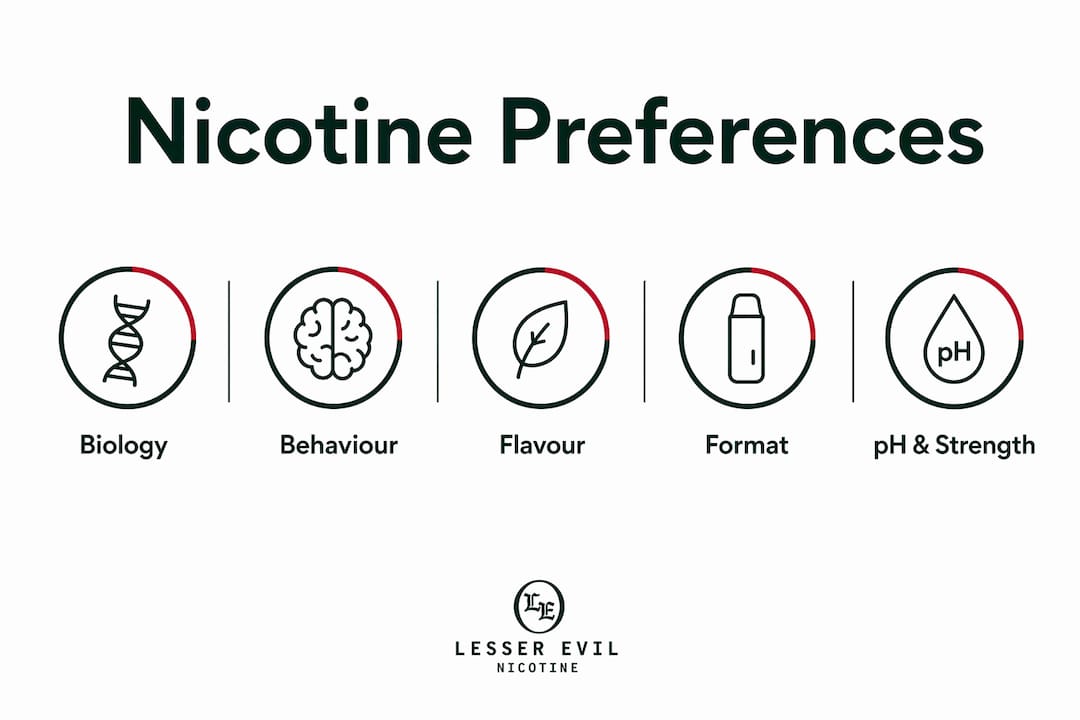
Biology plays a bigger role in nicotine preferences than most people realise. High estradiol levels in women are associated with greater nicotine use and more difficulty reducing it, while progesterone is linked to better outcomes when women do decide to cut back. These are not small effects. Sex steroid hormones actively modulate the behavioural reinforcement pathways that make nicotine feel rewarding.
What this means practically is that a woman’s relationship with nicotine shifts across her menstrual cycle. The urge to use, the satisfaction from using, and the ease of going without all fluctuate with hormonal changes. No standard nicotine product accounts for this. Understanding your own female nicotine habits is the first step toward choosing products that actually work for you.
Behaviourally, the picture is equally distinct. Women are more likely to reach for nicotine in response to stress, social situations, or emotional cues, rather than purely for the physical hit. The ritual matters. The smell matters. The taste matters. This is why shame-based approaches and cold turkey methods fail women disproportionately. The product has to meet the ritual, not fight it.
Key behavioural drivers for women include:
- Stress and mood regulation. Nicotine use in women is closely tied to emotional state, not just physical habit.
- Social context. Women are more likely to use nicotine in social settings and respond to social cues around use.
- Sensory experience. Taste, scent, and texture influence whether a product feels satisfying, regardless of nicotine dose.
- Discretion. Visible smoke, vapour, or a bulky device conflicts with how many women want to manage their habit.
Pro Tip: If you notice your nicotine use increases at certain points in the month, that is likely hormonal. Tracking it gives you real information to work with, rather than blaming willpower.
What flavour and format characteristics make nicotine palatable for women?
Sweetness is not a cosmetic feature in nicotine products for women. It is a core driver of appeal and satisfaction. Experimental studies show that female subjects demonstrate a marked preference for nicotine combined with sweeteners like sucrose and saccharin, while male subjects tend to favour spice or menthol profiles. This is a consistent finding across both animal models and national survey data.
The practical implication is that fruit-forward and sweet flavour profiles, such as green apple, black grape, or peppermint with a sweet finish, are not just more enjoyable for women. They are more likely to result in continued use and satisfaction. Sweet-flavoured nicotine products correlate with enhanced satisfaction and product loyalty in female users specifically.
How pH and nicotine strength affect the experience
The chemistry of a nicotine product has a direct impact on how it feels in the mouth. Research on nicotine pouches shows that moderate pH and moderate nicotine strength produce the highest appeal and sweetness ratings in female users. Push the pH too high or the nicotine concentration too strong, and palatability drops sharply. This non-linear effect is more pronounced in women than in men.
What this means for you as a consumer: a product that feels harsh or burns is not just unpleasant. It is chemically miscalibrated for female use. Lower nicotine strength with a balanced pH is not a compromise. It is the correct formulation.
Format matters as much as flavour
The delivery format shapes the entire experience. The most palatable options for women tend to share these characteristics:
- No combustion. Nothing is burned, so there is no smoke, no smell on clothes, and no lung exposure.
- No inhalation. Oral formats deliver nicotine through the mouth lining, not the airways.
- No visible device. Battery-free formats like oral gels and mouth sprays leave no hardware to carry or charge.
- Natural ingredients. Natural flavours and sweeteners rather than synthetic compounds.
Pro Tip: Start with the lowest available nicotine strength in your chosen format. You can always use more. Starting too strong makes the product feel harsh and puts you off a format that might otherwise suit you perfectly.
How do palatable nicotine products fit into women’s wellness and lifestyle goals?
Women who vape or smoke are not making irrational choices. They are managing stress, social situations, and ingrained rituals with the tools available to them. The problem is that most of those tools come with a significant cost: inhaled chemicals, visible vapour, device dependency, or battery waste. Palatable nicotine products in oral formats remove those costs without removing the ritual.
Oral nicotine products deliver nicotine without combustion and without inhalation. You are not breathing anything in. That is a factual difference from vaping or smoking, and it matters to women who are thinking carefully about what they put in their bodies.
The wellness alignment goes further than just avoiding inhalation. Products formulated with natural sweeteners and natural flavours, free from tobacco, and requiring no battery or device fit neatly into a lifestyle that values clean ingredients and low environmental impact. No e-waste. No cartridges. No charging cables. That is not a minor point for a generation that reads ingredient labels and thinks about sustainability.
Discretion is the other major lifestyle factor. A product you can use at your desk, in a restaurant, or between meetings without anyone noticing is a fundamentally different proposition from stepping outside for a vape. The social and professional freedom that comes with a truly discreet format is something women consistently report as a priority. Explore the full range of nicotine delivery formats to understand which options fit your daily routine.
What practical factors should women consider when choosing palatable nicotine products?
Choosing the right product comes down to matching the format and flavour to your actual use patterns, not to what sounds good in theory. Here is a practical framework:
-
Match nicotine strength to your current habit. Frequent vapers often find that standard oral products underdose them. Standard products were designed for cigarette smokers, not daily vapers, so the dose calibration is often wrong. Look for products that acknowledge this gap.
-
Start with your flavour instinct. If you already gravitate toward fruit or mint in food and drink, a sweet or fruit-forward nicotine product will feel natural. If you find sweet things cloying, a clean mint profile like peppermint is a better starting point.
-
Prioritise discretion for your main use context. Think about where you use nicotine most often. If it is at work or in social settings, a format with no visible output and no device is going to serve you better than something that requires a step outside.
-
Trial formats before committing. Palatability is personal. A flavour that works brilliantly for one person can feel wrong for another. Try small quantities of two or three options before settling on a regular product.
-
Account for hormonal fluctuation. If you notice your nicotine use or satisfaction levels shift across the month, that is worth tracking. Adjusting your approach around those patterns is more effective than ignoring them.
-
Avoid underdosing. Using a product that does not satisfy you leads to using more of it, or switching back to a less suitable option. Getting the dose right from the start matters.
Key takeaways
Palatable nicotine for women is defined by sweet flavours, smooth oral delivery, and discreet formats that match female hormonal and behavioural use patterns, not just nicotine dose.
| Point | Details |
|---|---|
| Biology shapes preference | Estradiol and progesterone actively influence nicotine satisfaction and use patterns in women. |
| Sweetness drives appeal | Female users consistently prefer sweet and fruit-forward flavour profiles over spice or menthol. |
| pH and strength matter | Moderate nicotine strength and balanced pH produce the highest palatability ratings in women. |
| Discretion is non-negotiable | Oral formats with no combustion, no vapour, and no device align with how women want to manage their habit. |
| Standard products often underdose | Products calibrated for cigarette smokers frequently fail frequent female vapers on dose and format. |
Why palatability is the wrong thing to overlook
I have spent a lot of time watching the nicotine category talk past the women it is supposedly serving. The conversation almost always defaults to dose, dependency, and willpower. It rarely gets to taste, ritual, or the simple fact that a product has to be genuinely pleasant to use if you are going to keep using it.
The research on this is not ambiguous. Women’s nicotine use is ritualistically and sensorially driven in ways that male-coded products simply do not address. The pouch category, in particular, has been built almost entirely around a male aesthetic and a male flavour profile. Harsh, strong, and packaged like a sports supplement. That is not a product failure for men. It is a category failure for women.
What I find genuinely interesting is that the solution is not complicated. Sweet flavours, smooth delivery, natural ingredients, and a discreet format. Those are not radical innovations. They are just the right design choices for the right audience. The fact that it has taken this long for the category to get there says more about who has been making the decisions than about what women actually want.
The other misconception worth naming is that palatability is somehow trivial, a nice-to-have rather than a core product requirement. It is not. A product that tastes good and feels right is a product you will actually use consistently. Consistency is what makes any nicotine management approach work. Palatability is not the cherry on top. It is the whole point.
— Luke McLeod
Lesser Evil Nicotine: built for exactly this
Lesser Evil Nicotine was designed around the woman that the rest of the nicotine category ignores. The oral gel is tobacco-free, battery-free, and formulated with natural flavours and natural sweeteners. It sits under the tongue and delivers nicotine through the oral mucosa. You do not breathe it in. There is no device, no vapour, and no e-waste.

Three flavours are available: Peppermint, Black Grape, and Green Apple. Each one was chosen to hit the sweet and fresh profiles that research consistently shows women prefer. The Lesser Evil Oral Mister is the place to start if you want a palatable, discreet nicotine option that was actually built with you in mind. A nicotine mouth spray is also coming. Lesser Evil Nicotine launches in the UK in 2026, placed in premium independent retail across London.
FAQ
What is palatable nicotine for women?
Palatable nicotine for women refers to nicotine products formulated with sweet flavours, smooth oral delivery, and discreet formats that match female hormonal and behavioural use patterns. The term covers oral gels, mouth sprays, and low-dose pouches with natural sweeteners, as distinct from harsh or tobacco-flavoured products.
Why do women prefer sweet-flavoured nicotine products?
Research shows female users consistently prefer nicotine combined with sweeteners like sucrose and saccharin, while male users tend to favour spice or menthol. This preference is linked to both hormonal biology and behavioural patterns around sensory experience.
Do oral nicotine products work differently from vaping?
Yes. Oral nicotine products deliver nicotine through the mouth lining rather than the lungs. You do not inhale anything, which means no vapour, no combustion, and no airway exposure. Nicotine absorption is slower than with cigarettes but reaches comparable levels.
Why do standard nicotine products often fail women who vape frequently?
Standard products were calibrated for cigarette smokers, not frequent vapers. Frequent female vapers report that the dose is too low and the format does not match their ritual, leading to poor satisfaction and a tendency to revert to vaping.
How does the menstrual cycle affect nicotine use in women?
High estradiol levels are associated with increased nicotine use and reduced ability to cut back, while progesterone is linked to easier reduction. This means nicotine satisfaction and urge to use can shift meaningfully across the month, which is worth tracking if you want to manage your habit more effectively.