

Synthetic nicotine risks: UK guide for oral gel users

TL;DR:
- Synthetic nicotine poses addiction and cardiovascular risks similar to tobacco nicotine, with added concerns about purity, potency, and long-term effects. Manufacturing opacity and labelling gaps increase the potential for contamination and inaccurate dosing, while early animal studies suggest biological differences from natural nicotine. Using oral nicotine products can reduce inhalation harms, but systemic risks remain, emphasizing the importance of transparent quality testing and cautious use.
Synthetic nicotine carries the same addiction and cardiovascular risks as tobacco-derived nicotine, plus additional unknowns around purity, potency, and long-term effects. The Connecticut Department of Public Health is direct: scientists have not yet established the long-term health impacts, and flavour ingredients have been shown to be harmful or toxic. Here are the risks that matter most right now:
- Addiction — synthetic nicotine is still nicotine, and just as habit-forming
- Cardiovascular effects — raised heart rate and blood pressure apply regardless of nicotine source
- Purity uncertainty — proprietary manufacturing means contaminants are not always disclosed
- Potency variance — racemic mixtures may behave differently from pure S-nicotine
- Labelling gaps — “tobacco-free” does not mean tested, safe, or accurately dosed
- No long-term human data — early studies are in rodents; human evidence is thin
Table of Contents
- What synthetic nicotine actually is, and why “tobacco-free” can mislead you
- Established health risks every nicotine user should know
- What early research says about synthetic nicotine specifically
- Manufacturing, purity, and labelling risks you need to understand
- How your route of use changes the risk picture
- Practical steps UK users can take to reduce risk
- The UK regulatory picture and where it’s heading
- About the author and what Lesser Evil Nicotine can responsibly say
- Key takeaways
- A pragmatic take on harm reduction and synthetic nicotine
- Lesser Evil Nicotine: a tobacco-free oral gel for UK adults
- Useful sources and further reading
What synthetic nicotine actually is, and why “tobacco-free” can mislead you
Synthetic nicotine (SyN) is produced in a laboratory from chemical precursors rather than extracted from tobacco leaves. The end molecule is still nicotine — same formula, same receptor activity — but the manufacturing route matters.
Tobacco-derived nicotine (TDN) is roughly 99.3% S-nicotine, the naturally occurring form. Synthetic versions range from fully racemic (50% S, 50% R) to near-identical stereospecific S-nicotine, depending on the process. R-nicotine is less well studied, and researchers flag that its pharmacological effects are not fully understood. Some manufacturers use petrochemical feedstocks and heavy-metal catalysts in synthesis, which introduces contamination risks that tobacco extraction does not.
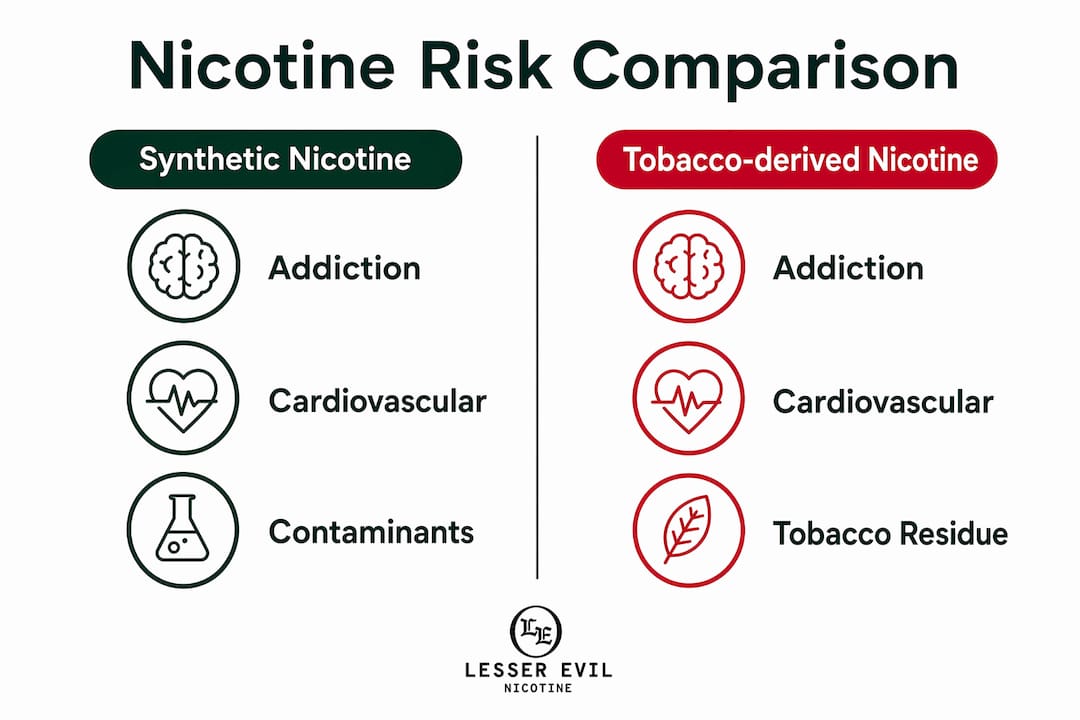
The “tobacco-free” label exploits a real consumer confusion. Absence of tobacco leaf does not mean absence of nicotine, contaminants, or risk.
Pro Tip: Ask any brand for a Certificate of Analysis (COA) that specifies enantiomeric purity (ideally ≥99% S-nicotine) and confirms third-party testing for heavy metals and residual solvents. If they can’t produce one, that tells you something.
Established health risks every nicotine user should know
These risks apply whether your nicotine came from a lab or a tobacco plant.
Nicotine is as addictive as heroin, cocaine, or alcohol according to research cited by public health authorities. Dependence develops quickly, and dose escalation is common without active management.
Systemically, nicotine raises heart rate and blood pressure, constricts blood vessels, and increases cardiovascular strain. For adults with existing heart conditions, that is not a trivial consideration. Brain development is also at risk for anyone under 25 — nicotine impairs memory, attention, and learning capacity in adolescents.
- Addiction and physical dependence
- Elevated heart rate and blood pressure
- Increased cardiovascular strain
- Impaired brain development in under-25s
- Potential harm from flavour ingredients, independent of nicotine source
One environmental note worth making: vaping devices generate significant e-waste through batteries and single-use hardware. Oral gels and pouches sidestep that entirely.
What early research says about synthetic nicotine specifically
This is where things get genuinely uncertain, and where you should pay attention.
Rodent studies show that synthetic and tobacco-derived nicotine produce different inflammatory responses in the lungs, including distinct changes in MMP-9, a protease linked to tissue damage. These are not identical substances in biological terms, even if the core molecule is the same.
Acellular assays also show that reactive oxygen species (ROS) generation varies by both nicotine type and flavour. Some synthetic nicotine flavour combinations generated more ROS than their tobacco-derived equivalents; others generated less. ROS drive oxidative stress, which is implicated in lung and cardiovascular disease.
Researchers warn that racemic or modified synthetic molecules could be more potent and have different pharmacodynamics than tobacco-derived S-nicotine — meaning prior nicotine safety assumptions may not fully apply to all synthetic variants.
The critical caveat: these are animal and lab-bench studies. They do not map directly onto long-term human risk. No large-scale human trials on synthetic nicotine health outcomes exist yet. That absence of evidence is itself the problem.
Manufacturing, purity, and labelling risks you need to understand
The lack of standardised, transparent manufacturing is the central consumer safety gap. Manufacturers are not required to disclose their synthesis routes, which makes independent quality assurance difficult.
Independent analyses have detected lead and arsenic in both synthetic and tobacco-derived nicotine samples. Synthetic routes that use heavy-metal catalysts are a plausible source. Absence of tobacco-specific nitrosamines in synthetic samples does not guarantee absence of other synthesis-derived impurities.

Then there are nicotine analogs. Some modified molecules bind more strongly to nicotinic receptors than standard nicotine, may be more potent in animal models, and can fall outside existing regulatory definitions. Independent lab work has found discrepancies between labelled and actual content in some analog-containing products.
What to look for on a COA or product label:
- Enantiomeric purity stated (target: ≥99% S-nicotine)
- Heavy metal testing results (lead, arsenic at minimum)
- Residual solvent screen
- Third-party laboratory name and accreditation (ISO or GLP standard)
- Batch number traceable to the test report
- No undisclosed “nicotine analog” ingredients
Pro Tip: Check whether the formulation and testing details are publicly available before you buy. A brand that publishes COAs is making a verifiable claim; one that doesn’t is asking you to trust marketing copy.
How your route of use changes the risk picture
If you’re using an oral gel rather than a vape, several inhalation-specific risks simply don’t apply to you. E-cigarette aerosols contain formaldehyde, acetaldehyde, acrolein, and ROS generated by heating. None of that happens when nicotine is absorbed via the oral mucosa.
That said, systemic nicotine risks — addiction, cardiovascular effects — remain fully present regardless of delivery route. The oral vs inhalation comparison is about what you avoid, not what you eliminate.
| Risk dimension | Oral gel / pouch | Vaping (inhalation) |
|---|---|---|
| Respiratory exposure | None | Direct aerosol exposure |
| Dose control | Moderate to good | Variable by device |
| Cardiovascular risk | Present | Present |
| Flavour-driven ROS | Not inhaled | Inhaled directly |
| E-waste | None (battery-free) | Significant |
| Lung inflammation risk | Not applicable | Documented in studies |
For oral users, the practical actions are:
- Stay aware of your dose per session and per day
- Verify COAs before committing to a brand
- Avoid use during pregnancy
- Do not use if under 18
Practical steps UK users can take to reduce risk
You can’t eliminate nicotine risk, but you can make smarter choices about what you put in your body and who you buy from.
- Verify COAs: request or find published third-party lab results before purchasing
- Check for stereospecific S-nicotine claims backed by chiral purity data
- Avoid products that list “nicotine analog” without specifying the compound
- Prefer brands that name their testing laboratory and provide batch-traceable results
- Report any adverse effects via the MHRA Yellow Card scheme — collect the product name, batch number, and a description of symptoms before you report
- Pregnant people and adolescents should avoid all nicotine products; NHS guidance is the relevant reference for your situation
The MHRA Yellow Card system is the UK’s official route for reporting suspected adverse reactions to any product, including nicotine-containing consumer goods. Using it matters: it builds the evidence base that regulators need to act.
The UK regulatory picture and where it’s heading
The UK currently regulates nicotine-containing products under a framework that distinguishes between licensed medicines (such as NRT patches and gum), tobacco products, and consumer nicotine products such as pouches and oral gels. Synthetic nicotine products that are not tobacco-derived sit in a category that has seen rapid regulatory evolution globally, partly because vendors initially used synthetic nicotine to sidestep tobacco product rules.
In the UK, the MHRA and the Office for Health Improvements and Disparities (OHID) are the key bodies to watch. The UK regulatory framework for nicotine products is evolving, and guidance on novel oral products is likely to tighten as evidence accumulates.
- MHRA oversees medicines; consumer nicotine products fall under Trading Standards and OHID
- Labelling rules for non-tobacco nicotine products are less prescriptive than for tobacco products
- Regulatory definitions may shift as synthetic and analog products proliferate
- Watch for OHID and MHRA updates on novel oral nicotine product categories
About the author and what Lesser Evil Nicotine can responsibly say
Luke McLeod writes about oral nicotine products, harm reduction, and UK consumer guidance for Lesser Evil Nicotine. His guides cover non-inhalation nicotine methods and practical product choices for adult users.
Disclosure: Lesser Evil Nicotine is a consumer brand preparing a UK launch of oral gel products in 2026. It is not a medicine, not a licensed NRT, and makes no health claims. The information in this article is general guidance, not medical advice. Confirm your own situation with the MHRA, NHS, or a qualified health professional.
Lesser Evil Nicotine publishes Certificates of Analysis for its products, uses third-party laboratory testing, and directs users to the MHRA Yellow Card scheme for reporting adverse events. These are the transparency standards we hold ourselves to — and the ones worth demanding from any brand you consider.
Key takeaways
Synthetic nicotine carries the same core addiction and cardiovascular risks as tobacco-derived nicotine, with additional uncertainty around purity, potency, and long-term effects that only transparent third-party testing can partially address.
| Point | Details |
|---|---|
| Addiction risk is unchanged | Synthetic nicotine is still nicotine — equally habit-forming regardless of its source. |
| Purity is not guaranteed | Heavy metals and analog impurities have been detected; always request a third-party COA. |
| Oral use avoids inhalation harms | Oral gels bypass respiratory exposure, but systemic nicotine risks remain fully present. |
| Report problems to MHRA | Use the Yellow Card scheme with product name, batch number, and symptom details. |
| Lesser Evil Nicotine | Publishes COAs, uses third-party lab testing, and is tobacco-free, battery-free, and natural-flavoured. |
A pragmatic take on harm reduction and synthetic nicotine
The conversation around synthetic nicotine tends to go one of two ways: either it’s marketed as the clean, pure alternative, or it’s treated as uniquely dangerous. Neither framing is quite right.
What the evidence actually shows is more nuanced. Synthetic nicotine is not inherently more dangerous than tobacco-derived nicotine, but it is not inherently safer either. The risks that matter most — addiction, cardiovascular strain, potency uncertainty — are present in both. What differs is the manufacturing opacity and the near-total absence of long-term human data.
For adult vapers making a pragmatic switch to oral products, the relevant question is not “is synthetic nicotine safe?” It’s “is this specific product from this specific brand made transparently, tested independently, and dosed accurately?” That’s a question a COA can partially answer. Marketing copy cannot.
The harm-reduction case for oral nicotine products rests on what you stop doing — breathing heated aerosols, inhaling flavour chemicals, generating e-waste — not on any claim that nicotine itself is harmless. Anyone selling you that story is selling you something else entirely.
Lesser Evil Nicotine: a tobacco-free oral gel for UK adults
No vapour. No battery. No rubbish in your body that you don’t need.
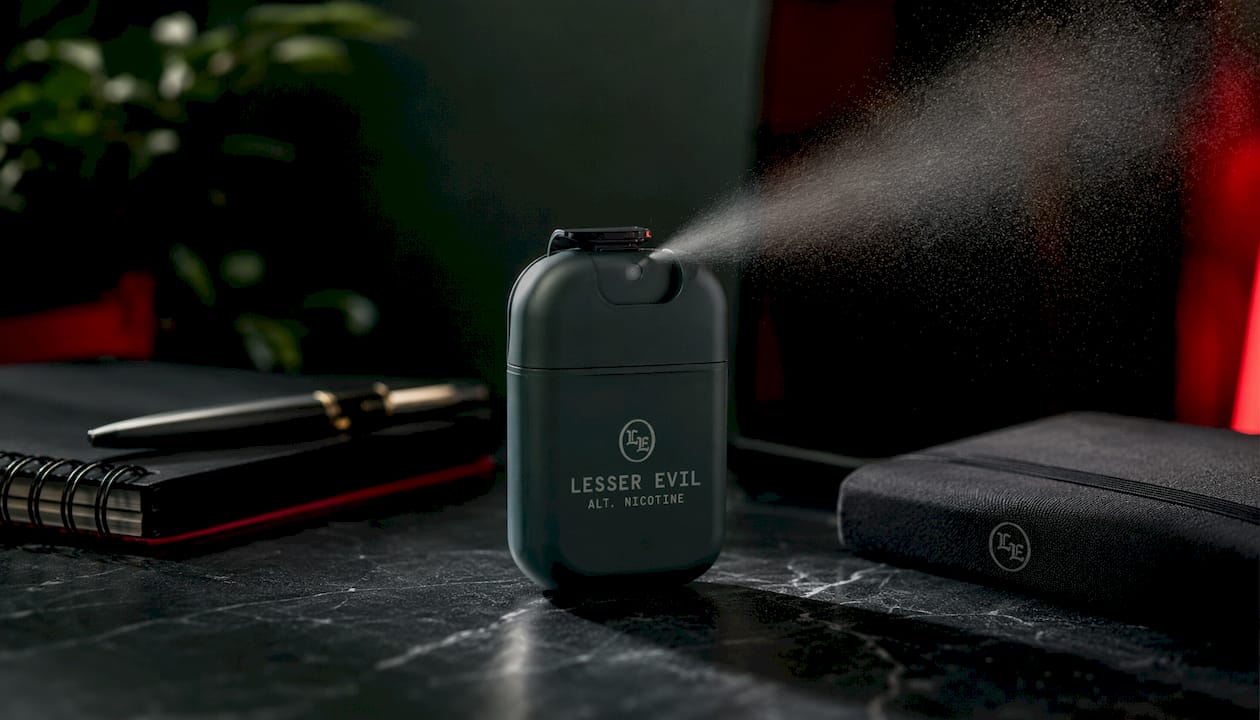
The Lesser Evil Oral Mister is a sublingual nicotine gel — applied under the tongue, absorbed via the oral mucosa — that is tobacco-free, battery-free, and formulated with natural flavours and natural sweeteners. Available in Peppermint, Black Grape, and Green Apple, with a nicotine mouth spray also in development for the UK market.
It is not an NRT. It is not a medicine. It makes no health claims. It’s a consumer product for adults who want to use something instead of vaping or smoking, without the heated aerosols, the e-waste, or the synthetic junk. Lesser Evil Nicotine publishes COAs and uses third-party lab testing — because that’s the minimum standard worth holding any brand to.
UK launch is 2026. Find out more and register your interest at lesserevil.store.
Useful sources and further reading
- Connecticut Department of Public Health: Synthetic Nicotine Fact Sheet — plain-language overview of synthetic nicotine risks, youth concerns, and labelling issues
- Tobacco Control: Synthetic nicotine has arrived — peer-reviewed analysis of regulatory history, stereoisomer issues, and manufacturing routes
- PubMed: Tobacco-derived and tobacco-free nicotine cause differential inflammatory cell influx and MMP-9 in mouse lung — rodent study on biological differences between nicotine types
- PMC: Differences in acellular ROS generation by e-cigarettes containing synthetic and tobacco-derived nicotine — lab findings on oxidative stress by flavour and nicotine source
- PMC: Independent analyses of nicotine contaminants and metals — heavy metal detection in synthetic and tobacco-derived nicotine samples
- Scientific American: Nicotine analogs pose possible health risks yet evade regulation — accessible overview of analog risks and regulatory gaps
- MHRA Yellow Card — UK’s official adverse event reporting system; use this if you experience unexpected effects from any nicotine product
- NHS: Nicotine and health — NHS guidance on nicotine, smoking, and health for UK adults; relevant for pregnancy and under-18 cautions
- PouchSupply.eu: Snus vs vape — a comparison of two popular nicotine alternatives — industry perspective on non-inhalation product categories