

The role of formulation in nicotine products: 2026 guide

TL;DR:
- Nicotine product formulation combines nicotine form, excipients, flavour, and pH to control delivery and sensory experience. Proper formulation affects absorption, comfort, flavour duration, and regulatory classification, with premium products using multi-layer flavour systems for 20-40 minutes of taste. Poor formulation can cause irritation, rapid flavour fade, and inconsistent effects, impacting consumer satisfaction and market success.
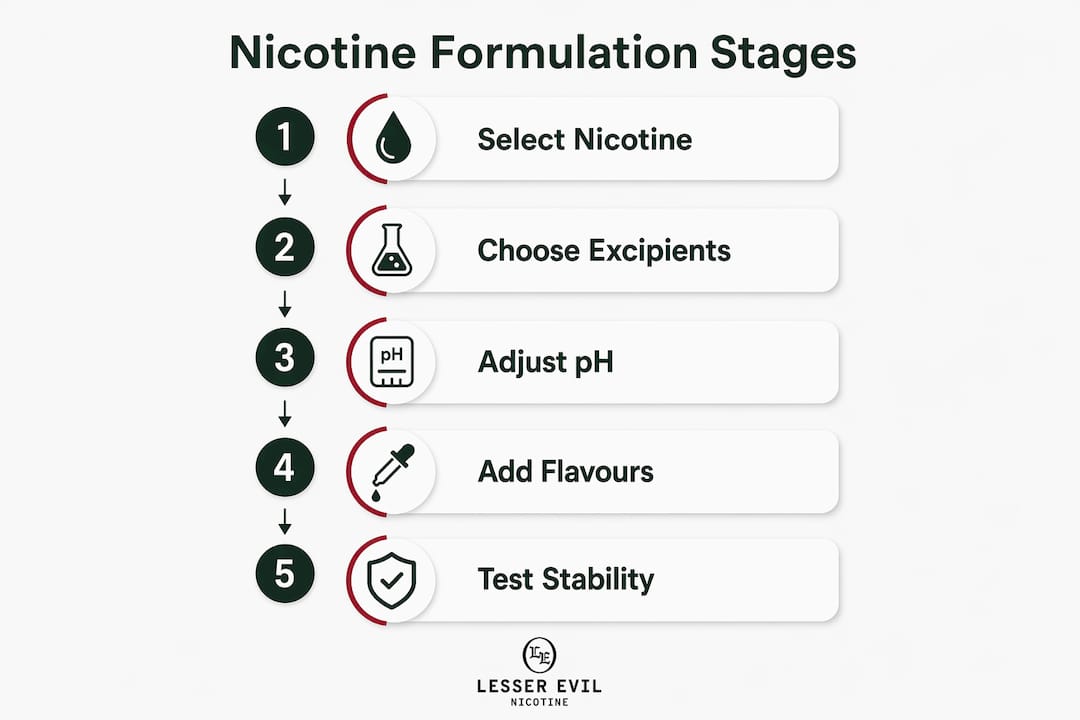
Nicotine product formulation is defined as the precise combination of nicotine form, excipients, flavour systems, and pH modifiers that together control how nicotine is delivered, how a product feels in the mouth, and how long the experience lasts. The role of formulation in nicotine products goes well beyond mixing ingredients. It determines pharmacokinetic outcomes like AUC (total nicotine absorbed), Cmax (peak concentration), and Tmax (time to peak), all of which shape whether a product actually satisfies. Modern modelling now integrates dissolution data and dynamic pH profiles to forecast these metrics without relying solely on clinical trials. If you’ve ever used a nicotine product that tasted harsh, faded too quickly, or just felt wrong, that’s a formulation problem. Getting it right is what separates a product people reach for again from one they bin after a week.
What is the role of formulation in nicotine products?
Formulation is the engine under the bonnet of any nicotine product. It controls not just how much nicotine reaches your bloodstream, but how fast, how smoothly, and with what sensory experience attached.
The two primary nicotine forms are freebase nicotine and nicotine salts. Freebase nicotine sits at a higher pH, which makes it absorb quickly but also creates a sharp, harsh sensation at higher doses. Nicotine salts lower the pH by pairing nicotine with an organic acid, which reduces harshness and allows for a smoother, more gradual release. That’s why salt-based formats have become the standard for oral nicotine products aimed at people who want a consistent, comfortable experience rather than an intense hit.
Excipients are the supporting cast. They include:
- Fillers (such as microcrystalline cellulose) that give the product structure and bulk
- Humectants (such as propylene glycol or glycerol) that retain moisture and influence mouthfeel
- Buffering agents that adjust pH to optimise both absorption and comfort
- Ion-exchange resins that bind nicotine and release it gradually as saliva interacts with the product
Each of these components affects the final sensory experience. A poorly chosen humectant can make a product feel slimy. An incorrect buffer can make it sting. The oral nicotine delivery mechanism depends on all these variables working together.
Pro Tip: If a nicotine product burns or irritates your gum, the pH is likely too high. That’s a buffering failure, not a nicotine strength problem.
How does flavour formulation affect palatability?
Flavour is not decoration. Nicotine actively modifies how flavour is perceived, which means you cannot develop a flavour system in isolation from the nicotine formulation itself. Nicotine suppresses delicate flavours and alters cooling and throat feel, particularly at higher strengths. A flavour that tastes balanced at 4mg can taste flat or chemical at 10mg.

The role of formulation palatability in nicotine products is therefore a calibration exercise. Flavour developers must account for the specific nicotine salt used, the pH of the matrix, and the presence of cooling agents like menthol or WS-3. These interactions are not always predictable, which is why the best formulations are built with nicotine and flavour developed simultaneously rather than sequentially.
Premium manufacturers target a flavour duration of 20–40 minutes using multi-layer flavour systems. These systems combine an immediate-release layer for the first burst of taste with a sustained-release layer that maintains the profile throughout use. Failing to hit that window is considered a formulation failure, not a flavour failure.
Here’s how flavour strategy typically maps to nicotine strength:
- Low strength (2–4mg): Nuanced profiles work well. Fruit, botanical, and light citrus notes can come through cleanly because nicotine interference is minimal.
- Moderate strength (6–8mg): Flavour needs more intensity to hold its own. Tropical blends and sharper fruit profiles tend to perform better.
- High strength (10mg+): Strong profiles like mint or coffee dominate this segment because they are robust enough to cut through nicotine’s sensory interference.
- Very high strength (15mg+): Flavour options narrow significantly. Most products in this segment rely on menthol or intense mint because almost nothing else survives the interaction.
Lesser Evil Nicotine’s approach with its oral nicotine gel uses natural flavours in Peppermint, Black Grape, and Green Apple. The gel matrix delivers nicotine via the oral mucosa, which changes the flavour interaction profile compared to a pouch sitting against the gum.
Pro Tip: If you find that a nicotine product tastes great for the first two minutes then goes flat, that’s a single-layer flavour system. Look for products that explicitly use multi-layer or sustained-release flavour technology.
What are the technological and regulatory challenges in nicotine formulation?
Getting a formulation right in the lab is one thing. Making it work at commercial scale, consistently, across thousands of batches, is another problem entirely. Lab success does not guarantee commercial success. Flavour dispersion, batch repeatability, and compatibility with pH modifiers all become harder to control as production volume increases.
The standard production sequence for oral nicotine products follows this order:
- Dry blending: Filler, nicotine, and pH adjusters are combined first to achieve even distribution before any liquids are introduced
- Humectant addition: Moisture-retaining agents are blended in to achieve the target water activity and mouthfeel
- Flavour incorporation: Flavour is added last in the wet phase to minimise volatilisation and preserve aromatic integrity
- Forming and packaging: The matrix is shaped (pouch, gel, or other format) and sealed under controlled conditions to protect shelf stability
Manufacturers must design formulations to support stability and regulatory compliance throughout this entire sequence, not just at the point of consumption.
The regulatory dimension adds another layer of complexity. Formulation choices affect classification under consumer product or medicinal frameworks, depending on the nicotine form and acid selected. Different nicotine salts carry different thermal stability profiles and impurity risks, which directly influence regulatory status. A product that uses a nicotine salt with poor thermal stability may generate impurities during manufacturing that trigger medicinal classification requirements. That’s not a minor paperwork issue. It can determine whether a product reaches the market at all.
For anyone wanting to understand how UK rules apply to these products, the nicotine regulation UK guide covers the current framework in plain language.
| Formulation factor | Consumer product impact | Regulatory implication |
|---|---|---|
| Nicotine salt type | Affects harshness and absorption rate | Influences impurity profile and classification |
| pH / buffering system | Controls comfort and bioavailability | Must be documented for compliance submissions |
| Flavour system | Determines palatability and duration | Ingredient safety data required per jurisdiction |
| Humectant selection | Affects mouthfeel and shelf stability | Approved ingredient lists vary by market |
What should consumers and manufacturers look for in nicotine product formulation?
Formulation quality is not always visible on a label, but there are markers worth knowing. For consumers, the sensory experience tells most of the story. A well-formulated product should feel comfortable from the first moment, maintain its flavour for the duration of use, and deliver a consistent effect without burning or stinging.
Here is what to look for when assessing a nicotine product’s formulation quality:
- Absence of irritation: Burning or stinging at the gum line signals a pH problem. A properly buffered product should feel neutral in the mouth.
- Flavour longevity: A product that tastes good for the full 20–40 minute window has a multi-layer flavour system. One that fades in five minutes does not.
- Consistent effect: If the nicotine hit varies significantly between uses of the same product, batch consistency is poor.
- Natural ingredients: Products using natural flavours and sweeteners avoid the synthetic aftertaste that many people find off-putting in standard pouches.
- Delivery format: Oral nicotine formats that absorb via the oral mucosa rather than requiring inhalation remove the lung from the equation entirely.
For manufacturers, the strategic relationship between nicotine concentration and flavour intensity is the central design challenge. Nicotine concentration shapes flavour strategy and market segmentation simultaneously. A brand that wants to serve both low-strength and high-strength users cannot use the same flavour system across the range. Each strength tier needs its own calibrated flavour profile.
Emerging formats in 2026 include oral nicotine gels and nicotine mouth sprays. These formats change the delivery geometry entirely. A sublingual gel, for example, sits under the tongue and absorbs directly through the oral mucosa, which alters both the Tmax and the flavour interaction compared to a pouch pressed against the cheek. The importance of nicotine product design in these newer formats is even greater because there is no established consumer reference point. The product has to be right from day one.
Pro Tip: When comparing nicotine products, ignore the marketing and read the ingredient list. Natural sweeteners, named flavour compounds, and a listed pH modifier are signs of a formulated product. “Flavouring” as the only descriptor is a sign of a cheap one.
Key takeaways
Formulation is the single most important variable in nicotine product performance, determining delivery speed, sensory comfort, flavour longevity, and regulatory classification.
| Point | Details |
|---|---|
| Nicotine form matters | Nicotine salts reduce harshness and improve absorption consistency compared to freebase nicotine. |
| Flavour and nicotine must be co-developed | Nicotine suppresses delicate flavours, so calibrating both together is the only way to achieve a balanced product. |
| Multi-layer flavour systems are the standard | Premium products target 20–40 minutes of flavour duration using immediate and sustained-release layers. |
| Regulatory classification depends on formulation | The choice of nicotine salt and acid directly influences whether a product is classified as a consumer good or a medicine. |
| Sensory experience signals formulation quality | Irritation, rapid flavour fade, and inconsistent effect are all formulation failures, not user errors. |
Why formulation is the conversation the nicotine industry keeps avoiding
I’ve spent time looking at how nicotine products are built, and the thing that strikes me most is how rarely formulation gets discussed honestly with consumers. The industry talks about flavours and strengths constantly. It almost never talks about pH, excipients, or why one product burns and another doesn’t.
The people most affected by poor formulation are the ones who’ve already decided they want to move away from smoking or vaping. They pick up a nicotine product, it stings or tastes wrong, and they go back to what they know. That’s a formulation failure with real consequences.
What I find genuinely interesting about where the market is heading in 2026 is the move toward formats that don’t just replicate the pouch experience with better flavours. Oral gels and sprays are asking a different question: what if the delivery format itself was designed around comfort and discretion from the ground up, rather than adapted from tobacco-era formats? That’s where the most interesting formulation work is happening.
The brands getting this right are the ones treating nicotine and flavour as a single design problem, not two separate departments. Lesser Evil Nicotine’s approach with its sublingual gel format is a good example of that thinking applied to a real product. Whether it’s gel, spray, or something else, the principle is the same: formulation is not a back-end manufacturing detail. It’s the product.
— Luke McLeod
Lesser Evil Nicotine: formulation built for real life
Lesser Evil Nicotine’s Oral Mister is a sublingual nicotine gel that absorbs through the oral mucosa. You don’t breathe it in. There’s no battery, no vapour, and no e-waste. The formulation uses natural flavours and natural sweeteners across three options: Peppermint, Black Grape, and Green Apple.

The gel format changes the sensory experience compared to a standard pouch. Because it sits under the tongue rather than against the gum, it avoids the gum irritation that poorly buffered pouches cause. The types of nicotine products available in 2026 are more varied than ever, but few are built with this level of formulation attention. If you’re looking for a discreet, tobacco-free option that doesn’t ask you to breathe anything in, the Lesser Evil Oral Mister is worth a look.
FAQ
What does nicotine product formulation actually mean?
Nicotine product formulation is the combination of nicotine form, excipients, pH modifiers, and flavour systems that together control how nicotine is absorbed, how the product feels, and how long it lasts.
Why do some nicotine products burn or sting?
Burning or stinging is caused by a pH that is too high, which is a buffering failure in the formulation. A properly buffered product should feel neutral against the oral mucosa.
What is the difference between freebase nicotine and nicotine salts?
Freebase nicotine absorbs quickly but feels harsh at higher doses. Nicotine salts pair nicotine with an organic acid to lower pH, which reduces harshness and creates a smoother, more gradual release.
How long should a nicotine product’s flavour last?
Premium oral nicotine products target a flavour duration of 20–40 minutes using multi-layer flavour systems. A product that fades in under five minutes is using a single-layer system.
Does formulation affect whether a nicotine product is regulated as a medicine?
Yes. Formulation choices influence regulatory classification based on the nicotine salt and acid selected, their thermal stability, and the resulting impurity profile. Getting this wrong can shift a product from consumer goods regulation into medicinal frameworks.