

Non-inhalation nicotine methods explained: 2026 guide

TL;DR:
- Non-inhalation nicotine methods deliver nicotine through the mouth’s mucosa instead of the lungs. They provide a slower, steadier absorption and eliminate harmful combustion toxins, offering a less risky alternative to smoking or vaping.
A non-inhalation nicotine method is any delivery system that gets nicotine into your bloodstream without you breathing anything in. No smoke, no vapour, no lung exposure. Instead, nicotine absorbs through the oral mucosa, the soft tissue lining your mouth, and passes directly into the bloodstream. Products in this category include oral pouches, nicotine gum, lozenges, and mouth sprays. If you’re researching what is non-inhalation nicotine method and whether it’s a realistic alternative to smoking or vaping, this guide covers the science, the products, and the practical reality of switching.
What is a non-inhalation nicotine method and how does it work?
A non-inhalation nicotine method delivers nicotine via the oral mucosa rather than the lungs. The key mechanism is buccal absorption: nicotine passes through the thin membrane lining the cheeks, gums, and under the tongue, then enters the bloodstream directly. This bypasses the respiratory system entirely, which means no combustion byproducts, no tar, and no carbon monoxide reaching your airways.

The industry term for this category is “non-combustible oral nicotine delivery.” It sits apart from both traditional tobacco products and conventional nicotine replacement therapies (NRTs) like patches. The defining characteristic is that absorption happens in the mouth, not the chest.
Understanding this distinction matters. Smoking delivers nicotine by burning tobacco and inhaling the resulting smoke. Vaping heats liquid and you inhale the vapour. Both routes send nicotine through your lungs first. Non-inhalation methods skip that step entirely, which changes both the speed of delivery and the risk profile of what enters your body.
What types of non-inhalation nicotine products are available?
The non-smoking nicotine options on the market fall into a few clear categories, each with a slightly different mechanism and user experience.
- Oral nicotine pouches: Small pouches placed between the gum and upper lip. They contain synthetic or tobacco-derived nicotine, plant fibres, pH stabilisers, and flavourings. No tobacco leaf, no combustion, no tar or carbon monoxide. Nicotine releases gradually as saliva activates the pouch.
- Nicotine gum: A polacrilex resin binds nicotine and releases it as you chew. The nicotine absorbs through the buccal mucosa when you “park” the gum between your cheek and gum rather than chewing continuously.
- Nicotine lozenges: Dissolve slowly in the mouth, releasing nicotine for buccal absorption. Straightforward to use, though the slower dissolution means a gentler onset.
- Oral nicotine mouth sprays: Sprayed directly onto the oral mucosa for faster absorption than pouches or gum. The fine mist coats the soft tissue and nicotine enters the bloodstream quickly relative to other oral formats.
- Sublingual nicotine gels: Applied under the tongue, where the mucosa is particularly thin and permeable. Lesser Evil Nicotine’s patent-pending formulation uses this route, delivering nicotine via a tobacco-free gel with natural flavours and natural sweeteners.
What all these formats share is the absence of combustion-related toxins. Oral pouches eliminate the tar and carbon monoxide produced by burning tobacco, which are among the most harmful components of cigarette smoke.
Pro Tip: Place a pouch or gel under your upper lip or tongue and leave it still for the first few minutes. Movement and excessive saliva production can reduce how much nicotine actually absorbs through the mucosa.
How does absorption speed compare to smoking or vaping?
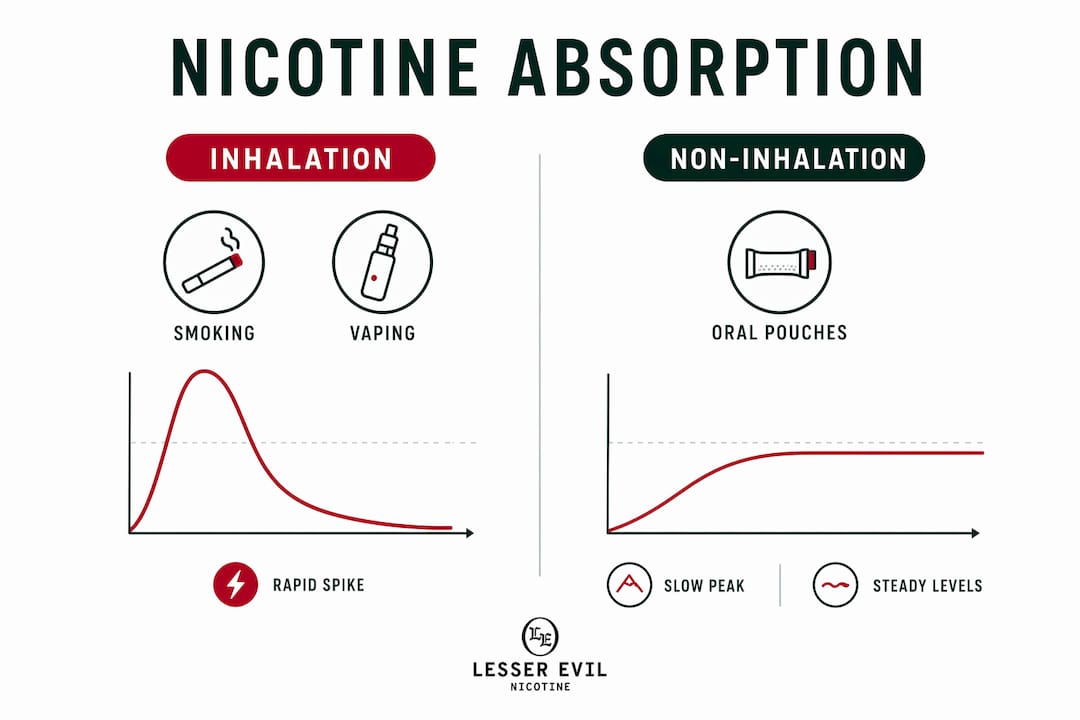
This is where non-inhalation nicotine delivery systems differ most noticeably from smoking. The experience feels different because the pharmacokinetics are genuinely different.
Blood nicotine levels peak at 15–65 minutes with oral pouches, compared to roughly 7–9 minutes with cigarettes. That is a meaningful gap. It means you won’t feel the same rapid “hit” you get from inhaling, and that’s not a flaw in the product. It’s the method working as intended.
The table below summarises how the main delivery methods compare on absorption speed and nicotine profile.
| Delivery method | Peak nicotine time | Nicotine spike profile |
|---|---|---|
| Cigarette | 7–9 minutes | Sharp, rapid spike |
| Oral nicotine pouch | 15–65 minutes | Gradual, steadier rise |
| Nicotine gum | 30–60 minutes | Moderate, controlled |
| Nicotine lozenge | 30–60 minutes | Moderate, controlled |
| Sublingual gel | Faster than gum | Moderate, relatively quick |
Steadier plasma nicotine levels are actually a feature for people who find the peaks and crashes of smoking disruptive. Physiologically based pharmacokinetic models confirm that buccal tissue permeation produces a flatter, more sustained nicotine curve than inhalation. That curve matches clinical data from real-world pouch users.
There are two absorption pathways at play. Nicotine absorbed directly through the buccal mucosa enters the bloodstream without passing through the liver first. Nicotine that gets swallowed with saliva goes through gastrointestinal absorption and first-pass liver metabolism, which reduces its bioavailability. This is why technique matters: keeping the product still in your mouth maximises the direct buccal route.
Oral pH also plays a role. Acidic conditions in the mouth, from coffee, fizzy drinks, or citrus, reduce how efficiently nicotine crosses the mucosa. Low oral pH slows buccal absorption noticeably. Avoiding food and acidic drinks for 15 minutes before use makes a real difference to how much nicotine you actually absorb.
Pro Tip: Skip the coffee or orange juice for 15 minutes before using any oral nicotine product. Acidic drinks lower your oral pH and reduce how well nicotine absorbs through the mucosa.
What do regulators and scientists say about non-inhalation nicotine?
The regulatory picture for non-inhalation nicotine alternatives has become clearer in recent years. The FDA recognises non-combustible oral nicotine pouches as having harm reduction potential for adults who currently smoke or vape, specifically because they lack combustion byproducts. That is a meaningful position from the world’s most scrutinised medicines regulator.
The scientific consensus broadly aligns with that view. The key points are:
- No combustion toxins: Oral nicotine products produce no tar, no carbon monoxide, and no combustion-related carcinogens. These are the chemicals most associated with smoking-related disease.
- No aerosol inhalation: Unlike vaping, oral methods produce nothing you breathe in. Your lungs are not involved in the delivery process.
- Nicotine remains addictive: Regulators and researchers are consistent on this point. Nicotine is addictive regardless of how it’s delivered. Non-inhalation methods avoid combustion carcinogens but still deliver addictive nicotine.
- Long-term data is limited: Oral nicotine pouches are relatively new. Regulators note that long-term safety data is still accumulating, particularly for newer synthetic nicotine formats.
- Distinct from tobacco products: Tobacco-free oral nicotine products are regulated differently from cigarettes and smokeless tobacco in most jurisdictions. In the UK, the regulatory framework for these products is evolving. The UK nicotine regulation landscape is worth understanding if you’re making decisions about which products to use.
The honest summary: non-inhalation methods remove the most harmful aspects of nicotine delivery, but they are not risk-free. Nicotine is still nicotine.
How do you use non-inhalation nicotine products effectively?
Getting the most from any oral nicotine delivery system comes down to technique and managing your expectations about onset time. The experience is genuinely different from smoking or vaping, and that takes some adjustment.
Practical do’s and don’ts for first-time users
Do:
- Place the product under your upper lip, between your cheek and gum, or under your tongue depending on the format.
- Leave it still. Excessive movement reduces buccal contact and absorption.
- Wait 15 minutes after eating or drinking before use, especially after acidic drinks.
- Give it 20–30 minutes before deciding whether you need another dose. Slower nicotine delivery means the effect builds gradually.
- Start with a lower-strength product if you’re new to oral nicotine formats.
Don’t:
- Chew or suck on pouches or gels to try to speed up the effect. It doesn’t work that way and can cause irritation.
- Use multiple products simultaneously to chase a faster hit. That’s how you overshoot your intended dose.
- Expect the same rapid onset as a cigarette. The slower curve is the point, not a problem.
- Use immediately after coffee, juice, or a meal. Acidic oral conditions reduce absorption.
The biggest adjustment for people switching from smoking is the absence of that rapid spike. Many people initially perceive oral nicotine as weaker because the hit isn’t instant. It isn’t weaker. The nicotine levels oral pouches deliver are actually closer to cigarettes than traditional NRT formats like gum or lozenges. The difference is timing, not quantity.
Steady nicotine levels have a practical upside. You’re less likely to experience the sharp peaks and crashes that drive the urge to reach for another cigarette. The oral nicotine benefits of a flatter curve include fewer sudden urges and a more manageable overall experience.
Key takeaways
Non-inhalation nicotine methods deliver nicotine through the oral mucosa, bypassing the lungs entirely and removing combustion toxins from the equation.
| Point | Details |
|---|---|
| Core mechanism | Nicotine absorbs through the buccal mucosa, not the lungs, eliminating smoke and vapour. |
| Slower onset | Peak nicotine takes 15–65 minutes with oral products versus 7–9 minutes with cigarettes. |
| Oral pH matters | Avoid acidic food and drink for 15 minutes before use to maximise absorption. |
| Regulatory stance | The FDA recognises non-combustible oral nicotine as having harm reduction potential for adults. |
| Nicotine is still addictive | Removing combustion does not remove addiction risk. Informed use is the only responsible approach. |
My take on non-inhalation nicotine in 2026
Why the “it’s not as strong” complaint misses the point
I’ve spoken to a lot of people who tried oral nicotine once, decided it wasn’t working, and went straight back to vaping. Almost every time, the issue wasn’t the product. It was the expectation.
We’ve been conditioned by cigarettes and vapes to expect nicotine to hit fast. That rapid spike is partly what makes inhalation so compelling and so hard to walk away from. When oral nicotine doesn’t deliver that same jolt in the first five minutes, people assume it isn’t doing anything. Then they use two pouches at once, or they go back to the vape “just to top up.” Neither of those is the product failing. That’s the user chasing a pharmacokinetic profile that oral delivery simply isn’t designed to replicate.
The steadier curve of oral nicotine isn’t a compromise. For a lot of people, it’s actually a better fit for daily life. You’re not riding peaks and crashes. You’re not stepping outside every 45 minutes. You’re managing a habit on your terms, discreetly, without breathing anything in.
The regulatory progress is real and it matters. The FDA’s position on non-combustible oral nicotine reflects a genuine shift in how public health bodies are thinking about harm reduction. That doesn’t mean these products are consequence-free. Nicotine is addictive, full stop. But the removal of combustion from the equation is not a trivial thing. It’s the difference between breathing garbage and not breathing garbage.
My practical advice: give oral nicotine a proper two-week trial before you judge it. Use it correctly, avoid acidic drinks beforehand, and resist the urge to double-dose in the first 20 minutes. The adaptation period is real, but most people who get through it don’t go back.
— Luke McLeod
Lesser Evil Nicotine: oral nicotine without the rubbish
If you’ve read this far and you’re ready to try a non-inhalation format that doesn’t feel like a compromise, Lesser Evil Nicotine is worth a look. The brand is built around a patent-pending sublingual nicotine gel, tobacco-free, battery-free, and formulated with natural flavours and natural sweeteners. No vapour, no smoke, no e-waste.

The Lesser Evil Oral Mister delivers nicotine via the oral mucosa in a discreet, pocket-sized format. Available in Peppermint, Black Grape, and Green Apple, it’s designed for adults who want to use something instead of vaping without switching to a product that feels clinical or male-coded. Lesser Evil Nicotine is launching in the UK in 2026, positioned for urban professionals who want control over their habit without putting rubbish in their bodies.
FAQ
What is a non-inhalation nicotine method?
A non-inhalation nicotine method delivers nicotine through the oral mucosa rather than the lungs. Products include oral pouches, nicotine gum, lozenges, mouth sprays, and sublingual gels.
How does non-inhalation nicotine work in the body?
Nicotine absorbs through the soft tissue lining the mouth and enters the bloodstream directly, bypassing the respiratory system. Buccal absorption avoids the liver’s first-pass metabolism when the product is held still in the mouth.
Is non-inhalation nicotine effective compared to smoking?
Oral pouches deliver blood nicotine levels closer to cigarettes than traditional NRT formats, but with a slower onset of 15–65 minutes versus 7–9 minutes for cigarettes. The effect is real; the timing is different.
Are non-inhalation nicotine products safer than smoking?
The FDA recognises non-combustible oral nicotine as having harm reduction potential because it removes combustion byproducts including tar and carbon monoxide. Nicotine itself remains addictive, and long-term data on newer formats is still accumulating.
Why does oral nicotine feel weaker than vaping?
The absence of a rapid nicotine spike makes oral delivery feel less intense initially. The nicotine levels are comparable to cigarettes over time, but the slower absorption curve requires an adjustment period before most people find their rhythm.