

Nicotine product sustainability explained: the full picture

How different nicotine products rank on sustainability
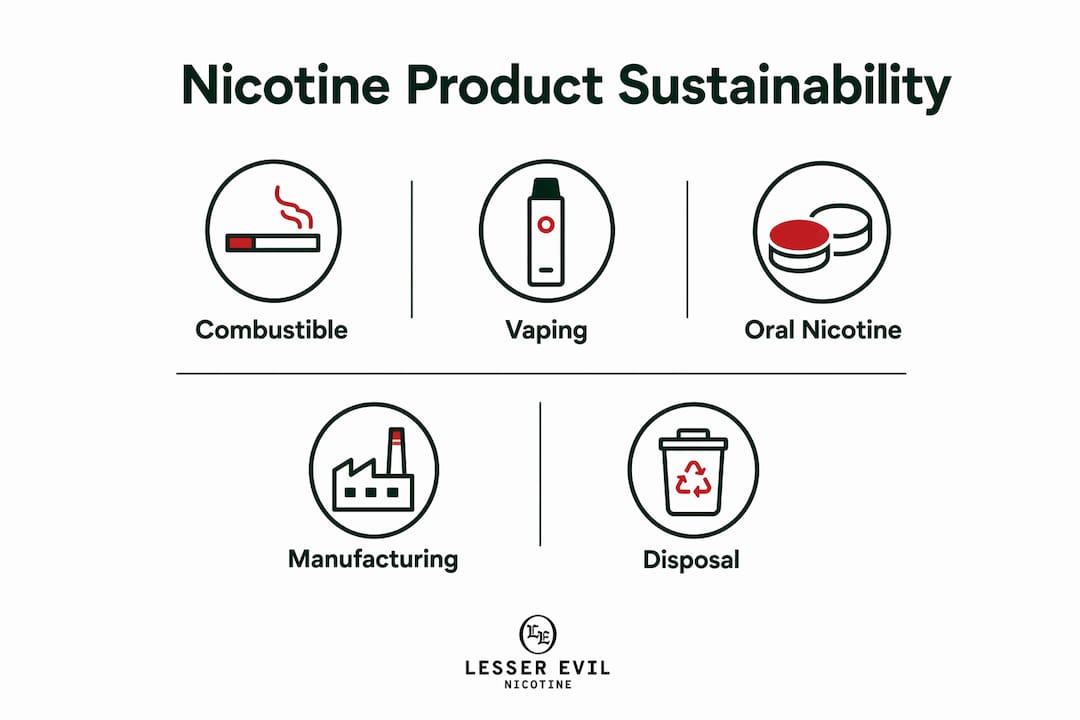
Not all nicotine products are created equal when it comes to environmental impact. Combustible cigarettes sit at the worst end of the spectrum, generating deforestation, soil degradation, toxic waste, and roughly 14 g of CO₂ per cigarette across its entire production chain. Vaping products eliminate combustion but introduce lithium-ion batteries, plastic cartridges, and e-liquid residues. Oral nicotine products, including gels and pouches, produce no airborne emissions and generate packaging waste that accounts for less than 1% of overall municipal solid waste streams, as confirmed by the FDA.
Nicotine product sustainability, in lifecycle terms, covers raw material sourcing, manufacturing processes, product use, and post-consumer disposal. The environmental burden shifts dramatically depending on which delivery format you choose.
Combustible cigarettes:
- Highest CO₂ output across the full lifecycle
- Cellulose acetate filters persist in the environment for years, leaching heavy metals and nicotine
- Tobacco cultivation drives deforestation, pesticide use, and water depletion
Vaping products:
- No combustion, but significant e-waste from batteries and circuit boards
- Plastic cartridges and e-liquid residues contaminate soil and water when improperly discarded
- Manufacturing is energy-intensive, with components often sourced from low and middle-income countries
Oral nicotine products (pouches, gels, lozenges):
- No combustion, no aerosol, no airborne emissions
- Packaging waste is minimal relative to other product categories
- Key remaining challenge is synthetic pouch fibres and non-biodegradable sachet materials
Regulatory bodies are paying closer attention. The UK’s approach to harm reduction, the WHO Framework Convention on Tobacco Control (WHO FCTC) Article 18 on environmental protection, and the US FDA’s 2026 programmatic environmental assessment of oral nicotine products all signal that sustainability is now a formal part of nicotine product regulation, not an afterthought.
What does nicotine itself actually do to the environment?
Nicotine is a naturally occurring alkaloid. In soil and water under aerobic conditions, it biodegrades relatively quickly, with a half-life of roughly 1–2 days. That sounds reassuring, until you factor in the scale of global nicotine product use and the delivery systems that carry it.
The real ecological damage from tobacco-derived nicotine starts long before anyone lights up. Tobacco cultivation is water-intensive: a single cigarette requires about 3.7 litres of water across its full lifecycle, from growing and curing through to disposal. Global tobacco production uses a very large volume of water annually. Pesticide and fertiliser use during cultivation degrades soil and contaminates waterways, while curing tobacco leaves accounts for a disproportionate share of the crop’s total carbon output.
Cigarette combustion adds another layer. Burning tobacco releases thousands of chemical compounds into the air, including volatile organic compounds, polycyclic aromatic hydrocarbons (PAHs), and tobacco-specific nitrosamines. These don’t just affect the person smoking. They settle into soil, wash into waterways, and accumulate in aquatic organisms.
Pro Tip: The ecological harm of cigarette butt leachate is often underestimated. Studies show that cigarette butt leachate is toxic to microbes, plants, benthic organisms, bivalves, zooplankton, and fish. The cellulose acetate filter is a plastic, and it sheds microfibres into aquatic environments as it degrades.
Nicotine itself, when it leaches from discarded cigarette butts or e-liquid containers in high concentrations, is a potent neurotoxin to non-human species. The compound’s short environmental half-life offers limited protection when billions of cigarette butts are littered every year, each releasing a slow drip of nicotine, cotinine, heavy metals, and PAHs into surrounding ecosystems.
How manufacturing and delivery systems pile on the footprint
The delivery vehicle is often where the real environmental weight sits, not the nicotine itself. The WHO FCTC environmental analysis makes this point clearly: industry strategies that focus on reducing material footprint in delivery systems tend to have the greatest sustainability impact.
Manufacturing any nicotine product is resource-intensive. Extracting and purifying nicotine from tobacco requires large volumes of water and generates non-recyclable halogenated waste. The FDA has noted that nicotine manufacturing is water-intensive and that expanded production capacity will increase both water use and wastewater discharge, requiring additional environmental controls and permitting.
Disposable vapes are the starkest example of delivery-system waste. Disposable vapes generate CO₂ during manufacturing, and given their global annual discard in the billions, this contributes a substantial total CO₂ emission from production alone.
Major environmental impacts by product component:
- Lithium-ion batteries (vaping devices): fire risk in waste facilities, leach cobalt, nickel, and lead into soil and water
- Cellulose acetate filters (cigarettes): a synthetic plastic that sheds microfibres and persists for months to years
- Plastic cartridges and pods (vaping): centuries to decompose, leach residual nicotine and flavouring chemicals
- Synthetic pouch fibres (conventional oral pouches): non-biodegradable sachet materials complicate composting
- Packaging materials (all categories): blister packs and plastic wrappers add to landfill unless specifically designed for recyclability
The numbers in context: Billions of disposable vapes are discarded globally each year, contributing a significant amount of CO₂ emissions, equivalent to the emissions produced annually by tens of thousands of cars.
A scoping review on e-cigarette environmental impacts found that air quality, water, land use, and animal life are all threatened across the production, use, and disposal phases of vaping products. The review also noted that eco-friendly claims by vape manufacturers have been used as a marketing strategy without formal lifecycle assessments to back them up.
Combustible vs vaping vs oral: how do they actually compare?
Here is where the trade-offs get concrete. Each product category has a distinct sustainability profile, and no single format is perfect.

| Category | Combustion emissions | Waste type | E-waste risk | Airborne exposure | Packaging burden |
|---|---|---|---|---|---|
| Combustible cigarettes | Very high (CO₂, VOCs, PAHs) | Cellulose acetate butts, ash | None | High (second and thirdhand smoke) | Moderate |
| Disposable vapes | None from use | Batteries, plastics, e-liquid residue | High | Aerosol during use | Moderate to high |
| Refillable vaping devices | None from use | Batteries, coils, pods | Moderate | Aerosol during use | Lower per use |
| Oral nicotine pouches | None | Synthetic fibres, plastic sachets | None | None | Low |
| Oral nicotine gels | None | Minimal packaging | None | None | Very low |
Oral nicotine products have one clear structural advantage: the FDA has confirmed they are “free of airborne emissions and therefore will not affect air quality in the vicinity of use.” There is no secondhand or thirdhand exposure pathway, which removes a significant environmental and public health concern in one go.
Vaping products eliminate cigarette butt waste, but the environmental pollution review published in Sustainability found that e-cigarette waste likely exceeds that of traditional cigarettes in terms of component complexity. Batteries, circuit boards, and e-liquid pods each carry distinct disposal hazards. Some discarded vaping devices have the potential to exceed US EPA hazardous waste thresholds for lead.
Consumer behaviour shapes outcomes across all categories. Proper disposal of vaping components through dedicated e-waste facilities reduces contamination risk substantially, but compliance with such requirements remains a significant challenge without clear labelling and accessible infrastructure. For cigarette butts, the sheer volume and small size make collection costly and largely ineffective at scale. Oral nicotine products sidestep most of these disposal complications, though conventional pouch sachets still require attention to packaging materials.
Understanding the nicotine product lifecycle in full, from raw material sourcing through to post-consumer waste, is the only honest way to compare these categories. Partial assessments, focusing only on use-phase emissions or only on packaging, miss the bigger picture.
What the industry and regulators are actually doing about it
Sustainability in nicotine manufacturing is moving from voluntary gesture to regulatory expectation. The FDA’s programmatic environmental assessment of oral nicotine products, published in March 2026, is the clearest signal yet that environmental controls will be embedded in premarket tobacco product application (PMTA) reviews. Manufacturers will be expected to address waste handling, child-resistant packaging, disposal risks, and environmental compliance as part of product authorisation.
The WHO FCTC provides the international framework. Article 18 calls on parties to protect the environment and public health from tobacco product waste, and the convention’s guidance covers everything from banning single-use plastics in tobacco products to extended producer responsibility schemes. The UK, as a post-Brexit signatory to the FCTC, retains obligations under this framework.
Lifecycle assessment is the scientific tool manufacturers use to quantify environmental impact across every stage of production. It covers raw material extraction, energy and water use in manufacturing, distribution emissions, use-phase impacts, and end-of-life waste. Carbon accounting sits alongside this, translating lifecycle data into CO₂-equivalent figures that can be benchmarked and reported.
Current best practices and emerging standards in sustainable nicotine production:
- Lifecycle assessment (LCA) as a standard part of product development and regulatory submission
- Biodegradable or compostable packaging materials, such as polylactic acid (PLA) or cellulose-based films
- Battery-free product design to eliminate lithium-ion e-waste entirely
- Tobacco-free nicotine sourcing to reduce agricultural land use and pesticide burden
- Extended producer responsibility (EPR) programmes requiring manufacturers to fund post-consumer waste collection
- Child-resistant, recyclable packaging as a baseline expectation in PMTA and UK regulatory reviews
- Renewable energy use in manufacturing facilities to reduce production-phase carbon output
The challenge is that harm reduction goals and environmental sustainability goals do not always align neatly. A refillable vaping device is more sustainable than a disposable one, but it still carries battery and coil waste. Oral nicotine products avoid combustion and e-waste, but conventional pouch formats still use synthetic fibres. The most sustainable formats tend to be those that minimise both the delivery system’s material complexity and its post-consumer waste stream.
You can dig into how UK regulations are shaping these expectations in the nicotine regulation UK guide from Lesser Evil Nicotine.
Lesser Evil Nicotine: what a genuinely low-footprint oral nicotine product looks like
Lesser Evil Nicotine is preparing for its UK launch in 2026 with a product that takes the sustainability logic of oral nicotine and pushes it further. The brand’s patent-pending formulation is the world’s first low-burn oral nicotine gel, delivered sublingually under the tongue via the oral mucosa. It is tobacco-free, battery-free, and uses natural flavours and natural sweeteners. No vaporised chemicals. No e-waste. No synthetic pouch fibres.
The gel format matters from an environmental standpoint. Conventional oral pouches, even tobacco-free ones, typically use synthetic cellulose or plant-based fibre sachets that may be encased in non-biodegradable plastic or foil. Lesser Evil’s gel eliminates the pouch structure entirely, removing that waste stream from the equation. The Lesser Evil Oral Mister is a discreet, minimal-packaging delivery system designed for urban professionals who want to use nicotine without contributing to the rubbish pile.
Product design choices that reduce ecological footprint:
- Battery-free system: zero contribution to lithium-ion e-waste
- Tobacco-free formulation: no agricultural land use, deforestation, or pesticide burden from tobacco cultivation
- No aerosol or combustion: no airborne emissions, no thirdhand residue on surfaces
- Natural flavours and sweeteners: Peppermint, Black Grape, and Green Apple, without synthetic additive waste
- Minimal packaging: designed to reduce material use relative to conventional pouch formats
- No synthetic pouch fibres: the gel format bypasses the sachet waste problem entirely
Pro Tip: If you are comparing oral nicotine options on environmental grounds, ask two questions: does the product require a battery, and does it use synthetic fibres in a pouch? A battery-free, fibre-free format like a sublingual gel removes two of the main waste streams associated with the oral nicotine category.
Lesser Evil is positioned squarely for the urban professional woman aged 25–40 who currently vapes and wants a cleaner alternative, not in a medical sense, but in a material sense. You don’t breathe it in. There’s no device to charge and eventually bin. The brand’s apothecary-dark aesthetic and discreet format reflect a deliberate choice to make something that fits into a considered, low-waste lifestyle without the male-coded branding that dominates the pouch market.
For anyone thinking seriously about oral nicotine product benefits beyond the personal, the environmental case for gel-based formats over vaping or combustibles is grounded in the same lifecycle logic that regulators are now formalising.
Key takeaways
Oral nicotine products carry a substantially lower environmental burden than combustible or vaping alternatives across every lifecycle stage, from manufacturing through to disposal.
| Point | Details |
|---|---|
| Combustibles are the worst offenders | Cigarettes generate roughly 14 g of CO₂ each across their full lifecycle, plus persistent plastic filter waste and toxic leachate. |
| Vaping shifts, not solves, the waste problem | Disposable vapes contribute a significant amount of CO₂ emissions from production, plus lithium battery and plastic cartridge waste. |
| Oral nicotine has the lowest airborne impact | The FDA confirmed oral nicotine products produce no airborne emissions and have minimal effect on ambient air quality near users. |
| Packaging waste from oral nicotine products accounts for less than 1% of overall municipal solid waste streams, according to the FDA. | |
| Battery-free and fibre-free formats go furthest | Gel-based oral nicotine eliminates both lithium e-waste and synthetic pouch fibres, the two main waste streams in the oral category. |