

Secondhand vape exposure: what the evidence actually says

Yes, secondhand vape exposure carries real risk to bystanders. It is not as dangerous as secondhand cigarette smoke, but it is not harmless either. The aerosol exhaled by a vaper contains nicotine, ultrafine particles, volatile organic compounds (VOCs), and trace metals — all of which bystanders can inhale without choosing to. The bottom line from the current evidence:
- Secondhand vape aerosol is measurably different from clean air.
- Vulnerable groups, especially children and pregnant people, face the greatest risk.
- The single most effective protective measure is not ventilation. It is not vaping indoors when others are present.
Key takeaways
| Point | Details |
|---|---|
| Aerosol is not clean air | Exhaled vape aerosol contains nicotine, ultrafine particles, VOCs, and trace metals. |
| Cohort evidence links exposure to symptoms | The Thorax study found OR 1.40 for bronchitic symptoms and OR 1.53 for shortness of breath in exposed young adults. |
| Children absorb nicotine from vapour | JAMA data shows children exposed to secondhand vapour have higher cotinine than unexposed children, though ~83.6% lower than smoke-exposed children. |
| No vaping indoors is the only sure fix | Ventilation and purifiers reduce but do not eliminate ultrafine particle exposure. |
| Lesser Evil Nicotine produces no aerosol | The Oral Mister is a sublingual gel: no vapour exhaled, no bystander aerosol exposure. |
Table of Contents
- What does the evidence say about secondhand vape exposure risk?
- What is actually in exhaled vape aerosol?
- How does secondhand vape aerosol compare with secondhand cigarette smoke?
- What health effects has research actually documented?
- Who is most at risk from secondhand vaping?
- How long does vape aerosol stay in the air, and what about surfaces?
- How to reduce bystander exposure at home, in cars, and at work
- What do UK health bodies and the law currently say?
- Where is the evidence weak, and what does the Thorax cohort actually tell us?
- The part most harm-reduction conversations get wrong
- No aerosol, no bystander exposure: the Lesser Evil Oral Mister
- Sources
What does the evidence say about secondhand vape exposure risk?
The strongest signal comes from a prospective cohort published in Thorax, which found that household secondhand nicotine vape exposure was associated with higher odds of bronchitic symptoms (OR 1.40, 95% CI 1.06–1.84) and shortness of breath (OR 1.53, 95% CI 1.06–2.21) in young adults, after adjusting for active smoking, active vaping, and secondhand tobacco or cannabis exposure. An odds ratio (OR) above 1.0 means the exposed group had higher odds of that outcome; a 95% confidence interval (CI) that does not cross 1.0 means the association is statistically significant.
Stat to know: A bystander regularly exposed to vaping at home had 53% higher odds of reporting shortness of breath compared with someone not exposed, per the Thorax cohort.
A systematic review covering 2004–2024 reached a consistent conclusion: secondhand e-cigarette exposure is not harmless. The review also flagged that study quality varies considerably and that more prospective research is needed before firm causal claims can be made.
NHS guidance acknowledges that current evidence has not demonstrated clear harm to bystanders from vaping, while recommending caution, particularly around children and pregnant people. The CDC is more direct: e-cigarette aerosol can contain nicotine and potentially harmful substances, and e-cigarettes are not safe for youth, pregnant people, or non-users.
Key study types that inform the current picture:
- Prospective cohort studies (follow people over time; stronger for causality)
- Cross-sectional analyses (snapshot data; useful for prevalence and biomarkers)
- Experimental chamber studies (controlled exposure; good for short-term symptom data)
- Systematic reviews (aggregate findings; limited by the quality of included studies)
What is actually in exhaled vape aerosol?
Exhaled aerosol is not water vapour. It is a complex mixture, and its composition shifts depending on the device, the liquid, and how the person vapes. Here is what bystanders are typically exposed to:
| Constituent | Why it matters for bystanders |
|---|---|
| Nicotine | Addictive; crosses the placenta; toxic to fetal development |
| Ultrafine particles | Penetrate deep into lung tissue; linked to respiratory and cardiovascular effects |
| Aldehydes and VOCs | Respiratory irritants; formaldehyde and acrolein detected in some aerosols |
| Flavouring chemicals | Some (e.g. diacetyl) associated with respiratory disease at occupational levels |
| Trace metals | Tin, nickel, lead detected in some aerosol samples; potential toxicity at repeated exposure |
The EPA notes that ultrafine particles in e-cigarette aerosol can penetrate deep into the lungs and that indoor vaping increases involuntary exposure time for everyone in the space. The visible cloud looks transient and harmless. The particles are neither.
Biomarker evidence backs this up. Health Canada’s overview confirms that nicotine has been detected in the blood and urine of non-users after exposure to secondhand aerosol. Cotinine, the main nicotine metabolite, is measurable in bystanders who have not vaped themselves. That is not a theoretical risk. It is a documented biochemical response.
How does secondhand vape aerosol compare with secondhand cigarette smoke?
Lower risk is not the same as no risk. Secondhand vape aerosol generally contains fewer toxic constituents than secondhand cigarette smoke, partly because there is no combustion and no sidestream smoke. But “generally lower” covers a wide range, and several factors complicate the comparison.
A JAMA Network Open cross-sectional study found that children exposed to secondhand vapour had serum cotinine approximately 83.6% lower than children exposed to secondhand tobacco smoke. Critically, their cotinine was still significantly higher than that of unexposed children. So the hierarchy is clear: smoke exposure is worse, vapour exposure is still measurable, and no exposure is the baseline you want for a child.
UCL reporting on the same research area summarised the finding plainly: secondhand vaping exposure is very low compared with secondhand smoking, but still higher than no exposure, and avoidance for children remains the recommendation.
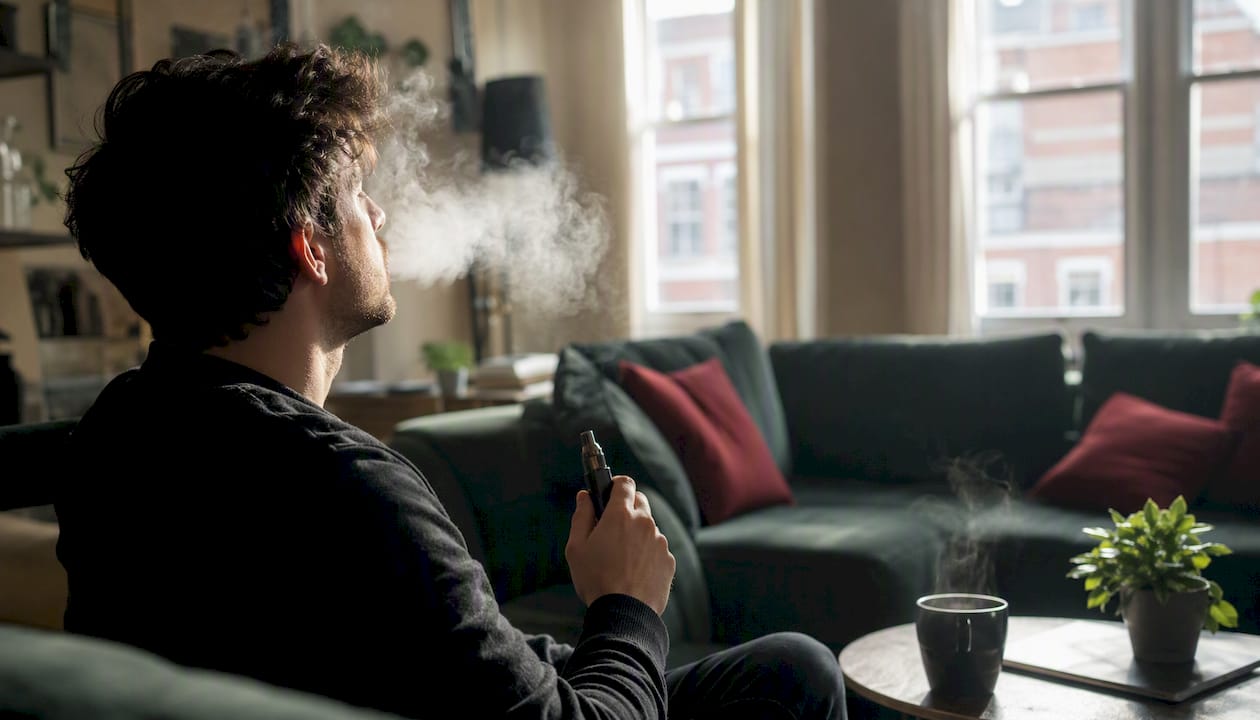
There is a behavioural wrinkle worth noting. Because vaping is widely perceived as safer, many people vape indoors far more freely than they would smoke. That perception gap can erode the relative-exposure advantage: a household member who is never around a smoker but lives with someone who vapes indoors all day may accumulate more total aerosol exposure than the numbers suggest. The Thorax cohort was designed around exactly this real-world household scenario.
What health effects has research actually documented?
Short-term effects from experimental studies are fairly consistent. Controlled exposure to e-cigarette aerosol has produced:
- Eye, nose, and throat irritation
- Transient cough and shortness of breath
- Increased airborne particle counts in the breathing zone
A 2015 peer-reviewed review documented these irritant effects under controlled conditions and confirmed that exhaled aerosol raises airborne particle counts measurably.
Stat to know: The Thorax cohort found bystanders exposed to household vaping had 40% higher odds of bronchitic symptoms (OR 1.40, 95% CI 1.06–1.84) compared with unexposed individuals.
Longer-term epidemiological associations are more cautious. The Thorax cohort data links household exposure to bronchitic symptoms and shortness of breath, but the study design cannot prove causation. Some research has also flagged possible acute cardiovascular signals, including transient endothelial dysfunction after short-term exposure, though this evidence is preliminary and based on small samples.
The honest summary: short-term irritant effects are well-documented; longer-term respiratory associations are emerging but not yet definitive; cardiovascular signals exist but need replication. The absence of certainty is not the same as the absence of risk.
Who is most at risk from secondhand vaping?
Not everyone in the room faces the same exposure risk. Some groups are genuinely more vulnerable, and they deserve specific mention.
- Children and infants. Developing lungs are more susceptible to particle and chemical insults. Children also breathe more air relative to their body weight, so their effective dose per kilogram is higher. The cotinine data from the JAMA study confirms measurable nicotine absorption even at the lower exposure levels typical of vapour.
- Pregnant people. Nicotine crosses the placenta and is associated with adverse fetal development outcomes. The CDC is explicit that e-cigarettes are not safe for pregnant people. For more on nicotine’s specific effects during pregnancy, the Lesser Evil guide on nicotine and dental health for women covers related nicotine concerns in detail.
- People with asthma, COPD, or cardiovascular disease. Pre-existing airway inflammation or reduced lung function means the same particle and irritant load causes a disproportionate response. Even brief exposure can trigger symptoms in someone with reactive airways.
- Workplace staff with repeated exposure. A hospitality worker or office employee in a space where vaping occurs regularly accumulates exposure across a full working day. Cumulative dose matters, and occupational exposure is rarely accounted for in studies focused on household settings.
How long does vape aerosol stay in the air, and what about surfaces?
Ultrafine particles do not simply disappear when the visible cloud disperses. Particle size determines behaviour: the smallest particles stay airborne longest and penetrate deepest into the lungs when inhaled. The EPA’s indoor air quality guidance confirms that ultrafine particles from e-cigarette aerosol can degrade indoor air quality and increase involuntary exposure time for everyone in the space.
Surface deposition is a separate concern. Nicotine and some other aerosol constituents settle onto furniture, walls, carpets, and clothing. This is sometimes called “thirdhand” exposure. A child who touches a contaminated surface and then puts their hands near their mouth receives a secondary nicotine dose that has nothing to do with being in the room when vaping occurred.
Opening a window helps. Running an air purifier helps more. But neither eliminates the risk entirely. Standard home ventilation is not sufficient to remove ultrafine particles reliably, and non-toxic air purifier guidance can help you choose a unit that actually captures fine particles rather than just moving air around.
Pro Tip: If you want to reduce aerosol exposure in a shared space, the only measure that works with certainty is taking vaping outside entirely. Purifiers and open windows are mitigation, not elimination.
How to reduce bystander exposure at home, in cars, and at work
The hierarchy of protection is straightforward. The further you move from the source, the lower the exposure.
- At home: No vaping indoors is the most effective rule. If someone in the household vapes, outdoors only, away from windows and doors, removes the aerosol from shared air entirely.
- In cars: Vaping in an enclosed vehicle with passengers, especially children, concentrates aerosol in a very small space. Even with a window open, particle levels rise sharply. No vaping in cars with passengers is the standard recommendation.
- Around children: Remove children from any space where vaping is occurring. Do not rely on distance within the same room.
- Workplaces: Employer-level vape-free indoor policies, consistent with existing smoke-free rules, are the most practical approach. The Truth Initiative recommends comprehensive indoor clean-air measures that include vaping alongside smoking.
- After indoor vaping: Wash hands and change clothes before close contact with infants or young children. Nicotine residue on skin and fabric is a real secondary exposure route.
Pro Tip: Raising a vape-free indoor rule with a partner or housemate lands better when it is framed around a specific person, not a general principle. “I’d rather keep it outside when the kids are home” is a different conversation from “vaping indoors is harmful.”
What do UK health bodies and the law currently say?
UK smoke-free legislation, primarily the Health Act 2006, covers tobacco smoking in enclosed public spaces and workplaces. Vaping is not covered by the same blanket prohibition. That means the legal position on indoor vaping is largely governed by organisational policy rather than statute.
In practice:
- NHS guidance recommends caution around children and pregnant people and advises against vaping in shared spaces where vulnerable people are present.
- Gov.uk evidence updates acknowledge that while vaping is less harmful than smoking for the user, the evidence on bystander risk is still developing and a precautionary approach is warranted.
- Employers are advised to treat vaping consistently with smoking for indoor workplace policies. Many organisations have extended their smoke-free policies to include vaping, particularly in healthcare, education, and hospitality settings.
- Public transport and hospitality venues typically ban indoor vaping under their own policies, even where the law does not require it.
The gap between the legal position and the public-health recommendation is worth noting. The absence of a legal ban does not mean vaping indoors around others is considered safe. It means the policy framework has not yet caught up with the evidence.
Useful UK resources:
- NHS vaping myths and facts
- Gov.uk evidence review on e-cigarettes
- CDC health effects of vaping
Where is the evidence weak, and what does the Thorax cohort actually tell us?
Most of the existing research has real limitations. Short follow-up periods mean we cannot yet say what years of household vape exposure does to lung function. Exposure misclassification is common: studies rely on self-reported vaping behaviour rather than objective air monitoring. Device and liquid heterogeneity is enormous, so findings from one study may not generalise to another device type or flavour profile. Experimental chamber studies use controlled conditions that rarely reflect real-world use patterns.
The Thorax prospective cohort is a genuine step forward because it followed real people in real households over time, rather than relying on a single snapshot or a laboratory chamber. Its associations between household exposure and respiratory symptoms are adjusted for multiple confounders, which makes the findings more credible than earlier observational work.
Stat to know: In the Thorax cohort, household secondhand vape exposure was associated with OR 1.53 (95% CI 1.06–2.21) for shortness of breath. An OR of 1.53 means exposed individuals had 53% higher odds of that symptom compared with unexposed individuals, after controlling for other exposures.
The systematic review makes the research gap explicit: cotinine changes in non-users are consistent across studies, but clinical end-points are mixed. What the field needs most is longer longitudinal studies with objective exposure measurement, representative samples, and standardised outcome definitions. Until those exist, the precautionary approach is the rational one.
Pro Tip: The most useful future research would combine wearable air-quality monitors with biomarker sampling across a full year in households where vaping occurs. That kind of study would finally give us dose-response data rather than binary exposed/unexposed comparisons.

The part most harm-reduction conversations get wrong
There is a version of the vaping debate that treats “less harmful than smoking” as a full stop. It is not. Less harmful for the user is a meaningful claim. Less harmful for everyone else in the room is a different question, and the evidence does not support the same level of confidence.
The precautionary logic is not anti-vaping. It is pro-bystander. An adult making an informed choice about their own nicotine use is a different situation from a child or a pregnant person absorbing nicotine because someone else is vaping in a shared space. Those two situations deserve different frameworks.
What the evidence actually supports: vaping indoors around others, particularly children and pregnant people, carries a real and measurable risk that is not eliminated by ventilation. The Thorax cohort data is not a scare story. It is a signal from a well-designed study that deserves a proportionate response. That response is not complicated: take it outside.
The harm-reduction argument for vaping is strongest when the vaper is the only one breathing the aerosol. The moment it becomes a shared-air situation, the calculus changes. Acknowledging that is not inconsistent with supporting adult smokers who switch to vaping. It is just honest.
No aerosol, no bystander exposure: the Lesser Evil Oral Mister
If the problem with vaping around others is the aerosol, the cleanest solution is a nicotine format that produces none.

The Lesser Evil Oral Mister is a sublingual nicotine gel, applied under the tongue via the oral mucosa. Tobacco-free, battery-free, no vapour, no cloud, no e-waste. Nicotine is absorbed through the mouth lining, so there is nothing to exhale and nothing for the people around you to breathe. It comes in three natural flavours: Peppermint, Black Grape, and Green Apple, with natural sweeteners and no synthetic additives. If you want to understand how non-inhalation nicotine formats work more broadly, the Lesser Evil guide to non-inhalation nicotine methods lays it out clearly. The Oral Mister is available now at lesserevil.store.
Sources
This article provides general health information only and is not a substitute for professional medical advice. For personalised guidance, consult a qualified healthcare professional or refer to NHS and gov.uk resources directly.