

Quit smoking without vaping: your 2026 guide

TL;DR:
- Quitting smoking without vaping is possible with behavioral strategies, oral substitutes, and support. The body begins healing within 20 minutes, and nicotine is eliminated in three days, easing withdrawal symptoms. Addressing both physiological urges and hand-to-mouth rituals greatly improves long-term success.
Quitting smoking without vaping is achievable. The most effective approach combines behavioural modification, oral substitutes, and structured support rather than swapping one nicotine delivery device for another. Nicotine cessation, the clinical term for stopping nicotine use entirely, does not require a vape pen, a patch, or a prescription. Your body starts repairing itself within 20 minutes of your last cigarette. Your brain adapts within days. What you need is a plan that addresses both the physical urge and the hand-to-mouth ritual, because those are two separate problems that most people treat as one.
What physiological changes occur when you quit smoking without vaping?
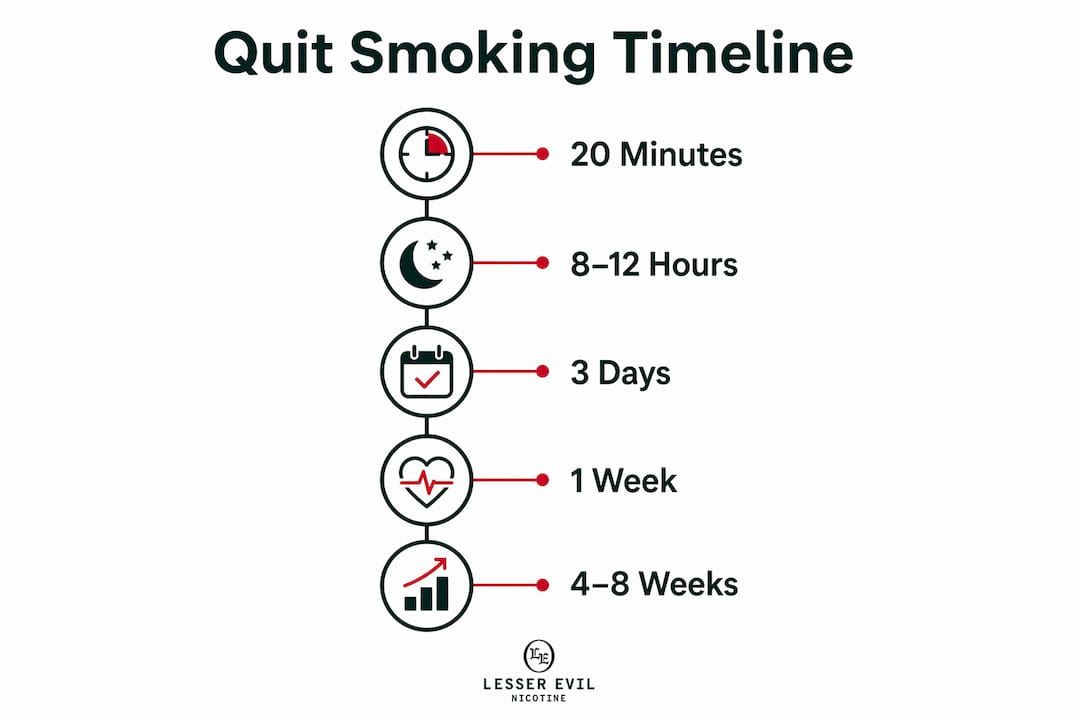
Your body responds to quitting faster than most people expect. Heart rate and blood pressure normalise within 20 minutes of your last cigarette. That is not a motivational slogan. It is a measurable physiological fact that means your cardiovascular system starts recovering before you have even finished your first nicotine-free hour.
The timeline gets more encouraging from there. Nicotine clears your body within 3 days, and acute symptoms, including mood swings, headaches, and difficulty concentrating, typically ease within one week. That one-week window is the hardest stretch. Knowing it has a defined end makes it survivable.
Understanding the timeline matters because it stops you from catastrophising. A headache on day two is not a sign that something is wrong. It is your nervous system recalibrating after years of nicotine signalling.
| Timeframe | What happens |
|---|---|
| 20 minutes | Heart rate and blood pressure normalise |
| 8–12 hours | Carbon monoxide levels drop significantly |
| 3 days | Nicotine fully eliminated from the body |
| 1 week | Acute symptoms begin to ease |
| 1–3 months | Circulation and lung function improve |
How can you manage nicotine urges and replace smoking rituals without vaping?
The urge to smoke is not purely chemical. A large part of it is behavioural. Most quitters need to address oral fixation separately from the nicotine addiction itself to succeed long term. That hand-to-mouth motion, the act of reaching for something, is its own deeply ingrained habit.

Setting a firm quit date is the single most effective first step. It gives your brain a concrete boundary rather than a vague intention. Cold turkey quitting, despite its reputation, matches long-term success rates of medication-assisted approaches when paired with behavioural strategies.
The key is replacing the ritual, not just removing it. When you reach for a cigarette, your brain is often responding to a trigger, not a genuine physiological need. Substituting that motion with something harmless short-circuits the habit loop.
Effective oral substitutes and behavioural tactics include:
- Toothpicks or cinnamon sticks for the hand-to-mouth motion without calories
- Sugar-free gum or mints to occupy the mouth during peak urge windows
- Herbal teas to replace the post-meal cigarette ritual with a warm, satisfying alternative
- Straws as a surprisingly effective fidget tool that mimics the physical act of smoking
- Cold water sipped slowly to delay and defuse an urge within 3–5 minutes
- Short walks or breathing exercises to break the mental association between a location and smoking
Oral substitutes prepared in advance prevent the high-calorie snacking that often fills the gap left by smoking rituals. Keep a kit ready: gum in your bag, a water bottle on your desk, a box of herbal tea in the kitchen.
Pro Tip: Prepare your oral substitute kit the night before your quit date. Having something in your hand or mouth within seconds of an urge is far more effective than searching for an alternative mid-craving.
Willpower alone is not a strategy. You need to manage nicotine cravings at work and in social settings with pre-planned responses, not improvised resistance.
What strategies help minimise weight gain when quitting smoking without vaping?
Weight gain is real, and pretending otherwise sets people up for a nasty surprise. Most people who quit smoking gain 4–6 kg within the first three months. That figure is worth sitting with, because it is the reason many people reach for a vape instead of dealing with the underlying issue.
The gain happens for two reasons. Nicotine suppresses appetite and raises metabolic rate slightly. When you remove it, both effects reverse. Your appetite increases and your metabolism slows. The result is predictable weight gain unless you plan for it.
The good news is that weight gain stabilises after about one year for most people, and extreme gain is uncommon. The first three months are the critical window.
The most evidence-backed approach is to focus entirely on quitting for 4–8 weeks before attempting any dietary restriction. Trying to quit smoking and diet simultaneously increases relapse risk. Your brain has a finite amount of self-regulation capacity. Use it on the harder problem first.
Pro Tip: Do not start a calorie-restricted diet during your first month of quitting. Eat structured meals with high-protein, high-fibre snacks to manage appetite, then address weight after your quit is stable.
Moderate exercise burns 150–250 calories per 30-minute session and also reduces urge intensity during cessation. A brisk 30-minute walk is not just a calorie offset. It is a direct tool for managing the urge to smoke.
| Approach | Best for | Risk |
|---|---|---|
| Quit first, address weight after 4–8 weeks | Most people; reduces relapse risk | Temporary weight gain accepted |
| Simultaneous quitting and dieting | High motivation, strong support network | Higher relapse risk due to self-regulation strain |
| Exercise-led approach | Active people; manages both weight and urges | Requires consistent routine |
What support options and digital tools can improve success?
Going it alone is harder than it needs to be. Structured digital cessation programmes can improve quitting success rates by up to 40%. That is a substantial lift from something you can access on your phone.
Healthcare providers play a key role in building personalised quit plans that combine behavioural and counselling components. A GP or practice nurse can help you identify your specific triggers and build a plan around them, without defaulting to a prescription.
Support options worth using:
- NHS Stop Smoking Services: free, evidence-based, and available across the UK with both in-person and digital options
- Quitlines: telephone-based counselling that provides real-time support during high-risk moments
- Behavioural apps: tools that track smoke-free days, calculate savings, and send motivational prompts at trigger times
- Online communities and forums: peer support from people at the same stage of quitting, which normalises the difficulty and reduces isolation
- Counselling or CBT: cognitive behavioural therapy addresses the thought patterns that drive relapse, not just the physical urge
The combination of a personal quit plan, at least one form of social support, and a digital tracking tool consistently outperforms willpower alone. You do not need all three. You need at least two.
Pro Tip: Tell two people your quit date. Accountability to others is one of the most underused and most effective behavioural tools available.
How do you troubleshoot common challenges when quitting without vaping?
Relapse is not failure. It is data. The most common triggers are social settings, stress, and alcohol. Knowing your triggers in advance is the difference between a plan and a wish.
Behavioural implementation intentions, known as “if-then” plans, significantly improve the ability to manage urges and avoid relapse. The format is simple: “If I feel the urge at a party, then I will step outside and drink water for five minutes.” Pre-planning removes the need for in-the-moment decision-making, which is exactly when willpower fails.
Oral fixation is a specific pitfall that catches people off guard. Removing cigarettes without replacing the hand-to-mouth motion often leads to snacking, which then drives the weight gain that becomes a reason to relapse. Address the fixation directly with the substitutes listed above, not with crisps or biscuits.
Environmental changes make a measurable difference. Remove all smoking paraphernalia from your home on quit day. Wash clothes that smell of smoke. Change your morning routine so it does not pass through the usual smoking spots. These are not symbolic gestures. They are practical interruptions to habitual behaviour.
Cravings peak in intensity and then decline. The perceived calming effect of nicotine is not relaxation. It is the relief of satisfying a withdrawal state that nicotine itself created. Once you understand that, the urge loses some of its power.
Pro Tip: If you are reducing gradually rather than quitting cold turkey, pair each reduction step with a specific behavioural change, such as switching your smoking location or time, to weaken the habit loop before you cut the last cigarette.
Key takeaways
Quitting smoking without vaping works best when you combine a firm quit date, oral substitutes for the hand-to-mouth habit, and structured support rather than relying on willpower alone.
| Point | Details |
|---|---|
| Body recovers fast | Heart rate normalises within 20 minutes; nicotine clears within 3 days. |
| Oral fixation is separate | Address the hand-to-mouth habit with substitutes, not just nicotine removal. |
| Weight gain is manageable | Quit first for 4–8 weeks, then address weight with exercise and structured eating. |
| Digital support lifts success | Structured programmes improve quit rates by up to 40%; use at least two support tools. |
| Pre-plan your responses | “If-then” plans for triggers reduce impulsive relapse more than willpower alone. |
Why I think most quit advice misses the point
Most quit-smoking content focuses almost entirely on the nicotine. The patches, the gums, the apps counting your smoke-free hours. And yes, the chemical dependency is real. But in my experience, the people who struggle most are not fighting nicotine. They are fighting a ritual.
The cigarette after coffee. The smoke break that gave you five minutes of actual quiet in a loud office. The thing you did with your hands when you did not know what to do with your hands. That is not a drug problem. That is a behavioural pattern that nicotine got tangled up in, and you cannot patch your way out of a pattern.
What actually works is replacing the ritual with something that satisfies the same need. Not just something to chew on, but something that fits the moment. A walk instead of a smoke break. A hot drink instead of a post-dinner cigarette. Something that gives you the pause, the transition, the sensory hit, without the lung tax.
The weight gain fear is also massively underaddressed. People quit, gain a few kilos, panic, and reach for a vape because at least that does not make them heavier. The research is clear: focus on quitting first, let your body stabilise, then deal with weight. Trying to do both at once is how you end up doing neither.
If you are reading this because you want to stop smoking without picking up a vape, you are already thinking about it correctly. The goal is not to swap one habit for another. It is to get out of the loop entirely. That takes preparation, not heroics.
— Luke McLeod
What Lesser Evil Nicotine offers instead of a vape
If you want to step away from smoking without putting vapour in your lungs, Lesser Evil Nicotine is worth knowing about. It is a tobacco-free, battery-free oral nicotine gel delivered under the tongue. No inhalation. No e-waste. No vaporised chemicals.
The gel comes in three flavours: Peppermint, Black Grape, and Green Apple. It is not a cessation product and does not claim to be. It is simply a different way to take nicotine, one that does not involve breathing anything in. For people who want to use something instead of smoking or vaping, it sits in a different category entirely. A nicotine mouth spray is also in development. Lesser Evil Nicotine launches in the UK in 2026, and you can find out more at the Lesser Evil Oral Mister product page.
FAQ
How long does it take to quit smoking without vaping?
Nicotine clears your body within 3 days, and acute symptoms typically ease within one week. Most people find the first 7 days the hardest stretch.
Can you quit cigarettes without patches or nicotine replacement?
Yes. Most successful long-term quitters use behavioural strategies rather than pharmacological aids, and their long-term success rates match those who use medication.
How do you stop smoking without gaining weight?
Focus entirely on quitting for the first 4–8 weeks before addressing diet. Use regular moderate exercise to offset metabolic changes, and replace smoking rituals with low-calorie oral substitutes rather than snacks.
What are the best oral substitutes for quitting smoking?
Toothpicks, sugar-free gum, and herbal tea are the most effective options for managing the hand-to-mouth habit without adding calories or continuing nicotine use.
Does quitting cold turkey actually work?
Cold turkey quitting, when paired with behavioural strategies and support, matches the long-term success rates of medication-assisted approaches. Setting a firm quit date and preparing oral substitutes in advance significantly improves the odds.