

What is mindful nicotine consumption? A 2026 guide

TL;DR:
- Mindful nicotine consumption involves deliberate, scheduled use and full awareness of triggers and sensations. It replaces reactive habits with intentional actions, reducing unplanned consumption and improving self-knowledge. Tobacco-free oral products like gels and pouches support this practice through fixed dosing and purposeful placement.
Mindful nicotine consumption is the intentional, conscious practice of regulating each nicotine interaction through self-awareness, scheduled use, and dose control rather than automatic, habit-driven intake. It is the opposite of reaching for your vape on autopilot every time stress hits. The practice draws on established mindfulness techniques, including urge surfing and body scan exercises, and sits within the broader framework recommended by the 2026 VA/DOD Clinical Practice Guidelines, which position mindfulness as a valuable component of multi-modal behavioural approaches. If you are 25 to 40, vaping out of habit rather than choice, and wondering whether there is a smarter way to manage your habit, this is where to start.
What does mindful nicotine consumption actually mean?

Mindful nicotine consumption is defined as deliberate, self-aware use centred on scheduled timing, dose control, and clear intention. The word “mindful” here is not a wellness buzzword. It refers to the same psychological principle used in cognitive behavioural therapy: non-judgmental awareness of your thoughts, urges, and physical sensations in real time.
Applied to nicotine, this means noticing the urge to use, pausing before acting, and making a conscious choice rather than a reflexive one. Most habitual vapers or smokers operate on autopilot. A stressful email arrives, a hand reaches for the device. Mindful use interrupts that loop.
The core techniques include:
- Urge surfing: Observing a craving rise and pass over 3–5 minutes without acting on it. The urge loses power when you stop feeding it automatically.
- Body scan: Checking in with physical sensations before and after use to build honest awareness of what nicotine is actually doing for you.
- Breathing exercises: Using a few slow breaths to create a pause between the trigger and the response.
- Scheduled use: Deciding in advance when you will use nicotine, rather than responding to every urge as it arrives.
Non-judgmental awareness is the foundation. Observing cravings without judgment prevents the shame spiral that often follows a relapse, which itself triggers further use. You watch the urge the way you would watch a cloud pass. You do not have to act on it.
Pro Tip: Set a two-minute timer the next time an urge hits. Breathe slowly and observe the sensation without acting. Most urges peak and fade within that window.
How does mindful use differ from habitual smoking or vaping?
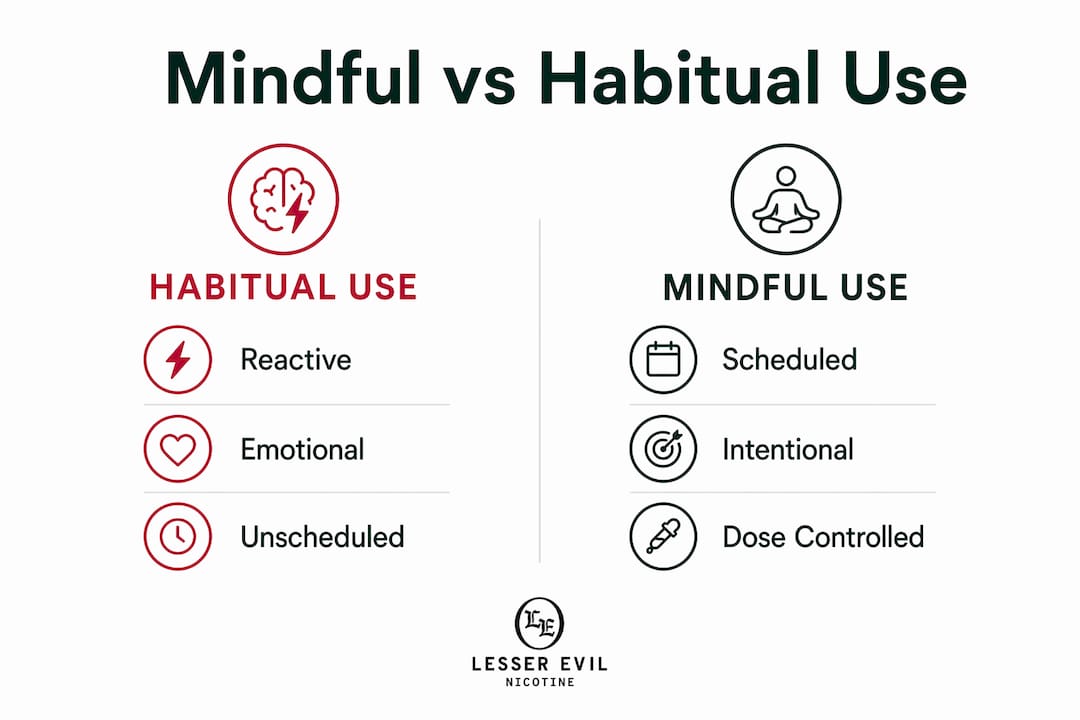
Habitual nicotine use is reactive. Mindful nicotine use is scheduled. That single distinction changes everything about how much you consume and why.
A habitual smoker or vaper links nicotine to emotional states: stress, boredom, social situations, the end of a meal. The autopilot behaviour means they rarely notice what they are actually feeling before they light up or hit the device. Mindful use requires you to identify the trigger first, then decide whether nicotine is the right response.
The table below shows the practical differences between the two approaches.
| Factor | Habitual use | Mindful use |
|---|---|---|
| Timing | Reactive, triggered by emotion or environment | Scheduled, decided in advance |
| Dose awareness | Rarely tracked | Actively monitored |
| Sensory attention | Absent, often mechanical | Present, focused on taste and sensation |
| Emotional role | Used as a crutch for stress | Treated as a tool with clear purpose |
| Frequency | Driven by urges | Governed by personal limits |
Sensory attention is one of the most underrated parts of conscious nicotine use. Paying full attention to the actual taste, sensation, and emotional effect during use often reveals that the experience delivers far less than the habit promised. That realisation is more powerful than willpower alone.
Pro Tip: Before your next nicotine session, write down one word describing why you want it right now. Do this for a week. The patterns you spot will surprise you.
What practical techniques support mindful nicotine use?
Mindful nicotine use does not happen by accident. It requires a small set of repeatable routines that replace reactive habits with intentional ones. Here is a practical framework you can start today.
-
Set a daily usage limit. Decide before the day starts how many times you will use nicotine. Write it down. Setting time boundaries and daily limits is one of the most reliable ways to interrupt automatic use patterns.
-
Define your intention. Ask yourself what you want from this session. Focus? A short break? Stress relief? Knowing the goal before you start means you can assess afterwards whether it actually worked.
-
Create a placement ritual. If you use a nicotine pouch or sublingual gel, place it deliberately. Sit down, take a breath, and give the experience your full attention for the first 60 seconds. This is the opposite of using while scrolling your phone.
-
Pair use with a breathing exercise. Take three slow breaths before placing your product. This activates the parasympathetic nervous system and creates a conscious pause between the trigger and the action. It also means you are already calmer before the nicotine arrives.
-
Track your triggers. Keep a simple note on your phone. Each time you use nicotine, log the time and the emotional state that preceded it. After a week, you will have a clear picture of your actual usage patterns rather than a vague sense of them.
-
Review and adjust weekly. Look at your log every Sunday. Are you using more on stressful days? Are certain times of day automatic? Use that data to shift your schedule rather than relying on willpower in the moment.
The most effective mindful users interrupt automatic stress-nicotine associations through intentional scheduling rather than trying to resist urges through sheer determination. Scheduling is a system. Willpower is not.
You can also read more about managing nicotine at work if your triggers are concentrated during the working day.
What are the benefits and limitations of mindful nicotine consumption?
Mindful nicotine use delivers real, measurable changes in how you relate to your habit. It also has clear limits, and being honest about both is the point.
The benefits:
- Reduced automatic use. Scheduling and trigger tracking directly cut the number of unplanned sessions. You use less because you are paying attention.
- Better emotional regulation. Urge surfing builds the mental muscle to sit with discomfort without immediately reaching for a fix. That skill transfers to other areas of your life.
- Harm reduction through awareness. Treating nicotine as a tool rather than a reflex means you are less likely to use chaotically or excessively.
- Reduced shame. Non-judgmental observation of cravings breaks the guilt cycle that often drives further use after a slip.
- Clearer self-knowledge. Most people genuinely do not know how much they use or why. Mindful practice makes both visible.
The limitations:
Mindfulness alone does not eliminate nicotine dependence. The 2026 VA/DOD Clinical Practice Guidelines are explicit: mindfulness interventions work best as part of multi-modal approaches that include intensive behavioural counselling and approved pharmacotherapy. If your goal is full abstinence, mindfulness is one component, not the whole plan.
Unplanned frequent use also negates mindfulness goals by increasing dependence over time. Awareness without structure is not enough. The scheduling and tracking elements are non-negotiable if you want results.
For a broader view of what reducing nicotine intake looks like in practice, the Lesser Evil Nicotine guide covers the territory well.
How do tobacco-free nicotine products fit into mindful use?
Certain nicotine delivery formats are better suited to mindful consumption than others. Tobacco-free, battery-free options remove several variables that make habitual use harder to track and control.
Sublingual nicotine gel, placed under the tongue, delivers nicotine via the oral mucosa. You are not breathing anything in. There is no combustion, no vapour, no e-waste. The act of placing a gel is inherently more deliberate than pulling out a vape device. That deliberateness is a feature, not a limitation.
| Product type | Delivery method | Mindful use compatibility |
|---|---|---|
| Sublingual nicotine gel | Oral mucosa absorption | High. Placement is deliberate and dose is fixed. |
| Nicotine pouches | Oral mucosa absorption | High. Pairing with deep breathing supports ritual use. |
| Vaping | Inhalation | Lower. Device accessibility encourages reactive, frequent use. |
| Cigarettes | Combustion and inhalation | Lowest. Automatic use is deeply embedded in the ritual. |
Tobacco-free oral products also support the sensory attention aspect of mindful use. Wellness-focused adults increasingly use oral nicotine formats for controlled focus and stress management without the chaotic rush associated with smoking. The fixed dose and the absence of a device you can mindlessly pick up dozens of times a day both support the scheduling discipline that mindful use requires.
Key takeaways
Mindful nicotine consumption works because it replaces reactive, automatic use with intentional scheduling, sensory awareness, and honest tracking of triggers and dose.
| Point | Details |
|---|---|
| Core definition | Mindful use means scheduled, dose-controlled nicotine intake driven by intention, not reflex. |
| Urge surfing | Observing cravings for 3–5 minutes without acting weakens the automatic craving-to-action link. |
| Scheduling beats willpower | Setting daily limits in advance is more reliable than resisting urges in the moment. |
| Mindfulness has limits | The 2026 VA/DOD guidelines confirm mindfulness works best alongside behavioural counselling, not alone. |
| Product format matters | Tobacco-free, battery-free oral formats support deliberate placement and fixed dosing better than vaping. |
Why I think most people are doing this backwards
By Luke McLeod
The standard advice around nicotine and mindfulness tends to focus on quitting. Meditate more, resist the urge, white-knuckle your way through. That framing misses the point entirely, and I think it is why so many people give up on the idea before it has a chance to work.
The real value of mindful nicotine use is not abstinence. It is self-knowledge. When you actually pay attention during use, you start noticing that the cigarette or vape rarely delivers what you thought it would. The stress does not disappear. The boredom does not lift. That realisation, experienced rather than just understood intellectually, is what shifts behaviour. It is more powerful than any amount of willpower.
What I have found is that the people who make genuine progress are the ones who treat awareness as the goal, not reduction. Reduction tends to follow naturally once you stop lying to yourself about what the habit is actually doing. Scheduling and tracking are not restrictions. They are just honest accounting.
The other thing worth saying: format matters more than people admit. If your nicotine delivery method makes it easy to use twenty times a day without noticing, mindfulness cannot do much. Choosing a product that requires a deliberate act of placement is not a small thing. It is the difference between a habit you manage and one that manages you.
— Luke McLeod
Lesser Evil Nicotine: built for intentional use
If you are trying to use nicotine more deliberately, the format you choose matters as much as the mindset you bring to it.
Lesser Evil Nicotine is a sublingual nicotine gel placed under the tongue. It is tobacco-free, battery-free, and made with natural flavours and natural sweeteners. No vapour to breathe in. No device to mindlessly reach for. No e-waste. The gel comes in three flavours: Peppermint, Black Grape, and Green Apple. Each application is a deliberate act, which is exactly the kind of friction that supports the scheduling and sensory awareness practices described above. Lesser Evil Nicotine is preparing for its UK launch in 2026, built specifically for adults who want to manage their habit without putting rubbish in their bodies.
FAQ
What is mindful nicotine consumption in simple terms?
Mindful nicotine consumption is the practice of using nicotine intentionally rather than automatically. It involves scheduling use, tracking triggers, and paying full attention to sensations and effects rather than reaching for nicotine on reflex.
Does mindful nicotine use actually reduce how much you consume?
Scheduling and trigger tracking directly reduce unplanned sessions. The 2026 VA/DOD Clinical Practice Guidelines note that mindfulness works best as part of a broader behavioural approach rather than as a standalone method.
What is urge surfing and how does it apply to nicotine?
Urge surfing means observing a craving for 3–5 minutes without acting on it, allowing the urge to rise and pass naturally. Applied to nicotine, it rewires the automatic link between a trigger and reaching for your product.
Which nicotine products support mindful consumption best?
Tobacco-free oral formats such as sublingual nicotine gels and nicotine pouches support mindful use because placement is deliberate and dosing is fixed. Vaping devices are more accessible and therefore easier to use reactively and frequently.
Is mindful nicotine use the same as conscious nicotine use?
The terms are used interchangeably. Both describe intentional, self-aware nicotine intake governed by personal limits and clear purpose rather than emotional triggers or habit.