

Gum irritation from oral nicotine gel: what to expect

Mild, transient mouth irritation is common when you start using a sublingual oral nicotine gel. Serious long-term injury is uncommon. A small prospective study following 30 smokers over 3–12 months found any mucosal changes were mild, reversible, and resolved by the six-month visit. The IADR position statement recommends personalised oral-health care for nicotine product users and routine dental screening. Lesser Evil Nicotine’s sublingual gel is tobacco-free, water-based, and precision-dosed, meaning your exposure to the mucosa is measured rather than prolonged.
Quick orientation:
- Most irritation appears in the first few days to several weeks and settles on its own.
- Technique matters more than most people realise. Where you place the gel changes everything.
- See a dentist or GP if you have persistent ulcers, bleeding, or pain lasting more than two to three weeks.
Key takeaways
Mild, transient mouth irritation from sublingual oral nicotine gel is common in the first few weeks but typically resolves with correct technique and does not indicate serious mucosal injury.
| Point | Details |
|---|---|
| Irritation is usually transient | Clinical studies show mucosal changes from sublingual nicotine are generally mild and reversible within weeks. |
| Technique is the main variable | Placing gel on the mid-floor of the mouth, not against the gum, cuts frictional irritation significantly. |
| Adaptation window is 3–4 weeks | Most users adapt to mouth and throat sensation within the first three to four weeks, per SmPC data. |
| Red flags need professional review | Persistent ulcers, bleeding, or expanding lesions beyond two to three weeks warrant a dentist or GP visit. |
| Lesser Evil Nicotine’s formulation | Water-based, precision-dosed, tobacco-free sublingual gel designed to reduce unnecessary mucosal exposure. |
Table of Contents
- Why does sublingual oral nicotine gel irritate the mouth?
- What does the clinical evidence actually say?
- How to use sublingual gel to reduce mouth irritation
- What to expect over time, and when to see a dentist
- Simple home care to manage mild irritation
- How Lesser Evil Nicotine’s formulation addresses irritation
- The honest view on oral irritation and new gel formats
- Lesser Evil Nicotine: a discreet, tobacco-free option worth trying
- Sources
Why does sublingual oral nicotine gel irritate the mouth?
Irritation arises from a combination of local chemical exposure, formulation pH, mechanical friction, and individual mucosal sensitivity. Understanding the mix helps you control it.
When you apply a sublingual gel, nicotine absorbs through the mucous membrane under the tongue. That membrane is thin and well-supplied with blood vessels, which is exactly why absorption is fast. It also means the tissue responds quickly to anything acidic, concentrated, or abrasive. Oral nicotine delivery via the sublingual route is efficient, but the same properties that make it work can cause a mild burning or soreness sensation early on.
Formulation factors that influence irritation:
- Nicotine concentration. Higher doses mean more local chemical exposure per application — for more details, see our percentuale nicotina liquidi spiegata guide.
- pH and acidity. A more acidic formulation can prompt you to shift the product around your mouth, increasing frictional contact. The In Vivo local tolerance study identified this as a likely driver of superficial keratosis in one sublingual tablet format.
- Excipients and solvents. Certain carriers and binders are more irritating to mucosal tissue than a water-based formula.
- Flavours and sweeteners. Strong flavour compounds can add mild chemical stimulation on top of the nicotine itself.
Behavioural factors matter just as much. Pressing the gel directly against gum tissue, moving your tongue repeatedly over the application site, or dosing too frequently all increase frictional and chemical load on the same patch of mucosa.
Higher-sensitivity groups include people with existing oral disease, dental implants, dentures, recent oral surgery, or pregnancy. If any of those apply to you, check with a dentist before starting.
Pro Tip: Place the gel on the mid-floor of the mouth rather than pressed against the gum line. That single change reduces direct gum contact and cuts frictional irritation significantly.
What does the clinical evidence actually say?
Clinical evidence consistently shows that mucosal changes from sublingual nicotine are generally mild, transient, and reversible over short-to-medium term follow-up. Some RCT data do report increased odds of mouth and throat irritation for certain formats, but the certainty of that evidence is moderate to low.
The prospective 3–12 month study cited above found lesions appeared in the first one to six weeks and resolved by the six-month visit. Most adverse events were mild: hiccups, a burning or smarting sensation, and sore throat. No lesions of clinical importance were recorded.
The In Vivo open single-centre trial reported mostly mild or moderate, transient local events. Biopsies in a subset showed superficial keratosis consistent with mechanical friction rather than toxic injury. Common events included dry mouth, soreness, and throat irritation.
What the systematic review found: A synthesis of randomised trial data reported a pooled odds ratio of 2.54 (95% CI 1.23 to 5.25) for mouth or throat irritation across NRT formats as a group. The authors flagged heterogeneity and judged the evidence certainty as low to moderate.
The Nicorette Microtab SmPC states that most undesirable effects occur in the first three to four weeks and that most users adapt to mouth and throat irritation within that window.
Limits of this evidence: The studies above examined sublingual tablets, not gels. Sample sizes were small. Products, doses, and populations varied. Treat these findings as directionally useful, not as a precise prediction for a novel gel format.

How to use sublingual gel to reduce mouth irritation
Simple technique and dose control prevent most irritation. Follow this routine from day one.
- Dry the application site lightly with your tongue before applying. A drier surface reduces dilution and keeps the gel where you placed it.
- Place a measured bead on the mid-floor of the mouth, not pressed against the gum. Let it sit. Do not push it into the gum line.
- Keep your tongue still. Moving it repeatedly across the gel spreads it onto gum tissue and increases frictional contact.
- Wait the recommended time before drinking or rinsing. Check the product guidance for the specific window.
- Start with the lowest effective dose and space applications out. More frequent dosing means more cumulative mucosal exposure.
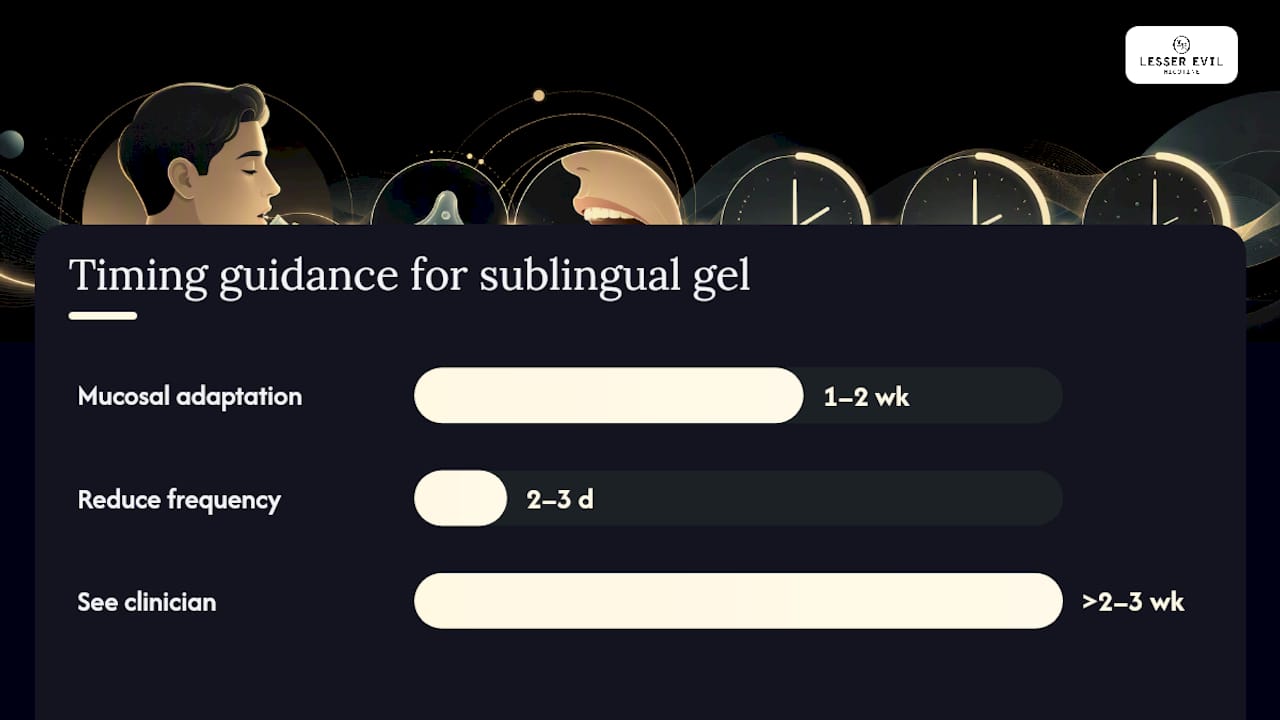
For the first one to two weeks, your mucosa is adapting. Expect some tingling or mild soreness. That is normal and usually settles. Refer to nicotine habit management best practices for practical guidance on spacing and dosing routines.
Pro Tip: If you notice early signs of rubbing or keratinisation, shift placement slightly toward the centre of the mouth floor and reduce frequency for two to three days. You do not need to stop entirely.
Safety note: Stop use and see a clinician if you experience persistent ulceration, bleeding, or pain lasting more than two to three weeks.
What to expect over time, and when to see a dentist
Most unwanted effects appear in the first days to three or four weeks and resolve with continued correct use. Persistent or worsening signs need professional assessment.
A rough timeline:
- First application: Possible tingling, mild burning, or soreness. Normal.
- Days 3–28: Adaptation window. Mild irritation may peak then ease. The SmPC data above supports this pattern.
- By four to six weeks: Most users have adapted. Residual irritation at this point warrants a dentist visit.
Red flags that mean see a dentist or GP now:
- Persistent ulcers that are not healing
- Bleeding from the application site
- Expanding white or red lesions
- Difficulty speaking or eating
- Fever or systemic symptoms alongside oral changes
Higher-risk groups who should consult a dentist before starting: people with active oral disease, recent implants or oral surgery, or immunosuppression. The IADR recommends personalised oral-health approaches and routine screening for all nicotine product users.
Simple home care to manage mild irritation
Simple oral-care steps usually relieve mild irritation and support mucosal recovery.
- Brush gently twice daily with a soft-bristled toothbrush. Avoid scrubbing the application site directly when it is sore.
- Floss gently. Keeping the rest of the mouth clean reduces overall bacterial load on irritated tissue.
- Ditch the alcohol-based mouthwash while the area is sore. It adds chemical stress to already sensitised mucosa.
- Rinse with warm saline (a pinch of salt in a glass of warm water) two to three times a day. It is cheap, gentle, and genuinely helpful.
- Reduce application frequency for a few days if soreness spikes. You are not failing; you are managing.
- Avoid spicy and acidic foods while the area heals. Citrus, vinegar-heavy dressings, and chilli all extend recovery time.
For OTC topical products: use only those labelled for oral mucosal use and ask a pharmacist or dentist before starting. See nicotine and dental health guidance for women for more on keeping your mouth in good shape while using oral nicotine products.
Pro Tip: Time your gel use away from hot drinks and meals. Heat and acidity from food and coffee add extra stress to the mucosa right when it is most vulnerable.
How Lesser Evil Nicotine’s formulation addresses irritation
Lesser Evil Nicotine’s sublingual gel is tobacco-free, battery-free, and water-based, with natural flavours and natural sweeteners. Those are not just marketing points. They have direct relevance to irritation risk.
Product facts relevant to oral comfort:
- Water-based formula. Avoids solvent carriers that can irritate mucosal tissue.
- Natural flavours and sweeteners across three options: Peppermint, Black Grape, and Green Apple. No synthetic flavour compounds associated with additional mucosal stress.
- Precision dosing. A measured application means you are not over-exposing the same patch of mucosa repeatedly.
- Low-burn design. The formulation is designed to reduce the harsh chemical sensation that prompts users to shift product around the mouth, which is the primary driver of frictional keratosis identified in the In Vivo trial.
- No tobacco, no e-waste, no battery. You are not breathing in vaporised chemicals or dealing with hardware.
The planned Lesser Evil Oral Mister mouthspray format extends the same approach. For readers curious about how different oral nicotine product types compare on format and application, that overview is worth a read.
The honest view on oral irritation and new gel formats
There is a tendency in nicotine product content to either catastrophise oral irritation or wave it away entirely. Neither is useful.
The clinical picture is actually pretty clear: sublingual nicotine causes mostly transient, mechanical irritation in the short term. The biopsy data from the In Vivo trial showed superficial keratosis, not pre-malignant change. The prospective study showed resolution by six months. That is a reassuring signal, not a guarantee, and it comes from tablet formats rather than gels.
What gets underplayed is how much technique drives the outcome. The frictional keratosis finding is not a nicotine toxicity story; it is a placement story. Most people who experience persistent soreness are pressing the product against gum tissue and moving it around. Fix the placement, and the irritation usually follows.
The evidence gap worth acknowledging honestly: we do not yet have long-term clinical data specifically on novel gel formats. Extrapolating from tablet studies is reasonable but not perfect. If you have any pre-existing oral condition, get a dentist’s view before you start. That is not a disclaimer; it is just sensible.
Lesser Evil Nicotine: a discreet, tobacco-free option worth trying
If you want a sublingual nicotine option that is tobacco-free, battery-free, and built around a water-based formula with natural flavours, Lesser Evil Nicotine is worth a look. The gel places nicotine under the tongue via the oral mucosa. You do not breathe it in. No vapour, no tobacco, no e-waste.

Three flavours: Peppermint, Black Grape, and Green Apple. Precision dosing keeps your exposure measured. The planned Lesser Evil Oral Mister mouthspray extends the same formula into a spray format for even more discreet use. If you experience any persistent oral irritation, follow the guidance above and consult a dentist. Ready to try it? Visit Lesserevil to see the full range and order directly.
Sources
- The long‐term effect of nicotine on the oral mucosa
- Local Tolerance of a Sublingual Nicotine Tablet, an Open Single‑centre Study | In Vivo
- Nicorette Microtab 2mg sublingual tablet - Summary of Product Characteristics (SmPC)
- Nicotine replacement therapy oral side‑effects (systematic review summary) — National Elf Service
- IADR: Use of tobacco and nicotine products — position statement
This article is general information, not a substitute for advice from a qualified doctor. Consult a qualified healthcare professional about your own circumstances before acting on anything here.