

Nicotine product ingredients label explained for vapers

Every nicotine product ingredients label tells you six things: the active nicotine, the structural vehicle or filler, a pH regulator, a moisture agent, food-grade flavourings, and any sweeteners or stabilisers. That’s it. Once you know those six categories, no label should catch you off guard.
A quick three-point check to memorise before you buy anything:
- Nicotine amount and unit — look for mg per pouch, mg per portion, or mg per spray. Percentage alone (e.g. 2%) needs context to be useful.
- pH adjuster presence — sodium carbonate or sodium bicarbonate on the list means the product is tuned for faster oral absorption.
- Expiry, batch number, and manufacturer contact — legally required in the UK; if they’re missing, walk away.
UK products must meet the Tobacco and Related Products Regulations 2016 (TRPR), which mandate nicotine presence warnings and contact details. What TRPR does not standardise is how strength is displayed, and that gap causes real confusion.
Table of Contents
- What does a nicotine product label actually show you?
- The six core ingredient categories and what each one does
- How is nicotine strength shown, and how do you compare doses?
- Plain-English translations of label terms that look scary
- Quick on-pack checks to run before you buy
- What the label won’t tell you
- How Lesser Evil Oral Mister maps to a clean label
- Key takeaways
- Why label literacy matters for urban professional women in London
- Lesser Evil Oral Mister: a tobacco-free gel with nothing to hide
- Authoritative sources and further reading
What does a nicotine product label actually show you?
Labels follow a predictable layout once you know where to look. The front panel carries the product name and strength indicator. The back or side panel holds the ingredient list, legal warnings, manufacturer name and address, batch number, and expiry date. Per-portion dosing information, where it exists, usually sits near the ingredient panel.

In the UK, two things are legally required on every nicotine-containing product: a statement that the product contains nicotine and a health warning. Everything else — per-dose metrics, nicotine origin (tobacco-derived or synthetic), and ingredient-by-ingredient breakdowns — is a manufacturer choice.
When you’re viewing a product image online, check for: (1) a visible strength figure with a unit, (2) a full ingredient list, and (3) a manufacturer address or website. If any of those are cropped out or absent, treat it as a red flag.
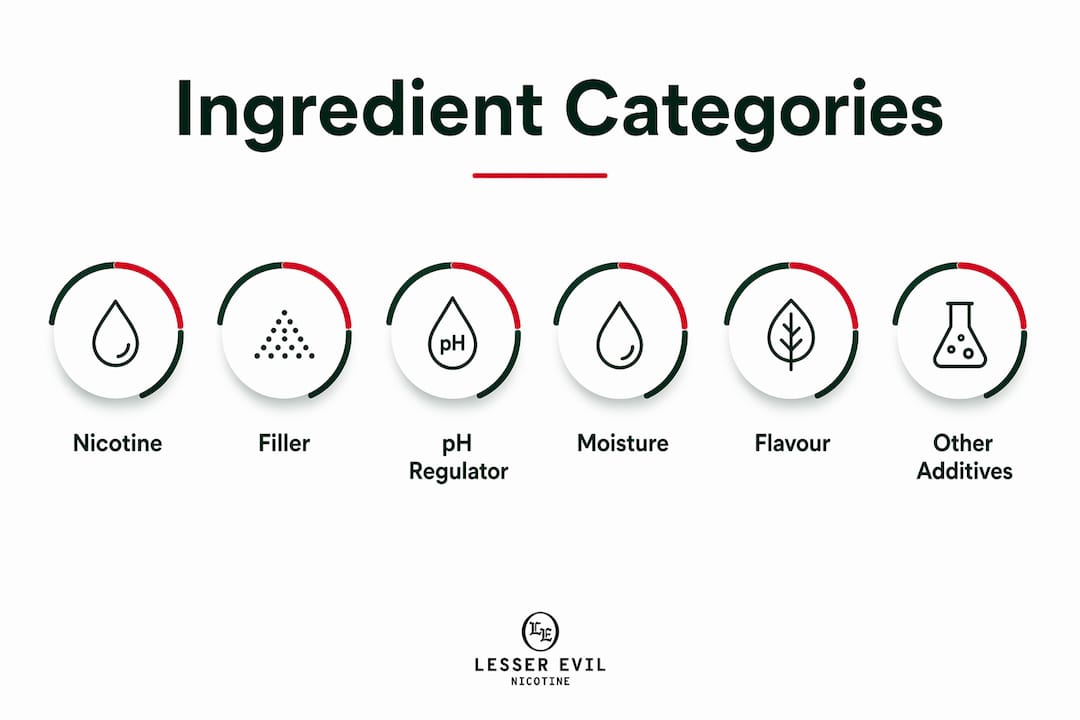
The six core ingredient categories and what each one does
Most oral nicotine products share the same basic architecture. The long chemical names on the label are almost always food- or pharma-grade ingredients doing straightforward jobs.
| Category | Typical label names | Plain-English function |
|---|---|---|
| Active nicotine | Nicotine, nicotine bitartrate | The substance you’re actually after |
| Plant-based filler/vehicle | Microcrystalline cellulose, hydroxypropyl cellulose | Gives the product structure and distributes nicotine evenly |
| pH regulator | Sodium carbonate, sodium bicarbonate | Raises alkalinity so nicotine absorbs faster through oral mucosa |
| Moisture agent | Water, humectant | Controls texture, release speed, and mouthfeel |
| Flavourings | Natural flavour, peppermint oil, fruit extract | Taste and aroma; must be food-grade in UK/EU oral products |
| Sweeteners/stabilisers | Sucralose, acesulfame K, gum arabic | Sweetness and shelf stability |
The filler (microcrystalline cellulose or hydroxypropyl cellulose) is inert — it doesn’t transfer into the bloodstream; its job is purely physical. The pH regulator is more interesting: sodium carbonate and sodium bicarbonate both push the product toward an alkaline environment, which shifts nicotine into its free-base form for quicker absorption through the oral mucosa. That’s also why some products feel sharper than others at the same nominal strength.
Moisture is a deliberate variable. Wetter products release nicotine and flavour faster; drier ones are slower and less drippy. Neither is better — it’s a formulation choice that affects feel as much as function.
Pro Tip: Prefer products with short, transparent ingredient lists. If you can’t identify the function of every item in under a minute, that’s worth questioning. Natural flavour indication (“peppermint oil”, “fruit extract”) is a cleaner signal than a generic “artificial flavouring.”
How is nicotine strength shown, and how do you compare doses?
Nicotine strength displays vary widely across UK products — mg per pouch, mg/g, percentage, or a vague descriptor like “strong.” That inconsistency is a known problem, not a quirk.
Common formats you’ll see:
- mg per pouch / mg per portion — the clearest format; tells you exactly what one use delivers
- mg/g — requires you to know the product weight to calculate per-portion dose
- % — percentage of total product weight that is nicotine; a 2% product at 0.7g per pouch = 14mg per pouch
- Descriptors only (“regular”, “strong”) — no numeric value; avoid these if precision matters to you
A quick conversion: if a label says 14 mg/g and each portion weighs 0.7g, you’re getting roughly 9.8mg per portion. That’s the maths worth doing before you assume “14” means 14mg per use.
Research confirms that simplified label formats outperform standard mg/mL or percentage labels in helping people correctly judge nicotine strength. Until standardisation arrives in the UK, the practical rules are:
- Always look for an explicit mg-per-portion figure.
- If you only see mg/g, find the stated portion weight and multiply.
- If you only see a percentage, multiply by the portion weight in grams and then by 10 to get mg per portion.
- Ignore descriptors (“medium”, “strong”) unless a numeric value backs them up.
For oral gel products, a per-spray µg or mg figure is the gold standard — it removes all ambiguity about what one dose delivers.
Plain-English translations of label terms that look scary
Many consumers see “microcrystalline cellulose” and assume the worst. Most of these names are just food or pharmaceutical terms for ordinary ingredients.
| Label term | Plain-English meaning | Why it’s there |
|---|---|---|
| Microcrystalline cellulose | Purified plant fibre | Structure and filler |
| Hydroxypropyl cellulose | Modified plant fibre | Binder and texture agent |
| Sodium carbonate | Soda ash (washing soda) | pH regulator for faster absorption |
| Sodium bicarbonate | Baking soda | Milder pH regulator |
| Sucralose | Artificial sweetener (Splenda) | Sweetness without sugar |
| Acesulfame K | Artificial sweetener (Ace-K) | Sweetness, often paired with sucralose |
| Gum arabic | Natural tree resin | Stabiliser and texture |
| Vanillin | Synthetic vanilla compound | Flavour note |
On the “natural vs synthetic” question: in UK/EU labelling, “natural flavour” means the flavouring was derived from a plant or animal source. “Artificial flavour” or “flavouring” means it was synthesised in a lab. Both must meet food-grade standards for oral products. Neither term is a health claim. If natural sourcing matters to you, look for named botanicals (“peppermint oil”, “black grape extract”) rather than the generic “natural flavour” catch-all.
Quick on-pack checks to run before you buy
Run through this before committing to any product:
- Is nicotine strength shown in mg per portion (not just mg/g or %)?
- Is there a batch number and expiry date printed on the pack?
- Is there a manufacturer name and contact address or website?
- Does the label state food-grade flavourings or list specific flavour compounds?
- Is the origin of nicotine stated (tobacco-derived or synthetic)?
Red flags: a percentage figure with no stated portion weight; a long ingredient list with no recognisable food or pharma names; absent contact details; no batch or expiry information.
UK pack analysis has found wide variance in nicotine descriptors on front-of-pack, which directly contributes to consumer confusion about actual strength. If a label leaves you guessing, that’s a product design problem, not a you problem.
What the label won’t tell you
Labels show formulation. They don’t show pharmacokinetics. You won’t find per-user absorption rates, exact delivery speed, or long-term safety data on any consumer nicotine product pack — that information simply isn’t there.
What to do instead: check the manufacturer’s website for detailed ingredient information, request a certificate of analysis from the retailer if you want lab-verified data, and read TRPR guidance for the legal limits that govern what’s permitted in UK products.
There’s also a meaningful contrast worth knowing. Vaping heats liquid and you inhale the vapour — and heated vape products can release metals and volatile compounds that aren’t present in the liquid at all. Oral gel and pouch formulations aren’t heated, so the ingredient list you read is closer to what you actually get. That’s a structural difference, not a marketing claim.
How Lesser Evil Oral Mister maps to a clean label
The Lesser Evil Oral Mister is a sublingual nicotine gel — applied under the tongue, absorbed via the oral mucosa. Here’s how it maps to the six label categories:
| Label category | Lesser Evil Oral Mister |
|---|---|
| Active nicotine | Low-dose nicotine per spray, stated in mg per dose |
| Vehicle | Water-based gel (no propylene glycol, no glycerol) |
| pH approach | Formulated for oral mucosa delivery |
| Moisture agent | Water-based; gel texture by design |
| Flavourings | Natural flavours: Peppermint, Black Grape, Green Apple |
| Sweeteners/stabilisers | Natural sweeteners; no artificial additives |
The product is tobacco-free, battery-free, and produces no e-waste. The formulation is patent-pending. Flavours are named specifically (not “natural flavour” as a catch-all), and the per-spray dose is explicit. That’s the label clarity this article has been describing — applied to a real product. For full ingredient and labelling details, the product page has everything.
Key takeaways
Every nicotine product label follows the same six-category structure — and once you know it, reading any pack takes under a minute.
| Point | Details |
|---|---|
| Six core categories | Every label covers nicotine, filler, pH regulator, moisture, flavourings, and sweeteners. |
| Prefer mg per portion | Per-portion mg is the clearest strength format; percentage alone needs portion weight to be useful. |
| Food-grade flavourings | UK/EU oral products must use food-grade flavourings; named botanicals are a cleaner signal than generic “natural flavour.” |
| Check batch and contact | Batch number, expiry, and manufacturer contact are legally required; absent details are a red flag. |
| Lesser Evil Oral Mister | Maps explicitly to all six categories with named natural flavours, per-spray dosing, and a water-based formula. |
Why label literacy matters for urban professional women in London
Most nicotine products are designed by people who assume you won’t read the label. The pouch category in particular has historically leaned into vague strength descriptors and male-coded branding that treats ingredient transparency as an afterthought.
That’s not good enough for someone who reads food labels, knows the difference between sucralose and stevia, and wants to know exactly what they’re putting in their body. The UK regulatory framework gives you the right to that information — TRPR requires it on pack. But the rules don’t yet require standardised strength display, which is why the skills in this article matter. Clear labelling supports informed choice. It doesn’t medicalise the product or make health claims. It just lets you decide.
Lesser Evil Oral Mister: a tobacco-free gel with nothing to hide
No vaporised chemicals. No battery. No rubbish ingredient list. The Lesser Evil Oral Mister is a sublingual nicotine gel with natural flavours (Peppermint, Black Grape, Green Apple), natural sweeteners, and a water-based formula that tells you exactly what’s in it and how much nicotine each spray delivers.
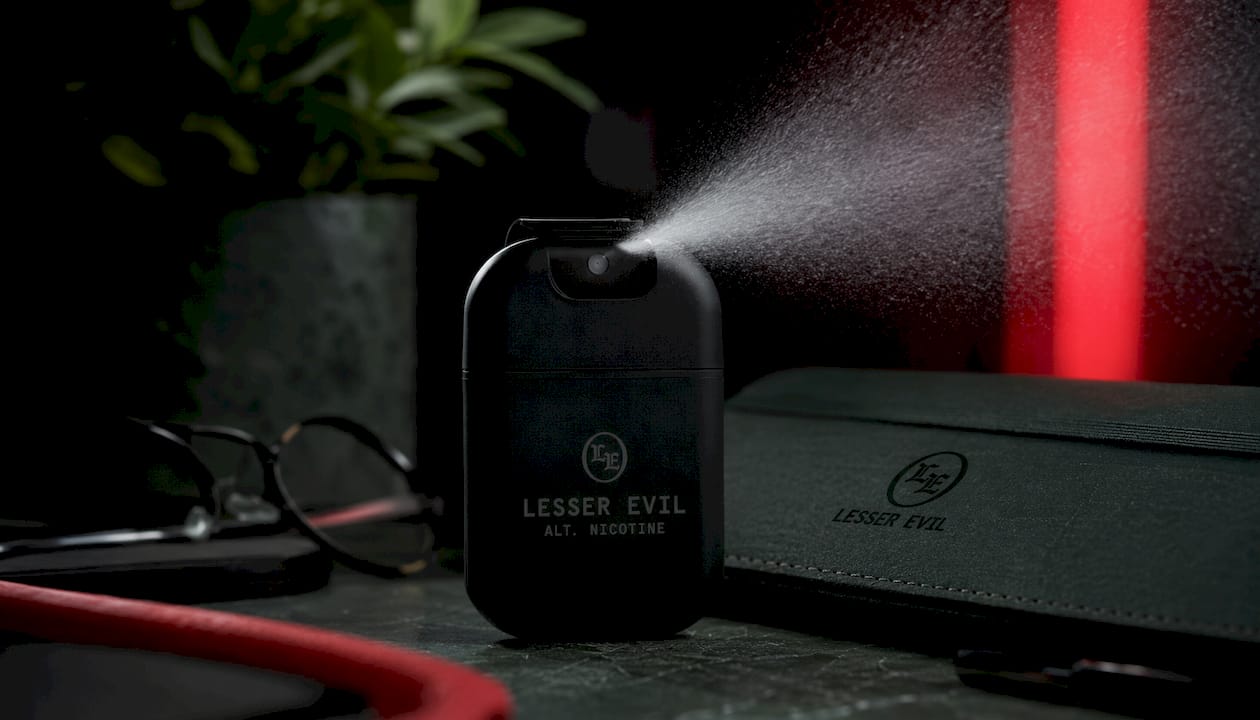
It’s tobacco-free, battery-free, and built for people who want precision over guesswork. If you’ve been using this guide to figure out what’s actually in your current product, this is what a clean label looks like in practice. View the full product details and ingredient information at the Lesser Evil Oral Mister page. For broader reading on tobacco-free alternatives, the blog has you covered.
Authoritative sources and further reading
For anyone who wants to go deeper on UK regulation, ingredient science, or independent research:
- UK TRPR labelling context — Lesser Evil’s guide to current UK nicotine product rules
- Nicotine descriptor variance on UK vape packs — peer-reviewed pack analysis on front-of-pack strength displays
- Novel nicotine label formats — experimental research on simplified strength labelling
- What’s inside a vape — Truth Initiative breakdown of heated-product chemistry
- Oral nicotine product types — overview of formulation categories for oral nicotine
- Pouch ingredient detail — industry-level comparison of pouch and vape formulations
- FDA on ENDS regulation — US regulatory context for ingredient oversight (note: UK TRPR governs UK products)