

Stop Metallic Nicotine Aftertaste for Vapers: pH, Forms, Fast Fixes

That lingering nicotine aftertaste is usually oral irritation, a stinging or metallic sensation your mouth’s nerves are producing, not a genuine smell coming off the nicotine itself. It’s chemesthesis rather than classic taste. If it’s bugging you right now, rinse your mouth with water and give it 15 minutes before you vape or smoke again. Most of the time, that alone tells you whether it’s the product or just a dry, irritated mouth.
TL;DR:
- Nicotine mainly causes a harsh, metallic aftertaste through chemesthetic irritation of trigeminal nerves, not from taste receptors.
- Higher pH free-base nicotine products tend to be harsher, while nicotine salts offer smoother, sweeter sensations due to their buffering.
- Repeated vaping or smoking increases irritation and dryness, which can intensify aftertaste, but symptoms typically diminish within hours after stopping.
- Immediate relief strategies include rinsing with water, chewing xylitol gum, and cleaning mouthpieces, with hydration and menthol flavors helping short-term.
- Switching to tobacco-free, sublingual nicotine gels or sprays avoids inhalation, combustion, and lingering vapour odour, often reducing metallic aftertaste.
Table of Contents
- What causes that stinging, metallic nicotine aftertaste?
- Does the type of nicotine change how it tastes?
- Why does your mouth feel dry and off after vaping?
- How to reduce nicotine aftertaste right now
- How long does nicotine aftertaste actually last?
- What Lesser Evil Nicotine’s formulation tells us about aftertaste
- Why does nicotine taste different for everyone?
- Does vaping or smoking more often make the aftertaste worse?
- What other chemicals in tobacco and vape liquids add to the taste?
- The conventional advice on aftertaste misses the real lever
- A smoke-free way to sidestep vapour aftertaste altogether
- Sources
- FAQ
What causes that stinging, metallic nicotine aftertaste?
Your tongue has two separate systems reporting back to your brain, and nicotine messes with both of them differently. Taste receptors handle sweet, sour, salty, bitter and umami. Chemesthesis is the other system, the one that reacts to wasabi’s sinus-burn, chilli’s heat and menthol’s cold snap. Nicotine sits mostly in that second camp.
Nicotine binds to trigeminal nociceptors, the same pain-sensing nerve endings that flare up when you bite into a raw chilli. That’s why people describe nicotine as “harsh” or “stinging” rather than simply bitter. Research into flavour science around vaping backs this up directly: nicotine’s core sensation is chemesthetic irritation, triggered through trigeminal pathways rather than a straightforward bitter-taste response.
There’s a receptor-level story here too. Nicotine activates nicotinic acetylcholine receptors, or nAChRs, which sit on both taste cells and trigeminal nerve fibres. A review of nicotine’s sensory effects found it elicits oral irritation and bitter taste through nAChRs and trigeminal nociceptors working in tandem, which is part of why the sensation feels layered rather than one-note. Peer-reviewed work on taste signalling adds another wrinkle: nicotine triggers both TRPM5-dependent and TRPM5-independent taste pathways, and blocking nAChRs with the compound mecamylamine dulls the taste response in animal studies. Two separate routes to the same unpleasant destination.
Here’s the bit most people never get told: nicotine doesn’t just add a bad flavour, it actively changes how everything else tastes.
- Nicotine suppresses perceived sweetness, which is why a normally sweet vape juice can taste flatter after a heavy session.
- It amplifies bitterness and harshness at higher concentrations, especially with free-base formulations.
- It can dull overall flavour intensity, leaving food and drink tasting muted for a short stretch afterwards.
- Menthol cross-desensitises the same trigeminal nerves nicotine irritates, which is why peppermint or menthol products often feel noticeably smoother.
Chemesthesis, in one line: it’s your mouth’s pain and temperature system reacting to a chemical, not your taste buds registering a flavour. That distinction explains almost everything else in this article.
Concentration matters more than most people assume. A review of nicotine formulations notes that manufacturers have deliberately engineered nicotine salt formulas specifically to push the sensory profile away from harsh chemesthetic irritation and towards smoothness, because the raw sensation from free-base nicotine at higher strengths is intense enough to put people off. That single fact underpins the entire nicotine salt category, and it’s the next place to look if you’re chasing a smoother experience as supported by clinical research.
Does the type of nicotine change how it tastes?
Yes, and the difference is measurable, not just anecdotal. A controlled clinical trial testing two nicotine salt formulations, benzoate and lactate, against free-base nicotine found something clear: nicotine salts produced higher smoothness and sweetness ratings and lower bitterness and harshness scores at both 50% and 100% concentrations. Free-base nicotine, the form used in most traditional cigarettes and some vape liquids, tends to hit harder and taste rougher. Salts are chemically buffered to feel gentler on the same trigeminal receptors doing all the complaining.
pH plays a bigger role than flavour ever will. That same clinical work found higher pH levels correlated directly with worse sensory appeal, meaning a more alkaline product tends to taste harsher and less pleasant, independent of the flavouring used. This matters for anyone comparing products, because two items with identical flavour names can taste completely different depending on their underlying chemistry.
- Free-base nicotine: typically higher pH, faster absorption through the lungs, associated with harsher chemesthetic sensations at comparable strengths.
- Nicotine salts (benzoate, lactate): lower pH, smoother sensory profile, the format most modern pod vapes use.
- Alkaline-buffered oral products: sometimes deliberately raised in pH to speed absorption through the mouth, which is where metallic aftertaste often creeps in.
That third point deserves its own explanation, because it trips people up constantly. Some oral nicotine products use alkaline buffering agents, sodium carbonate is a common one, to help nicotine cross the oral mucosa faster. The trade-off is a rapid shift in salivary pH, and flavour science research points to that alkaline spike as a major driver of metallic aftertaste in oral formats specifically. It’s not the nicotine tasting metallic. It’s the chemistry around it doing that.
One more thing worth clearing up: nicotine itself has no meaningful odour. The smell that clings to clothes, hair and car interiors after smoking comes from combustion, tar and the hundreds of other compounds released when tobacco burns, not from the nicotine molecule. That’s also true of the “no smell nicotine” search a lot of people run, because they’re conflating nicotine with the smoke around it. A smoke-free format naturally sidesteps that lingering scent simply because there’s nothing burning.
Why does your mouth feel dry and off after vaping?
Sometimes the aftertaste has nothing to do with the product’s chemistry and everything to do with what vaping does to your mouth. “Vape tongue” is the informal term for a temporary dulling of taste, and it’s a genuine sensory phenomenon, not just in your head.
Here’s what tends to be going on:
- Dehydration reduces saliva flow, and saliva is what carries flavour compounds to your taste receptors in the first place. Less saliva means muted, sometimes metallic-tasting results.
- Mouth breathing dries out oral tissue further, which compounds the dehydration problem, especially if you’re vaping frequently through the day.
- Residue builds up on device coils and mouthpieces, and that gunk imparts its own burnt or bitter notes that have nothing to do with the e-liquid flavour you picked.
- Recent food and drink skew your baseline, coffee, spicy meals and acidic drinks all temporarily shift how sensitive your taste buds are.
- Repeated exposure causes short-term receptor fatigue, similar to how a strong smell fills a room and then seems to fade the longer you’re in it.
The quickest diagnostic is simple. Drink a full glass of water, wait ten minutes, then try again. If the harshness drops noticeably, you were dealing with dry mouth or residue, not a flaw in the product. If nothing changes, the formulation itself is more likely the culprit. Dry mouth from vaping is common enough that it’s worth ruling out before you blame your juice or your gel.
How to reduce nicotine aftertaste right now
Fixing this doesn’t need to be complicated. Some remedies work in minutes, others need a day or two to show their effect properly.
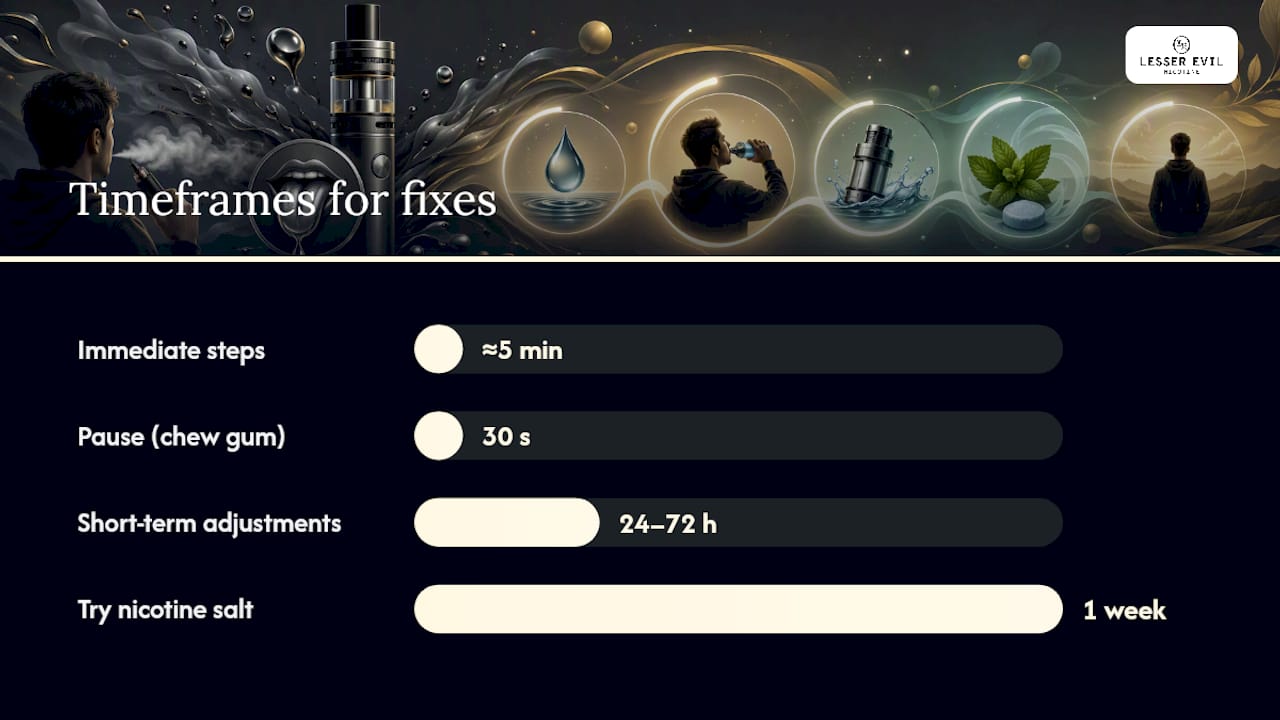
Immediate steps (next five minutes):
- Rinse your mouth with plain water, swishing for a few seconds before spitting it out.
- Chew a piece of xylitol gum, it boosts saliva flow and doesn’t mask the taste with more sugar.
- Brush your tongue, not just your teeth, since residue collects there more than people realise.
- Wipe down or clean your device’s mouthpiece if you’re vaping, since built-up gunk contributes its own bitterness.
Short-term adjustments (next 24 to 72 hours):
- Prioritise hydration throughout the day, not just when your mouth already feels dry.
- Get proper sleep, since fatigue itself can dull and distort taste perception.
- Try switching to a mint or menthol flavour for a few days, since menthol cross-desensitises the same trigeminal nerves that nicotine irritates, often making the whole experience feel smoother.
- If you’re using a high-strength free-base product, testing a nicotine salt formulation for a week is a reasonable way to see whether the harshness eases.
For anyone using nicotine gum or a similar oral product, technique changes the outcome more than people expect. The “chew and park” method, chewing briefly then resting the gum against your cheek rather than continuously chomping, prevents the sharp pH spikes that trigger sudden metallic hits. Products with alkaline buffers are the most prone to this, so pacing yourself matters more with those than with acidic or neutral-pH options.
Pro Tip: If a metallic taste appears suddenly partway through using an oral nicotine product, don’t keep chewing through it. Park it, swallow your saliva a couple of times, and give your mouth thirty seconds before continuing. That short pause is usually enough to let the pH spike settle.
If none of this shifts things and the aftertaste sticks around regardless of what you try, that’s a signal to see a dentist or GP rather than keep experimenting with flavours.
How long does nicotine aftertaste actually last?
Most chemesthetic irritation from nicotine is short-lived, clearing within minutes to a couple of hours once you rinse, hydrate or simply stop exposure. It isn’t a lasting change to your senses in the vast majority of cases.
Repeated, heavy exposure across a single day is a different story. Your trigeminal nerves and taste receptors can experience temporary desensitisation, similar to how your nose stops registering a smell after long exposure to it. This isn’t permanent damage. Sensitivity typically returns over days to weeks once exposure drops, based on general patterns seen with chemesthetic and taste receptor recovery.
Watch for signals that go beyond ordinary aftertaste. Persistent loss of taste or smell lasting more than a few days, mouth ulcers, unexplained bleeding, or any neurological symptoms like numbness or tingling that doesn’t resolve are reasons to get checked by a dentist or doctor rather than wait it out. Ordinary product-related aftertaste doesn’t come with those symptoms, and if yours does, that’s a different conversation entirely.
What Lesser Evil Nicotine’s formulation tells us about aftertaste
We build oral nicotine gel and spray, so we spend a lot of time thinking about what happens in someone’s mouth in the thirty seconds after they use a product. Our formulation is sublingual, meaning it sits under the tongue and absorbs through the oral mucosa, tobacco-free, battery-free, and flavoured with natural ingredients across Peppermint, Black Grape and Green Apple.
None of that is a health claim. It’s a description of how the format works. Because there’s no burning involved, there’s no smoke and no ash, which means none of the lingering combustion odour that clings to clothes and hair after a cigarette. That’s a straightforward chemistry outcome, not a promise about wellbeing.
For anyone who’s read this far and wants the deeper mechanics, our piece on how flavour affects nicotine acceptance goes further into formulation choices, and our natural flavours breakdown covers why we chose the ingredients we did.
— Luke McLeod
Why does nicotine taste different for everyone?
Genetics explain a fair chunk of why your mate can vape the same juice as you and describe it completely differently. Bitter taste perception is one of the most studied genetic variations in human sensory biology, and the same variability applies to how intensely someone experiences nicotine’s chemesthetic sting.
People carrying certain variants of bitter taste receptor genes are often classed as “supertasters,” registering bitter and irritant compounds far more intensely than average. If you’ve always found vaping or smoking rougher than everyone around you describes, genuine biological variation in receptor density and sensitivity is a plausible explanation, not just a difference in preference.
Age and smoking history change the picture too. Long-term smokers frequently report reduced taste sensitivity overall, partly from chronic exposure dulling receptor responsiveness over time. That’s one reason people who’ve smoked for years sometimes barely notice an aftertaste that a first-time vaper finds overwhelming; their baseline sensitivity has shifted. Hormonal factors and even recent illness can temporarily alter taste perception as well, which is why the same product can taste different to the same person on different days.
None of this means the sensation isn’t real when you notice it. It means two people can have an identical product experience and describe it in completely different terms, and both are accurately reporting what their nervous system is telling them.
Does vaping or smoking more often make the aftertaste worse?
Frequency and intensity both shape how pronounced nicotine’s aftertaste feels, and the relationship isn’t purely linear. Someone taking occasional puffs across a day generally reports less cumulative irritation than someone chain-vaping through back-to-back sessions.
Part of this comes down to receptor fatigue. Trigeminal nerves and taste cells exposed repeatedly in a short window respond less sharply with each subsequent exposure, similar to how a strong perfume seems to fade the longer you’re around it. Paradoxically, that can mean heavy same-day use sometimes feels less harsh in the moment, only for the irritation to resurface once you stop and your receptors reset.
Puff intensity, how deep and how long each inhalation is, also changes total nicotine and irritant exposure per session. Sustained sessions using higher wattages or higher-strength liquids deliver more nicotine per puff, which means more chemesthetic stimulation hitting the same receptors in a shorter span. If your aftertaste has been getting steadily worse, it’s worth honestly tracking whether your session frequency or intensity has crept up rather than assuming the product itself has changed.
This is also where the earlier “vape tongue” mechanics compound the problem. Frequent use dries out your mouth faster, saliva flow drops, and the reduced dilution effect means whatever irritant is present sits at a higher effective concentration in your mouth for longer.
What other chemicals in tobacco and vape liquids add to the taste?
Nicotine rarely acts alone. Vape liquids and tobacco products both contain a mix of compounds that shape the final sensory experience alongside nicotine’s own chemesthetic effect.
Propylene glycol and vegetable glycerine, the base liquids in most e-cigarettes, carry their own subtle flavour and mouthfeel, and higher PG ratios in particular tend to produce a sharper throat hit that can amplify the sense of harshness. Flavouring compounds add another layer. Cherry and other fruit flavourings have been shown in controlled testing to increase perceived sweetness and pleasantness when paired with nicotine, sometimes softening the overall aftertaste. The same research flags a catch worth knowing: certain volatile aroma compounds, benzaldehyde among them, can increase airway irritation when aerosolised, even as they make the liquid taste nicer. A flavour that tastes smoother in the mouth isn’t automatically gentler once it’s inhaled.
Combustion introduces a completely different chemical set. Burning tobacco releases tar, carbon monoxide and thousands of pyrolysis byproducts that contribute their own bitter, acrid notes layered on top of whatever nicotine itself is doing. That’s a large part of why cigarette aftertaste and vape aftertaste feel so different even at similar nicotine strengths; one format is adding combustion chemistry to the mix and the other isn’t. For a closer look at how burning specifically shapes flavour perception, retrohaling research from cigar sensory science breaks down how smoke interacts with olfactory pathways in ways nicotine alone never does.
The conventional advice on aftertaste misses the real lever
Most guidance on nicotine aftertaste jumps straight to masking, more mint, stronger flavours, sugar-free gum, and stops there. That’s a reasonable short-term patch, but it skips the actual lever that matters most: the chemistry of the product itself, specifically its pH and nicotine form.
The clinical data on nicotine salts versus free-base nicotine is the part people underweight. A formulation change does more for sensory comfort than any amount of flavour-chasing, because you’re addressing the trigeminal irritation at its source rather than trying to out-flavour it. If you’ve cycled through five different mint flavours and still get hit with harshness or a metallic edge, the format is very likely the actual problem, not your flavour choice.
The other overlooked piece is hydration’s outsized role. It sounds almost too simple to be useful, but dry mouth genuinely concentrates whatever irritant is present, and most people troubleshoot everything except the glass of water that would have solved it in ten minutes.
— Luke McLeod
A smoke-free way to sidestep vapour aftertaste altogether
If you’ve read this far, you already understand why some of that harshness and lingering aftertaste traces back to inhaling vapour or smoke in the first place, not just to the nicotine inside it. An oral nicotine sublingual gel and spray format exists that is designed to skip that inhalation step entirely.
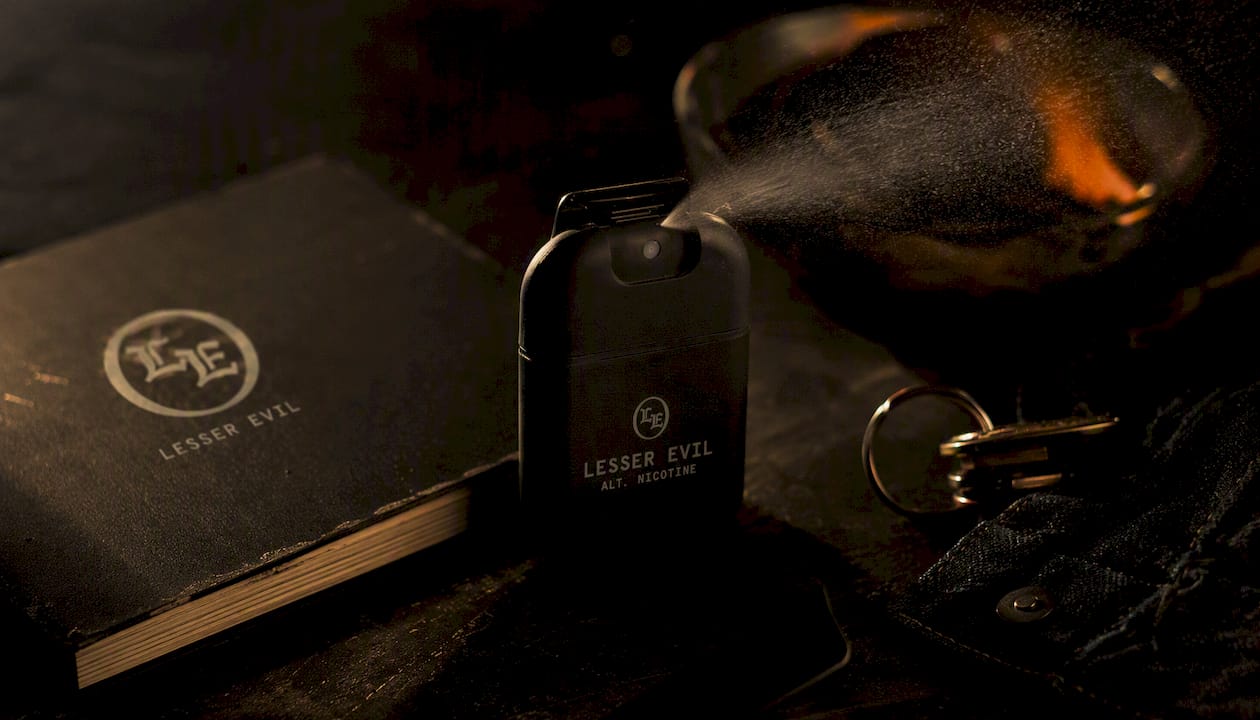
This product is designed to sit under the tongue, absorbing through the oral mucosa rather than the lungs. It is tobacco-free and battery-free, so there is no vapour to inhale, no combustion odour to linger on clothes, and no e-waste from devices. It is offered in three natural flavours: Peppermint, Black Grape and Green Apple, formulated with natural sweeteners. For anyone who’s spent this whole article nodding along about metallic aftertaste from alkaline-buffered products or harshness from free-base nicotine, a low-burn gel format built around a cleaner ingredient list is worth a look precisely because it changes the chemistry, not just the flavour on top of it.
Head to the Lesser Evil Oral Mister product page for the full ingredient list and dosing guidance, or browse the wider Lesser Evil Nicotine range to compare flavours before you order.
Sources
The sensory science behind this article draws on peer-reviewed work covering how nicotine interacts with trigeminal nerves and taste pathways, including flavour science research on electronic cigarettes, the clinical comparison of nicotine salt and free-base sensory attributes, and a review of nicotine’s broader sensory effects. For readers wanting the receptor-level detail, the TRPM5 and nAChR taste pathway study is the primary source.
On the product side, our own pages on odourless nicotine chemistry and managing cravings without vapour clouds go into more depth than this article had room for.
- Frontiers | Flavor science in the context of research on electronic cigarettes
FAQ
How do I get rid of nicotine taste in my mouth?
Rinse with water first, then chew xylitol gum to boost saliva flow and clear residue. If the taste persists after that, cleaning your device’s mouthpiece or switching to a lower-pH, mint-flavoured product often resolves it within a day.
Is vaping 20 times a day likely to make aftertaste worse?
Frequent, intense vaping sessions increase cumulative exposure to nicotine and other compounds, which tends to worsen dryness and irritation over the course of a day. Spacing sessions out and hydrating between them typically reduces the buildup noticeably.
How long does it take for nicotine to fully leave your system?
This varies by individual metabolism and usage pattern, and isn’t something this article can put a precise figure on. What’s better established is that the chemesthetic aftertaste itself, the stinging or metallic sensation, usually clears within minutes to a couple of hours once you rinse or stop exposure.
Can a dulled sense of taste from smoking be reversed?
Taste sensitivity affected by heavy smoking or vaping often improves over days to weeks once exposure reduces, based on how chemesthetic and taste receptor recovery generally works. Persistent loss of taste lasting beyond that window warrants a dental or medical check rather than waiting it out.
Does switching to an oral nicotine product change the aftertaste?
It can, mainly because you remove inhalation and combustion from the equation entirely. Lesser Evil Nicotine’s Oral Mister is tobacco-free and battery-free, and its natural flavour profile means the sensory experience comes from gel chemistry rather than vapour or smoke, though individual response still varies by formulation and pH.