

Natural flavours in oral nicotine gels: a practical guide

Natural flavours in tobacco-free oral nicotine gels and sprays do one primary job: make nicotine tolerable. Raw nicotine is bitter, harsh, and unpleasant at almost any dose. Natural flavouring agents, whether peppermint extract, black grape, or green apple, mask that bitterness, add sweetness or cooling, and reduce the sensory friction that would otherwise put you off using the product. A randomised controlled trial published in Tobacco Control found that mint, menthol, and citrus variants were rated significantly more appealing than unflavoured options, with higher use intentions among adult users of inhalable nicotine products.
What flavours do not do is change how much nicotine you absorb. Clinical pharmacokinetic data show that when nicotine content is held constant, flavour does not substantially alter Tmax, Cmax, or AUC. Nicotine dose and buccal pH drive uptake. Flavour drives palatability and your willingness to stick with a non-inhalable format.
- Natural flavours mask nicotine bitterness and improve palatability
- Cooling and sweetness increase product appeal in adult users
- Flavour choice does not change nicotine absorption
- pH and nicotine dose are the real pharmacokinetic levers
Table of Contents
- What does ‘natural flavours’ actually mean in a sublingual gel?
- How natural flavours shape sensory experience and product appeal
- Why pH and nicotine form matter alongside flavour
- Safety signals and flavouring additives worth knowing
- How Lesser Evil Nicotine positions natural flavours in a low-burn gel
- Do natural flavours affect satisfaction in tobacco-free oral nicotine users?
- Can natural flavour components cause allergic reactions?
- Natural versus artificial flavours: what actually differs?
- Long-term effects of repeated flavouring agent exposure
- Key takeaways
- The flavour question nobody asks
- Lesser Evil Oral Mister: where to find it
- Useful sources
What does ‘natural flavours’ actually mean in a sublingual gel?
In a tobacco-free oral nicotine gel or spray, ‘natural flavours’ refers to botanical extracts and food-grade flavouring preparations derived from plant sources. Peppermint oil, grape skin extract, and apple-derived flavour compounds are typical examples. They appear on ingredient labels as ‘natural flavouring’, ‘natural flavour’, or by the specific botanical name (e.g. Mentha piperita extract).
Three broad families dominate oral nicotine products. Mint and menthol deliver cooling and freshness. Fruit profiles, including black grape and green apple, lean sweeter and less sharp. Citrus variants sit somewhere between the two, with brightness and mild acidity.
‘Natural flavour’ is a sensory descriptor and an ingredient class, not a safety guarantee. The term tells you the flavour source is plant-derived; it says nothing about concentration, purity, or the presence of additional flavouring chemicals in the formulation.
Labelling practices vary. Some products list individual flavour compounds; others use the catch-all ‘natural flavouring’. If you want to know exactly what is in a product, look for a full ingredient disclosure or contact the manufacturer directly.
How natural flavours shape sensory experience and product appeal
Oral nicotine products are judged on five sensory axes: sweetness, cooling, bitterness, harshness or irritation, and aftertaste. Natural flavours act on all five, but not equally.
| Flavour family | Typical sensory profile | Best fit for professional use |
|---|---|---|
| Mint / menthol | Strong cooling, fresh aroma, low sweetness | Familiar, discreet if mild; strong menthol can be noticeable |
| Fruit (grape, apple) | Sweeter, softer, lower cooling | Lower sensory footprint; suits those sensitive to cooling |
| Citrus | Bright, slightly acidic, moderate sweetness | Clean aftertaste; less cooling than mint |
| Smooth / unflavoured | Bitter, harsh, no masking | Rarely preferred; lowest appeal scores in trials |
Research from Ohio State found that fruit flavours caused less burning than mint in young adult vapers, and gum formulations scored higher on sweetness and flavour strength than pouches. For someone switching from vaping, a fruit or citrus profile often feels less abrupt than a sharp menthol hit.
Pro Tip: Try one flavour at home at a low dose before committing to a full pack. Note the sweetness-to-cooling ratio after two minutes. If it feels too ‘candy’, go cooler; if the menthol is overpowering, try a fruit profile instead.
Why pH and nicotine form matter alongside flavour
pH is the variable most people overlook. In a sublingual gel or pouch, buccal pH determines how much nicotine exists in its free-base form versus its protonated (salt) form. Free-base nicotine crosses the oral mucosa more readily, but it also tastes harsher. A predictive pharmacokinetic model published in Nature Scientific Reports identified buccal and saliva pH as a pivotal parameter for nicotine permeability and absorption.
The relationship between pH and appeal is not linear. A randomised experimental study in PMC found an inverted U-shape: mid-range pH values produced the most favourable sensory ratings, while extremes in either direction reduced sweetness and appeal. High nicotine concentration independently reduced appeal scores and increased perceived harshness.
| pH range | Nicotine form | Typical sensory effect |
|---|---|---|
| Low (acidic, ~4–5) | Mostly protonated | Reduced absorption; milder taste but lower delivery |
| Mid-range | Mixed | Optimal sensory balance; highest appeal ratings in trials |
| High (alkaline, ~8) | Mostly free-base | Faster absorption; increased bitterness and harshness |
Natural flavours do not meaningfully shift this chemistry. A peppermint extract does not change the pH of a formulation; the manufacturer sets pH deliberately. What flavour does is layer sweetness and cooling on top of whatever the underlying chemistry delivers, softening the perception of harshness without altering the pharmacokinetics. Oral nicotine delivery explained covers the buccal absorption mechanism in plain language if you want the full picture.
Safety signals and flavouring additives worth knowing
Natural does not mean inert at high concentrations. Laboratory analyses of oral nicotine products detected a wide range of flavouring chemicals, with menthol the most frequent. Triacetin and methyl salicylate appeared at high concentrations in some products. Synthetic coolants such as WS-3 and WS-23 were also detected.
Long-term oral exposure to concentrated flavouring chemicals in nicotine products is not yet well characterised. Most toxicology data comes from inhalation studies, which are not directly applicable to sublingual or buccal use. Treat any product with a long, opaque ingredient list with appropriate caution.
Additives to look for on labels:
- WS-3 / WS-23: synthetic coolants that activate the TRPM8 receptor without menthol’s odour; used to preserve cooling effects after flavour bans
On the UK regulatory front, the Tobacco and Vapes Bill includes powers to restrict flavours in nicotine products, restrict sales to under-18s, and tighten advertising rules. Synthetic coolants like WS-3 present an enforcement challenge because they can produce a characterising cooling sensation without technically meeting the definition of a ‘menthol flavour’. For the latest on UK vape regulations in 2026, check current government guidance.
How Lesser Evil Nicotine positions natural flavours in a low-burn gel
Lesser Evil Nicotine is preparing a UK launch in 2026 with a patent-pending sublingual nicotine gel built around natural flavours and natural sweeteners. The product facts:
- Sublingual gel, absorbed via the oral mucosa (under the tongue)
- Tobacco-free, battery-free, zero e-waste
- Natural flavours and natural sweeteners only
- Three flavours: Peppermint, Black Grape, Green Apple
- Water-based formulation; a mouth spray is also planned
- Precision dosing for controlled, low-burn use
For a professional woman who vapes and wants to stop breathing in vaporised chemicals, the format matters. You don’t inhale it. There’s no battery to charge, no vapour cloud, no smell lingering on your clothes. The fruit and peppermint profiles are designed for a low sensory footprint, which maps directly to the discretion priorities covered in this article. Oral nicotine product benefits has the full product breakdown.
Do natural flavours affect satisfaction in tobacco-free oral nicotine users?
Flavour does influence how satisfying a product feels, though the mechanism is sensory rather than pharmacological. A product that tastes good is one you actually use consistently. A broad evidence review links sweetness and coolness to increased liking and sustained use patterns in adult nicotine users.
The practical implication: if a flavour feels unpleasant, you’ll use the product less consistently, which undermines the whole point of switching from inhalable formats. Getting the flavour right is not a luxury. It’s what keeps you off the vape.
Can natural flavour components cause allergic reactions?
Yes, some can. Menthol and methyl salicylate are the most common sensitisers in oral nicotine products. Menthol can trigger contact sensitivity in people with existing reactions to Lamiaceae family plants (mint, basil, lavender). Methyl salicylate is chemically related to aspirin; people with salicylate sensitivity should check labels carefully.
Fruit-derived flavour compounds are generally lower-risk, but ‘natural’ does not mean allergen-free. If you notice oral irritation, swelling, or unusual tingling that persists beyond normal product use, stop and consult a pharmacist or GP. UK vaping and nicotine product flavour trends includes useful background on common flavour ingredients.
Natural versus artificial flavours: what actually differs?
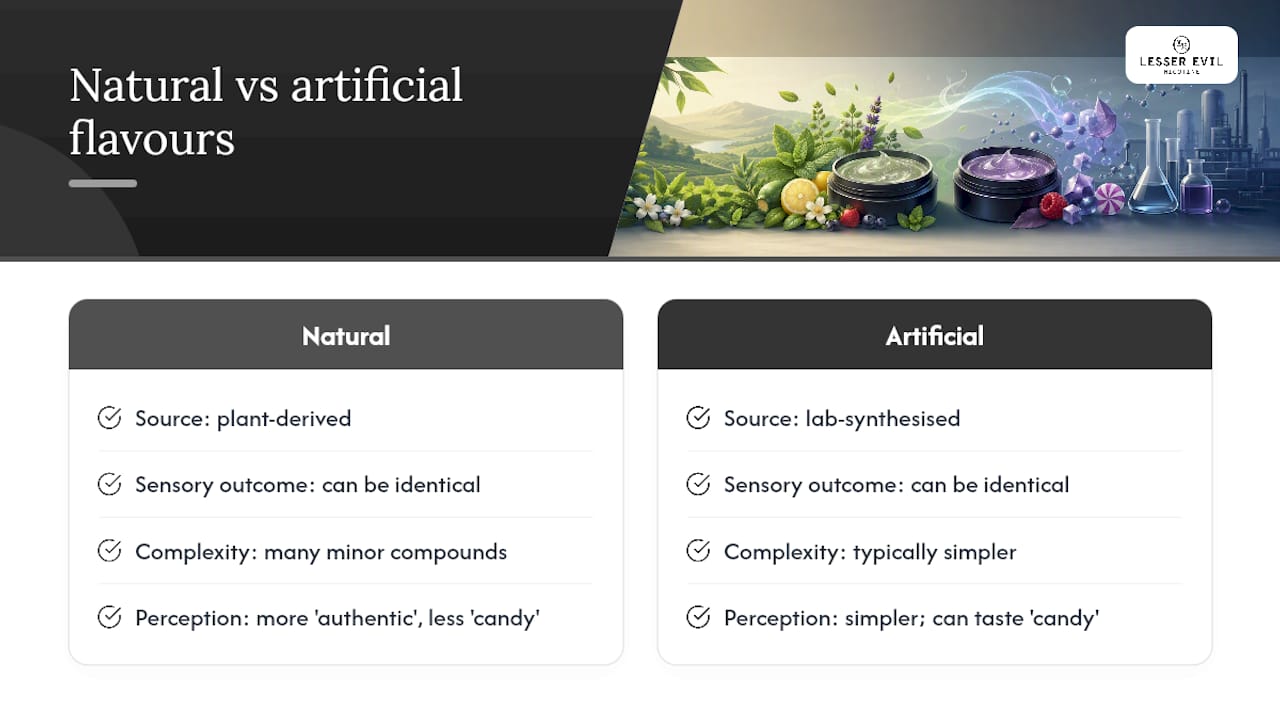
The honest answer is: less than the marketing suggests, and more than the ingredient list shows. Natural flavours are derived from plant sources; artificial flavours are synthesised in a lab. Both can produce identical sensory outcomes. Both can include compounds that raise safety questions at high concentrations.
Where natural flavours tend to win on user experience is complexity and authenticity. A natural peppermint extract carries dozens of minor flavour compounds alongside menthol; a synthetic peppermint flavour is typically simpler. That complexity is often perceived as more ‘real’ and less ‘candy’. For adult users who find artificial sweetness off-putting, natural profiles tend to feel more balanced.
From a health-impact standpoint, the distinction matters less than concentration and formulation. A natural flavour at a very high concentration can be more irritating than a well-formulated artificial one. The ingredient source is less important than what is actually in the product and at what level.
Long-term effects of repeated flavouring agent exposure
This is the honest gap in the evidence. Most safety data for flavouring chemicals comes from food-grade or inhalation contexts, neither of which maps cleanly onto daily sublingual use over months or years. Oral mucosal tissue is more permeable than skin but less exposed than lung tissue, so inhalation toxicology data cannot be applied directly.
What is known: menthol at high oral doses has shown effects on oral mucosal tissue in some studies. Methyl salicylate accumulates with repeated exposure and is absorbed through the oral mucosa. Synthetic coolants like WS-3 are relatively new in consumer products, and long-term human data simply does not exist yet.
The practical takeaway: choose products with transparent ingredient lists, avoid formulations with very high concentrations of any single flavouring chemical, and stay alert to UK regulatory updates as the Tobacco and Vapes Bill powers come into force.
Key takeaways
Natural flavours in tobacco-free oral nicotine gels improve palatability and discretion, but nicotine dose and buccal pH remain the primary drivers of absorption and sensory harshness.
| Point | Details |
|---|---|
| Flavour masks bitterness | Natural flavours improve palatability by masking nicotine’s bitter taste; mint, fruit, and citrus score highest on appeal in trials. |
| Flavour doesn’t change uptake | Clinical PK data confirm flavour does not substantially alter Tmax, Cmax, or AUC when nicotine dose is held constant. |
| pH is the real lever | Mid-range buccal pH produces the best sensory balance; extremes reduce sweetness and appeal in an inverted U-shape pattern. |
| Watch the ingredient list | Menthol, methyl salicylate, triacetin, and synthetic coolants (WS-3/WS-23) appear in many products; long-term oral exposure data is limited. |
| Lesser Evil Nicotine | Sublingual gel with natural flavours (Peppermint, Black Grape, Green Apple), tobacco-free and battery-free, launching in the UK in 2026. |
The flavour question nobody asks
The conversation about natural flavours in oral nicotine products almost always focuses on appeal, as if the only thing that matters is whether you like the taste. That misses the more interesting point.
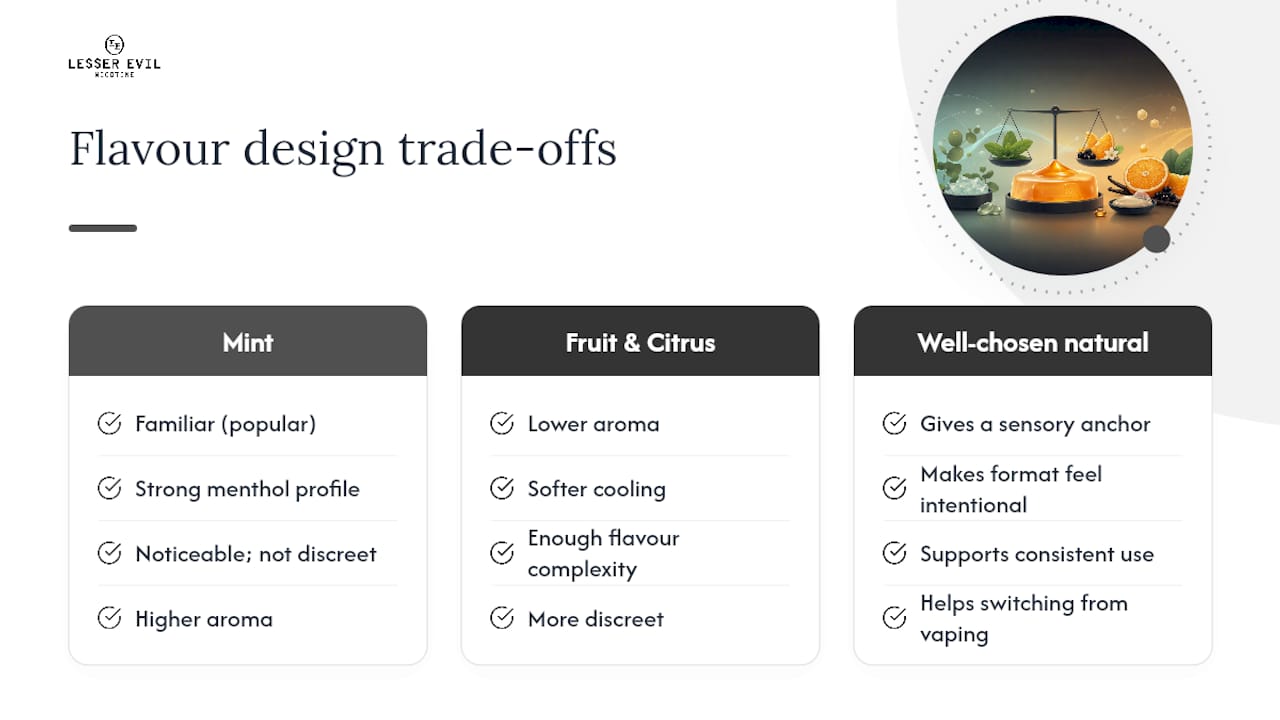
Flavour is the interface between a product’s chemistry and a person’s willingness to use it consistently. For someone switching from vaping, the sensory experience of a sublingual gel is genuinely unfamiliar. It doesn’t hit the throat. There’s no cloud. The ritual is completely different. A well-chosen natural flavour doesn’t just make the product taste better; it gives you a sensory anchor that makes the new format feel intentional rather than like a compromise.
What I think gets underestimated is the discretion dimension. Mint is popular because it’s familiar, but a strong menthol profile in a professional setting is not actually discreet. It’s noticeable. The more interesting design space is the fruit and citrus end: lower aroma, softer cooling, still enough flavour complexity to feel like a real product rather than a medical lozenge. Lesser Evil Nicotine’s Black Grape and Green Apple profiles sit exactly in that space, which is why the brand’s approach to flavour feels more considered than most of what’s currently on the market.
Lesser Evil Oral Mister: where to find it
If you’ve read this far and you’re ready to try a sublingual gel that actually takes flavour seriously, Lesser Evil Nicotine is the one to watch. The Lesser Evil Oral Mister is a tobacco-free, battery-free sublingual nicotine gel with natural flavours and natural sweeteners, available in Peppermint, Black Grape, and Green Apple. No vape cloud. No e-waste. No rubbish in the formula.

UK launch is planned for 2026. Head to lesserevil.store to register your interest, check availability, and get product details before it hits shelves.
Useful sources
- Effects of flavour and modified risk claims on nicotine pouch perceptions and use intentions among young adults who use inhalable nicotine and tobacco products: a randomised controlled trial | Tobacco Control
- Effects of Nicotine Concentration and pH on Nicotine Pouch Appeal and Sensory Experience: A Randomized Experimental Study - PMC
- Classification, perception, and toxicity of emerging flavored oral nicotine pouches | MDPI/International Journal of Environmental Research and Public Health
- A themed issue editorial on the role of flavouring in tobacco products - PMC
- Use of nicotine pouches in the UK: product and user characteristics (PLOS One printable)
- Synthetic cooling agents and flavour ban circumvention in ONPs (medRxiv preprint)
- Plasma nicotine pharmacokinetics of oral nicotine pouches across varying flavours and nicotine content (Velo study PDF)
- Appeal and sensory characteristics of oral nicotine products in young adults who vape e‑cigarettes (Ohio State study)
- Predictive pharmacokinetic modelling of buccal absorption from ONPs (Nature Scientific Reports, 2026)