

Odourless nicotine: why pharmaceutical grade purity removes smell

Yes, genuinely odourless nicotine exists: unflavoured pouches, sublingual gels and sprays, and unflavoured lozenges all fit the bill. Whether any single product delivers on that promise depends almost entirely on the purity of the nicotine used and how it’s formulated. There’s addiction risk with any nicotine product, and worth knowing that discreet doesn’t mean risk-free. There are tobacco-free sublingual nicotine options built around that discretion.
TL;DR:
- Only pharmaceutical-grade nicotine with USP or EP standards is truly odourless, as lower grades contain traces that cause smell.
- Vapes produce faint vapour smell even at low flavours, making them less suitable for those seeking completely odourless options.
- Odourless products still carry addiction risks, and contamination has been flagged in some market options, urging caution despite marketing claims.
- Discretion depends on format: pouches offer long-lasting silence, while gels and sprays act faster but require careful handling to avoid odour release.
- “Odourless” claims are often marketing shorthand; verified purity and lab testing are essential for ensuring actual neutrality.
Table of Contents
- What counts as odourless or low-odour nicotine?
- Why some nicotine products don’t smell at all
- Is odourless nicotine actually safe to use?
- How to choose the right odourless nicotine product
- Using pouches, gels and lozenges without drawing attention
- What Lesser Evil Nicotine brings to the odourless conversation
- Why “odourless” gets thrown around too loosely
- Try Lesser Evil Oral Mister for a discreet, tobacco-free option
- Sources
What counts as odourless or low-odour nicotine?
Not every “discreet” nicotine product is actually odourless. Some just smell less obvious than a cigarette, which isn’t the same thing.
Nicotine pouches sit between your gum and lip, releasing nicotine through the oral mucosa for roughly 30 to 60 minutes. Unflavoured versions are built from plant fibres and water, marketed as smoke-free and spit-free, and are about as close to scentless as pouches get, according to the American Lung Association.
Sublingual gels and sprays work the same way, absorbed under the tongue rather than heated or burned. No smoke means nothing lingering on your breath or clothes.
Lozenges and gum dissolve slowly in the mouth, with a longer, gentler release than a pouch.
Low-scent vapes are the outlier here. Even “unflavoured” e-liquid produces vapour, and vapour carries some smell, however faint. Calling any vape truly odourless is a stretch.
A quick breakdown of what you’re choosing between:
- Pouches: 30 to 60 minutes, highly portable, genuinely unscented when unflavoured
- Sublingual gels/sprays: fast absorption, no smoke or vapour at all, easy to use anywhere
- Lozenges/gum: slower release, familiar format, minimal odour when unflavoured
- Vapes: residual vapour smell even at low flavour intensity, not a true zero-odour option
“Unflavoured” matters more than it sounds. It’s not about taste preference, it’s about stripping out the volatile compounds that create smell in the first place.
Why some nicotine products don’t smell at all
Pure nicotine, on its own, is a clear liquid that’s close to odourless. Distilled to 99.5%+ purity under pharmaceutical standards like USP or EP, it barely registers on the nose, according to Chemnovatic’s breakdown of nicotine grading. Lower-grade nicotine keeps traces of the raw material it came from, and that’s usually where the smell comes from, not the nicotine itself.
Most of what you actually smell in a nicotine product comes from everything added around it: flavourings, sweeteners, solvents, or leftover tobacco material. That’s the real reason “tobacco-free” and “unflavoured” together matter more than either one alone.
On the label, here’s what’s worth checking:
- Nicotine purity grade (look for USP or EP references)
- Whether the product is tobacco-derived or synthetic
- “Unflavoured” versus “mild flavour”, which are not interchangeable
- Any mention of batch testing or lab reports backing odour claims
Pro Tip: Batch testing and lab reports aren’t marketing fluff. They’re the closest thing you’ll get to independent proof that what’s on the label matches what’s actually in the product.
Multi-stage distillation combined with what manufacturers call organoleptic profiling, essentially testing how something smells and tastes at each production stage, is what separates a genuinely neutral product from one that just claims to be.

Is odourless nicotine actually safe to use?
Smokeless doesn’t equal harmless. That’s the single most important thing to hold onto here, and it’s worth repeating because odourless products get marketed in ways that blur this line.
Nicotine itself is an addictive substance, full stop, regardless of the delivery method. Removing the smoke and the smell doesn’t remove that.
Independent product analyses have also flagged contaminants in some nicotine pouches on the market, according to the American Lung Association, which is a reminder that “clean” branding and actual purity aren’t automatically the same thing.
A few points worth knowing before you assume any odourless product is a health product:
- Most odourless nicotine products are consumer goods, not licensed medicines
- Health New Zealand frames non-combustible nicotine products within harm-reduction context, without treating them as approved treatments
- A PHCC briefing notes that evidence on oral nicotine products and their role in reducing smoking is still limited and developing
- Some oral nicotine products use tobacco-derived nicotine, others use synthetic nicotine, and that distinction isn’t always obvious on the packaging
Pro Tip: If a product’s marketing leans hard on words like “clean” or “safe” without naming a purity standard or a regulator, treat that as a gap to ask about, not a claim to trust.
For anything you’re unsure about, check authoritative public health sites rather than product marketing pages. They’re not selling you anything.
How to choose the right odourless nicotine product
Picking between formats comes down to a handful of practical trade-offs, not brand loyalty.
- Decide what matters most first: speed of effect, discretion, or how much control you want over dosing. Sublingual formats tend to win on speed and control; pouches win on sheer portability.
- Check for ingredient transparency: a product that names its nicotine grade, flavour sourcing, and sweetener type is telling you more than one that just says “natural” and stops there.
- Look for odour claims backed by specifics: “unflavoured” plus a purity standard beats “odour-free” with nothing behind it.
- Factor in disposal: battery-free formats produce no e-waste, which matters if that’s a consideration for you. Single-use pouches and gels are simpler to dispose of than devices with batteries.
- Weigh cost against format: reusable devices cost more upfront but less per use; single-use formats cost more per use but need zero maintenance.
The honest trade-off is usually discretion versus speed. A pouch sits quietly for an hour; a sublingual gel or spray acts faster but needs a moment of attention to use.
Using pouches, gels and lozenges without drawing attention
Each format has its own rhythm, and getting it wrong is usually what causes odour or mess, not the product itself.
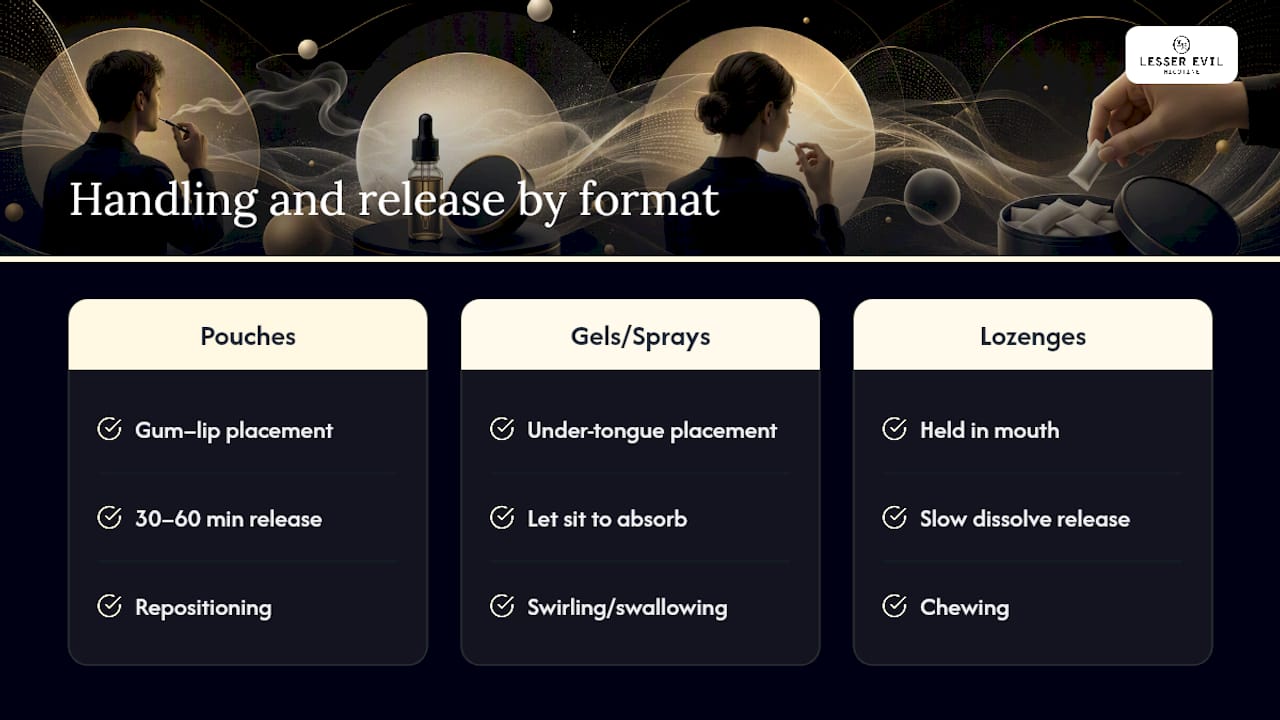
Pouches: place between gum and lip, leave for 30 to 60 minutes, then dispose of it properly. Don’t keep repositioning it.
Sublingual gels and sprays: apply under the tongue and let it sit. Resist the urge to swirl it around your mouth or swallow it.
Lozenges: let it dissolve slowly rather than chewing or biting down, which is where most of the taste and any smell actually escapes.
Pro Tip: Manipulating a pouch or gel more than necessary is the most common mistake. Leaving it alone lets your oral mucosa absorb the nicotine steadily, which cuts down on leakage, taste bleed, and any faint odour release.
A few habits worth building in: don’t run multiple products at once, dispose of used products discreetly rather than leaving them visible, and don’t assume “odourless” means “invisible” if you’re not being careful with handling.
What Lesser Evil Nicotine brings to the odourless conversation
Lesser Evil Oral Mister is a sublingual nicotine gel, used under the tongue rather than inhaled or applied to skin. It’s tobacco-free, battery-free, and built with natural flavours and natural sweeteners across three options: Peppermint, Black Grape, and Green Apple. No smoke, no vapour, no battery to charge or bin.
That battery-free design also means no e-waste, which sits alongside the format’s natural discretion, no cloud of vapour, no ashtray smell clinging to fabric.
This piece was written from an editorial standpoint focused on formulation and purity, not a clinical one. For more on how sublingual and non-inhalation formats compare, Lesser Evil Nicotine’s own guide to non-inhalation nicotine methods covers the mechanics in more depth.
Why “odourless” gets thrown around too loosely
Here’s what nobody selling nicotine products wants to say out loud: most odour claims are marketing shorthand, not chemistry. “Odour-free” on a pack tells you nothing about whether the manufacturer actually distilled the nicotine to pharmaceutical grade or just skipped the flavour additives that would have made the smell obvious.
The uncomfortable truth is that purity is expensive and hard to verify from the outside. A brand can call something “clean” without ever mentioning USP or EP standards, and most buyers won’t know to ask. That’s not a reason to distrust every product on the market, but it is a reason to stop treating “odourless” as a self-evident fact and start treating it as a claim that deserves a source.
The bigger shift worth watching isn’t really about smell at all. It’s about how nicotine use is becoming a private act rather than a social signal, no smoke to announce it, no lingering vapour cloud, no smell on your coat when you walk into a meeting. That changes the etiquette questions people used to argue about (where can you smoke, who has to smell it) into something closer to a personal choice with almost no visible footprint. Whether that’s a genuinely good development or just a more convenient one is worth sitting with, rather than assuming the marketing has already answered it for you.
— Luke McLeod
Try Lesser Evil Oral Mister for a discreet, tobacco-free option
If you’ve read this far weighing pouches against sprays against lozenges, here’s the practical version: Some products deliver nicotine as a sublingual gel with a quick spray under the tongue, without using plant fibre or pouch packets.

Certain sublingual gels are tobacco-free, battery-free, and available in several natural flavours with natural sweeteners. They produce no vapour to inhale and no battery waste. These products may appeal to adults who want a discreet nicotine option that can be used instead of vaping or pouches. Head to the Lesser Evil Oral Mister product page to see flavours, pricing, and place an order.
This article is general information, not a substitute for advice from a qualified doctor. Consult a qualified healthcare professional about your own circumstances before acting on anything here.
Sources
- American Lung Association — emerging products and smokeless options
- Chemnovatic — discussion of nicotine purity and USP/EP standards
- American Lung Association — commentary on nicotine pouches and youth risk
- Health New Zealand — vaping to stop smoking
- PHCC briefing — oral nicotine products and cessation evidence