

Why women avoid cigarette smoke: what you need to know

Cigarette smoke hits women differently, and the body of evidence explains exactly why so many steer clear of it. It threatens fertility and pregnancy outcomes, raises heart and stroke risk (especially alongside some contraceptives), drives lung cancer and COPD, ages skin faster, and puts household members at risk through secondhand exposure. Add in the sensory and social side, from pregnancy-driven smell aversions to the awkwardness of asking a partner to smoke outside, and avoidance stops looking like a preference. It looks like common sense.
The main reasons women avoid cigarette smoke:
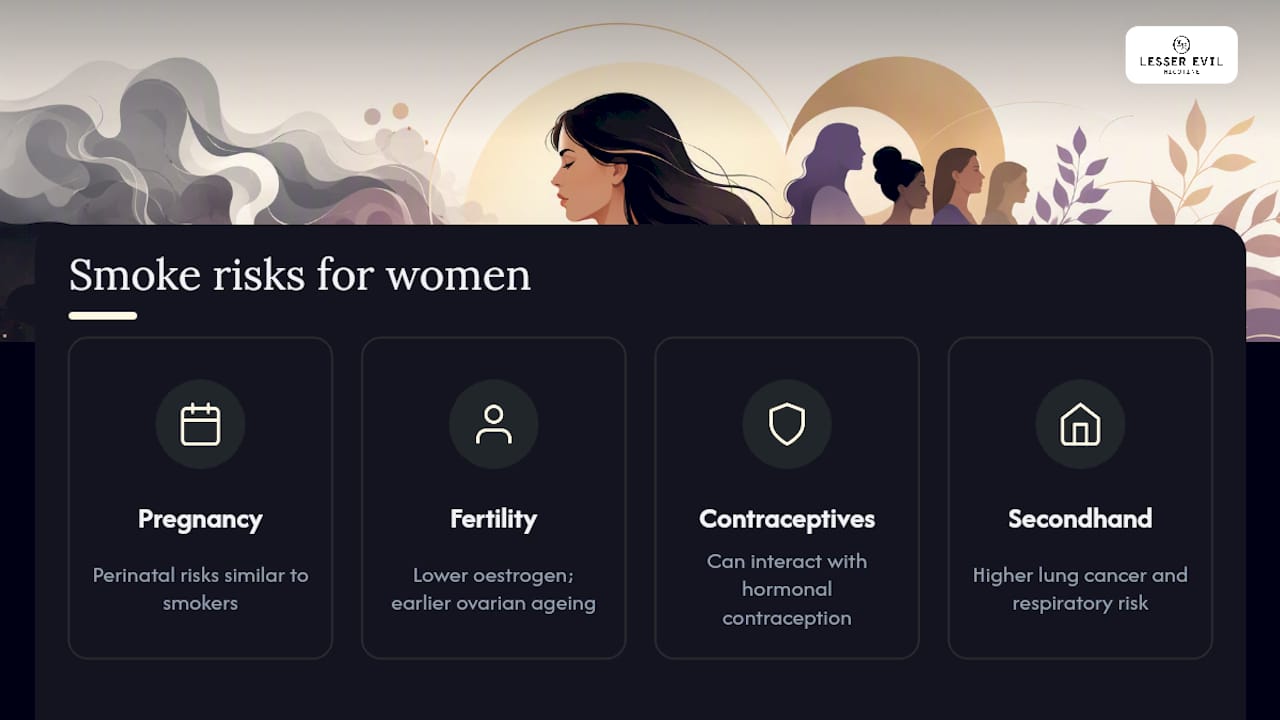
- Pregnancy and fertility risks — miscarriage, preterm birth, low birth weight, and reduced fertility
- Cardiovascular danger — heart attack and stroke risk, worse when combined with oestrogen-based contraception
- Lung disease — lung cancer and COPD, which claims women’s lives at a startling rate
- Visible ageing — wrinkles, grey hair, and gum disease well before their time
- Secondhand exposure — the risk smoke poses to children and non-smoking partners at home
Key Takeaways
Cigarette smoke carries female-specific risks across pregnancy, fertility, heart health, lung disease, ageing, and household safety that together explain why avoidance is a rational, evidence-backed choice.
| Point | Details |
|---|---|
| Pregnancy raises the stakes | Miscarriage, preterm birth, and SIDS risk all climb with smoke exposure, making avoidance a protective act. |
| Heart risk compounds with contraception | Smoking alongside oestrogen-based birth control significantly raises stroke and heart attack risk. |
| COPD hits women hard | Around 80% of COPD deaths in women are linked to smoking, per the American Lung Association. |
| Sensory aversions are real | Many pregnant women report smoke smelling or tasting worse, which is linked to reduced smoking. |
| A smoke-free alternative exists | Lesser Evil Nicotine offers a tobacco-free, battery-free oral gel for women who want nicotine without the smoke. |
Table of Contents
- Why women avoid cigarette smoke: the biology behind it
- Why is smoke avoidance so strong during pregnancy and fertility years?
- Does smoking really raise heart and stroke risk for women?
- Why do women face higher lung cancer and COPD risk?
- How does smoking speed up reproductive ageing?
- Why does smoking age your skin faster than it should?
- What secondhand smoke risks affect women specifically?
- Why is asking for a smoke-free home so hard?
- What practical steps reduce your exposure to cigarette smoke?
- What happens when you cut out cigarette smoke?
- Why this evidence matters beyond the statistics
- Get a discreet nicotine alternative that skips the smoke entirely
- Where to read more on this topic
- Frequently asked questions about why women avoid cigarette smoke
- Sources
Why women avoid cigarette smoke: the biology behind it
Tobacco smoke carries more than 7,000 chemicals, a good chunk of them carcinogens and oxidants that damage tissue on contact. That’s true for anyone who breathes it in. But female biology adds extra layers of risk that make avoidance a rational response rather than an overreaction.
- Tobacco toxicants interact with oestrogen metabolism, which may alter how the body processes the hormone
- Some evidence points to differences in how women’s lungs and airways respond to inhaled smoke compared with men’s
- Hormonal fluctuations across the menstrual cycle can affect how strongly smoke odours and cravings are perceived
Smoking is strongly linked to most COPD deaths in women, according to the American Lung Association. That single figure explains a lot about why women’s health messaging around smoke has sharpened in recent years.
Why is smoke avoidance so strong during pregnancy and fertility years?
Reproductive years are when avoidance instincts kick in hardest, and the data backs that instinct up completely. Smoking and secondhand exposure during pregnancy are tied to a cluster of outcomes no expectant mother wants to gamble with:
- Miscarriage and stillbirth
- Preterm birth and low birth weight
- Increased risk of sudden infant death syndrome (SIDS)
- Reduced fertility and, separately, earlier menopause linked to lower oestrogen levels
For women using hormonal contraception, smoke exposure adds another layer of concern given how tobacco toxicants interact with reproductive hormones. Quitting during pregnancy is one of the most protective moves a mother can make. The CDC frames pregnancy as a genuine turning point for both maternal and foetal health, not just a good intention.
There’s also a fascinating sensory dimension. Pregnancy rewires smell and taste, and tobacco smoke often becomes one of the first things to turn a stomach.
In one published study, many pregnant women reported that the smell of cigarette smoke had changed, and a significant number noticed a change in taste. Olfactory aversion was linked to higher odds of smoking less since becoming pregnant.
That finding, from a study on sensory aversions to tobacco smoke among pregnant women, suggests the body sometimes does the persuading before the mind catches up.
Does smoking really raise heart and stroke risk for women?
Yes, and the risk compounds in ways that catch a lot of women off guard. Smoking damages blood vessel linings, thickens the blood, and pushes blood pressure up, all of which raise the odds of heart attack and stroke. Combine that with oestrogen-containing contraceptives and the risk climbs further, since oestrogen already nudges clotting factors upward.
- Endothelial damage makes artery walls stiffer and more prone to plaque build-up
- Smoking increases clot formation, a key driver of stroke risk
- Blood pressure rises measurably with regular smoke exposure
Pro Tip: If you’re on a combined hormonal contraceptive pill, patch, or ring, talk to your GP about how smoke exposure factors into your specific risk profile. This discussion can help you understand your individual risk.
Why do women face higher lung cancer and COPD risk?
Lung tissue doesn’t discriminate by sex, but the outcomes for women often look worse on paper. Some research suggests women face roughly double the lung cancer risk of men in comparable smoking contexts, and smoking accounts for around 80% of COPD deaths among women, per the American Lung Association.
- Lung cancer risk rises sharply with cumulative smoke exposure, whether first or secondhand
- COPD develops through years of airway inflammation and scarring
- Reporting patterns, inhalation depth, and biological susceptibility may all play a role in why women’s outcomes differ
Secondhand smoke carries much of that same respiratory burden, particularly for women who live with a smoker but don’t smoke themselves.
How does smoking speed up reproductive ageing?
Smoking doesn’t just threaten fertility in the short term. It appears to accelerate the biological clock itself.
- Lower circulating oestrogen levels are commonly reported among women who smoke
- Earlier menopause is a well-documented association, sometimes by several years
- Menstrual irregularities are more frequent in women who smoke regularly
- Ovarian ageing may begin earlier, shortening the practical window for conception
None of this needs a lab coat to understand. Fewer years of fertility and a rockier menstrual cycle are reasons enough to keep smoke at arm’s length.
Why does smoking age your skin faster than it should?
Skin tells the truth eventually, and smoke speeds up the reveal. Public-health data shows women who smoke report higher rates of premature greying, roughly doubling by age 50 compared with non-smokers, alongside visibly deeper wrinkles, according to the American Lung Association.
The mechanism is straightforward: smoke constricts blood vessels near the skin’s surface, starving tissue of oxygen and nutrients, while breaking down collagen and elastin. Gums take a hit too, with smokers facing significantly higher rates of periodontal disease.

Pro Tip: If ageing skin is what motivates you more than statistics ever could, that’s a completely valid reason to cut exposure. Vanity and health can point in the same direction.
What secondhand smoke risks affect women specifically?
Women who don’t smoke still carry a heavy share of the burden when smoke fills a shared space. Living with a smoker raises lung cancer and respiratory disease risk for the non-smoking partner, and the danger multiplies for pregnant women and young children in the home.
- Non-smoking women exposed at home face measurably higher lung cancer risk
- Children in smoking households have higher rates of asthma, ear infections, and respiratory illness
- Pregnant women exposed to secondhand smoke face similar perinatal risks to active smokers, including low birth weight
Smoking remains linked to around 80% of COPD deaths in women overall, a figure that includes those who never lit a cigarette themselves but breathed someone else’s smoke for years, per the American Lung Association.
Why is asking for a smoke-free home so hard?
Health risk is only half the story. Plenty of women avoid smoke for reasons that have nothing to do with a lab result. Negotiating a smoke-free home isn’t always simple, especially where a partner or older relative smokes and household power dynamics make confrontation uncomfortable. Standing near smokers outside a pub or office building carries its own safety concerns after dark, and there’s still social stigma attached to being the one who “makes a fuss.”
- Asking guests to smoke outside can feel like an awkward power move rather than a reasonable request
- Some women avoid confrontation with a smoking partner rather than risk household tension
- Standing outside smoking areas alone at night raises personal safety concerns
Pro Tip: Frame the ask around a shared reason, not a personal demand: “Can we keep the flat smoke-free for the baby/the dog/my asthma?” tends to land better than a flat request.
What practical steps reduce your exposure to cigarette smoke?
Avoidance works best as a set of small, repeatable habits rather than one big confrontation. Start with the spaces you control and work outward.
- Set a smoke-free home rule and apply it consistently, including for visitors
- Ask smokers to step outside, away from open windows and doors
- Check your workplace’s smoking policy and use designated outdoor zones only
- Steer clear of smoky pubs, terraces, and festival crowds where you can
- Prioritise protecting children and pregnant household members above all else
For anyone managing their own nicotine use rather than someone else’s smoke, non-inhalation options exist worth knowing about. The Lesser Evil Oral Mister is one such option, a discreet product for adults who already use nicotine and want something that isn’t smoke. It’s worth understanding the full range of nicotine products and how they differ before choosing one, and reading up on cigarette ingredients helps put the avoidance instinct into sharper context.
Pro Tip: Keep a one-line script ready for shared spaces: “I’d rather we kept this area smoke-free, is that alright?” Short, direct requests get fewer arguments than long justifications.
What happens when you cut out cigarette smoke?
The payoff starts faster than most people expect, and it keeps compounding for years.
- Within days: carbon monoxide levels drop and oxygen circulation improves
- Within weeks: lung function and circulation begin measurable improvement
- During pregnancy: stopping exposure at any stage improves outcomes for mother and baby, according to the CDC
- Within years: risk of heart disease, stroke, and several cancers falls substantially
Women who stop smoking sharply cut their risk of premature death, and national data shows women now quit at rates comparable to men, according to the CDC’s Surgeon General report. The earlier the exposure stops, the more of that benefit gets banked. For a broader look at what actually helps, this comparison of quitting methods is worth a read.
Why this evidence matters beyond the statistics
I think about the women in my own circle who quietly rearrange their lives around someone else’s smoking, the sister who won’t let her toddler near a smoky balcony, the friend who went quiet on cigarettes the moment she saw two lines on a test. The data explains their instincts. It doesn’t need to convince them.
Get a discreet nicotine alternative that skips the smoke entirely
Everything above points the same direction: smoke itself, not nicotine alone, drives most of the female-specific harm covered in this article. Lesser Evil Nicotine exists for women who already use nicotine and want a route that doesn’t involve lighting anything or inhaling vapour.

The product is a low-burn oral nicotine gel used under the tongue, tobacco-free, battery-free, and flavoured naturally in Peppermint, Black Grape, and Green Apple, so there’s nothing to breathe in and no e-waste left behind. It was built with precision dosing in mind, giving you more control over how much nicotine you’re actually using rather than however much a cigarette or vape happens to deliver. For urban professional women juggling discretion, habit, and a preference for fewer chemicals in their routine, it fills a gap that smoke never should have occupied in the first place. If that sounds like what you’ve been after, take a look at the Lesser Evil Oral Mister and see which flavour fits.
Where to read more on this topic
- Women and Tobacco Use — American Lung Association
- Smoking, pregnancy and babies — CDC
- Women and smoking: a report of the Surgeon General — CDC
- Gender differences in smoking cessation and morbidity — PMC
- Female nicotine withdrawal explained: a guide for women — Lesser Evil
Frequently asked questions about why women avoid cigarette smoke
Why do women avoid cigarette smoke more than they used to? Awareness of female-specific risks, including pregnancy complications, contraceptive interactions, and faster visible ageing, has grown considerably as public-health messaging has caught up with the research.
Does secondhand smoke really affect non-smoking women? Yes. Women living with a smoker face higher lung cancer and respiratory disease risk, and pregnant women exposed to secondhand smoke face similar perinatal risks to those who smoke directly.
Can smoking affect fertility even before pregnancy? It can. Smoking is associated with lower oestrogen levels, menstrual irregularities, and earlier ovarian ageing, all of which can shorten the practical window for conception.
Why does pregnancy make smoke smell or taste worse? Hormonal shifts during pregnancy alter smell and taste perception, and cigarette smoke is one of the substances most commonly reported as newly unpleasant, a change linked to reduced smoking in pregnant women.
Is Lesser Evil Nicotine a way to quit smoking? No. Lesser Evil Nicotine is a tobacco-free, battery-free nicotine gel for adults who already use nicotine and want an alternative that doesn’t involve smoke or vapour. It isn’t marketed as a treatment or cessation aid.
This article is general information, not a substitute for advice from a qualified doctor. Consult a qualified healthcare professional about your own circumstances before acting on anything here.
Sources
- Women and Tobacco Use | American Lung Association
- Study on sensory aversions to tobacco smoke among pregnant women (UNC repository)
- Smoking, pregnancy and babies | CDC
- Women and smoking: a report of the Surgeon General (CDC)
- Review on gender differences in smoking cessation and morbidity (PMC article)