

Quitting smoking methods compared: what actually works

Going cold turkey works for roughly 6 in every 100 people. That number tells you everything about why method choice matters. The 2023–2024 Cochrane reviews found that varenicline, cytisine, and nicotine-containing e-cigarettes each help 12–18 people per 100 quit for six months or longer. Combination NRT (a patch plus a fast-acting form) delivers similar results. Behavioural support stacked on top of any pharmacological method pushes those numbers further still.
Here’s the quick picture:
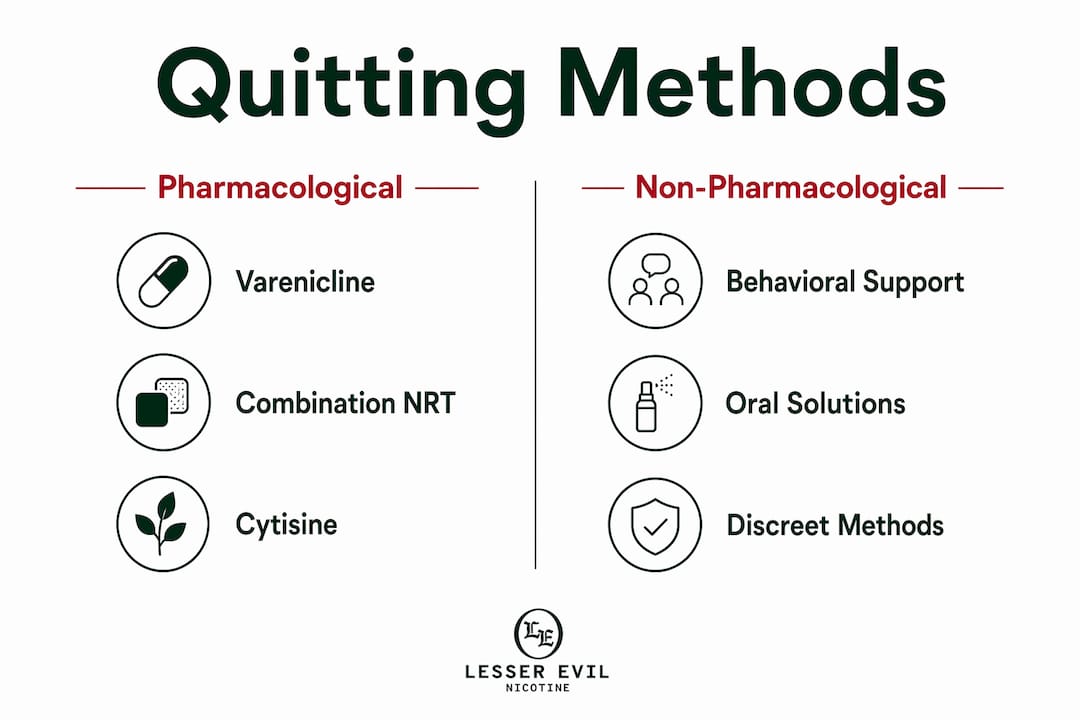
- Varenicline (Champix): helps many people quit; high-certainty evidence; prescription only in the UK
- Cytisine: helps many people quit; high-certainty evidence; not widely licensed in the UK yet
- Combination NRT: patch plus gum or lozenge; comparable quit rates to the top pharmacological options
- Nicotine e-cigarettes: help many people quit; licensed for use in English cessation services
- Bupropion (Zyban): helps some people quit; moderate effect; prescription required
- Behavioural support alone: meaningfully increases quit success when combined with pharmacotherapy
- Discreet oral nicotine alternatives: sublingual gels and mouth sprays; no inhalation, no battery, no e-waste
No single method suits everyone. The right pick depends on your triggers, your lifestyle, and honestly, how much you hate the idea of inhaling anything ever again.
How do quitting smoking methods compare on effectiveness and cost?
Pharmacological methods are the most evidence-backed options available in the UK right now. Varenicline at standard dose combined with standard NRT ranked first for sustained abstinence in a major network meta-analysis, though this combination remains unlicensed in the UK. Within licensed options, varenicline alone sits at the top, followed by combination NRT.

Cost-effectiveness matters too. A UK cost-effectiveness analysis found all active interventions cost-effective against the NHS £20,000 per quality-adjusted life-year threshold. E-cigarettes at low dose appeared most cost-effective in the base case, with varenicline plus NRT close behind.
| Method | Effectiveness (per 100) | Mode of use | Discreteness | Cost-effectiveness (UK) | UK availability | User experience |
|---|---|---|---|---|---|---|
| Varenicline | 12–18 | Daily tablet | High | Cost-effective vs £20k QALY | Prescription (NHS) | Nausea reported; no inhalation |
| Cytisine | 12–18 | Tablet course | High | Cost-effective | Limited UK access | Mild GI side effects |
| Combination NRT | 10–19 | Patch + gum/lozenge | Moderate | Cost-effective | OTC pharmacies | Skin irritation; gum burns gums |
| Nicotine e-cigarettes | 10–19 | Inhaled vapour | Low in public | Cost-effective | Widely available | Inhalation required; battery/e-waste |
| Bupropion | ~9 | Daily tablet | High | Cost-effective | Prescription (NHS) | Insomnia; headaches possible |
| Oral nicotine gel/spray | Not a cessation aid | Sublingual/oral | Very high | OTC pricing | UK launch 2026 | No inhalation; discreet; natural flavours |
Behavioural support is not optional. Adding counselling to any pharmacological method improves cessation by 15%–88%. The NHS Stop Smoking Service, telephone quitlines, and motivational interviewing all have solid evidence behind them. Brief interventions work, but longer and more intensive support consistently outperforms them.
Side effects across pharmacological methods are generally mild. A Cochrane overview noted small harms including nausea, insomnia, and headaches with NRT, varenicline, and cytisine. Bupropion carries a slightly elevated risk of serious adverse events. NRT has been used since the 1980s with no evidence of serious harms.
For urban professionals, the discreteness column matters a lot. Patches are invisible under clothing. Gum is socially acceptable but visible. E-cigarettes produce visible vapour and require a charged device. Sublingual gels and oral sprays sit in a different category entirely: nothing to charge, nothing to exhale, nothing anyone around you notices. If you want to manage nicotine at work without stepping outside or pulling out a device, that distinction is real.
Pro Tip: Urges typically peak and fade within minutes. Oral solutions that occupy your mouth and hands, like sublingual gels, let you ride that wave without reaching for a vape or a cigarette.
Lesser Evil Nicotine: no inhalation, no battery, no rubbish

If you’re done breathing things in, Lesser Evil Nicotine is built for exactly that. The Oral Mister is a sublingual nicotine gel, placed under the tongue and absorbed via the oral mucosa. Tobacco-free, battery-free, zero e-waste. Natural flavours (Peppermint, Black Grape, Green Apple) and natural sweeteners. Nothing vaporised, nothing combusted.
It’s designed for the urban professional who vapes and wants out of the inhalation loop entirely. Pocket-sized, discreet, and genuinely palatable in a way that most oral nicotine products aren’t. A nicotine mouth spray is also coming. UK launch is 2026, going into premium independent retail first.
GET THE ORAL MISTER and use nicotine on your terms, not your device’s.
Key takeaways
Varenicline, cytisine, and combination NRT are the most effective licensed cessation methods in the UK, and behavioural support meaningfully boosts every one of them.
| Point | Details |
|---|---|
| Top pharmacological options | Varenicline and cytisine help 12–18 per 100 quit; combination NRT delivers comparable results. |
| Behavioural support multiplies results | Adding counselling to pharmacotherapy improves quit success by 15%–88%. |
| Cold turkey rarely works | Only around 6 in 100 succeed without any aid or support. |
| Discreteness varies widely | Patches and oral gels are the most discreet; e-cigarettes require inhalation and a charged device. |
| Lesser Evil Nicotine | Sublingual gel and upcoming mouth spray: tobacco-free, battery-free, no inhalation, UK launch 2026. |