

Stop smoking glow up guide: look better, feel better

Yes, quitting combustible smoking produces visible appearance gains. Your complexion gets brighter, your breath improves, and your gums start recovering within days, not months. The NHS confirms that health improvements begin almost immediately after you stop, and local stop-smoking services are significantly more effective than going it alone. The single best thing you can do right now? Pick a quit date soon and write it down.
Here is what to expect, roughly:
- Minutes to hours: Carbon monoxide clears, oxygen levels rise, circulation begins to improve
- Days 2–5: Reduced puffiness, less grey skin tone, breath starts to freshen
- Weeks 2–4: Skin tone visibly brighter, lip colour improving, gum inflammation easing
- Months 1–3: Measurable brightness gains, early texture improvement, more energy
- Months 6–12+: Gum health significantly improved, long-term collagen recovery under way
If you want a discreet, non-inhaled oral nicotine option to use instead of smoking or vaping while you work through this process, the Lesser Evil Oral Mister is a sublingual nicotine gel: tobacco-free, battery-free, no vapour, and no e-waste. It is a consumer product, not a medicine. More on it below.
Table of Contents
- What actually changes in your body after you quit smoking?
- How to build your personal quit and glow plan
- What quitting aids are available in the UK?
- How to handle urges: the 3-3-3 rule and what actually works
- Daily habits that speed up your glow up
- How to stay smoke-free when things go wrong
- Where to get UK support and when to contact a professional
- Key takeaways
- Why the appearance angle is the most underrated quit motivator
- Lesser Evil Oral Mister: a discreet, non-inhaled option
- Further reading and UK-focused sources
What actually changes in your body after you quit smoking?
The glow up is real, and it is physiological. Smoking causes vasoconstriction: your blood vessels narrow, blood flow to the skin drops, and your complexion takes on that familiar grey, dull cast. Stop smoking, and that vasoconstriction begins to reverse within hours. More blood reaches the surface, oxygen delivery improves, and the rosier look many quitters notice in the first week is not imagination.

Beyond circulation, smoking drives chronic low-grade inflammation throughout the body, including in the skin. Collagen production slows. Gum tissue becomes inflamed and bleeds more easily. Over time, the skin around the mouth and eyes develops fine lines earlier than it would otherwise.
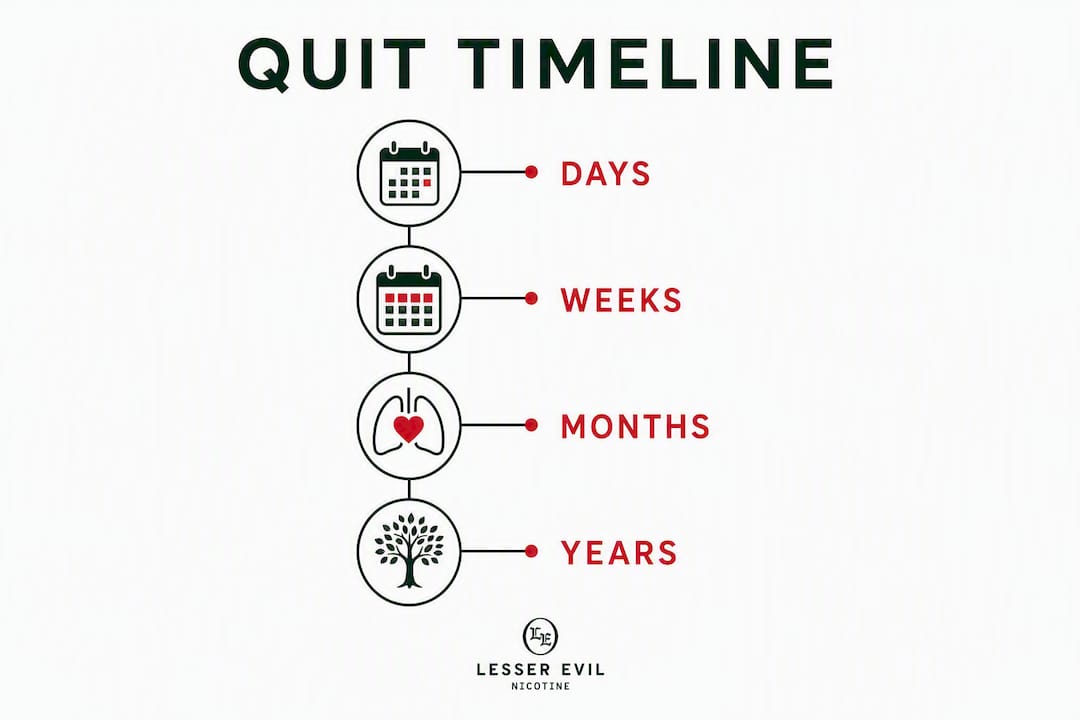
| Timeframe | What changes | Appearance impact |
|---|---|---|
| — | Blood pressure and pulse rate drop | Hands and feet warmer |
| 8–12 hours | Carbon monoxide levels halve | Skin oxygen levels rise |
| 2–5 days | Circulation improving, taste and smell recovering | Reduced puffiness, less grey tone |
| 2–4 weeks | Gum inflammation reducing, skin hydration improving | Brighter complexion, lip colour returns |
| 1–3 months | Measurable colour and brightness gains; energy noticeably higher | Skin looks visibly healthier |
| 6–12 months | Gum bleeding reduces significantly, plaque build-up slows | Teeth appear cleaner; gum line healthier |
| 1 year+ | Collagen partially restores; inflammation markers calm | Texture improvement, reduced sallowness |
One honest caveat: deep wrinkles and long-standing pigment changes may persist. UV damage, diet, and genetics all play a role. Quitting removes the main driver of accelerated skin ageing, but it does not erase years of damage overnight.
Dental timeline specifically: Breath freshness improves within days as carbon monoxide and volatile compounds clear. Gum bleeding typically reduces within four to eight weeks as inflammation settles. Surface staining is a longer game: a professional clean at around three months gives you a realistic baseline, and a dentist can advise on whitening options once gum health has stabilised.
Tracking your progress: Take a photo in consistent natural light, same angle, every two weeks starting from your quit date. Log it alongside a note of how you feel. Apps like StopSmokingApp let you pair streak data with visual milestones, which makes the early gains feel concrete rather than abstract.
How to build your personal quit and glow plan

A quit plan is not complicated. It is a short document that answers four questions: when, who knows, what replaces the habit, and what do I get when I hit a milestone. The WHO recommends choosing a quit date within the next two weeks, writing it down, and keeping the plan visible.
Here is a step-by-step structure you can fill in today:
- Tell one person — A friend, partner, or colleague who will check in. Accountability is not nagging; it is data.
- Choose your support route — NHS Smokefree, a local stop-smoking service, your GP, or a combination. Free behavioural support is available across the UK; some NRT programmes are also free via local services.
Tailoring for different routines: If you are an urban professional who smokes during work breaks, the habit is partly about the micro-break itself, not just the nicotine. Build a replacement break ritual: a short walk, a glass of water, a discreet oral product. Shift workers face different trigger patterns, often tied to handover stress or night-shift fatigue. Older adults may have longer-established rituals and benefit most from structured local service support alongside any product choice.
Cost snapshot: Behavioural support via NHS stop-smoking services is free. Some NRT programmes (patches, gum) are available free through local services. Over-the-counter NRT typically costs £10–£30 per week depending on the product. Prescription medicines (varenicline, bupropion) are available via a GP; standard NHS prescription charges apply unless you are exempt. E-cigarette hardware and consumables are paid out of pocket.
Pro Tip: Set up a dedicated photo album on your phone labelled with your quit date. Drop a selfie in every two weeks in the same spot, same light. Pair it with a streak tracker. Seeing the visual evidence stacks up faster than you expect, and it is a powerful re-anchor on a hard day.
What quitting aids are available in the UK?
There is no single right answer here. The best option depends on how heavily you smoke, whether you also vape, your work and social context, and whether you want something prescribed or over-the-counter. Here is a plain-English breakdown of the main categories, followed by a comparison table.
| Category | How it works | UK availability | Typical cost | Best for | Practical notes |
|---|---|---|---|---|---|
| Nicotine patches | Slow-release nicotine through skin; worn all day | OTC (pharmacies, supermarkets) | £10–£30 per week | Heavy smokers wanting steady background nicotine | Discreet under clothing; no hand-to-mouth action |
| Nicotine gum / lozenge | Fast-acting oral NRT; releases nicotine via mouth lining | OTC | — | Those who need on-demand relief; good for social triggers | Technique matters; do not chew like regular gum |
| Nicotine inhalator | Mimics hand-to-mouth action; cartridge releases nicotine vapour into mouth | OTC | — | Smokers who miss the physical ritual | Not inhaled into lungs; vapour stays in mouth |
| Prescription medicines (varenicline / bupropion) | Reduce urges and the reward effect of smoking via brain chemistry | Prescription only (GP) | NHS prescription charge (or free if exempt) | Heavy smokers; those who have tried NRT without success | Require GP consultation; some side effects; not suitable for everyone |
| E-cigarettes (vaping) | Inhaled nicotine vapour; no tobacco combustion | OTC (vape shops, online) | Variable; hardware + consumables ongoing | Smokers switching away from combustion; not for those wanting to stop inhalation | Produces e-waste; still inhaled; not recommended for non-smokers |
| Non-inhaled oral nicotine gel | Sublingual gel applied under tongue; nicotine absorbed via oral mucosa; tobacco-free, battery-free | OTC / direct-to-consumer | Varies by brand | Adults wanting a discreet, non-inhaled option instead of smoking or vaping | No vapour, no combustion, no e-waste; not a medicine |
| Behavioural support / stop-smoking services | One-to-one or group coaching; trigger analysis; structured plans | Free via NHS / local services | Free | Anyone; most effective when combined with a product | Significantly more effective than going it alone |
NICE guidance consistently recommends combining behavioural support with a pharmacological aid for the best outcomes. That combination is available free or at low cost through NHS stop-smoking services. Speak to your GP or pharmacist before starting prescription medicines; they can assess which option suits your health profile.
On Lesser Evil Oral Mister specifically: It is a sublingual oral nicotine gel, meaning you place it under the tongue and nicotine is absorbed through the oral mucosa. Tobacco-free, battery-free, no vapour. Available in Peppermint, Black Grape, and Green Apple. It is a consumer product, not a medicine, and carries no cessation claim. For adults who want to explore non-inhalation nicotine options instead of smoking or vaping, it is one option to consider.
How to handle urges: the 3-3-3 rule and what actually works
Urges peak fast and fade fast. Most last three to five minutes at their worst. The 3-3-3 coaching rule is built around that window: sit with the urge for three minutes without acting on it, distract yourself for three minutes, then reassess for three minutes. By the time you have gone through all three stages, the peak has usually passed.
Practical substitutes that work in real-world settings:
- Water: Sipping cold water gives the hand-to-mouth action something to do and genuinely helps.
- Brief walk: Even two minutes outside resets the stress loop that triggers many urges.
- Breathwork: Four counts in, hold four, out four. It sounds basic; it works because it directly counters the shallow breathing pattern smoking reinforces.
- Oral gel or gum: A discreet oral product used instead of a cigarette or vape addresses the hand-to-mouth ritual without inhalation. The Lesser Evil Oral Mister is sublingual: no vapour, no smell, nothing to explain to colleagues.
- Chewing gum or a snack: Not ideal long-term, but useful in the first two weeks.
For urban professionals, the micro-break ritual is often the real habit, not just the nicotine. Replace the break, not just the cigarette. A two-minute walk to get water, a quick stretch at your desk, or stepping outside without a cigarette all preserve the mental reset the break was providing.
Workplace specifics: Keep your substitute in a jacket pocket or bag so it is as accessible as a cigarette was. If colleagues smoke on breaks, you do not have to avoid them entirely; just have your substitute ready and your ‘why I quit’ prompt on your phone. For a clean nicotine alternative that produces no vapour and no smell, an oral gel is genuinely discreet in an office or meeting context.
Pro Tip: Save a photo from your visual diary as your phone lock screen. On a hard day, that image is faster and more visceral than any written reminder. Pair it with a one-line note: “Day X. Skin already looks different.”
Daily habits that speed up your glow up
Quitting does the heavy lifting, but a few daily habits accelerate what your body is already doing. None of these require a complicated routine or expensive products.
Skincare basics:
- Gentle cleanser morning and evening (no harsh scrubs in the first month while skin is recalibrating)
- Moisturiser with hyaluronic acid or ceramides to support the skin barrier
- Broad-spectrum SPF 30+ every morning, full stop. UV exposure is the second biggest driver of premature skin ageing after smoking; removing one without protecting against the other slows your results
- Weekly exfoliation (a mild chemical exfoliant like lactic acid works well) from around week three onwards to help with the dull surface layer
If you have persistent pigmentation or deeper lines, a consultation with a dermatologist at the three-month mark gives you a realistic picture of what is structural versus what will continue to improve.
Dental care:
- Brush twice daily with a fluoride toothpaste; use an electric toothbrush if you can.
- Floss or use interdental brushes daily. Gum health is where the most visible early gains happen.
- Use an alcohol-free mouthwash for breath freshness.
- Book a dental hygienist appointment at around three months. Surface staining from smoking responds well to a professional clean, and it gives you a clean baseline for any whitening you want to consider later.
Lifestyle boosters:
- Drink at least 1.5–2 litres of water daily. Hydration directly affects skin plumpness and clarity.
- Aim for seven to eight hours of sleep. Skin repairs itself during sleep; poor sleep undoes a lot of what quitting gains you.
- Moderate exercise three to four times a week improves circulation, which is already recovering post-quit. Even brisk walking counts.
- Reduce alcohol. It dehydrates skin and disrupts sleep, both of which slow your glow up.
- Eat antioxidant-rich foods: berries, leafy greens, oily fish, nuts. Vitamin C in particular supports collagen synthesis.
A simple daily routine:
- Morning: Cleanse, moisturise, SPF. Glass of water before coffee.
- Daytime: Substitute breaks with water or a walk. Keep your oral substitute accessible.
- Evening: Cleanse, moisturise, floss and brush. Log your streak. Drop a photo in your album every two weeks.
How to stay smoke-free when things go wrong
A slip is not a failure. It is a data point. The most effective long-term approach treats each lapse as information: what triggered it, what time of day, what was the emotional state? Write it down, adjust the plan, and restart immediately. The worst thing you can do is let one cigarette become a reason to abandon the whole effort.
Immediate steps after a lapse:
- Note the trigger: location, time, emotional state, who you were with
- Restart your quit plan the same day, not “from Monday”
- Call or message your support person
- If you are using a stop-smoking service, contact them; they expect lapses and are not there to judge
Long-term maintenance:
- Habit stacking works well here. Pair your smoke-free streak with a new positive ritual: a morning run, a skincare routine, a weekly photo check-in. The new habit borrows momentum from the quit.
- Review your visual diary at one month and three months. The physical evidence is motivating in a way that abstract health stats are not.
- Social planning matters. Know in advance which situations are high-risk (nights out, stressful work periods) and have your substitute and your 3-3-3 plan ready before you walk in.
Pro Tip: Set calendar reminders at two weeks, one month, and three months with a small, appearance-linked reward attached. A new skincare product at two weeks. A haircut at one month. A professional dental clean at three months. Tying the reward to something visible keeps the motivation concrete.
Where to get UK support and when to contact a professional
You do not have to figure this out alone, and in the UK, you do not have to pay for most of the best support.
Who to contact and when:
- GP or pharmacist: For prescription medicines (varenicline, bupropion), for advice on which NRT suits your health profile, or if you have an existing health condition that affects your options. A GP appointment is the right first step if you want a prescription route.
- Local stop-smoking services: Free, tailored behavioural support with trained advisers. They offer one-to-one and group sessions, structured quit plans, and often free or subsidised NRT. Find your local service via NHS Smokefree.
- NHS Smokefree helpline and resources: Free online tools, quit plans, and a helpline. The NHS Better Health quit smoking hub is the clearest starting point for UK adults.
What is typically free vs paid:
- Free: behavioural support via local stop-smoking services; NHS Smokefree online resources and tools; some NRT programmes through local services
- Paid (OTC): nicotine patches, gum, lozenges, inhalators (£8–£25/week depending on product)
- Paid (prescription): standard NHS prescription charge applies for varenicline and bupropion (free if you hold a valid exemption certificate)
- Paid (devices): e-cigarette hardware and consumables; oral nicotine consumer products
Comprehensive programmes combining virtual appointments, personalised plans, and prescription options report markedly higher long-term abstinence than single-method approaches. The evidence consistently points the same direction: combine support with a product, and your odds improve substantially.
This article is general information, not medical advice. Consult your GP or pharmacist to confirm which options are right for your health profile and circumstances.
Key takeaways
Quitting combustible smoking produces measurable appearance improvements within days, with skin brightness and gum health continuing to improve over the first three months and beyond.
| Point | Details |
|---|---|
| Pick a quit date now | Choose a date within the next two weeks, write it down, and remove smoking cues the night before. |
| Expect early visible gains | Circulation improves within days; measurable skin brightness typically appears by months 1–3. |
| Combine support and a product | Local stop-smoking services are around three times more effective than going it alone; free support is available via NHS Smokefree. |
| Track progress visually | Photograph your skin every two weeks in consistent light; pair with a streak tracker to stay motivated. |
| Lesser Evil Oral Mister | A sublingual, tobacco-free, battery-free oral nicotine gel for adults who want a discreet, non-inhaled option instead of smoking or vaping. |
Why the appearance angle is the most underrated quit motivator
Most quit-smoking advice leads with health statistics: reduced cancer risk, better lung function, lower cardiovascular risk. All true, all important. But for a lot of people, those numbers are too abstract to feel urgent on a Tuesday afternoon when the urge hits hard.
What actually moves people is the mirror. Seeing your skin look different at two weeks, noticing your breath has changed, watching your gum line recover: these are immediate, personal, and impossible to dismiss. The research backs this up. Pairing visible milestones with structured behavioural support fuels confidence and reduces relapse risk in a way that abstract health projections simply do not.
The photo diary approach is not vanity. It is a feedback loop. You are giving your brain concrete evidence that the effort is producing results, which is exactly what keeps behaviour change going past the first difficult fortnight. The glow up is real, it starts faster than most people expect, and it compounds. That is the argument for starting today rather than “soon.”
Lesser Evil Oral Mister: a discreet, non-inhaled option
If you are working through a quit plan and want something to use instead of reaching for a vape or a cigarette, the Lesser Evil Oral Mister is worth knowing about.
It is a sublingual oral nicotine gel: you place it under the tongue, and nicotine is absorbed through the oral mucosa. No vapour. No combustion. No battery, no e-waste. The formula is tobacco-free, water-based, with natural flavours and natural sweeteners. Available in Peppermint, Black Grape, and Green Apple.
It is a consumer product, not a medicine, and it makes no claim to treat nicotine dependence or help you quit. What it is: a discreet, non-inhaled oral nicotine option for adults who want something to use instead of inhaled products. Nothing to explain to colleagues. Nothing to charge. No smell.
For medical questions about quitting, speak to your GP or pharmacist. For product information and to order, visit the Lesser Evil store.
Further reading and UK-focused sources
- NHS Better Health: quit smoking — The UK’s primary free resource for quit plans, tools, and local service directories. Start here.
- NHS Smokefree — Find your local stop-smoking service, access the Smokefree app, and get structured support.
- WHO: quit today — The WHO’s practical quit-date framework, including trigger identification and substitute planning.
- Freshquit: Andy’s story — A real account of relapse management and the data-driven approach to staying smoke-free long term.
- Lesser Evil: quit smoking without vaping — Practical guidance on quitting without switching to another inhaled product.
- Lesser Evil: quitting smoking methods compared — Evidence-based summary of the main quit methods and how they stack up.