

Busy women: stop gum related jaw pain by switching to sublingual gel

Most jaw pain from nicotine gum comes from the chewing itself, not the nicotine. A sublingual gel removes that repetitive chewing load entirely, though systemic nicotine can still affect muscle tension in some people. Lesser Evil Oral Mister, a tobacco-free sublingual gel spray, is a relevant option if you want the nicotine without the jaw workout.
TL;DR:
- Most jaw pain from nicotine gum results from repetitive chewing strain on muscles, not the nicotine itself, which is partly due to chewing technique.
- Switching to a sublingual gel eliminates the mechanical load on jaw muscles but may still cause mouth sensations and systemic effects from nicotine absorption.
- Reducing jaw pain involves resting the jaw, using warm compresses, doing gentle stretches, and avoiding jaw clenching, especially if pain persists beyond a week.
- Transitioning to a nicotine sublingual gel is straightforward with low doses, gradual absorption, and careful monitoring of discomfort over several days.
- Nicotine delivery methods that avoid chewing, like Lesser Evil Oral Mister, offer discreet use and eliminate the main cause of gum-related jaw soreness.
Table of Contents
- What causes nicotine gum jaw pain: chewing versus chemistry
- Is your jaw pain from chewing or something else?
- How to relieve jaw pain right now
- Why sublingual gel puts less strain on your jaw
- How to switch to a sublingual gel without guessing
- A straight-talking view on ditching the chew
- Trying Lesser Evil Oral Mister for yourself
- Sources
What causes nicotine gum jaw pain: chewing versus chemistry
There are two separate things happening every time you chew nicotine gum, and only one of them is about the nicotine.
The first is purely mechanical. Chewing gum for twenty or thirty minutes at a stretch puts sustained, repetitive strain on the masseter and temporalis, the two big muscles that clamp your jaw shut. That’s the same muscle group you’d overwork by chewing steak for an hour straight. Add the “chew and park” technique many gum brands recommend (chew until it tingles, then tuck it against your cheek, then chew again) and you’re often chewing for far longer than the label suggests, which only piles on more load. Research on nicotine gum absorption shows chewing technique directly affects how much nicotine gets swallowed versus absorbed, and heavier or longer chewing tends to mean more mechanical strain on top of it.
The second pathway is systemic, and it’s easy to miss. Nicotine is a stimulant. It raises heart rate and blood pressure, and it can increase muscle tension throughout the body, jaw included. A 2024 study in the Journal of Orofacial Medicine and Pain found this systemic effect can contribute to jaw and neck discomfort, particularly in people who already have some TMJ sensitivity. A broader integrative review also links smoking with higher rates of temporomandibular disorders in younger female adults, pointing to stress hormones and inflammation as part of the mechanism.
In short:
- Mechanical strain: repetitive chewing fatigues the masseter and temporalis and stresses the TMJ.
- Systemic effect: nicotine as a stimulant can raise muscle tension and, in some people, heighten pain sensitivity over time.
Most people chewing nicotine gum for jaw discomfort are dealing with the first cause. Switching delivery method addresses that one directly, but not necessarily the second.
Is your jaw pain from chewing or something else?
Before you assume gum is the culprit, run through a quick self-check.
- Location and pattern: chewing-related pain is usually on both sides, dull rather than sharp, and worse right after a long chewing session.
- Timing: does it ease off within a few hours of putting the gum down? That points to muscle overload rather than a dental issue.
- Trigger test: does yawning widely or clenching briefly reproduce the ache? That’s classic TMJ or muscle strain.
- Red flags: sharp pain in one specific tooth, visible swelling, fever, or trouble opening your mouth fully are not chewing-fatigue symptoms. Those need a dentist or GP, not a product swap.
If your pain fits the first three and skips the fourth, you’re very likely dealing with mechanical overload, which is exactly what a chewing-free delivery method is built to sidestep.
How to relieve jaw pain right now
Before you think about switching products, calm the muscles down.
Stop chewing gum for a few days if you can, and stick to soft foods so your jaw gets a genuine rest. Warm compresses held against the jaw for ten minutes at a time relax tight muscle fibres, and gentle stretches (slowly opening your mouth as wide as comfortable, holding, then releasing) help loosen the masseter without overworking it. Watch for daytime clenching, which quietly undoes any rest you’re giving your jaw. An over-the-counter pain reliever can help in the short term, always used according to the product’s own guidance.
- Pause gum use and eat softer foods for a few days.
- Apply warm compresses to the jaw hinge morning and evening.
- Do slow, gentle jaw stretches rather than forcing movement.
- Notice and consciously stop jaw clenching during the day.
- Check with a dentist or GP if pain persists beyond a week or if you spot any of the red flags above.
Pro Tip: Set a phone reminder to check your jaw tension every couple of hours. Most people clench without realising it, and catching yourself mid-clench is the fastest way to break the habit.
If chewing gum irritation is a recurring problem for you, it’s worth reading more on how gum-based products cause jaw soreness and what tends to help.
Why sublingual gel puts less strain on your jaw
Here’s the mechanical logic: a sublingual gel sits under your tongue and absorbs through the oral mucosa. There’s no chewing, no clamping, no repetitive muscle contraction. The masseter and temporalis simply aren’t involved, which removes the primary driver of chewing-related jaw ache from the equation entirely.
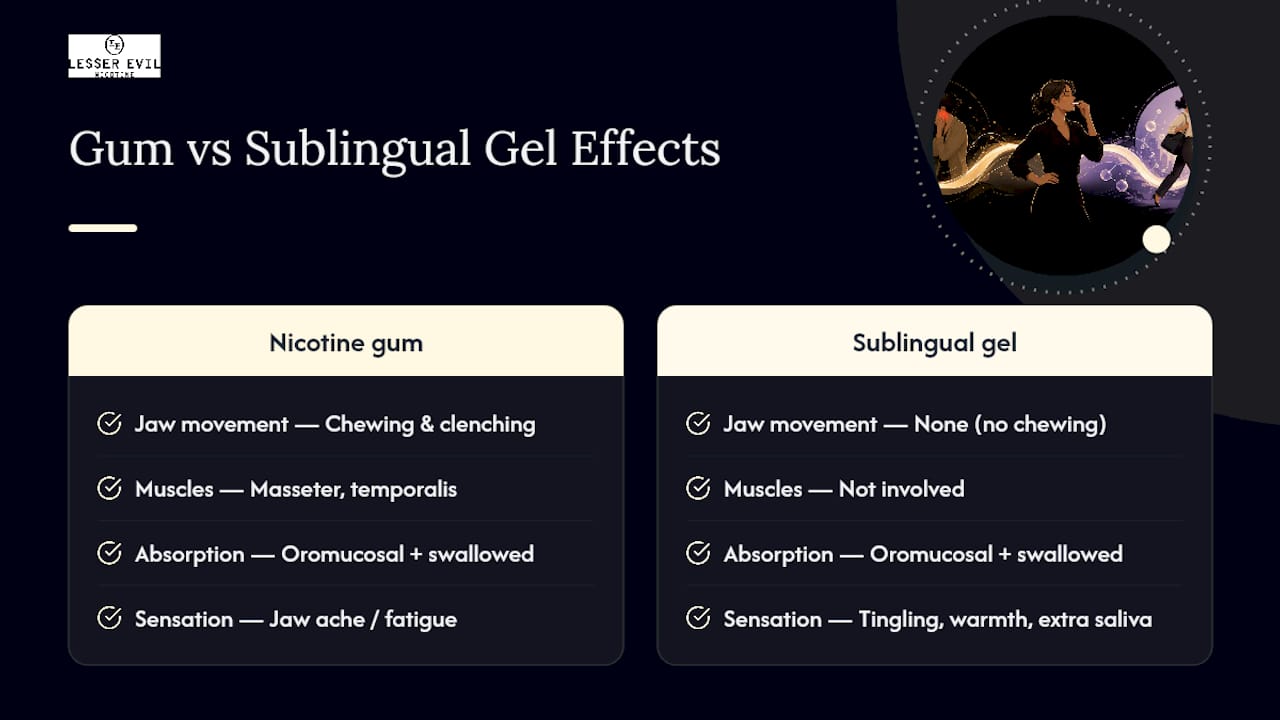
That doesn’t mean nicotine itself becomes a non-issue. Population pharmacokinetic research on oromucosal nicotine formulations shows these products still combine oromucosal absorption with a swallowed fraction, and the exact split varies by formulation. So the nicotine still gets into your system, and if you’re someone whose muscle tension is sensitive to nicotine’s stimulant effect, that part of the picture may not disappear just because the chewing does.
What does change is the type of mouth effect you’re likely to notice. Mayo Clinic’s drug information on oromucosal nicotine lists mouth, tooth, jaw or neck pain among potential effects for this product category generally, so it’s worth knowing that some mouth sensation is possible with any oromucosal format. But the profile is different: instead of muscle fatigue, sublingual users more commonly report mild tingling, warmth, or a bit of extra saliva where the gel sits, none of which comes from repeated jaw contraction. You can read more on how oral nicotine absorption actually works if you want the fuller mechanics.
How to switch to a sublingual gel without guessing
Swapping formats is straightforward, but a bit of structure helps you judge whether it’s actually working for your jaw.
- Start with one low dose. Apply a single spray under the tongue and leave it there rather than swallowing straight away.
- Wait it out. Give it fifteen to thirty minutes before deciding how you feel. Sublingual absorption is gradual, not instant.
- Log your jaw comfort. Note any ache, tension, or ease over the next 24 to 72 hours and compare it honestly with a typical gum day.
- Watch your mouth, not just your jaw. Mild tingling or extra saliva is common and usually settles. Persistent soreness in one spot is not.
- Adjust the cadence. If one flavour or dosing pattern feels off, try another before writing off the format entirely. Peppermint, Black Grape and Green Apple all feel different in the mouth.
- Know when to stop. If jaw pain persists past a week regardless of what you’re using, that’s a signal to see a dentist rather than keep experimenting with products.
For a wider view of how oral formats stack up against each other on taste, dosing, and daily practicality, this breakdown of oral nicotine benefits is worth a read before you commit to one routine.
A straight-talking view on ditching the chew
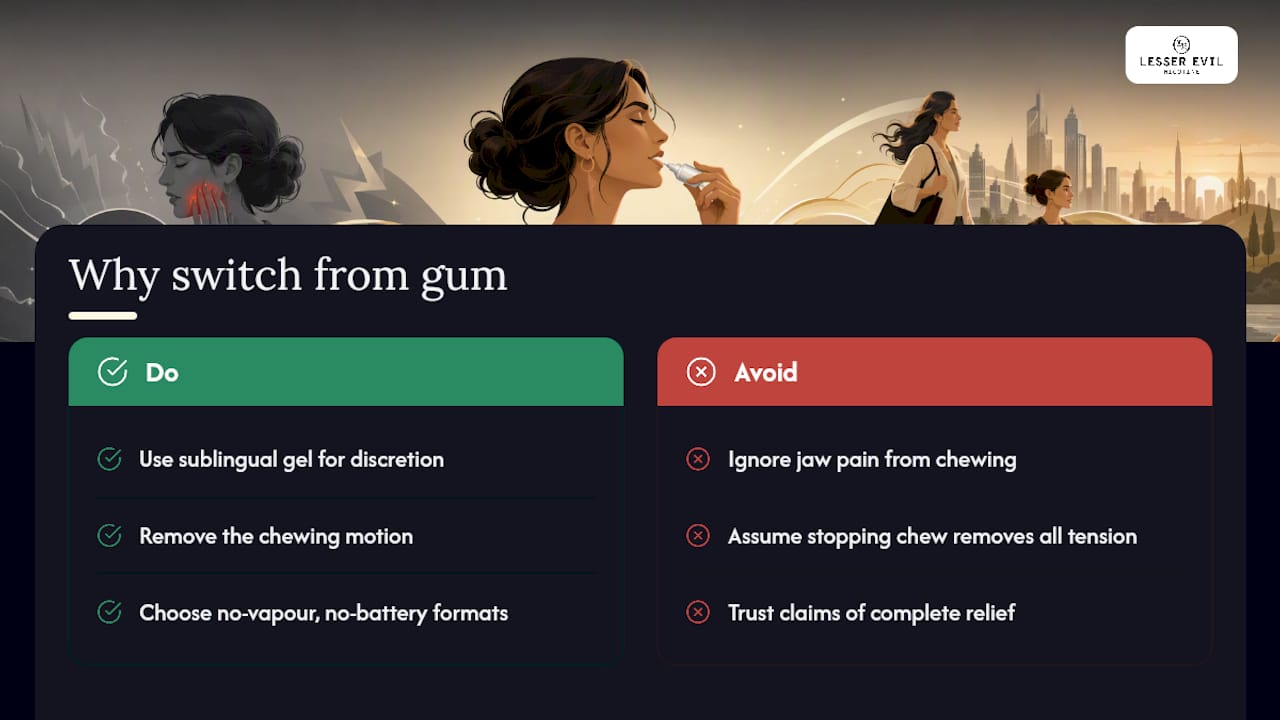
Plenty of people chew nicotine gum for months before connecting the dots between their sore jaw and the habit itself. That gap surprises me every time. The mechanical case is obvious once you say it out loud: chewing anything repeatedly for half your waking day will eventually strain a muscle. What’s less obvious is that removing the chew doesn’t remove nicotine’s stimulant effect on muscle tension entirely, and I think products in this space oversell relief without saying that plainly.
What sublingual gel genuinely offers is discretion and one less variable, no chewing motion, no visible gum, no battery or vapour cloud. For anyone juggling meetings and wanting something they can use without anyone noticing, that’s the practical win worth having. Read further on the brand’s own comparison of oral formats if you want to dig deeper.
— Luke McLeod
Trying Lesser Evil Oral Mister for yourself
Lesser Evil Oral Mister is the sublingual gel spray behind everything discussed above: no chewing, no jaw load, no tobacco. It’s a tobacco-free, battery-free formula in three natural flavours (Peppermint, Black Grape and Green Apple), applied with a quick spray under the tongue rather than half an hour of jaw work.
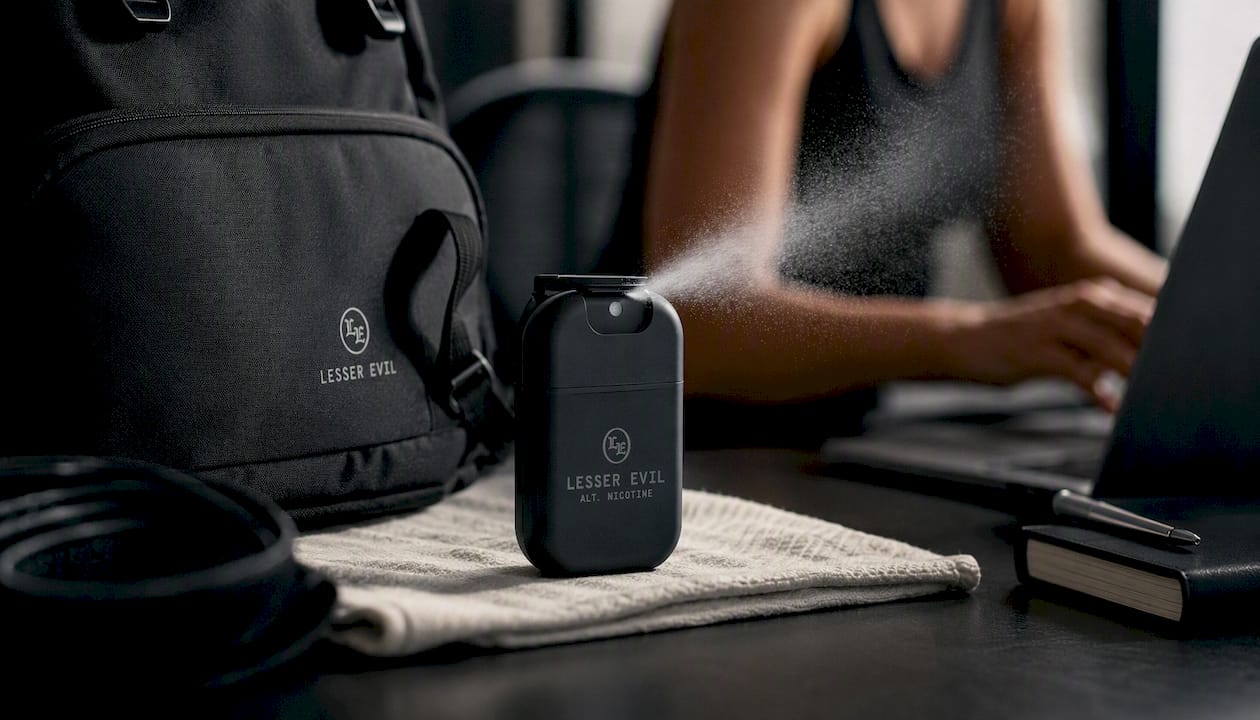
Because it’s applied rather than chewed, there’s simply no mastication involved, which is the mechanical piece that causes most gum-related jaw soreness in the first place. Customers report finding it easier to use discreetly at a desk or in a meeting than gum or a vape, with no visible cloud, no device to charge, and nothing left behind that counts as e-waste. Some also mention using less nicotine overall once they’re not chewing on autopilot, though how that plays out varies person to person. If you’re curious how people generally weigh up nicotine formats before switching, this piece on comparing tobacco formats is a useful outside perspective.
If your jaw is telling you it’s had enough of chewing, the next step is simple: try Lesser Evil Oral Mister and see how it fits into your day.
Sources
- Are smokers more susceptible to temporomandibular disorders? (Journal of Orofacial Medicine and Pain, 2024)
- Repercussions of smoking on orofacial pain and TMD: integrative review (2024)
- Nicotine oral/oromucosal route — Mayo Clinic (drug information)