

Why vaping disrupts social settings: what you need to know

TL;DR:
- Vaping alters social space by affecting sensory environment, visibility, and social expectations, leading to conflict. Clearer rules, device choices, and asking permission can reduce disputes, especially in shared environments. Vapourless nicotine alternatives like Oral Mister offer social disruption-free options.
Vaping changes how people share space because it alters three things at once: the sensory environment (smell, visible vapour), the visibility of the behaviour itself, and the social expectations people bring to a setting. The Royal College of Physicians frames nicotine without smoke as a harm-reduction strategy; however, that public-health nuance rarely filters down to the pub, the office, or the school corridor. The result is a behaviour that sits in a legal and social grey zone, and grey zones breed friction.
- Sensory disruption: vapour plumes and sweet or chemical scents intrude on people who did not consent to them.
- Visibility and norms: some devices are almost invisible; others produce clouds that dominate a room. The gap between the two shapes how disruptive vaping feels to bystanders.
- Social identity: vapers and non-vapers often hold different expectations about where vaping is acceptable, and those mismatched expectations are the root of most conflict.
The CDC notes that marketing, flavours and peer influence are central drivers of youth vaping uptake, which means the social spread of the habit is partly by design. Understanding why vaping disrupts social settings is the first step to navigating it better, whether you vape or not.
Table of Contents
- Why does vaping disrupt social settings in the first place?
- How does vaping shape identity, stigma, and who gets judged?
- How does vaping change group dynamics and relationships?
- Where does vaping cause the most friction in the UK?
- What does UK law and public-health policy say about vaping?
- How can you reduce vaping-related friction in group settings?
- Key takeaways
- The social cost of ambiguity
- A vapourless option worth knowing about
Why does vaping disrupt social settings in the first place?
Disruption, in a social context, means any behaviour that interrupts the shared comfort, routines, or expectations of a group. Vaping hits all three.
The sensory mechanism is the most immediate. When someone exhales a cloud of sweet-scented vapour across a dinner table or in a cinema queue, they are altering the air that everyone else breathes. Unlike a phone ringing, which is brief, a vaping session can repeat every few minutes. The cumulative effect on bystanders, especially those with respiratory sensitivities, is not trivial.
The behavioural mechanism is subtler. Vaping often happens without the social rituals that once surrounded smoking: no stepping outside, no asking permission, no visible lighter. That absence of ritual means bystanders get no warning and no chance to opt out. The behaviour just appears.
The normative mechanism is the deepest. Because UK law and guidance treats vaping differently from smoking, venues and individuals are left to set their own rules. Some workplaces ban it entirely; others allow it at desks. Some pubs permit it indoors; others do not. That patchwork of rules means a vaper moving between settings can never be sure what is acceptable, and neither can anyone else.
The practical upshot:
- Vaping in enclosed spaces without asking is the single most common trigger for social conflict.
- Ambiguous venue rules create confrontations that clear signage would prevent.
- Frequency matters as much as location: one discreet puff is rarely the issue; repeated, visible use in a shared space almost always is.
Research published via Frontiers in Public Health found that stricter regulatory environments are associated with higher perceived social unacceptability among vapers themselves, which suggests that clearer rules actually reduce friction rather than increase it.
How does vaping shape identity, stigma, and who gets judged?
Vaping sits in an awkward social position: it is not smoking, but it is not nothing. That ambiguity means the social judgement a vaper receives depends heavily on who they are, why they are perceived to be vaping, and what group they are in.
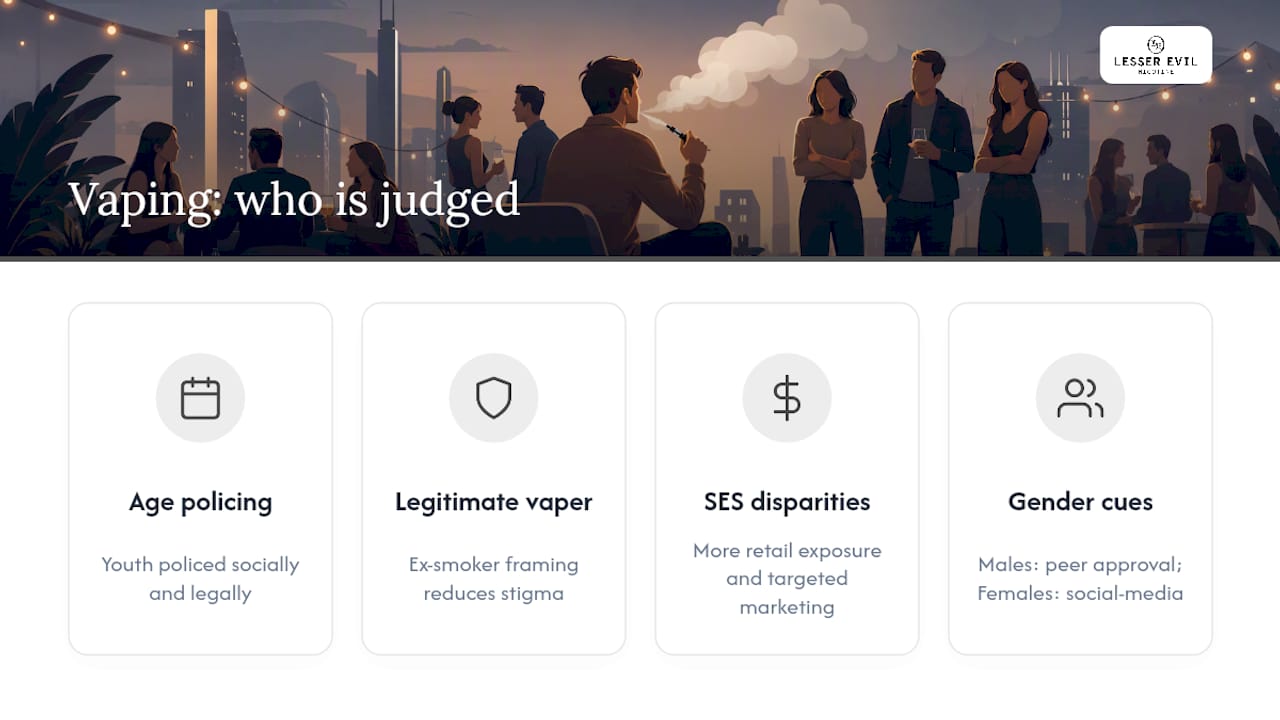
Qualitative research with young adults found that vapers actively construct “legitimate vaper” identities, positioning themselves as former smokers who switched for health reasons rather than as people who simply took up a new habit. This legitimacy narrative reduces stigma. A 40-year-old who visibly switched from cigarettes to a pod device is judged very differently from a 19-year-old who never smoked and uses a brightly coloured disposable. Same behaviour, very different social reception.
Intersectionality shapes this further. Age is the most obvious factor: youth vaping is policed more aggressively, both socially and legally. But sexuality, race, and socioeconomic status also influence how vaping is perceived and who gets challenged for it.
Research on socioeconomic disparities shows that low-SES communities face higher exposure to vape retail, more targeted marketing, and weaker enforcement, all of which normalise vaping locally. A behaviour that is unremarkable on one street can be stigmatised two postcodes away. That geographic and class dimension means “social disruption” is not a universal experience: it is shaped by where you are and who you are.
Gender adds another layer. Frontiers in Public Health research found that male and female vapers respond to different social cues: peer approval tends to drive male uptake, while social-media influence plays a stronger role for female vapers. That split matters for understanding how vaping spreads through different social groups and why the same intervention does not work equally across genders.
How does vaping change group dynamics and relationships?
The social effects of vaping are not limited to the moment of use. Over time, vaping can reshape group dynamics in ways that are easy to miss until the damage is done.
The most immediate effect is physical splitting. When someone in a group needs to vape and cannot do so where the group is gathered, they leave. Repeatedly. In a work meeting, that is a minor irritant. In a social evening, it fragments the group and creates a two-tier dynamic: those who step out together and those who stay behind. The “vaping break” becomes its own social ritual, one that excludes non-vapers.
Research linking vaping to social and emotional wellbeing found that young people who vaped during the COVID-19 pandemic reported worse emotional health and were less likely to adhere to social distancing and mask-wearing. The pandemic context is specific, but the underlying pattern is not: vaping is associated with behaviours that prioritise personal habit over shared social norms.
Key associations from the research:
- Vapers in the pandemic study reported higher rates of mood and sleep problems compared to non-vapers.
- Reduced adherence to distancing rules was linked to the social rituals around vaping, including device sharing and group use.
- Exclusion cuts both ways: non-vapers can feel sidelined when a group’s social life revolves around vaping breaks; vapers can feel judged and excluded when their habit is treated as a moral failing.
The emotional dimension matters. When vaping becomes a source of conflict in a relationship or friendship group, it rarely stays just about the vaping. It becomes a proxy for respect, consideration, and shared values.
Where does vaping cause the most friction in the UK?
Some settings generate far more vaping-related conflict than others. Here is where the flashpoints are, and why.
Schools and colleges are the sharpest battleground. Disposable vapes are small enough to use in toilets and corridors, and the CDC’s guidance on youth vaping is clear that nicotine is particularly risky for adolescents because it can harm brain development. UK schools are legally required to have smoke-free policies, and most extend these to vaping, but enforcement is patchy and confrontational.
Workplaces present a different challenge. Most UK employers ban vaping indoors, but the rules around outdoor vaping areas, vaping at desks in home-working contexts, and vaping during video calls are often unwritten. That ambiguity creates resentment on both sides.
Hospitality venues (pubs, restaurants, bars) are legally permitted to set their own vaping policies. Many allow it; many do not. The absence of a universal rule means customers and staff are constantly navigating uncertainty.
Public transport is a legal no. Vaping is banned on all TfL services, National Rail, and most bus operators. Yet reports of vaping on the London Underground and on buses are common, particularly from younger users emboldened by device discreteness.
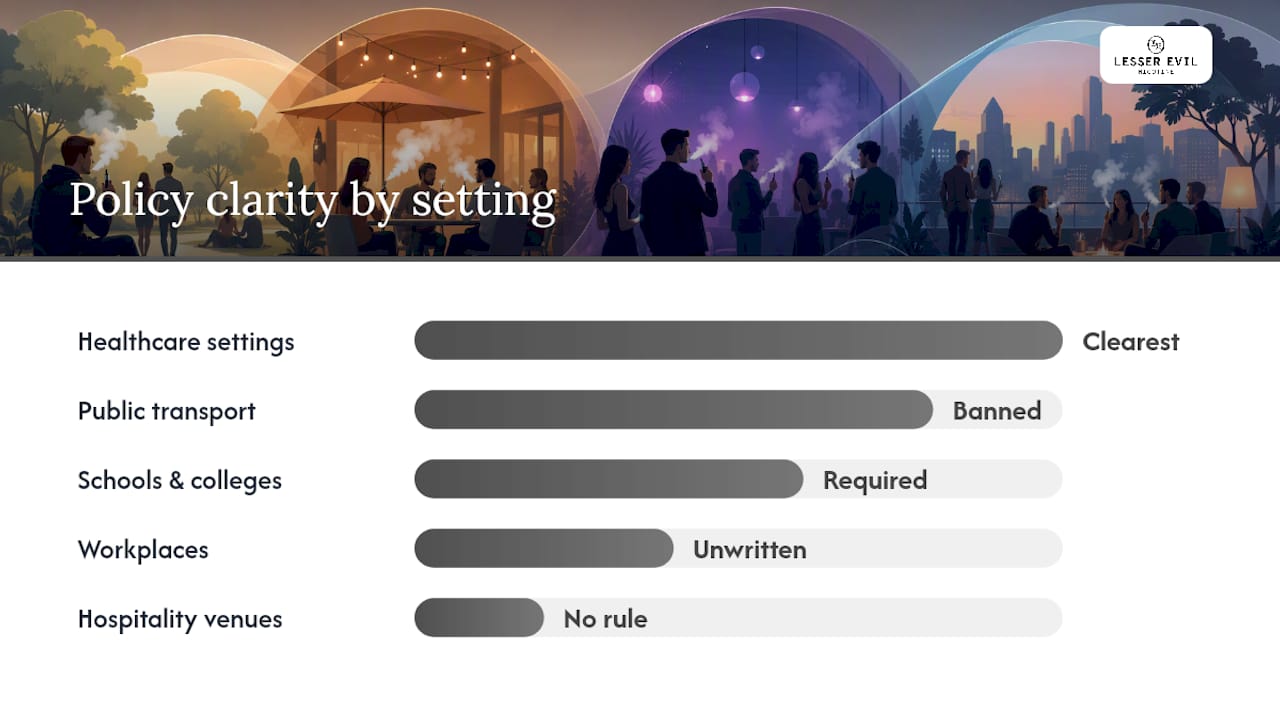
Healthcare settings have the clearest rules and the highest stakes. Vaping near hospital entrances or in clinical areas is both prohibited and genuinely harmful to vulnerable patients.
Venue checklist for managers:
- Post clear, visible signage at entrances stating your vaping policy.
- Train front-of-house staff on how to address vaping politely and consistently.
- Designate an outdoor vaping area if your venue permits it, to reduce indoor use.
- Include vaping in your staff handbook alongside smoking policy.
- Review your policy annually as UK regulations evolve.
Quick etiquette checklist for vapers:
- Always check signage before using a device indoors.
- If there is no sign, ask a member of staff rather than assuming.
- Step well away from entrances and non-vapers when using outdoors.
- Never vape near children or in enclosed spaces with others present.
What does UK law and public-health policy say about vaping?
UK policy on vaping is more nuanced than a simple ban, and that nuance directly shapes social norms. Here is the compact version.
A landmark review referenced by gov.uk estimated e-cigarettes as substantially less harmful than combustible tobacco. That framing positioned vaping as a harm-reduction tool in public-health discourse, which is why NHS Stop Smoking services have, at various points, been permitted to recommend vapes to smokers. The social implication is significant: vaping has institutional legitimacy in the UK that it lacks in many other countries.
The RCP’s harm-reduction guidance reinforces this, framing nicotine without smoke as preferable to combustible tobacco. Neither the gov.uk review nor the RCP guidance, however, says vaping is harmless or that it should be permitted everywhere. That gap between “less harmful than smoking” and “socially acceptable anywhere” is where most of the friction lives.
For a full breakdown of current UK vape regulations, including the 2026 updates to advertising and sales rules, the UK Vape Regulations 2026 guide is a useful reference.
| Agency / Measure | What it says | Social implication |
|---|---|---|
| gov.uk landmark review | E-cigarettes estimated as substantially less harmful than tobacco | Gives vaping institutional legitimacy; reduces stigma among adults |
| RCP harm-reduction guidance | Nicotine without smoke is preferable to combustible tobacco | Supports vaping as a transition tool; does not endorse unrestricted use |
| Health Act (smoke-free) | Bans smoking in enclosed public spaces; does not automatically cover vaping | Venues must set their own vaping rules, creating a patchwork of policies |
| Age of Sale regulations | Minimum age to purchase vapes in the UK | Reduces youth access in theory; social sharing between peers undermines this in practice |
| Advertising restrictions | Vaping advertising is tightly regulated under MHRA and ASA rules | Limits normalisation via mass media; social media remains a significant gap |
Research comparing regulatory environments found that stricter laws correlate with higher perceived social unacceptability among vapers. The UK’s relatively permissive public-health framing may therefore contribute to lower social friction in some contexts, while creating confusion in others.
How can you reduce vaping-related friction in group settings?
Whether you vape or you are on the receiving end of someone else’s habit, there are practical steps that actually work.
For vapers:
- Ask before you use. One sentence (“Do you mind if I vape?”) changes the entire social dynamic. It signals consideration and gives others a genuine choice.
- Choose a less visible device. A pod system with a tight draw produces far less vapour than a sub-ohm mod. The hardware choice is a social choice too.
- Step away from the group. Even if vaping is technically permitted in the space, moving a few metres away reduces the sensory impact on others.
- Reduce frequency in social settings. Vaping every ten minutes in a group dinner is noticed; once during a break is not.
- Never share devices. Infection risk aside, it normalises the behaviour in settings where others may feel pressured to participate.
For non-vapers and venue staff:
- Address it directly but without accusation. “Could you take that outside?” lands better than “You shouldn’t be doing that in here.”
- Point to policy, not personal preference. “Our venue policy is no vaping indoors” removes the personal element and makes it easier for the vaper to comply without losing face.
- Use signage proactively. A clear sign at the entrance prevents most confrontations before they start.
- Escalate calmly. If a polite request is ignored, involve a manager rather than escalating the confrontation yourself.
Numbered escalation steps for workplaces:
- Remind the colleague of the written policy (email or in person, depending on your relationship).
- If it continues, raise it with a line manager as a policy compliance issue, not a personal complaint.
- If the manager does not act, escalate to HR with a written record of the dates and incidents.
- For persistent issues, request a formal review of the workplace vaping policy.
Pro Tip: Frame requests around the space, not the person. “This is a no-vaping area” is far less confrontational than “You can’t vape here.” The first is about the room; the second is about them. People respond very differently to each.
For practical guidance on responsible nicotine use in professional and social settings, the approach is the same: consideration first, habit second.
Key takeaways
Vaping disrupts social settings through three overlapping mechanisms: sensory intrusion, ambiguous social norms, and mismatched expectations between vapers and non-vapers.
| Point | Details |
|---|---|
| Three core mechanisms | Sensory cues (vapour, scent), device visibility, and mismatched social expectations drive most vaping-related friction. |
| Device choice matters | Pod systems produce less vapour and scent than box mods; hardware is a social decision as much as a personal one. |
| Rules reduce conflict | Stricter regulatory environments are associated with higher perceived social unacceptability among vapers, meaning clear rules actually help. |
| Etiquette works | Asking permission before vaping and stepping away from groups are the two most effective ways to reduce friction in shared spaces. |
| Lesser Evil Nicotine | The Oral Mister sublingual gel produces no vapour and no scent, removing the sensory and visibility triggers that cause social disruption. |
The social cost of ambiguity
There is a version of this conversation that treats vaping as a simple etiquette problem, solvable with better signage and a polite word. That version is too easy.
What the research actually shows is that vaping disrupts social settings because it arrived faster than the norms needed to govern it. Smoking took decades to move from unrestricted to banned indoors. Vaping compressed that arc into a few years, and the social rules are still catching up. The result is a behaviour that is simultaneously framed as a public-health tool by the RCP and as an antisocial nuisance by the person sitting next to you on the Tube.
The intersectional dimension is the part most commentators skip. Who gets challenged for vaping in a pub, and who does not, is not random. Age, race, class, and gender all shape how the same behaviour is policed socially. A middle-aged professional with a discreet pod device is rarely confronted. A young person with a brightly coloured disposable almost always is. That inconsistency is not just unfair; it means the social friction around vaping is not really about the vapour. It is about who is doing it and what that signals to the people around them.
The practical answer is not to stop vaping or to police others more aggressively. It is to close the gap between behaviour and expectation: clearer venue rules, better device choices, and the basic social skill of asking before you act. None of that is complicated. It just requires treating the people around you as part of the equation.
A vapourless option worth knowing about
If you vape and the social friction is getting old, there is a straightforward alternative that sidesteps the whole problem. No cloud, no smell, no device to explain.
Lesser Evil Nicotine’s Oral Mister is a sublingual nicotine gel that delivers nicotine under the tongue via the oral mucosa. Tobacco-free. Battery-free. Three natural flavours: Peppermint, Black Grape, and Green Apple. Nothing goes into the air. Nothing to charge. Nothing to leave on the table as a conversation piece.
It is preparing for UK launch in 2026. If you want a vapourless option that produces no plume and no scent, check the product page for availability and get on the list early.