

Why vape clouds are embarrassing in public (and what to do)

Visible vape clouds are one of the most common sources of social embarrassment for adult vapers in the UK. The fix is usually simpler than you think: step a few paces away from bystanders, exhale downward, and consider switching to a mouth-to-lung or pod device that produces far less visible vapour. If you want zero cloud altogether, a no-vapour oral nicotine option removes the problem entirely.
Three things you can do right now:
- Move at least two or three steps away from anyone nearby before you take a draw
- Exhale slowly downward toward the ground rather than straight ahead
- Switch to a pod or mouth-to-lung kit, or try a sublingual oral nicotine gel that produces no vapour at all
Surveys consistently show a sizeable share of the British public feel bothered by vaping in shared spaces, particularly on public transport and in queues. The social discomfort is real, and understanding why it happens is the first step to managing it.
Key takeaways
Visible vape clouds cause social embarrassment in public primarily because of visibility, scent, and generational perception gaps, and the most effective fixes combine device choice, technique, and knowing the UK’s venue rules.
| Point | Details |
|---|---|
| Clouds draw attention by design | Large vapour output is a visible social signal; bystander discomfort is about surprise and scent, not just health. |
| UK law leaves rules to venues | Vaping isn’t covered by the 2006 smoking ban; each venue and transport operator sets its own policy. |
| MTL and pod devices cut clouds sharply | Switching from a sub-ohm kit to a mouth-to-lung or pod device is the single biggest reduction in visible vapour. |
| Second-hand exposure is low but comfort still matters | UCL research found second-hand vaping exposure very low versus tobacco smoke; bystander comfort is a separate issue. |
| Lesser Evil Oral Mister produces no cloud | The sublingual nicotine gel is tobacco-free, battery-free, and leaves nothing visible for anyone around you to react to. |
Table of Contents
- Why do vape clouds attract attention and feel embarrassing in public?
- Where can you actually vape in the UK? Law, transport, and venue rules
- Public vaping etiquette: the dos and don’ts that actually matter
- How to reduce visible clouds: devices, liquids, and technique
- What to say if someone objects: calm responses that actually work
- Are vape clouds actually harmful, and how long do they linger?
- When are large clouds actually acceptable?
- Why considerate vaping is actually in your own interest
- The Lesser Evil Oral Mister: no cloud, no compromise
- Sources
Why do vape clouds attract attention and feel embarrassing in public?
The short answer: visibility. A large cloud of vapour in a shared space is impossible to ignore. It moves into other people’s personal space, carries a scent they didn’t choose, and signals a behaviour that a significant portion of the population still associates with smoking.
It’s a social signal whether you intend it or not
When you exhale a dense cloud in a café, on a platform, or in a queue, you are creating a visible event. Bystanders notice it the same way they notice someone playing music without headphones. It isn’t necessarily rude, but it draws eyes and triggers a social calculation in the people around you: is this OK here? That moment of uncertainty is where the awkwardness lives.
Scent compounds the problem. Many people stepping outside expect fresh air. A sudden hit of sweet or menthol vapour in their personal space can feel startling, even if the smell itself isn’t unpleasant. The surprise element is often what tips mild irritation into an actual complaint.
Generational and cultural divides
Younger vapers tend to normalise public vaping because it’s woven into their social environment. Older cohorts, particularly those who lived through decades of anti-smoking campaigns, often read visible vapour the same way they read cigarette smoke: as an imposition. That generational gap is real, and it shapes how a cloud gets received depending on who’s standing nearby.
Reporting in The Standard references YouGov and HAYPP survey data showing rising complaints about public vaping, with transport environments drawing the most friction. The data points to a clear pattern: the more confined the space, the more likely a visible cloud is to cause offence.
Statistic callout: HAYPP data cited in press coverage shows a notable increase in vaping-related complaints on public transport in recent years, with a significant share of respondents reporting they find public vaping bothersome.
Pro Tip: If you’re in any doubt about whether a space is appropriate, treat it the same as you would smoking. That default alone will save you most awkward encounters.
Where can you actually vape in the UK? Law, transport, and venue rules
Here’s the thing most vapers don’t realise: vaping is not covered by the Health Act 2006 smoking ban. UK government guidance confirms that e-cigarettes are not classed as tobacco products under that legislation, which means no national law automatically bans vaping indoors. The decision sits entirely with individual venues, employers, and transport operators.
In practice, that means the rules vary wildly. A pub garden might be fine; the pub itself almost certainly isn’t. A hotel room is a serious risk: many hotels now use vape detectors and levy cleaning charges for indoor vaping, treating it identically to smoking. Event spaces, shopping centres, and workplaces overwhelmingly apply no-smoking policies to vaping by default.
Transport rules
Transport is where the rules get most enforced. The London Assembly’s guidance confirms that London’s transport operators treat vaping as undesirable on public transport, and TfL’s own policy prohibits it across the network. National rail operators follow similar lines. Taxis and private hire vehicles are at the driver’s discretion, but most prohibit it.
For a fuller picture of how UK nicotine product rules work, the UK nicotine regulation guide covers the regulatory context in plain language.
Quick checklist for checking venue rules:
- Look for signage at the entrance or near designated smoking areas
- If there’s no sign, ask a member of staff before you vape
- Assume indoor spaces are off-limits unless explicitly told otherwise
- On any public transport, treat it as a no-vape zone regardless of signage
Pro Tip: Hotels are the biggest trap. Even “outdoor” hotel balconies are often covered by the same policy as the room. Check before you check in.
Public vaping etiquette: the dos and don’ts that actually matter
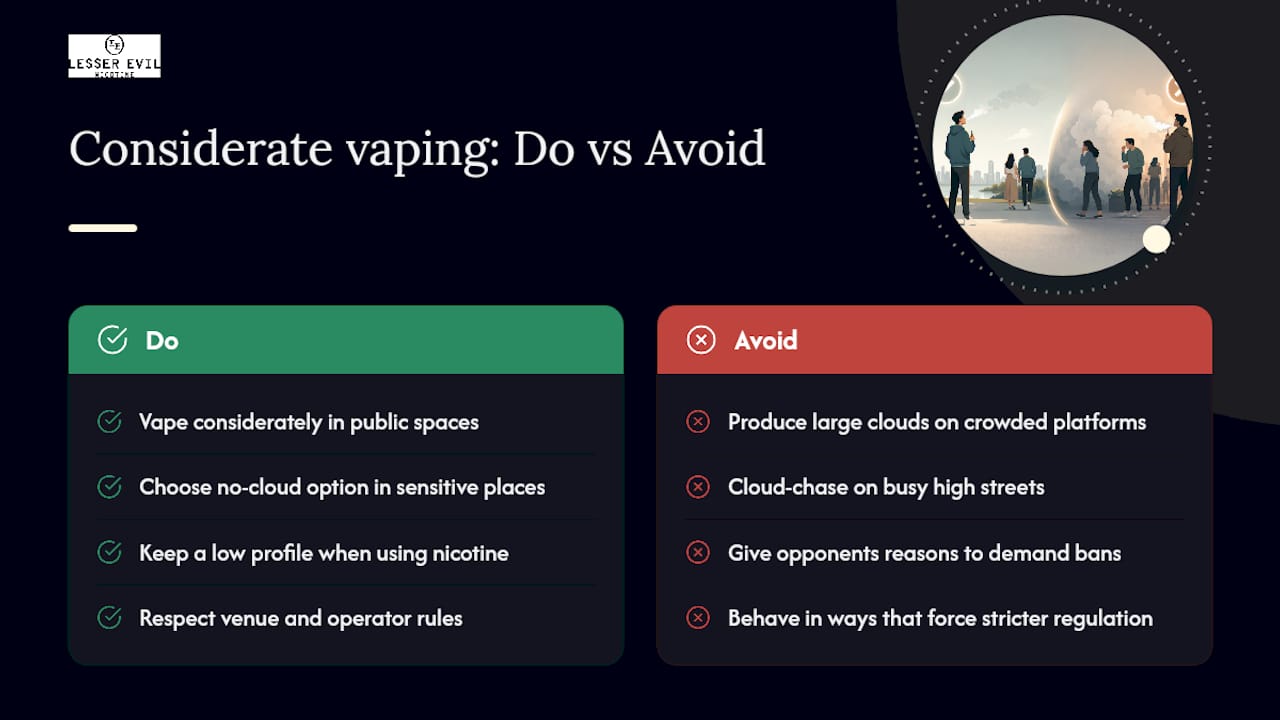
Good vaping etiquette isn’t about being apologetic for your habit. It’s about being considerate enough that nobody has a reason to complain, and that collective behaviour doesn’t hand politicians an easy case for stricter restrictions. Etiquette guides from UK vaping specialists consistently land on the same practical rules.
Do:
- Step a few paces away from bystanders, especially in queues or on busy pavements
- Keep draws brief and exhale downward or away from people
- Check for children, elderly people, or anyone who looks like they might have a respiratory condition nearby
- Ask permission in borderline settings like pub gardens or communal outdoor areas
Don’t:
- Vape in lifts, stairwells, queues, or any confined shared space
- Blow vapour in the direction of another person’s face
- Cloud chase in shared public spaces — save that for private or designated settings
- Vape in taxis, on trains, or on any public transport without explicit permission
Borderline settings deserve a specific mention. A pub garden with plenty of space and no children nearby is generally fine. A communal hallway in a block of flats is not, even if you’re technically outdoors. The considerate default is: if someone could reasonably object, move further away or wait.
Pro Tip: Timing matters as much as location. A quick, low-cloud draw during a lull in foot traffic is very different from a long session in the middle of a crowded pavement.
How to reduce visible clouds: devices, liquids, and technique
Cloud size is not fixed. It’s a product of your device, your liquid, and how you inhale. All three are adjustable, and even small changes make a visible difference.
Device type is the biggest lever
Sub-ohm or direct-to-lung (DTL) kits are built for cloud production. They run at high wattage, use low-resistance coils, and push large volumes of warm vapour. If you’re using one of these in public, you’re going to produce a noticeable cloud no matter what you do with your technique.
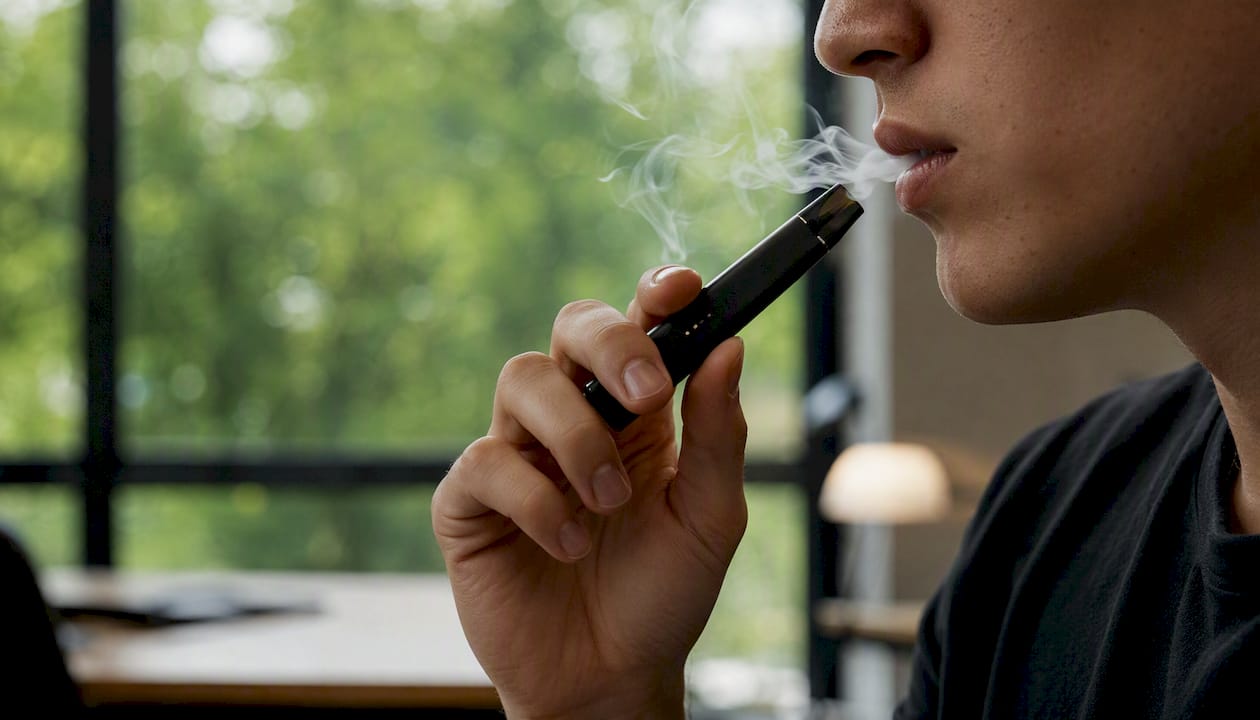
Mouth-to-lung (MTL) kits and pod systems work differently. They run at lower wattage, use higher-resistance coils, and produce a much tighter, cooler draw. The vapour output is a fraction of a sub-ohm kit. For public use, an MTL pod device is the practical choice.
Liquid choices that reduce visible vapour
VG (vegetable glycerin) is what creates thick, visible clouds. PG (propylene glycol) produces much thinner vapour. For low-visibility vaping, a higher-PG blend (50/50 or above PG) in an MTL device cuts visible output significantly. Nicotine salt liquids, which are designed for pod systems, tend to come in higher-PG formulations by default.
Technique adjustments for on-the-spot cloud reduction
Even with the same device, how you inhale and exhale changes what bystanders see:
- Take a slower, gentler draw rather than a hard pull
- Hold the vapour briefly before exhaling to allow some dispersion
- Exhale slowly downward toward the ground
- Exhale into your sleeve or jacket if you need to be especially discreet
For a practical overview of discreet nicotine use techniques that go beyond device choice, there’s a dedicated guide worth reading.
The VG/PG considerations explained by KaliVape offer useful background on how liquid composition affects vapour production, even if that guide is written from a European perspective.
| Device type | Cloud output | Best for public use? |
|---|---|---|
| Sub-ohm / DTL kit | High | No |
| Mouth-to-lung (MTL) kit | Low to medium | Yes |
| Pod system | Very low | Yes |
| Oral nicotine gel | None | Yes |
What to say if someone objects: calm responses that actually work
Someone pulling a face or saying something is not an attack. It’s usually just discomfort, and how you respond in the next ten seconds determines whether it stays minor or escalates.
The goal is simple: acknowledge, offer a solution, move on.
Short scripts that work:
- “Sorry about that, I’ll move further away.” Then move. Done.
- “Fair enough, I didn’t realise it was bothering you.” No defensiveness, no argument.
- “I’ll step away and finish this over there.” Offers a concrete action immediately.
What to avoid:
- Don’t explain that vaping is legal or that the science says it’s low-risk. Nobody wants a lecture when they’re already irritated.
- Don’t stand your ground physically. Moving away costs you nothing and defuses almost every situation.
- Don’t apologise excessively either. One brief acknowledgement is enough; over-apologising invites further comment.
A typical scenario: someone in a pub garden says “do you have to do that here?” The effective response is a calm “sorry, I’ll move down a bit” followed by actually moving. The conversation ends there. Staying put and explaining your rights turns a five-second moment into a five-minute argument.
Pro Tip: Body language matters as much as words. Turning slightly away from the person while you respond signals you’re not being defensive, even before you say anything.
Are vape clouds actually harmful, and how long do they linger?
This is where the evidence is genuinely reassuring, though it doesn’t change the social equation.
UCL research published in 2024 found that measured second-hand exposure from e-cigarettes is very low compared with second-hand tobacco smoke, based on constituent concentrations. That’s meaningful context. It doesn’t mean vape aerosol is inert, but the exposure levels are substantially different from passive smoking.
A landmark review cited on gov.uk estimated that e-cigarettes are around 95% less harmful than tobacco at a population level. That figure is widely quoted in policy discussions and is used as a harm-comparison benchmark, not a safety guarantee. The NHS frames e-cigarettes as an alternative to smoking for adults, not as a medicinal product, and advises anyone with health questions to speak to a GP.
How quickly does vapour disperse?
Outdoors, vape aerosol disperses within seconds in any light breeze. Even in still air, it breaks up far faster than cigarette smoke, which contains particulates that linger. Indoors is a different story: in a poorly ventilated room, aerosol can persist for several minutes. That’s the practical reason why indoor vaping in shared spaces remains socially problematic even when the health risk is low.
The takeaway: the science supports a lower-risk profile than smoking, but bystander comfort is a separate issue from measured exposure. Both matter.
When are large clouds actually acceptable?
Cloud chasing has its place. It’s just not most public spaces.
Settings where large clouds are generally fine:
- Private homes where everyone present has consented
- Dedicated vaping events, expos, or enthusiast meetups
- Some outdoor social settings with consenting adults and plenty of space
The rule of thumb for deciding:
- Has everyone in the immediate space either consented or chosen to be there for vaping?
- Is there enough ventilation and distance that non-vapers aren’t affected?
- Is the setting explicitly recreational rather than shared public infrastructure?
If the answer to all three is yes, you’re probably fine. A vaping meetup in a private venue: yes. A restaurant terrace with mixed diners: no. A train platform: absolutely not.
Cloud chasing in shared public spaces doesn’t just create individual awkwardness. It feeds the narrative that vapers are inconsiderate, which is one of the most direct routes to stricter local restrictions. IOFAM’s etiquette guidance makes this point clearly: individual behaviour shapes collective policy outcomes. Save the big sessions for spaces built for them.
Why considerate vaping is actually in your own interest
There’s a version of this conversation that frames etiquette as self-sacrifice. I don’t buy it. Considerate vaping is straightforwardly self-interested.
Every time a vaper produces a large cloud on a crowded platform or in a pub garden full of families, they hand someone a reason to push for a ban. The UK’s current regulatory position, which leaves venue and transport policy to individual operators rather than imposing a blanket national prohibition, exists partly because the vaping community has generally not behaved badly enough to force a harder response. That tolerance is not guaranteed.
The social licence to vape in outdoor public spaces is genuinely fragile. It depends on enough vapers being considerate enough that the majority of non-vapers don’t feel strongly enough to demand legislation. One person cloud chasing on a busy high street doesn’t just embarrass themselves; they give ammunition to the people who want to restrict everyone.
If you’re thinking about a no-cloud option for situations where even a small amount of visible vapour feels like too much, the role of discretion in nicotine use is worth reading. It covers the behavioural side of keeping a low profile without giving up nicotine entirely.
The Lesser Evil Oral Mister: no cloud, no compromise
If the cloud problem is the problem, the cleanest fix is removing the cloud entirely.

Lesser Evil Oral Mister is a sublingual oral nicotine gel: you apply it under the tongue, it absorbs via the oral mucosa, and nothing gets breathed in or exhaled. No vapour. No visible cloud. No aerosol drifting into anyone’s personal space.
Product facts:
- Sublingual nicotine gel (under the tongue), not inhaled
- Tobacco-free, battery-free, zero e-waste
- Natural flavours and natural sweeteners
- Three flavours: Peppermint, Black Grape, Green Apple
- For adult use only; not an NRT or medical product
It’s a practical option for urban professionals, frequent travellers, or anyone in settings where even a discreet MTL draw would attract attention. Meetings, flights, public transport, anywhere a cloud of any size is the wrong call. No device to charge, nothing to dispose of, nothing anyone around you will notice.
For adults who vape and want a no-cloud alternative that doesn’t involve pouches or patches, explore Lesser Evil Nicotine at the store and see which flavour fits.
Sources
The following UK authorities and studies were used in this article. For medical questions, speak to your GP or check NHS.uk directly.
- Second‑hand vaping exposure very low compared with second‑hand smoking (UCL)
- Vaping on public transport — London Assembly
- Using e‑cigarettes to stop smoking — NHS
This article is general information, not a substitute for advice from a qualified doctor. Consult a qualified healthcare professional about your own circumstances before acting on anything here.