

The role of discretion in nicotine use: 2026 guide

TL;DR:
- Discreet nicotine use involves low-visibility products like pouches and gels to minimize social disruption and odor. These formats improve harm reduction by drastically reducing toxicant exposure compared to traditional cigarettes. Responsible use requires self-awareness, careful format selection, and understanding workplace policies to manage habits safely.
Discreet nicotine use is defined as consuming nicotine products in ways that minimise visibility, odour, and social disruption. The role of discretion in nicotine use has grown sharply as young adults and professionals look for ways to manage their habits without drawing attention or breathing in vaporised chemicals. Products like nicotine pouches and oral nicotine gels now make that possible. Men account for 88% of nicotine pouch users, yet the 19–30 age group is growing fast, and women are increasingly driving demand for formats that fit their lives without the stigma. This guide covers why discretion matters, what the evidence says about harm reduction, and how to use discreet nicotine products responsibly.
Why is discretion important in nicotine consumption?
Social stigma is the single biggest driver of discreet nicotine use among young adults and professionals. Lighting up outside a meeting, or stepping away from a dinner table to vape, signals something you might not want to signal. The smell lingers. People notice. That visibility carries a cost, especially in professional settings where perception matters.
Workplace culture makes this worse. Workplace policies vary widely on nicotine. Some employers ban all nicotine use on site. Others only restrict smoking and vaping. A discreet format sidesteps most of those restrictions without requiring a conversation you probably do not want to have. That adaptability is exactly why formats like pouches and oral gels have taken off in professional environments.
Gender adds another layer. Women prioritise hidden nicotine use more intensely than men, often using discretion as a coping strategy tied to stress management and social perception. Cultural norms impose heavier moral judgement on female nicotine users, making visible consumption feel riskier. That is not a niche concern. It shapes which products women choose and how they use them.
The appeal of discretion also shows up in the numbers. 11% of young users cite discretion as their primary benefit of nicotine pouches over other formats. That figure sounds modest until you consider that it outranks flavour preference and convenience in some surveys. Discretion is not a nice-to-have. For many people, it is the deciding factor.
Key reasons discretion matters in nicotine consumption:
- Professional settings: Visible or odorous nicotine use can affect how colleagues and clients perceive you.
- Social environments: Smoking or vaping at social events draws attention and can make others uncomfortable.
- Gender dynamics: Women face stronger social judgement for visible nicotine use, making low-profile formats more appealing.
- Policy compliance: Discreet formats help people stay within workplace rules without giving up nicotine entirely.
- Personal privacy: Many people simply prefer to manage their habits without commentary from others.
Pro Tip: Before choosing a nicotine format for work, check your employer’s policy carefully. Some cover all nicotine products; others only restrict combustible tobacco and vaping. Knowing the rules lets you make an informed choice.
How does discreet nicotine use support harm reduction?
Harm reduction is the principle that reducing the damage from a behaviour matters even when stopping entirely is not the immediate goal. Discreet nicotine products sit squarely in that framework. They remove the most harmful elements of traditional tobacco use while keeping the nicotine delivery.
The evidence is clear. Nicotine pouches reduce toxicant exposure by over 95% compared to combustible tobacco. That is not a marginal improvement. It means the tar, carbon monoxide, and thousands of combustion byproducts that damage lungs and cardiovascular tissue are simply not present. You are not frying your lungs. You are not breathing garbage.
Oral nicotine products also eliminate smoke, odour, and spitting associated with traditional oral tobacco. That matters for secondhand exposure too. Nobody around you is inhaling anything. No one is dealing with the smell on your clothes or in your car. The social and physical harm reduction happen at the same time.
| Product format | Toxicant exposure | Odour level | Discretion level |
|---|---|---|---|
| Combustible cigarettes | Very high | Very high | Very low |
| Vaping / e-cigarettes | Moderate | Moderate | Low |
| Nicotine pouches | Very low (95%+ reduction) | Minimal | High |
| Oral nicotine gel | Very low | Minimal | Very high |
| Nicotine patches | Very low | None | High (hidden) |
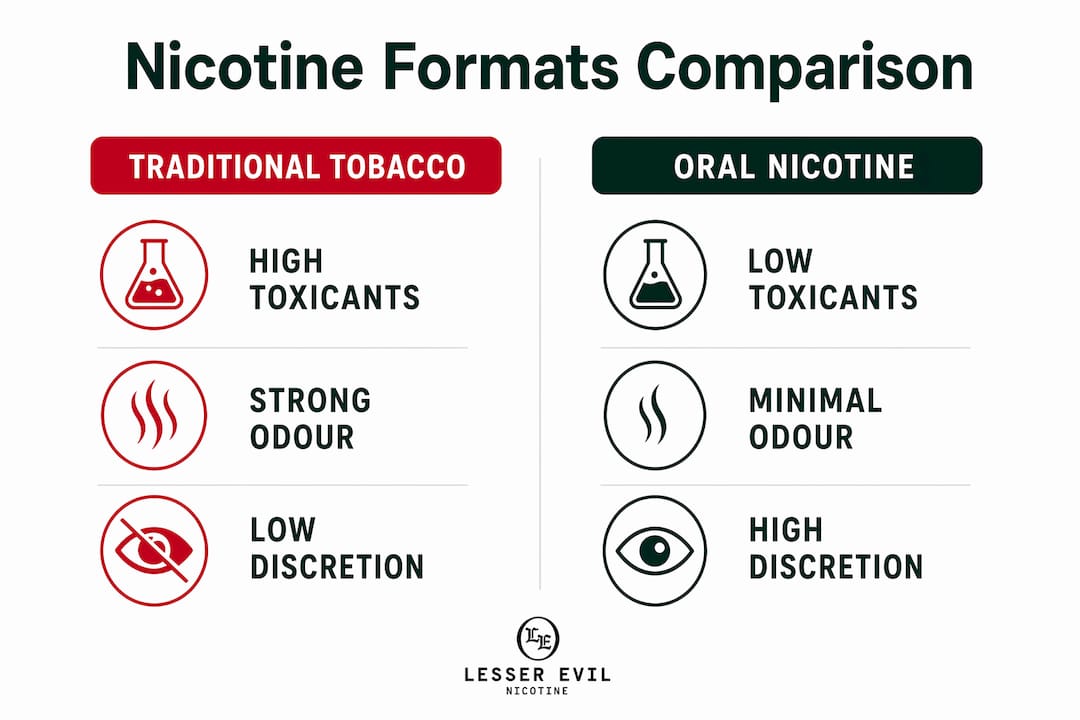
The table above makes the trade-offs visible. Moving from cigarettes to oral nicotine formats is not a small step. It is a significant shift in risk profile. Harm reduction and discretion are not competing goals. The most discreet formats tend to be the least harmful ones.
What social and psychological factors shape responsible discretionary nicotine use?
Stress is the most common reason people reach for nicotine in professional and social settings. That is not a character flaw. It is a well-documented pattern. The problem is when stress-driven use becomes invisible to the person doing it, making it harder to manage consciously.
Academic research identifies persistent moral judgement as a key influence on female nicotine users’ product choices. Women who use nicotine in visible ways face social consequences that men largely avoid. That pressure pushes female users toward discreet formats not just for convenience, but as a form of self-protection. Studies of female smokers in urban China show the same pattern: concealment behaviour runs alongside shifting social norms, suggesting that discretion is a response to stigma rather than shame about the habit itself.
Responsible discretionary nicotine consumption means being honest with yourself about why and how much you are using. Concealment from others is understandable. Concealment from yourself is where habits get harder to manage.
Guidelines for responsible nicotine use:
- Know your intake: Track how much you use each day. Awareness is the first step to control.
- Choose your format deliberately: Pick a product that fits your environment and your risk tolerance, not just what is convenient.
- Avoid escalation: Discreet formats make it easy to use more without noticing. Set a limit and stick to it.
- Do not use to mask stress: Nicotine can feel like it eases stress, but relying on it as your only coping tool creates dependency.
- Respect others’ spaces: Discreet does not mean invisible to everyone. Be aware of who is around you.
- Stay informed: Reducing your nicotine intake has measurable benefits. Know what those are before you decide on your approach.
Gender-sensitive awareness matters here. Women using nicotine for stress management deserve information that acknowledges that context, not just generic addiction messaging. The social pressures driving discreet use are real, and responsible use guidelines need to reflect that.
What products and strategies support effective discreet nicotine use?
The market for discreet nicotine products has expanded significantly. Three formats dominate: nicotine pouches, oral nicotine gels, and nicotine mouth sprays. Each has a different profile for discretion, delivery speed, and user experience.
Nicotine pouches sit between the gum and upper lip. They are tobacco-free, produce no smoke or vapour, and are nearly invisible in use. Brands like Velo, Zyn, and Nordic Spirit have built the category, but the format skews heavily male in both branding and design. Oral nicotine gels, like those from Lesser Evil Nicotine, are placed under the tongue and absorbed via the oral mucosa. They are tobacco-free, battery-free, and produce no e-waste. Nicotine mouth sprays offer fast delivery and are easy to use in public without drawing attention.
| Product | Delivery method | Discretion | Odour | Best context |
|---|---|---|---|---|
| Nicotine pouch | Gum line absorption | High | None | Office, commute, social events |
| Oral nicotine gel | Sublingual absorption | Very high | None | Any setting, especially professional |
| Nicotine mouth spray | Oral mucosa | High | Minimal | Quick use, on the go |
| Nicotine patch | Transdermal | Very high | None | All-day background use |
| Nicotine gum | Oral absorption | Moderate | Minimal | Casual settings |
Usage technique matters as much as product choice. Managing nicotine at work requires reading the room. An open-plan office is different from a private meeting. A client lunch is different from a solo commute. Matching your format to your context is the practical skill most people develop over time.
Do’s and don’ts of nicotine etiquette:
- Do choose formats with no odour or vapour in shared spaces.
- Do dispose of pouches or packaging discreetly and responsibly.
- Do not use any nicotine product in a way that affects others around you.
- Do not assume a discreet format is invisible to everyone. Some people will notice.
- Do check venue and workplace policies before using any nicotine product.
Pro Tip: If you are new to oral nicotine gels or pouches, start with a lower nicotine strength. The delivery via oral mucosa can feel different from vaping or smoking, and it is easy to misjudge your intake at first.
Understanding how gel delivers nicotine differently from combustible formats helps you make a more informed choice about which product suits your lifestyle.
Key takeaways
Discretion and harm reduction are not separate goals. The most discreet nicotine formats are also the ones with the lowest toxicant exposure, making responsible discretionary nicotine consumption a practical path for young adults and professionals managing their habits in 2026.
| Point | Details |
|---|---|
| Discretion drives product choice | 11% of young users name discretion as their primary reason for choosing nicotine pouches over other formats. |
| Harm reduction is significant | Oral nicotine products reduce toxicant exposure by over 95% compared to combustible tobacco. |
| Gender dynamics are real | Women face stronger social stigma for visible nicotine use, making discreet formats especially relevant for female users. |
| Workplace policies vary | Some employers ban all nicotine use; knowing your policy lets you choose a format that fits without conflict. |
| Responsible use requires awareness | Tracking intake and choosing formats deliberately prevents discreet use from becoming unmanaged use. |
Discretion is reshaping nicotine culture. Here is what I actually think about it.
The shift toward discreet nicotine formats is one of the more interesting behavioural changes I have watched play out in the past few years. On the surface, it looks like a product trend. Underneath, it is a cultural negotiation about who gets to use nicotine, where, and without judgement.
What strikes me most is the gender gap. The pouch category is dominated by male users and male-coded branding. Yet the people with the strongest practical need for discretion are often women, who face sharper social consequences for visible nicotine use. That mismatch between who the products are built for and who actually needs them most is a genuine gap in the market.
The harm reduction angle is also underappreciated. People talk about discreet nicotine use as if it is mainly about social convenience. It is also about not breathing in combustion products. Those two things happen to align, which is unusual in consumer behaviour. Usually, convenience and health pull in opposite directions.
My honest concern is that discretion can make it easier to use more without noticing. When there is no smoke, no smell, and no social friction, the feedback loops that naturally limit use disappear. Responsible use requires building your own awareness to replace those external signals. That is harder than it sounds, and most guidance on discreet nicotine use does not address it directly.
The brands that will matter in this space are the ones that take both the discretion and the responsibility seriously. Not as marketing language. As actual product design choices.
— Luke McLeod
Lesser Evil Nicotine: built for discreet, responsible use
Lesser Evil Nicotine was designed specifically for people who want to manage their nicotine habit without the rubbish that comes with vaping or smoking. The Lesser Evil Oral Mister is tobacco-free, battery-free, and produces no e-waste. It uses a sublingual gel format, placing nicotine under the tongue where it absorbs via the oral mucosa. No vapour. No smell. No lung tax.

Available in Peppermint, Black Grape, and Green Apple, with natural flavours and natural sweeteners. The low-dose formulation gives you real control over your intake. Lesser Evil Nicotine is preparing for its UK launch in 2026, positioned for urban professionals who want a cleaner way to manage their habit. If that sounds like you, Lesser Evil is worth a look.
FAQ
What is discreet nicotine use?
Discreet nicotine use refers to consuming nicotine through low-visibility, low-odour formats such as nicotine pouches, oral gels, or mouth sprays. These products allow people to manage their nicotine habit without producing smoke, vapour, or noticeable odour.
Are discreet nicotine products safer than cigarettes?
Oral nicotine products reduce toxicant exposure by over 95% compared to combustible tobacco, according to the Oral Nicotine Commission. They eliminate tar, carbon monoxide, and combustion byproducts entirely.
Why do women prefer discreet nicotine formats?
Academic research shows that cultural norms impose stronger moral judgement on female nicotine users, making visible consumption socially riskier for women. Discreet formats reduce that social exposure while still allowing nicotine use as a stress-management tool.
Can I use nicotine pouches or gels at work?
Workplace policies vary widely. Some employers ban all nicotine use on site; others only restrict smoking and vaping. Checking your specific workplace policy before using any nicotine product is the only reliable way to know where you stand.
What is the difference between a nicotine pouch and an oral nicotine gel?
A nicotine pouch sits between the gum and lip and releases nicotine through gum-line absorption. An oral nicotine gel, like those from Lesser Evil Nicotine, is placed under the tongue and absorbed via the oral mucosa, offering a tobacco-free and battery-free alternative with no vapour or odour.