

What is low burn nicotine? A plain UK guide

TL;DR:
- Low burn nicotine products include oral gels and non-combustible alternatives that deliver lower nicotine doses without inhalation. They are consumer goods, not medicines, and carry risks similar to regular nicotine products, requiring careful use and adherence to UK regulations. Switching from smoking to these methods changes the experience and may help reduce harm, but does not eliminate health risks.
“Low burn nicotine” is an informal phrase that usually refers to two things: oral nicotine products (gels, pouches) that deliver a lower dose without combustion, and reduced-nicotine tobacco or non-combustible alternatives that heat rather than burn. None of these are medicines or nicotine replacement therapies. They are consumer goods, and they are not risk-free.
A few things to know upfront:
- Age limit: You must be 18 or over to buy any nicotine product in the UK.
- Not a medicine: Low-burn oral products are sold as consumer goods, not licensed treatments.
- Not risk-free: Reduced nicotine does not mean no nicotine. Harm reduction is not the same as harm elimination.
- UK law applies: Products sold here must comply with UK Tobacco and Related Products Regulations.
Table of Contents
- How does low burn nicotine actually work?
- What does the evidence actually say?
- What should you expect if you switch?
- UK regulation and legal considerations
- Low-burn and oral nicotine options available in the UK
- How to use low-dose oral nicotine products safely
- Key takeaways
- A perspective worth sitting with
- Lesser Evil Oral Mister: a UK option worth knowing about
- Useful sources
How does low burn nicotine actually work?
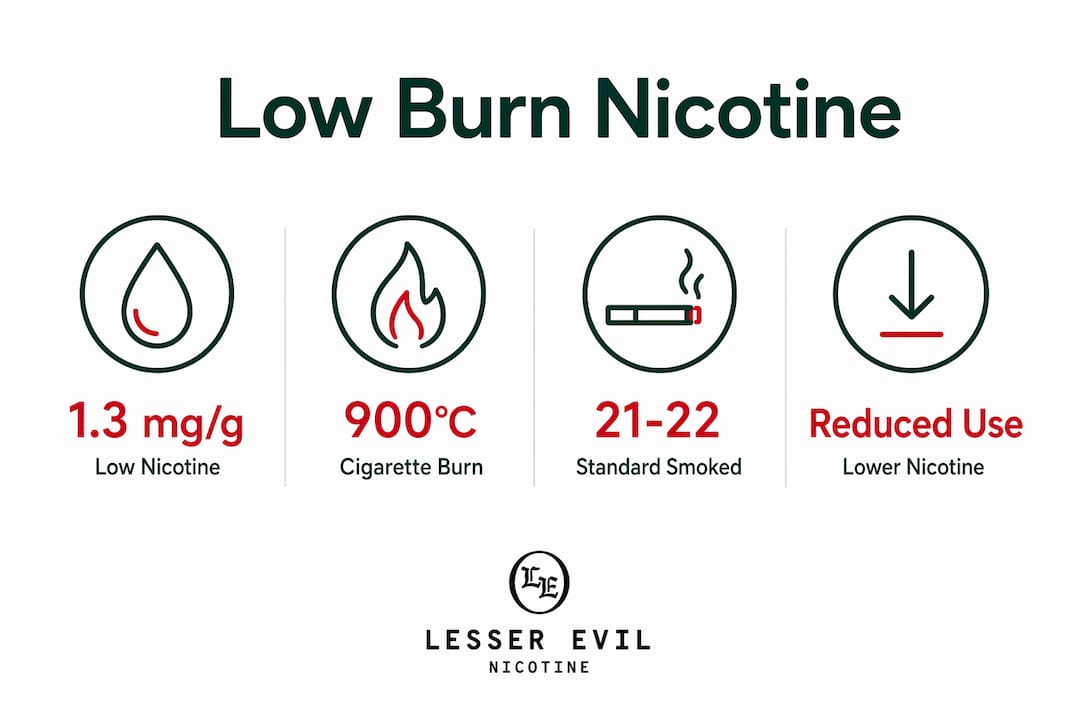
The phrase “low burn” points at the delivery route. Combusted cigarettes burn tobacco at temperatures up to 900°C, releasing thousands of chemicals alongside nicotine. Heat-not-burn devices heat tobacco at around 350°C, which reduces but does not eliminate harmful by-products. Vapes heat e-liquid into an aerosol you inhale. Oral products, including sublingual gels and pouches, skip inhalation entirely.
With non-inhalation nicotine methods, nicotine absorbs through the oral mucosa (the lining of your mouth and under your tongue). Onset is slower than inhalation and peak blood nicotine is lower. That changes how the product feels: less of an immediate hit, longer and steadier absorption.
Key differences at a glance:
- Combusted cigarettes: Fastest onset, highest chemical exposure, cigarette butt waste.
- Heat-not-burn: Faster onset than oral, still releases some toxins, device required.
- Vapes: Fast onset, aerosol inhaled, battery and coil waste.
- Oral gels/pouches: Slower onset, no inhalation, battery-free, discreet.
The NCI Thesaurus defines a low nicotine content cigarette as one containing approximately 1.3 mg of nicotine per gram of tobacco. Oral products vary widely in dose, so always check the label.

What does the evidence actually say?
The strongest trial data comes from a randomised study published in the New England Journal of Medicine, which tested cigarettes at different nicotine levels over six weeks. Participants assigned to cigarettes with reduced nicotine content (2.4 mg, 1.3 mg or 0.4 mg nicotine per gram) smoked fewer cigarettes per day (16.5, 16.3, and 14.9 respectively in week 6) compared with those on standard-nicotine cigarettes (22.2 and 21.3).
| Nicotine level (mg/g) | Cigarettes smoked per day at week 6 |
|---|---|
| Standard (22.2, 21.3) | ~21–22 |
| 2.4 mg/g | 16.5 |
| 1.3 mg/g | 16.3 |
| 0.4 mg/g | 14.9 |
Source: NEJM randomised trial.
Professor Peter Hajek and other experts acknowledge the harm-reduction potential of non-combustible alternatives for current smokers, while consistently cautioning that these products are not risk-free and should not be taken up by people who do not already use nicotine. Public-health bodies including the WHO have considered nicotine reduction as a policy tool to reduce the addictiveness of smoked tobacco, though population-level effects depend on broad access and policy changes alongside any product shift.
What should you expect if you switch?
Switching from inhalation to an oral product feels different. There is no throat hit, no visible vapour, and the nicotine arrives more gradually. Most people notice the difference within the first few uses.
Common things users report:
- A mild oral sensation (tingling or warmth under the tongue with a gel).
- Slower onset, roughly 10–20 minutes to feel the effect, compared with seconds for inhalation.
- Longer duration of effect once absorbed.
- Possible mild mouth or tongue irritation in early use, which typically settles.
- Transient light-headedness if the dose is higher than needed.
One pattern worth watching: compensatory behaviour. When nicotine delivery drops, some people use more product more often to compensate. Research on low-nicotine e-liquids found that vapers increased puff number and duration, and in some conditions formaldehyde exposure rose as a result. With oral products the mechanism differs, but the behavioural pattern can still occur.
Pro Tip: Track how many units you use per day for the first two weeks. If the number creeps up rather than staying flat or falling, you may be compensating. Adjust your dose or timing before the habit beds in.
For a direct comparison of what changes when you move away from smoking, the oral nicotine vs smoking guide is worth a read.
UK regulation and legal considerations
Most low-burn oral nicotine gels and pouches sold in the UK are classified as consumer goods, not licensed medicines. That means they are not regulated by the MHRA as medicinal products, but they must still comply with UK Tobacco and Related Products Regulations (TRPR) and, where applicable, the General Product Safety framework.
What this means for you as a buyer:
- Age verification: Retailers cannot sell nicotine products to anyone under 18.
- Labelling: Products must carry health warnings and ingredient disclosures.
- No therapeutic claims: Retailers and brands cannot legally claim a consumer nicotine product helps you quit or treats nicotine dependence.
- Nicotine concentration limits: E-liquids are capped at 20 mg/ml under TRPR; for detailed technical information on nicotine levels, see the livelli e qualità nicotina nei liquidi elettronici guide; oral products have separate category rules.
For a full breakdown of how UK law applies to different product types, the nicotine regulation UK guide covers the current framework. Always verify current rules directly with the MHRA or UK government guidance before purchasing, as regulations can change.
Low-burn and oral nicotine options available in the UK
The UK market includes several categories of lower-burn or non-combustible nicotine products. None of the following is a medical endorsement.
- Oral nicotine pouches: Tobacco-free pouches placed between the gum and lip. Widely available in UK vape retailers and some convenience stores.
- Heat-not-burn devices: Devices such as IQOS heat tobacco rather than burn it. Studies show IQOS delivered less nicotine than cigarettes and was less effective at reducing urges than high-nicotine pod systems.
- Nicotine mouth sprays: Fast-absorbing oral sprays; a category Lesser Evil Nicotine is also entering.
- Sublingual nicotine gels: The newest format in the UK. Lesser Evil Oral Mister is a sublingual gel (applied under the tongue, absorbed via the oral mucosa). It is tobacco-free, battery-free, made with natural flavours and natural sweeteners, and available in Peppermint, Black Grape, and Green Apple. No inhalation. No e-waste.
Lesser Evil Nicotine is going to market London-first through premium independent and curated vape retail. For a broader look at low-harm nicotine products available in the UK, the brand’s guide covers the category in more detail.
How to use low-dose oral nicotine products safely
Getting the most out of an oral nicotine product without overdoing it comes down to a few straightforward habits.
- Start with one unit. Use a single gel or pouch and wait at least 30 minutes before considering another. Oral absorption is slower than inhalation; give it time.
- Pick your moments. Use it when you would otherwise have smoked or vaped, not in addition to those habits.
- Keep it discreet. Oral gels and pouches are designed for use anywhere. No device, no cloud, no smell.
- Dispose responsibly. Pouches go in general waste; gels leave no physical waste beyond the packaging.
- Log your daily use. A simple note on your phone is enough. Patterns of increasing use are worth catching early.
Questions to ask yourself before each use: Am I reaching for this out of habit or genuine need? Have I already used one in the last hour?
Who should avoid nicotine products entirely: people who are pregnant, those with cardiovascular conditions, and anyone who does not currently use nicotine. If you have a health condition and are considering switching from smoking, speak to a GP or pharmacist first. This article is general information, not medical advice.
Pro Tip: Set a daily maximum before you start. Write it down. Having a pre-committed limit is far more effective than deciding in the moment.
Key takeaways
Low-burn nicotine products deliver nicotine without combustion, reducing exposure to smoke by-products, but they are not risk-free and are consumer goods, not medicines.
| Point | Details |
|---|---|
| What “low burn” means | Oral gels, pouches, and non-combustible alternatives that skip or reduce combustion. |
| What the evidence shows | NEJM trial participants on reduced-nicotine cigarettes smoked fewer per day, but these products remain harmful. |
| UK legal position | Consumer goods, not medicines; age 18+ only; no therapeutic claims permitted. |
| Watch for compensation | Using more product to compensate for lower dose can negate any reduction in intake. |
| Lesser Evil Oral Mister | A sublingual nicotine gel: tobacco-free, battery-free, natural flavours, preparing UK launch in 2026. |
A perspective worth sitting with
The conversation around low-burn nicotine tends to get hijacked by two camps: people who insist any nicotine is poison, and brands that quietly imply their product is basically wellness. Neither is honest.
What the evidence actually supports is narrower and more useful: switching away from combustion reduces exposure to the most harmful by-products of smoking. That is meaningful for someone who smokes. It is not a green light for a non-smoker to start. And it is not a substitute for quitting entirely if that is what you want to do.
What I find genuinely interesting about the oral gel format is how it changes the ritual. Vaping replaced the cigarette but kept the performance: the device, the cloud, the visible act. An oral gel is invisible. There is something in that shift, from a public habit to a private one, that changes how people relate to their use. Whether that matters to you depends on why you use nicotine in the first place.
Lesser Evil Oral Mister: a UK option worth knowing about
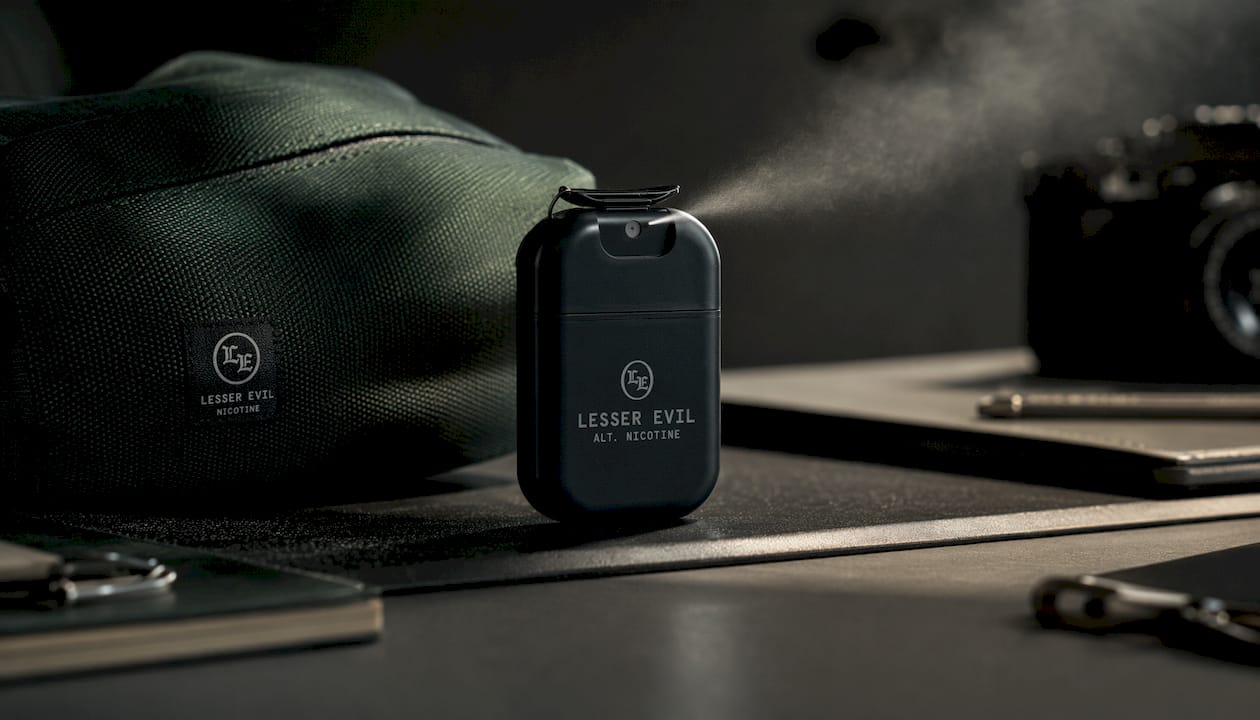
If you have been reading this and thinking “I want something that is not a vape and not a pouch,” the Lesser Evil Oral Mister is the product to look at. It is a sublingual nicotine gel: you place it under your tongue, it absorbs through the oral mucosa, and that is it. No battery, no aerosol, no tobacco. Natural flavours (Peppermint, Black Grape, Green Apple) and natural sweeteners. Nothing you need to charge or throw in a bin.
Lesser Evil Nicotine is launching in the UK in 2026, going into premium independent vape retail in London first. Head to the product page to see full product details and find out where to buy.
Useful sources
- Randomised Trial of Reduced-Nicotine Standards for Cigarettes, New England Journal of Medicine
- Heat not burn product compared with cigarettes and e-cigarettes, MedicalXpress (referencing Professor Peter Hajek)
- Reducing the nicotine content of cigarettes, Tobacco in Australia
- Are ‘heat not burn’ products any safer than cigarettes? UTS summary
- Real-world compensatory behaviour with low nicotine e-liquid, Addiction (Wiley)
- Lesser Evil blog: non-inhalation nicotine methods explained
- Lesser Evil blog: habit management and reducing nicotine intake