

Vaping byproducts explained: what's actually in the aerosol

E-cigarette aerosol contains thermal-degradation byproducts formed when propylene glycol, vegetable glycerin and flavouring chemicals are heated at the coil. The principal classes are carbonyls (formaldehyde, acetaldehyde and acrolein), metal contaminants leached from heating elements, volatile organic compounds, and ultrafine particles. These are not present in the liquid you fill the device with. They form during the heating process itself, which is why the terms “vape smoke” or “vapour” can be misleading. You are inhaling a chemically altered aerosol, not a simple mist.
The NHS and the UK Health Security Agency (UKHSA) are clear: vaping is not harmless. For adult smokers who switch completely, the exposure profile is generally lower than from combustible cigarettes. But for people who have never smoked, or who use both, the risk calculus looks very different. “Not as bad as cigarettes” is not the same as “safe.”
The CDC confirms that e-cigarette aerosol can contain nicotine, cancer-causing chemicals, heavy metals, tiny inhalable particles and volatile organic compounds. The five main byproduct classes to know:
- Carbonyls: formaldehyde, acetaldehyde, acrolein
- Metal contaminants: nickel, tin, lead (from coil degradation)
- Volatile organic compounds (VOCs): benzene, toluene and others
- Polycyclic aromatic hydrocarbons (PAHs) and tobacco-specific nitrosamines (TSNAs): present in some conditions
- Ultrafine particles: sub-micron droplets that penetrate deep into lung tissue
Key takeaways
Vaping aerosol contains thermal-degradation byproducts formed at the coil, including carbonyls, metals and VOCs, with levels that vary substantially by device condition, power setting and flavour chemistry.
| Point | Details |
|---|---|
| Carbonyls are the dominant byproducts | Formaldehyde, acetaldehyde and acrolein form when PG and VG are heated; levels rise sharply with higher power and coil ageing. |
| Metals leach from ageing coils | Nickel, tin and lead have been detected in aerosol; they are not present in fresh e-liquid and increase as hardware degrades. |
| Flavour chemistry amplifies risk | Terpene-heavy flavours and high-VG blends increase carbonyl formation; simpler flavour chemistries and lower power reduce it. |
| UK public-health position is clear | UKHSA and NHS say vaping is not harmless; full switching may reduce exposure for adult smokers, but dual use does not reliably lower risk. |
| Lesser Evil Oral Mister | A sublingual, non-inhaled nicotine option: no coil, no heating, no aerosol byproducts, tobacco-free and battery-free. |
Table of Contents
- What e-liquids start with: base ingredients and the byproducts they can produce
- How heating turns e-liquid into byproducts
- Main byproducts identified in studies: what each one does
- What increases or decreases byproduct levels in real use
- How scientists detect and quantify vaping byproducts
- How vaping byproduct exposures compare with cigarette smoke
- Key unknowns researchers highlight and study limitations
- Evidence-based steps to reduce byproduct exposure if you vape
- Recent research highlights: device ageing, terpene flavours and VG effects
- An honest take on what this evidence actually means
- The Lesser Evil Oral Mister: nicotine without the aerosol
- Sources
What e-liquids start with: base ingredients and the byproducts they can produce
Before anything is heated, an e-liquid is a relatively simple mixture. Understanding what goes in helps you understand what comes out.
The base solvents are propylene glycol (PG) and vegetable glycerin (VG), usually blended in ratios ranging from 50/50 to 30/70 PG/VG. PG is a thin, water-miscible humectant that carries flavour and produces a throat hit. VG is thicker, sweeter and produces denser aerosol clouds. Both are food-grade and considered safe to ingest. Inhalation is a different matter.
Nicotine is present as either free-base nicotine or nicotine salts (typically benzoate or lactate). The salt form uses an acidifier to lower pH, which smooths the throat hit at higher concentrations. The acidifier itself does not meaningfully alter byproduct chemistry at the coil, but it does affect how quickly nicotine is absorbed through the mucosa.
Flavourings are where the chemistry gets complicated. Common flavouring chemical classes include:
- Aromatic aldehydes (vanillin, benzaldehyde, cinnamaldehyde) — reactive under heat; vanillin can oxidise to vanillic acid or degrade to smaller carbonyls
- Esters (ethyl butyrate, isoamyl acetate) — relatively stable but can hydrolyse or fragment at coil temperatures
- Terpenes (limonene, linalool, menthol) — highly reactive; undergo oxidative cleavage to produce additional carbonyl fragments
- Alcohols (menthol, benzyl alcohol) — can dehydrate or oxidise to aldehydes
The practical upshot is this: PG tends to yield acetaldehyde on thermal degradation; VG tends to yield acrolein; terpene-heavy flavours can amplify formaldehyde and acrolein formation under some conditions. A comprehensive PMC review confirms that aerosol typically contains a broader range of compounds than the liquid itself, because heating creates new chemistry that was not present in the original formulation.
Many flavour aldehydes also react with PG to form acetals. These compounds can represent a substantial fraction of flavour-derived aerosol byproducts and tend to be chemically stable once in the respiratory tract.
How heating turns e-liquid into byproducts
Thermal degradation at the coil surface is the main pathway. Here is the sequence in plain terms:
E-liquid saturates the wick. The coil heats to temperatures typically between 150°C and 300°C, sometimes higher. At those temperatures, PG and VG do not simply evaporate cleanly. They undergo dehydration, oxidation and beta-scission reactions, fragmenting into smaller, more reactive molecules. Some of those fragments are stable enough to survive into the aerosol. Others react further with flavouring chemicals or with each other.
Metal coil surfaces act as catalysts, accelerating some of these reactions. Nickel-chromium and kanthal alloys are common coil materials, and their catalytic activity varies with temperature and oxidation state. An aged coil with surface oxidation behaves differently from a fresh one.
Wicking and dry-out matter enormously. When the wick cannot deliver liquid fast enough to match the heating rate, the coil contacts dry or semi-dry material. Temperatures spike locally, and byproduct yields increase sharply. This is the “dry puff” scenario. Research into key emission parameters shows that voltage and power settings, coil geometry and device reuse can multiply aldehyde emissions substantially. In some test conditions, aldehyde yields approached or exceeded occupational short-term exposure limits.
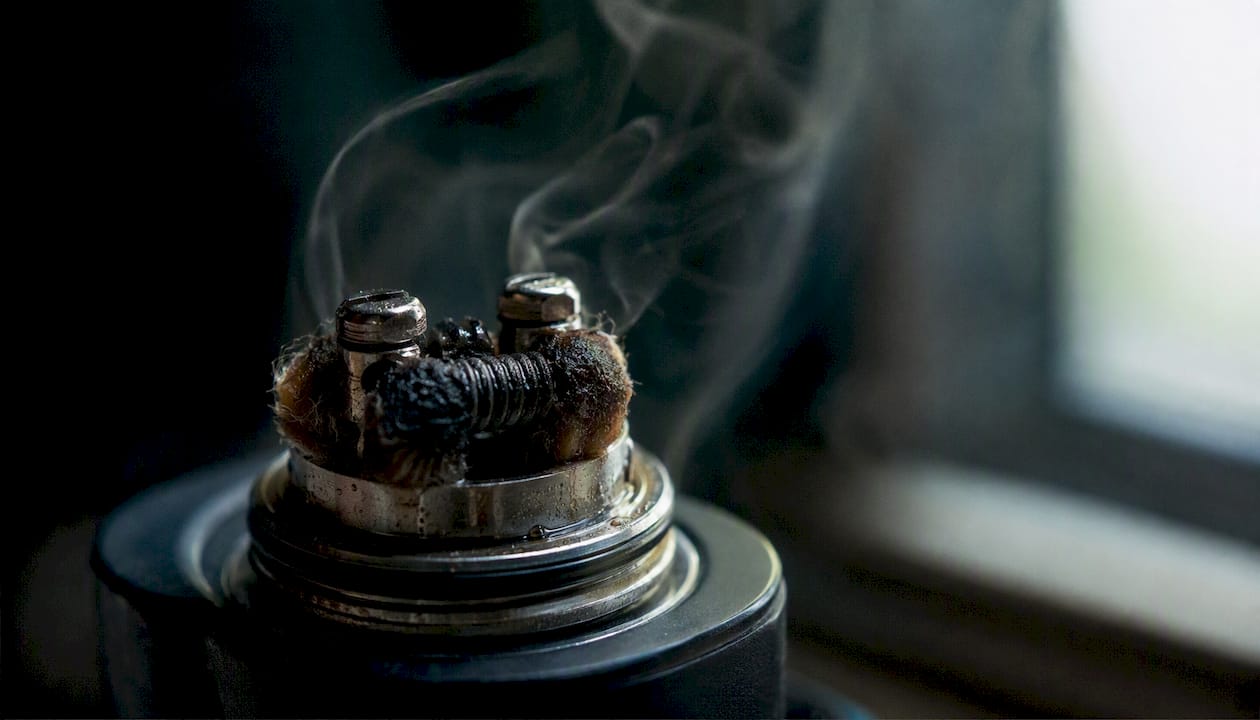
Flavour chemicals add another layer. Terpenes such as limonene undergo oxidative cleavage at coil temperatures to produce small carbonyl fragments, including formaldehyde and acetaldehyde. Aromatic aldehydes like vanillin can react with PG to form acetals. Expert analysis of vape aerosol organic byproducts notes that aldehydes are the dominant organic byproducts under normal vaping temperatures, with overheating introducing additional compounds including carbon monoxide.
Pro Tip: The single most controllable source of excess byproducts is running a device at higher wattage than the coil is rated for. Staying within the manufacturer’s recommended power range, replacing coils before they taste burnt, and using e-liquids with appropriate viscosity for your device’s wick all reduce the likelihood of localised overheating.
Main byproducts identified in studies: what each one does
NIH toxicology data confirms that PG and VG undergo thermal oxidation and fragmentation at the coil to produce carbonyls, with PG tending to generate acetaldehyde and VG tending to generate acrolein. Here is what the evidence says about each principal class.
| Byproduct class | Typical formation pathway | Evidence of presence in aerosol | Health note |
|---|---|---|---|
| Formaldehyde | Oxidation of PG/VG and terpene cleavage | Detected across multiple device types | Classified as a Group 1 carcinogen (IARC); respiratory irritant |
| Acetaldehyde | PG thermal degradation | Consistently detected; levels vary with power | Probable carcinogen (IARC Group 2A); mucosal irritant |
| Acrolein | VG thermal degradation | Present in most aerosol studies | Potent respiratory and cardiovascular toxicant; irritates airways |
| Nickel, tin, lead | Leaching from coil and solder as hardware ages | Detected in aerosol; increases with coil age | Nickel: carcinogenic; lead: neurotoxic; tin: pulmonary irritant |
| Benzene and VOCs | Thermal fragmentation of flavour chemicals | Detected at low but variable levels | Benzene is a Group 1 carcinogen; other VOCs are irritants |
| PAHs and TSNAs | Incomplete thermal reactions; tobacco-derived nicotine | Present at trace levels in some devices | Carcinogenic class; generally lower than in cigarette smoke |
| Ultrafine particles | Condensation of aerosol droplets | Sub-micron particles consistently detected | Deep lung penetration; cardiovascular and inflammatory effects |
Metal contaminants including nickel, tin and lead have been detected in aerosol and can leach from heating elements as coils age. These metals are not intended for inhalation.
On carbonyls and occupational limits: controlled emission studies have found that under specific high-power or dry-puff conditions, aldehyde yields in some devices approached or exceeded occupational short-term exposure limits. This does not mean every vaping session produces those levels. It means the upper range of real-world use can reach concentrations that regulators consider hazardous in workplace settings. Device condition and power settings are the dominant variables.
Peer-reviewed work on oral and respiratory effects documents that some flavouring chemicals considered safe to ingest are not safe to inhale. Diacetyl, used in some buttery or creamy flavours, has been linked to severe obstructive lung disease in occupational settings. Its presence in e-liquids has been documented, though many manufacturers have removed it following regulatory pressure.
Levels of most of these compounds are typically lower than in cigarette smoke. PAHs and combustion-derived tars, in particular, are substantially reduced because vaping does not involve combustion. But “lower than cigarettes” is not a clean bill of health, especially for carbonyls and metals in high-power or poorly maintained devices.
What increases or decreases byproduct levels in real use
Device power is the single biggest lever. Higher wattage means higher coil temperature, which means faster and more extensive thermal degradation of PG, VG and flavouring chemicals. The relationship is not linear. Small increases in voltage can produce disproportionately large increases in aldehyde emissions.
Factors that increase byproduct yield:
- Higher power/wattage settings (especially above the coil’s rated range)
- Older, oxidised or residue-coated coils
- High VG ratio (more acrolein precursor)
- Terpene-heavy or aromatic-aldehyde-heavy flavour concentrates
- Dry puffing or chain puffing (wick cannot re-saturate between draws)
- Tight airflow restricting vapour dilution
- Longer puff duration
Factors that tend to reduce byproduct yield:
- Lower power settings within the rated range
- Fresh coils and clean wicks
- Higher PG ratio (less acrolein, though more acetaldehyde precursor)
- Simpler flavour chemistries with fewer reactive compounds
- Temperature-control mode (limits maximum coil temperature)
- Adequate airflow and shorter puff intervals
Device ageing deserves particular attention. Emission studies show that repeated coil reuse raises emissions, likely because polymerisation residues accumulate on the coil surface, altering its thermal and catalytic properties. A coil that has been used for two weeks behaves differently from a new one, even if it does not taste burnt yet.
The PG/VG ratio creates a trade-off rather than a simple answer. Higher VG blends produce more acrolein. Higher PG blends produce more acetaldehyde. Neither is clearly preferable from a byproduct standpoint. What matters more is keeping power settings low and coils fresh.
How scientists detect and quantify vaping byproducts
Methods and sample types matter. Aerosol trapping and gas-phase analysis produce different compound profiles than liquid analyses, and the choice of analytical technique shapes what you find.
Common laboratory methods:
- GC-MS (gas chromatography-mass spectrometry): the workhorse for VOCs and carbonyls; separates and identifies volatile compounds with high sensitivity
- DNPH trapping (2,4-dinitrophenylhydrazine derivatisation): standard method for carbonyl collection from aerosol; carbonyls react with DNPH to form stable hydrazones that are then analysed by HPLC
- LC-MS (liquid chromatography-mass spectrometry): used for non-volatile and semi-volatile species, including some flavouring chemicals and TSNAs
- PTR-ToF-MS (proton transfer reaction time-of-flight mass spectrometry): online, real-time VOC detection without sample collection; fast but carries interpretation caveats
| Method | What it measures well | Key limitation |
|---|---|---|
| GC-MS | VOCs, carbonyls, terpene fragments | Requires sample collection; some compounds degrade before analysis |
| DNPH/HPLC | Carbonyls (formaldehyde, acetaldehyde, acrolein) | Selective; misses non-carbonyl species |
| LC-MS | Non-volatile flavour chemicals, TSNAs, nicotine | Less suited to highly volatile compounds |
| PTR-ToF-MS | Real-time VOC profiles | Can overestimate concentrations due to in-detector fragmentation of PG/VG |
That last point matters. Research published in ACS Chemical Research in Toxicology notes that PTR-ToF-MS can detect fragmentation of PG and VG inside the detector itself, which may inflate reported VOC concentrations. Online VOC readings from vaping studies should be interpreted with that caveat in mind.
Cross-study comparisons are genuinely difficult. There is no universally adopted puffing protocol for e-cigarettes. Studies vary in puff duration, inter-puff interval, flow rate, device power setting and coil age. A study using 55 ml puffs at 3.7 V on a fresh coil will produce very different numbers from one using 70 ml puffs at 4.5 V on a two-week-old coil. When you read a headline claiming “vaping produces X times more formaldehyde than cigarettes” or “vaping is 95% safer,” the device conditions behind that number are doing most of the work.
Aerosol analysis also differs from liquid analysis. The liquid contains the starting materials. The aerosol contains what survives or forms during heating. Comparing liquid composition to aerosol composition without accounting for thermal transformation understates the byproduct picture.
How vaping byproduct exposures compare with cigarette smoke
Most studies report lower levels of many combustion-related carcinogens in e-cigarette aerosol than in cigarette smoke. PAHs, carbon monoxide, hydrogen cyanide and the bulk of combustion-formed tars are substantially reduced or absent because vaping does not involve burning tobacco. That is a real and meaningful difference for adult smokers who switch completely.
What remains, or can be produced at concerning levels, is a different list. Carbonyls, particularly formaldehyde and acrolein, can reach significant concentrations in high-power devices. Metals are present in aerosol in ways that have no direct parallel in cigarette smoke chemistry. Flavour-derived byproducts are unique to vaping and have no long-term inhalation safety data behind them.
Yorkshire Smokefree NHS guidance makes the point plainly: some flavourings that are safe to eat are not safe to inhale. The inhalation route bypasses the digestive system entirely and delivers compounds directly to lung tissue and the bloodstream.
The UKHSA and NHS position: vaping is not recommended for non-smokers. For adult smokers who cannot stop by other means, switching completely to vaping is considered less harmful than continuing to smoke. The key word is “completely.” Dual use, where someone both smokes and vapes, does not reliably reduce overall exposure and may compound risks from both sources.
That dual-use point is often overlooked. Many people who vape also smoke occasionally. The harm-reduction argument for vaping rests on full substitution. Partial substitution does not deliver the same exposure reduction.
Key unknowns researchers highlight and study limitations
Long-term clinical outcomes from vaping are still genuinely uncertain. Widespread use of modern e-cigarette devices is a relatively recent phenomenon, and the devices and fluids available today differ substantially from those studied even five years ago. That makes extrapolating from existing data difficult.
The main limitations researchers consistently flag:
- Device heterogeneity: hundreds of device types, coil materials and power ranges exist; findings from one device do not generalise reliably to others
- Short follow-up in human studies: most clinical and biomarker studies run for months, not decades; chronic disease endpoints (lung cancer, COPD progression) require much longer observation
- Small sample sizes: many emission studies use a handful of devices and a limited range of conditions
- Measurement heterogeneity: no standardised puffing protocol means cross-study comparisons carry large uncertainty
- Confounding: most vapers are current or former smokers; separating vaping-specific effects from smoking history is methodologically hard
Absence of evidence is not evidence of absence. The fact that we do not yet have robust long-term data on vaping-related cancer risk does not mean that risk is zero. Chronic low-level exposure to carbonyls, metals and ultrafine particles is biologically plausible as a long-term harm. The honest answer is that we do not yet know the magnitude.
Where future research effort is most needed: standardised puffing protocols that reflect real-world use, prospective cohort studies with non-smoking vapers as a comparison group, and long-term toxicology on flavour-derived byproducts specifically. The flavour chemistry gap is particularly significant given how rapidly the flavour market has evolved.
Pro Tip: When reading a vaping emissions study, look for three things before accepting its headline number: the device power setting used, the coil age at the time of testing, and the puffing protocol. A study that does not report all three is difficult to interpret.
Evidence-based steps to reduce byproduct exposure if you vape
The clearest controls are device settings and maintenance. Here is what the evidence supports, in rough order of impact:
- Use lower power settings. Stay within the manufacturer’s rated wattage range. Higher power is the dominant driver of carbonyl formation. If your device has a temperature-control mode, use it.
- Replace coils and wicks regularly. Coil residues accumulate with use and increase emissions. Do not wait until the taste degrades noticeably. A coil that smells slightly burnt has already been producing elevated byproducts for some time.
- Avoid dry puffs and chain puffing. Give the wick time to re-saturate between draws. Dry-puff conditions produce the sharpest spikes in aldehyde emissions.
- Choose simpler flavour chemistries. Terpene-heavy flavours and high-concentration aromatic aldehyde flavours amplify carbonyl formation. Menthol and simple fruit esters tend to be less reactive than complex dessert or botanical blends.
- Consider your PG/VG ratio. High-VG blends produce more acrolein precursor. If acrolein exposure is a specific concern, a higher-PG blend at lower power may reduce it, though it shifts the profile towards acetaldehyde.
- Store e-liquids correctly. Heat and light degrade flavouring chemicals and can increase reactive compound concentrations before the liquid even reaches the coil. Keep bottles sealed, away from direct sunlight and at room temperature.
- Choose well-made devices with temperature control. Budget devices with poor coil consistency and no temperature regulation produce more variable and often higher emissions than regulated devices.
Pro Tip: Lower flavour concentration does not mean less flavour satisfaction for most people. Many experienced vapers find that halving the flavour concentrate percentage in a custom mix produces a cleaner taste and measurably less throat irritation, which is itself a proxy for lower carbonyl exposure.
If you want to stop inhaling vapour altogether, non-inhalation nicotine options remove the aerosol byproduct exposure pathway entirely. No coil, no heating, no thermal degradation chemistry. The Lesser Evil Oral Mister is one such option, delivering nicotine sublingually under the tongue, tobacco-free and battery-free. You do not breathe it in.
Recent research highlights: device ageing, terpene flavours and VG effects
Recent controlled studies add important nuance to the basic picture. Flavour class, VG content and power settings do not act independently. They interact, and the interactions can be significant.
A 2025 PMC study on flavouring effects and carbonyl formation found that terpene flavourings and high VG blends amplify certain carbonyl emissions in controlled experiments, and that reducing flavour concentration and device power can mitigate yields in many cases. This is one of the cleaner mechanistic confirmations that flavour chemistry is not a passive passenger in byproduct formation.
Device ageing produces a compounding effect. Emission parameter research documents that repeated coil reuse raises aldehyde emissions, with increases linked to polymerisation residues on the coil surface altering its thermal properties. The practical implication: a device used daily for two weeks is not producing the same emission profile as the same device on day one.
| Variable | Direction of effect on carbonyls | Practical implication |
|---|---|---|
| Increasing device power | Strong increase | Stay within rated wattage range |
| Higher VG ratio | Increases acrolein specifically | Consider PG-dominant blends if acrolein is the concern |
| Terpene-heavy flavours | Increases formaldehyde and acrolein | Choose simpler flavour chemistries |
| Coil reuse and ageing | Progressive increase | Replace coils on a regular schedule |
| Temperature-control mode | Reduces peak carbonyl spikes | Use TC mode where available |
The terpene finding deserves emphasis. Limonene and linalool, common in citrus and floral flavours, undergo oxidative cleavage at coil temperatures to produce formaldehyde, acetaldehyde and acrolein fragments. A device running a lemon-tart flavour at high wattage is producing a meaningfully different carbonyl profile than the same device running an unflavoured base. This is not captured in studies that use only unflavoured or single-compound liquids.
One-off emissions studies, which test a single device at a single power setting with a single liquid, understate the variability real users encounter. The range between a low-power device with a fresh coil and a simple flavour, versus a high-power device with an aged coil and a terpene-heavy liquid, is substantial.
An honest take on what this evidence actually means
The evidence on vaping byproducts is genuinely mixed, and the honest position is more nuanced than either “vaping is fine” or “vaping is as bad as smoking.” Here is where we land.
Vaping does not involve combustion, and that matters. The absence of burning tobacco removes a large class of carcinogens and toxicants from the exposure picture. For a long-term smoker who switches completely, the change in exposure profile is real and meaningful. The UKHSA’s position reflects that.
But the framing of vaping as a clean or neutral activity does not hold up to the chemistry. Thermal degradation is unavoidable when you heat organic compounds to 150°C or above. The question is not whether byproducts form, but which ones, at what concentrations, and under what conditions. The answer depends heavily on device design, maintenance, power settings and flavour chemistry, which means individual exposure varies enormously and is not well captured by any single study.
What bothers me about most public discourse on this topic is the binary. People either dismiss vaping risks entirely or treat every vaping study as proof of catastrophic harm. The actual picture is: a heterogeneous exposure profile, device-dependent, with some compounds at genuinely concerning levels under specific conditions, and genuine uncertainty about long-term outcomes. That is a harder message to communicate, but it is the accurate one.
The flavour chemistry gap is the part of this I find most underappreciated. We have reasonable data on PG and VG degradation. We have much less on the hundreds of flavouring compounds in commercial use, their thermal transformation products, and what those products do to lung tissue over years of daily inhalation. That gap is not a reason to panic. It is a reason to be honest about what we do not know.
The Lesser Evil Oral Mister: nicotine without the aerosol
If the chemistry in this article has you thinking about what you are actually breathing in every day, there is a straightforward alternative worth knowing about.

The Lesser Evil Oral Mister delivers nicotine sublingually, under the tongue via the oral mucosa. No coil. No heating. No thermal degradation chemistry. Because there is no vapour produced, there is no aerosol byproduct exposure pathway. You do not breathe anything in.
The formulation is tobacco-free, battery-free and uses natural flavours and natural sweeteners. No e-waste. Available in Peppermint, Black Grape and Green Apple. It is designed to be discreet enough to use anywhere, and the oral nicotine format means you are not contributing to the coil-heating chemistry this article has spent several thousand words unpacking.
Lesser Evil Nicotine is preparing its UK launch in 2026. If you want to be among the first to know when it lands, the product page is live now.
Sources
A note before the list: emission figures vary significantly across studies depending on device power, coil age and puffing protocol. When reading any vaping research, check those three variables before accepting a headline number.
- Canada
- A comprehensive review of the harmful compounds in electronic cigarettes - PMC
- Toxicology of E‑Cigarette Constituents - NCBI - NIH
- Emissions from electronic cigarettes: key parameters affecting the release of harmful chemicals
- Health Effects of Vaping | Smoking and Tobacco Use
- A full guide to vape aerosols. Post 6: organic byproducts
This article is general information, not a substitute for advice from a qualified doctor. Consult a qualified healthcare professional about your own circumstances before acting on anything here.