

What is buccal nicotine delivery? A clear explainer

TL;DR:
- Buccal nicotine delivery absorbs nicotine directly through the cheek or gum lining into the bloodstream without inhaling smoke or vapor. It provides a slower, steadier nicotine rise compared to smoking or vaping, reaching peak levels in about 10 to 20 minutes. This method offers a tobacco-free alternative with a different addiction profile and less respiratory exposure.
Buccal nicotine delivery is defined as the absorption of nicotine directly into the bloodstream through the lining of the cheek or gum, known as the buccal mucosa. No smoke. No vapour. No lung tax. The nicotine passes through the soft tissue of your mouth and goes straight into your blood. This is the core mechanism behind oral nicotine products like pouches, gels, and mouth sprays. It is a fundamentally different route to nicotine than smoking or vaping, and understanding how it works changes how you think about your options.
What is buccal nicotine delivery and how does it work physiologically?
The buccal mucosa is a thin, permeable membrane lining the inside of your cheeks and gums. Nicotine placed against this tissue dissolves into saliva and diffuses across the membrane into the capillaries beneath. Those capillaries feed directly into systemic circulation, bypassing the lungs entirely.
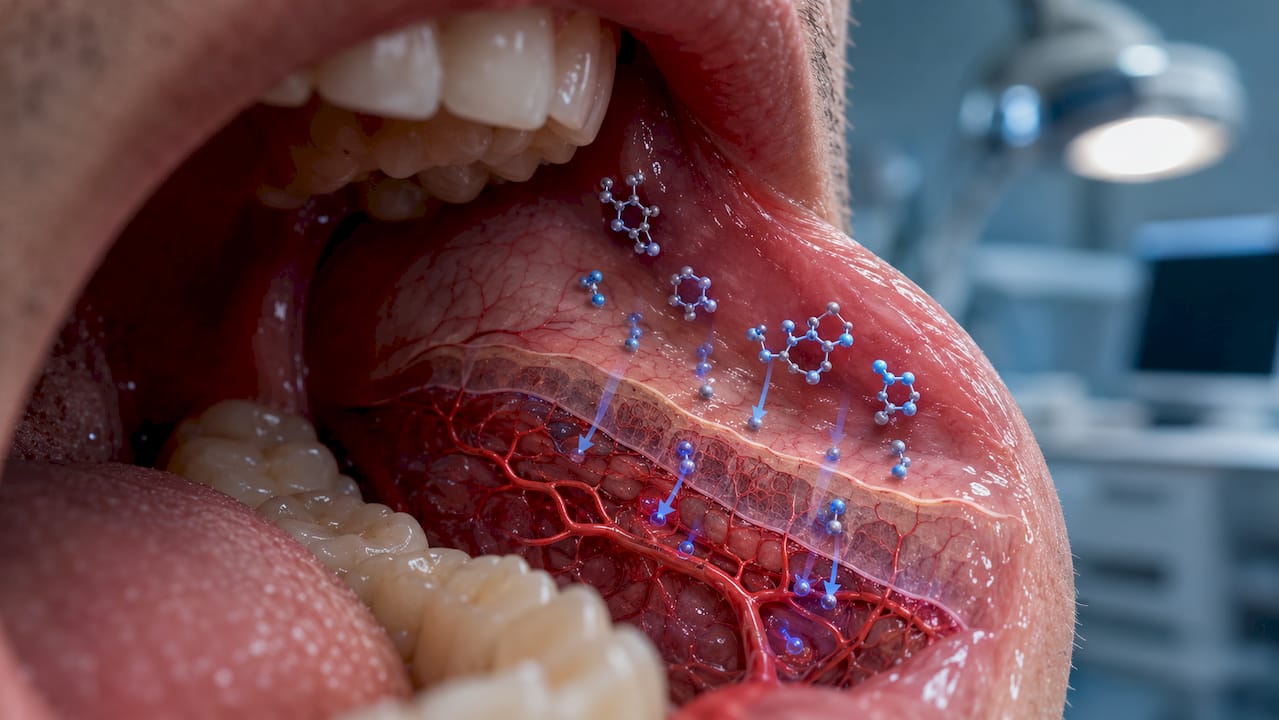
Buccal absorption is the rate-limiting step in this process. That means the speed at which nicotine crosses the mouth lining controls how fast it hits your blood. It is not instantaneous like a cigarette drag, but it is steady and sustained.
Saliva pH plays a bigger role than most people realise. Variation in pH can significantly alter the speed and extent of nicotine uptake through the buccal membrane. A more alkaline environment increases nicotine permeability. Product formulation, including flavour additives and buffering agents, directly affects this pH and therefore affects how quickly you feel the nicotine.
Not all the nicotine in a pouch or gel absorbs through the cheek. Some nicotine is swallowed and processed via the gastrointestinal tract, which has a different and slower absorption profile. This split pathway is why the overall pharmacokinetic curve from buccal products looks different to smoking. The result is a more gradual rise in blood nicotine rather than a sharp spike.
Nicotine absorption onset is continuous and influenced by saliva secretion and swallowing frequency. This prevents the rapid nicotine spikes associated with combustion products. Modern pouches can reach blood nicotine levels of 13 ng/mL within 10 minutes, maintaining them for around 60 minutes. That is faster than nicotine gum or lozenges, which makes buccal delivery a genuinely different category.
Pro Tip: Place a pouch or gel towards the back of your upper gum rather than the front. Saliva pooling is greater there, which supports more consistent absorption.
- Buccal mucosa is thin and highly vascularised, making it effective for drug absorption
- Saliva pH directly affects how permeable the membrane is to nicotine
- Absorption is continuous, not spiked, producing a sustained nicotine curve
- Some nicotine takes a gastrointestinal route, affecting the overall profile
- Onset begins within minutes and can sustain blood levels for up to 60 minutes
What are the main types of buccal nicotine products?
Oral nicotine pouches are the most widely recognised buccal delivery format. They are tobacco-free, containing pharmaceutical-grade nicotine, plant fibres, and flavourings. You place one between your upper lip and gum, and the nicotine absorbs through the buccal tissue over 20–60 minutes. Pouches come in a range of strengths, typically from 2 mg up to 20 mg per pouch.
Mouth sprays deliver nicotine directly onto the buccal mucosa in a fine mist. Absorption begins almost immediately on contact with the tissue. Sprays tend to have a faster onset than pouches because the nicotine is already dissolved and spread across a larger surface area.
Nicotine gels, like the one made by Lesser Evil Nicotine, sit under the tongue and against the cheek lining. The gel format allows for a controlled, low-burn release of nicotine through the oral mucosa. Lesser Evil Nicotine’s patent-pending formulation uses natural flavours and natural sweeteners, and comes in Peppermint, Black Grape, and Green Apple. It is tobacco-free and battery-free, which means no e-waste.
Nicotine tablets and lozenges dissolve slowly in the mouth, releasing nicotine for buccal and sublingual absorption over a longer period. They tend to have a slower onset than sprays or gels but are discreet and easy to use.
| Product type | Onset speed | Duration | Tobacco-free |
|---|---|---|---|
| Nicotine pouch | 10–20 minutes | 30–60 minutes | Yes |
| Mouth spray | 1–5 minutes | 20–30 minutes | Yes |
| Nicotine gel | 5–15 minutes | 30–60 minutes | Yes |
| Nicotine lozenge | 15–30 minutes | 30–60 minutes | Yes |
All of these formats share one defining feature: no combustion, no inhalation, and no respiratory system involvement. That is the core distinction from smoking and vaping.
How does buccal nicotine delivery compare to smoking and vaping?
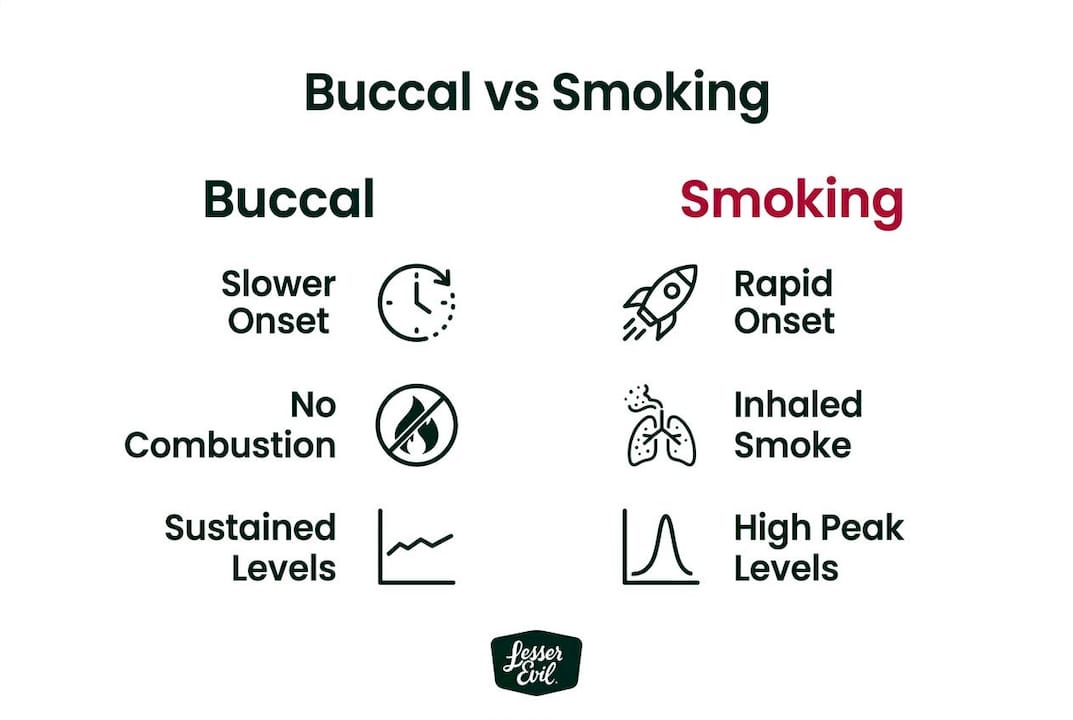
Smoking delivers nicotine to the lungs, where it crosses the alveolar membrane and reaches the brain in roughly 10 seconds. That speed is what makes cigarettes so effective at delivering a sharp nicotine hit. Vaping works similarly. You inhale vapour, nicotine absorbs through the lungs, and the effect is rapid.
Buccal delivery is slower. 4 mg nicotine pouches reach peak nicotine concentration at 20–65 minutes, compared to 5–8 minutes for combustible cigarettes. That is a fundamentally different experience. The slower rise means no sharp spike, which changes how the body responds to the nicotine.
The total nicotine exposure is also different. 4 mg pouches deliver about 91.73% of the total nicotine exposure found in cigarettes. That is a meaningful amount, but the peak concentration tells a different story. Peak nicotine from 4 mg pouches is about 69% of cigarette peak levels and takes much longer to reach. The body gets less of a jolt.
Buccal nicotine products do not involve combustion or inhalation. You are not breathing garbage into your lungs. There is no smoke, no vapour, and no respiratory exposure. That is the clearest factual difference between buccal delivery and smoking or vaping.
The slower, lower peak also affects the addiction profile. The rapid spike from smoking is closely linked to the reinforcing effect that drives habitual use. A slower, more sustained delivery curve simply does not produce the same sharp reward signal. That does not make buccal products risk-free, but it does make the pharmacological experience genuinely distinct.
Pro Tip: If you are used to vaping or smoking, expect buccal products to feel subtler at first. The nicotine is there. It just arrives differently. Give it 15 minutes before you judge whether it is working.
Vaping heats liquid and you inhale the vapour. Buccal delivery skips that entirely. You do not breathe it in. That is not a marketing claim. It is just how the route of administration works. For anyone who has ever thought “I wish I wasn’t breathing this stuff,” buccal delivery is the answer to that specific problem.
What are practical considerations for using buccal nicotine products?
Placement matters more than most people think. Positioning a pouch or gel against the upper gum, towards the back of the mouth, maximises contact with the buccal mucosa and supports consistent absorption. Placing it at the front of the lower lip reduces the surface area in contact with the tissue.
Saliva management is also relevant. Swallowing frequently reduces the concentration of dissolved nicotine against the membrane, which slows absorption. Letting saliva pool naturally around the product supports a steadier release. You do not need to do anything unusual. Just avoid swallowing more than normal.
- Place the product against the upper gum for best contact with buccal tissue
- Avoid eating or drinking for 15 minutes before use, as food and drink alter mouth pH
- Do not chew or suck pouches aggressively. Gentle pressure is enough
- Expect onset within 5–20 minutes depending on the product format
- Duration of effect typically runs 30–60 minutes per use
Strength selection is worth thinking about carefully. Starting with a lower dose and assessing how you feel after 20 minutes is a sensible approach. Buccal products release nicotine gradually, so the full effect is not immediate. Reaching for a second product too soon is a common mistake.
Pro Tip: Check the flavour profile of any buccal product you try. Flavour additives affect mouth pH, which in turn affects how quickly nicotine absorbs. Mint-forward formulations tend to have a more alkaline pH, which can support faster absorption.
The oral nicotine delivery experience varies between product formats. Gels and sprays tend to act faster than pouches because the nicotine is already in solution. Pouches require the product to dissolve first. Understanding this helps you choose the right format for the situation you are in.
Key takeaways
Buccal nicotine delivery absorbs nicotine through the cheek lining, producing a slower and more sustained blood nicotine curve than smoking or vaping, with no combustion or inhalation involved.
| Point | Details |
|---|---|
| Absorption route | Nicotine crosses the buccal mucosa into the bloodstream, bypassing the lungs entirely. |
| Onset and duration | Blood nicotine levels rise within 10–20 minutes and sustain for up to 60 minutes. |
| Slower peak than smoking | 4 mg pouches reach about 69% of cigarette peak nicotine levels, at a much slower rate. |
| No combustion | Buccal products involve no smoke or vapour, so the respiratory system is not exposed. |
| pH and placement affect absorption | Saliva pH and product placement against the gum both influence how fast nicotine absorbs. |
Why buccal delivery is more interesting than it looks
By Luke McLeod
Most people who ask “what is buccal nicotine delivery?” are really asking something simpler: “is this actually going to work, and is it worth switching?” I get that. The pharmacology sounds dry until you realise it changes the entire experience.
What genuinely surprised me when I started looking closely at buccal absorption is how much the slower curve matters. Smoking’s addictive pull is partly a function of speed. The faster nicotine hits the brain, the stronger the reinforcing signal. Buccal delivery breaks that pattern. It is not a weaker product. It is a different product, with a different relationship to the body.
The pH detail is the one most people miss entirely. The flavour in a nicotine product is not just cosmetic. It actively changes how the mouth lining responds to nicotine. That is why formulation matters, and why Lesser Evil Nicotine spent serious time on theirs. Natural flavours and natural sweeteners are not just a nice-to-have. They are part of how the product performs.
Experts caution that long-term safety of buccal nicotine products remains under study. That is worth saying plainly. These are non-combustible alternatives, not a clean bill of health. But the absence of combustion and inhalation is a factual, pharmacological distinction. That distinction is real, and it is worth understanding clearly before you make a choice.
The broader trend is clear. People want to use nicotine without frying their lungs. Buccal delivery is the most direct answer to that. The category is still young, and the products are getting better fast. That is genuinely exciting.
— Luke McLeod
Lesser Evil Nicotine: buccal delivery without the rubbish
Lesser Evil Nicotine is built around the same buccal delivery principle, with a formulation that takes it further. The Lesser Evil Oral Mister is a patent-pending oral nicotine gel, tobacco-free, battery-free, and made with natural flavours and natural sweeteners. No smoke. No vapour. No e-waste. Just nicotine through the oral mucosa, in Peppermint, Black Grape, or Green Apple.

A nicotine mouth spray is also coming. If you are a vaper who has been looking for something that actually fits your life without the lung tax, Lesser Evil Nicotine is worth a look. Find out more about clean nicotine alternatives and what makes this format different from everything else on the shelf.
FAQ
What is buccal nicotine delivery?
Buccal nicotine delivery is the absorption of nicotine through the lining of the cheek or gum directly into the bloodstream. It requires no inhalation and involves no combustion.
How fast does buccal nicotine absorb?
Modern nicotine pouches can reach blood nicotine levels of 13 ng/mL within 10 minutes, with effects sustained for around 60 minutes. This is faster than nicotine gum or lozenges.
Does buccal nicotine delivery involve inhaling anything?
No. Buccal nicotine products absorb through the mouth lining. There is no smoke, no vapour, and no respiratory system involvement.
How does buccal delivery compare to smoking for nicotine levels?
4 mg pouches deliver about 91.73% of the total nicotine exposure of cigarettes, but peak concentration is about 69% of cigarette levels and takes 20–65 minutes to reach rather than 5–8 minutes.
What affects how quickly buccal nicotine absorbs?
Saliva pH and product formulation are the primary factors. Placement against the upper gum and avoiding food or drink before use also support more consistent absorption.