

Nicotine use without stigma at work: 2026 guide

TL;DR:
- Nicotine use without stigma involves discreetly consuming legal products that do not harm your professional reputation.
- Most workplace protections cover off-duty use in certain states, but cotinine testing can still detect all nicotine formats.
Nicotine use without stigma in the workplace is defined as consuming nicotine discreetly, responsibly, and in line with both company policy and local law, without drawing negative attention or affecting your professional reputation. The landscape has shifted considerably. 29 states plus Washington D.C. now protect workers from employment penalties for legal off-duty nicotine use, and tech firms like Palantir have begun stocking oral nicotine products in office vending machines as a workplace perk. The product category matters too. Smoke-free, vapour-free formats, including sublingual gels like those from Lesser Evil Nicotine, have changed what discreet nicotine use actually looks like in a professional setting.
What legal protections and employer policies affect nicotine use at work?
Your legal position depends heavily on where you work and what your contract says. The smoker protection laws covering 29 states and D.C. shield employees from penalties for legal off-duty nicotine use. They do not, however, protect on-site use or override property-wide bans. If your employer has a nicotine-free campus policy, those laws do not help you during working hours.

Cotinine testing is the bigger practical concern. Cotinine is the metabolite your body produces after nicotine exposure, and it stays detectable in urine for up to four days. Employers use cotinine screens during hiring or annual wellness checks, and a positive result can mean a rescinded job offer or a health insurance surcharge of up to 50% under 2026 federal wellness rules. That surcharge applies whether you smoke, vape, or use a discreet oral product. The delivery method does not change the test result.
What employer policies typically look like
| Policy type | What it covers | Your exposure |
|---|---|---|
| Nicotine-free hiring | Screens applicants via cotinine test | Offer rescinded if positive |
| On-site use ban | No nicotine products on company property | Disciplinary action, including termination |
| Wellness surcharge | Higher premiums for nicotine users | Up to 50% premium increase |
| Off-duty protection | Covers legal use outside work hours | Protected in 29 states + D.C. |
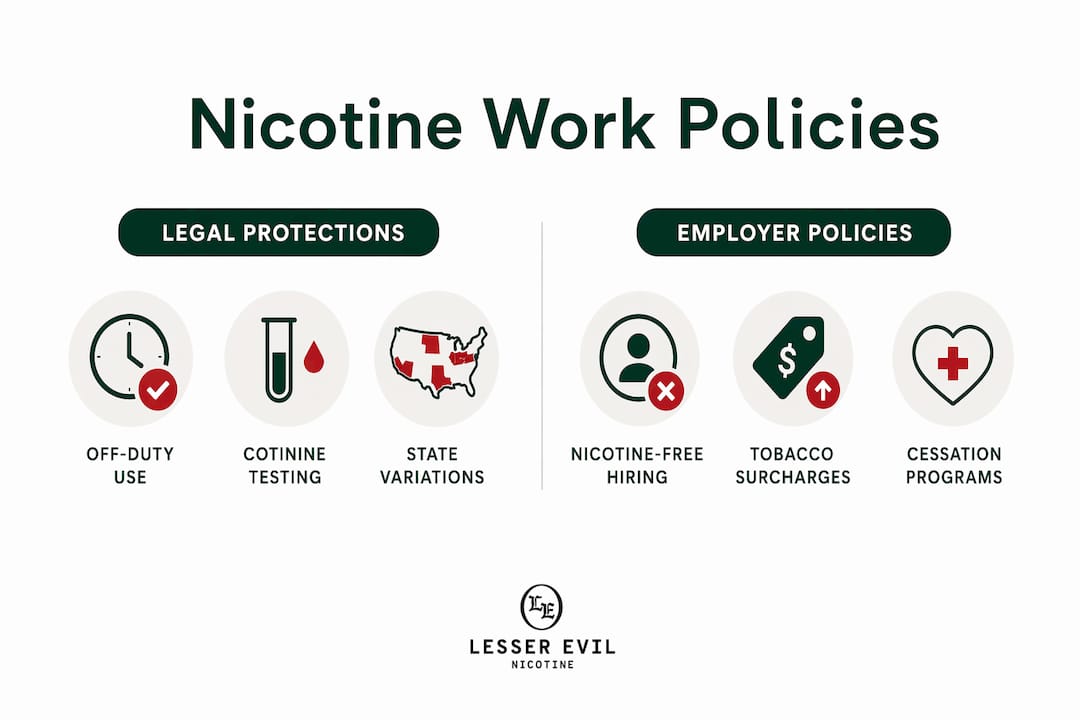
The good news: employers with tobacco surcharges must offer a reasonable alternative, such as a cessation programme, and waive the penalty if you demonstrate active participation. That is a lever worth knowing about. Read your employment contract carefully, particularly the wellness and substance use clauses, before assuming any nicotine product is safe to use at work.
Which discreet nicotine alternatives work best in professional settings?
The format you choose determines how visible, how social, and how policy-relevant your nicotine use becomes. Smoking and vaping both produce visible output, require leaving your desk, and carry strong sensory signals. Oral formats produce none of that.
Smoke-free and vapour-free options
- Oral nicotine pouches: Placed under the lip, odourless, and leave no visible residue. Tech firms like Palantir began offering these free to employees over 21 in early 2026, signalling a shift in how some workplaces frame nicotine use.
- Sublingual nicotine gels: Applied under the tongue and absorbed via the oral mucosa. Lesser Evil Nicotine’s gel is tobacco-free, battery-free, and uses natural flavours and sweeteners. You do not breathe it in, and there is no vapour, no smoke, and no device to charge.
- Nicotine mouth sprays: A compact, pocketable format with fast absorption. Lesser Evil Nicotine has a mouth spray in development for 2026.
Each of these formats lets you stay at your desk, in a meeting room, or at a client lunch without anyone noticing. That is the practical definition of discreet nicotine use in a professional context.
The trade-off with pouches is visibility. Visible pouch use can project a “biohacker” image that lands well in a startup but reads oddly in a traditional law firm or financial services office. A sublingual gel sits entirely under the tongue with nothing visible at all.
Pro Tip: Before a client meeting or presentation, switch to a format with zero visible profile. A sublingual gel or mouth spray leaves no tell-tale lip bulge and no scent, so your focus stays on the room, not on managing perceptions.
For a broader look at smoke-free nicotine formats, the options available in 2026 are more varied than most professionals realise.
How can professionals manage nicotine habits responsibly to avoid workplace stigma?
Responsible use at work is less about the product and more about timing, context, and awareness. These four steps cover the practical ground.
-
Know your company’s policy in writing. Employer policies often treat all nicotine products the same, regardless of format or harm profile. Unauthorised use, even of an odourless oral product, can result in a formal warning or termination. Get clarity before you assume anything is permitted.
-
Time your use around natural breaks. Using nicotine during a scheduled break, away from shared spaces, removes the social friction entirely. It also keeps your use off the radar of colleagues who might otherwise form opinions about your habits.
-
Be proactive with HR if you are in a wellness programme. If your employer runs a nicotine surcharge scheme, ask HR directly about the cessation programme alternative. Federal rules require employers to offer one. Participating can waive the surcharge and demonstrates good faith.
-
Choose formats that match your environment. A sublingual gel or compact mouth spray suits a client-facing role far better than a visible pouch. Match the product to the professional context, not just to your personal preference.
-
Keep use off-desk during video calls. A lip bulge or a visible product on your desk during a video call signals your habit to everyone on screen. Timing use before or after calls is a simple way to keep your professional image intact.
Pro Tip: If you are subject to a nicotine surcharge, document your participation in any employer-offered programme. Federal wellness rules require employers to waive the penalty for active participants, and having a paper trail protects you if the surcharge is applied incorrectly.
For more on managing nicotine at work, the practical detail matters more than most guides acknowledge.
What does research actually say about nicotine and workplace productivity?
The marketing narrative around nicotine as a focus enhancer is misleading, and the science is clear on this. Short-term alertness boosts from nicotine are real but temporary. Tolerance builds quickly, and over time, dependency heightens anxiety and impairs cognition rather than sharpening it.
The cognitive impact follows what researchers describe as an inverted U-curve. Low doses produce a mild alertness effect. Higher doses, or habitual use that has built tolerance, produce the opposite. Dr Robert Jackler of Stanford has noted that marketing nicotine pouches as “clean” performance enhancers is misleading precisely because the cognitive benefit disappears as use escalates.
“Nicotine’s short-term focus effects are real, but they are followed by tolerance and worsened cognitive function over time. The productivity narrative in nicotine marketing does not reflect what happens to regular users.” MD Anderson Cancer Center and the American Lung Association
This matters for professionals because the productivity case for nicotine is weaker than the marketing suggests. Using a discreet oral product instead of smoking or vaping removes the social and environmental downsides. It does not, however, unlock a cognitive edge that non-users lack. Framing your nicotine use as a focus tool in a workplace context is a narrative that does not hold up under scrutiny, and it is not one worth leaning on.
The more honest framing is this: you use nicotine, you want to do it without bothering anyone or damaging your career, and you are choosing a format that is less intrusive than smoking or vaping. That is a reasonable position. It does not need a productivity justification.
Key takeaways
Nicotine use without stigma at work requires knowing your legal rights, choosing a discreet format, and understanding your employer’s policy before you assume anything is permitted.
| Point | Details |
|---|---|
| Legal protections are partial | 29 states and D.C. protect off-duty use, but not on-site use or property-wide bans. |
| Cotinine testing affects all formats | Discreet oral products still trigger cotinine tests and potential insurance surcharges. |
| Format determines visibility | Sublingual gels and mouth sprays leave no visible trace, unlike pouches or vaping. |
| Policy awareness is non-negotiable | Employers can treat all nicotine products the same; check your contract before using anything at work. |
| Productivity claims are overstated | Nicotine’s focus benefits are short-term and diminish with regular use, per MD Anderson. |
What I have actually observed about nicotine and professional life
By Luke McLeod
The conversation around nicotine at work has changed faster than most people realise. Three years ago, the idea of a tech company stocking nicotine products as an office perk would have seemed absurd. Now it is a news story. That shift tells you something about where workplace culture is heading, but it does not mean the old stigma has gone away everywhere.
What I have seen is a split. In creative, tech, and startup environments, discreet oral nicotine use barely registers as a topic. In traditional professional settings, finance, law, corporate services, the old judgements still apply. The product format you choose signals more than just your nicotine preference. It signals how well you read the room.
The professionals who navigate this best are not the ones who hide their habit or the ones who make a point of it. They are the ones who choose formats that simply do not create a moment. No smell, no visible device, no lip bulge during a board meeting. The habit becomes invisible, and invisible habits do not attract stigma.
My honest advice: read your employment contract, know your legal position, and choose a product that matches your environment. The responsible use guide for urban professionals covers this in more depth, and it is worth the read before you make any assumptions about what is and is not acceptable where you work.
— Luke McLeod
Lesser Evil Nicotine: built for exactly this situation
If you want a nicotine format that genuinely disappears into your working day, Lesser Evil Nicotine’s sublingual gel is worth a look.

The Lesser Evil Oral Mister is a sublingual nicotine gel applied under the tongue. It is tobacco-free, battery-free, and produces no vapour and no smoke. The natural flavours, Peppermint, Black Grape, and Green Apple, are subtle enough to use before a meeting without leaving a trace. There is no device to charge, no e-waste, and nothing visible on your desk or your face. A nicotine mouth spray is also in development for 2026. Both formats are designed for professionals who want their habit to stay their business.
FAQ
What is nicotine use without stigma in the workplace?
Nicotine use without stigma at work means consuming nicotine discreetly, in line with company policy and local law, without affecting your professional reputation or bothering colleagues. Smoke-free, vapour-free formats like sublingual gels are the most practical way to achieve this.
Can my employer test for nicotine even if I use discreet products?
Yes. Cotinine tests detect nicotine metabolites regardless of the delivery format, and a positive result can lead to a rescinded job offer or insurance surcharges of up to 50% under 2026 federal rules. Check your employment contract for testing clauses before assuming any product is safe to use.
Are there legal protections for nicotine use at work?
Smoker protection laws in 29 states and D.C. protect employees from penalties for legal off-duty nicotine use. They do not cover on-site use, property-wide bans, or hiring decisions based on cotinine testing.
Does nicotine actually improve focus at work?
Short-term alertness effects are real but limited. Tolerance builds quickly, and regular use leads to heightened anxiety and impaired cognition over time, according to MD Anderson Cancer Center. The productivity case for nicotine is weaker than marketing suggests.
What is the most discreet nicotine product for professional settings?
Sublingual gels and compact mouth sprays produce no vapour, no smoke, and no visible profile. They are the least socially disruptive formats available, making them the most practical choice for client-facing roles or traditional office environments.