

Nicotine gel vs nicotine gum: which one actually works for you?

TL;DR:
- Nicotine gel offers passive absorption under the tongue, making it more discreet and easier to use than gum. Both products work within 5–10 minutes, but gel eliminates the need for chewing techniques and reduces side effects. Choosing the right product depends on personal preference, lifestyle, and physical comfort to ensure consistent use.
Nicotine gel is defined as a sublingual oral product that delivers nicotine passively through the mouth lining, while nicotine gum requires active chewing via a specific “chew and park” technique to release nicotine. Both are tobacco-free oral nicotine methods, and both skip the smoke and vapour entirely. The difference is in how much effort you put in and how discreet the whole thing feels. If you’ve been chewing gum and wondering whether there’s a less fiddly option, the nicotine gel vs nicotine gum comparison is worth understanding properly. Your routine, your jaw, and your social life all have a vote.
How does nicotine gel deliver nicotine compared to nicotine gum?
The delivery mechanism is where these two products split hard. Nicotine gel uses sublingual absorption, meaning you apply it under the tongue or against the inner cheek, and the oral mucosa absorbs nicotine directly into the bloodstream. No chewing required. No technique to master. You just apply and get on with your day.

Nicotine gum works differently. It delivers nicotine through the mouth lining using a controlled chewing method, but the key is that you must not chew it like regular gum. The correct approach is to chew a few times until you feel a tingle, then park the gum between your cheek and gum, let the nicotine absorb, then chew again. Repeat. It’s a rhythm you have to learn.
Both methods begin working within 5–10 minutes of correct use. That onset speed is comparable, so neither has a major edge on how fast the hit arrives. The real difference is in the user experience during those minutes.
Here’s what the two methods actually look like in practice:
- Nicotine gel: Apply under the tongue or to the inner cheek. Sit back. Absorption happens passively. No jaw movement, no visible product.
- Nicotine gum: Unwrap, chew a few times, park against the cheek, chew again, repeat for up to 30 minutes. Visible chewing, audible at times, requires attention.
- Gel side effects: Mild mouth irritation in some people, particularly with higher-strength products.
- Gum side effects: Jaw soreness, hiccups, and heartburn are common, usually from incorrect technique rather than the nicotine itself.
Pro Tip: If you swallow too much saliva while using nicotine gum, you’ll likely feel nauseous. The nicotine needs to absorb through your cheek, not your stomach. Park it, don’t gulp.
The passive nature of gel absorption is a genuine practical advantage for adults who want nicotine without a visible ritual. For people who find the chew-and-park method awkward or socially conspicuous, gel removes that friction entirely.
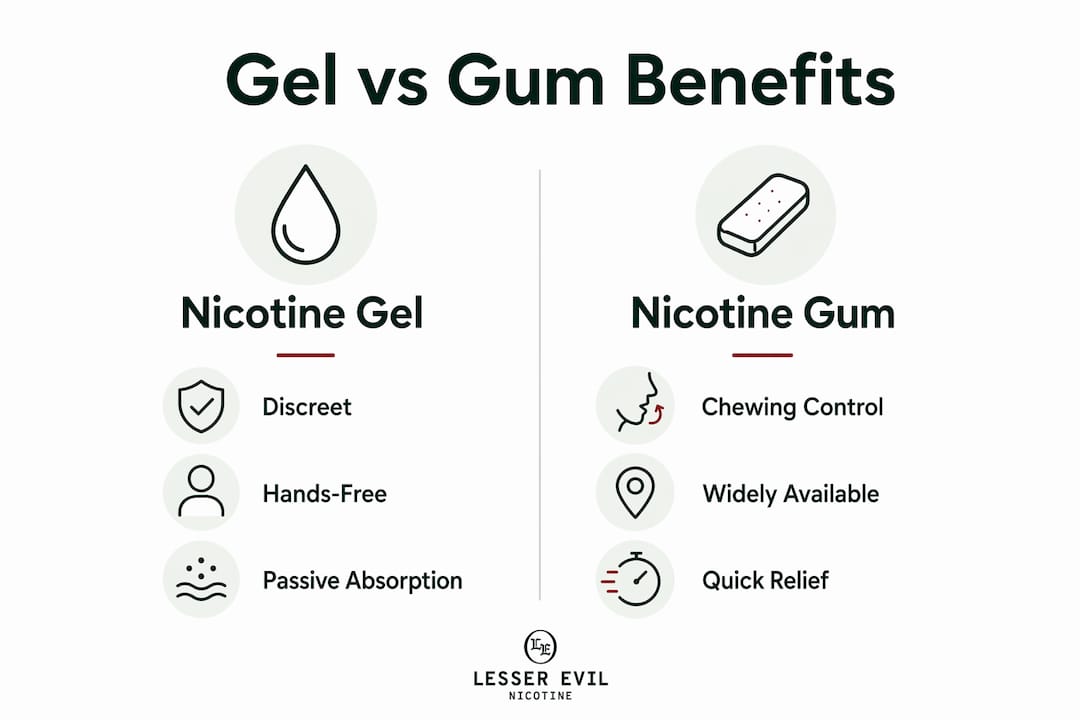
What are the advantages and disadvantages of nicotine gel versus nicotine gum?
Nicotine gels provide a discreet, hands-free option with natural flavours and a tobacco-free formulation. That combination suits adults who want something that fits into a professional or social setting without drawing attention. You’re not chewing visibly, not rustling a wrapper, and not explaining yourself to anyone.
Nicotine gum has its own strengths. The act of chewing gives some people a physical anchor, which can be genuinely useful when the urge to smoke or vape is tied to a hand-to-mouth habit. Dose control is also more tangible with gum because you can feel when you’ve had enough and simply stop chewing.
Advantages of nicotine gel
- Passive absorption, no technique required
- Discreet enough to use in meetings, on public transport, or at a desk
- Natural flavours (products like Lesser Evil Nicotine offer Peppermint, Black Grape, and Green Apple)
- Tobacco-free, battery-free, no e-waste
- No jaw fatigue or chewing-related side effects
Advantages of nicotine gum
- Provides oral activity that some people find satisfying
- Widely available in pharmacies and supermarkets
- Familiar format with decades of use behind it
- Dose control through chewing duration
The downsides worth knowing
Gum’s biggest drawbacks are physical. Jaw soreness is a real issue for regular users, and the hiccup and heartburn side effects put some people off entirely. The chew-and-park technique also takes practice, and getting it wrong means less nicotine absorbed and more stomach discomfort.
Gel is newer and less widely stocked in traditional retail, though that’s changing as the category grows. 67% of young nicotine users planned to quit in 2026, with many preferring oral gels for convenience and taste variety. That shift in preference is driving more stockists to carry gel formats.
Pro Tip: Avoid acidic drinks like coffee or fruit juice for 15 minutes before using either product. Acidic drinks reduce nicotine absorption through the mouth lining, so you’ll get less from the same dose.
Cost is another factor. Monthly spend on nicotine gum typically sits in the £30–£65 range depending on strength and frequency. Gel products vary, but the per-use cost is broadly comparable. The real cost difference shows up in how consistently you use each product correctly.
Who benefits most from nicotine gel versus nicotine gum?
The best nicotine product is the one you’ll actually use consistently, without social anxiety or physical discomfort. Discretion and convenience are the key adherence drivers, not clinical strength. That’s the honest truth, and it shapes who each format suits.
Gel tends to suit:
- Adults in professional settings where visible chewing feels awkward
- People who’ve had jaw pain, dental work, or sensitivity that makes chewing uncomfortable
- Younger adults who want something that doesn’t look like a pharmacy product
- Anyone who finds the chew-and-park technique fiddly or easy to get wrong
- People who vape and want something equally discreet to use instead
Gum tends to suit:
- People who find the physical act of chewing genuinely satisfying
- Adults who prefer a product with a long track record and wide availability
- Those who want to actively manage their dose through the chewing process
- People who don’t mind the visible ritual and find it helpful as a habit replacement
Oral gels are gaining popularity for lifestyle alignment, especially among 18–24 year olds. That demographic shift reflects something real: younger adults are less attached to the pharmacy-shelf format and more interested in products that fit their actual lives. If you’re managing nicotine use at work, gel is the more practical choice by a clear margin.
Dental health matters here too. If you have crowns, bridges, or jaw issues, chewing gum for 20–30 minutes multiple times a day is a legitimate concern. Gel sidesteps that entirely.
How to use nicotine gel and nicotine gum properly
Getting the technique right makes a real difference to how much nicotine you actually absorb and how comfortable the experience is.
Using nicotine gel correctly
- Apply a small amount under the tongue or against the inner cheek as directed on the product.
- Keep your mouth relatively still. Let the gel sit and absorb through the oral mucosa.
- Avoid eating, drinking, or rinsing your mouth for at least 15 minutes before and during use.
- Don’t apply more than the recommended dose in a session. More gel does not mean faster absorption.
- If you feel mild tingling, that’s normal. If you feel nausea, you may have used too much.
Using nicotine gum correctly
- Chew slowly until you feel a peppery tingle or taste, usually after 3–5 chews.
- Park the gum between your cheek and gum. Do not continue chewing.
- Wait about a minute, then chew again briefly, then park again.
- Repeat this cycle for up to 30 minutes. Do not chew continuously.
- Avoid swallowing excess nicotine, which causes nausea and heartburn. The nicotine absorbs through your cheek, not your gut.
Pro Tip: The most common mistake with nicotine gum is chewing it like regular gum. Continuous chewing pushes nicotine into your saliva, which you swallow, and that’s where the nausea comes from. Park it and be patient.
Both products work better when used consistently at regular intervals rather than reactively when the urge peaks. Building a schedule around your day, rather than waiting until you feel desperate, produces steadier nicotine levels and a more comfortable experience overall.
What impact does switching to oral nicotine have on harm reduction?
Both nicotine gel and nicotine gum deliver nicotine without combustion or inhalation. You don’t breathe anything in. There’s no vapour, no smoke, and no lung tax. That’s the fundamental shift when you move from smoking or vaping to an oral nicotine product.
The role of gel in nicotine delivery is expanding precisely because adults want options that don’t involve inhaling anything. Gum has offered that for decades. Gel now offers the same principle with a more discreet format.
Key practical differences from a harm reduction standpoint:
- Neither product produces smoke or vapour, so bystanders aren’t affected
- Both are tobacco-free, removing the combustion-related compounds entirely
- Gel products like Lesser Evil Nicotine are battery-free, meaning no e-waste
- Dose control is possible with both formats, giving you more say over your intake
- Neither requires a lighter, a device, or a designated smoking area
For adults who vape and want to use something instead, oral nicotine products remove the device dependency entirely. No charging, no coils, no liquid to refill. That simplicity is part of the appeal, and it’s worth factoring into your decision alongside the absorption mechanics.
Key takeaways
Nicotine gel absorbs passively through the oral mucosa, making it the more discreet and technique-free option compared to nicotine gum’s active chew-and-park method.
| Point | Details |
|---|---|
| Absorption method | Gel absorbs passively under the tongue; gum requires the chew-and-park technique to work correctly. |
| Side effect profile | Gum commonly causes jaw soreness and hiccups; gel may cause mild mouth irritation but avoids chewing fatigue. |
| Who suits gel | Adults in professional settings, those with dental sensitivity, and people who find gum technique fiddly. |
| Adherence driver | The product you’ll use consistently without discomfort is the right one, regardless of format. |
| Harm reduction | Both products deliver nicotine without smoke or vapour, removing inhalation from the equation entirely. |
Why I think the gel vs gum debate misses the real point
People spend a lot of time asking which product is clinically superior. I think that’s the wrong question. The right question is which one you’ll actually use every day without it becoming a chore or an embarrassment.
I’ve spoken to a lot of adults who tried nicotine gum and gave up, not because it didn’t work, but because the technique was fiddly, the jaw ache was annoying, and chewing visibly in a meeting felt unprofessional. Those aren’t small complaints. They’re the exact reasons people go back to vaping or smoking.
Gel removes most of those friction points. You apply it, you forget about it, and it does its job quietly. For busy adults, especially those in client-facing roles or open-plan offices, that discretion is genuinely valuable. It’s not a minor feature. It’s the whole point.
The other thing I’d push back on is the idea that the chewing ritual is universally helpful. For some people it is. For others, it’s just a reminder that they’re managing a habit, and that reminder isn’t always welcome. Gel lets you get the nicotine without the performance.
Consistency is what matters most in the long run. Pick the format that fits your actual life, not the one that looks best on a comparison chart.
— Luke McLeod
Lesser Evil Nicotine: a cleaner way to get your hit
If you’ve been thinking about switching from gum to something less fiddly, the Lesser Evil Oral Mister is worth a look. It’s a sublingual nicotine gel, tobacco-free, battery-free, and made with natural flavours and natural sweeteners. No chewing, no jaw ache, no e-waste.

Lesser Evil Nicotine comes in three flavours: Peppermint, Black Grape, and Green Apple. The formula is low-burn and designed to be genuinely palatable, not just functional. It’s built for adults who want to use something instead of vaping or smoking, without putting unnecessary rubbish in their bodies. If discretion and simplicity matter to you, this is the format that delivers both. Check out the types of nicotine products available if you want the full picture before deciding.
FAQ
What is the main difference between nicotine gel and nicotine gum?
Nicotine gel absorbs passively through the oral mucosa without chewing, while nicotine gum requires a specific chew-and-park technique to release nicotine through the mouth lining. Gel is more discreet and requires no technique to master.
How quickly does nicotine gel work compared to gum?
Both nicotine gel and nicotine gum begin working within 5–10 minutes of correct use. The onset speed is broadly comparable between the two formats.
Why does nicotine gum cause jaw soreness?
Jaw soreness from nicotine gum is usually caused by continuous chewing rather than the correct chew-and-park method. Chewing the gum like regular gum overworks the jaw and also pushes nicotine into the saliva, causing nausea.
Is nicotine gel suitable for use in professional settings?
Yes. Nicotine gel is applied discreetly under the tongue or against the inner cheek with no visible chewing or audible activity, making it well suited to offices, meetings, and public spaces.
Should I avoid drinks before using nicotine gel or gum?
Avoid acidic drinks such as coffee or fruit juice for at least 15 minutes before using either product. Acidic drinks reduce nicotine absorption through the mouth lining, which means you get less from the same dose.