

What is nicotine tolerance? A clear guide for adults

TL;DR:
- Nicotine tolerance develops through receptor desensitisation and upregulation, reducing response over time. It is reversible within 6 to 12 weeks of abstinence, but behavioral and hormonal factors influence its effect, especially in women. Managing tolerance involves gradual reduction, behavioral awareness, and patience to restore receptor sensitivity.
Nicotine tolerance is defined as a reduced response to nicotine following repeated exposure, meaning the same dose produces a weaker effect over time. Your body adapts to nicotine at a biological level, and that adaptation pushes you toward higher or more frequent doses to feel the same hit. This isn’t a character flaw or a lack of willpower. It’s receptor pharmacology, plain and simple. Understanding how tolerance builds, what it does to your behaviour, and how biological factors like sex hormones shape it gives you real knowledge about your own nicotine use.
What is nicotine tolerance and how does it develop?
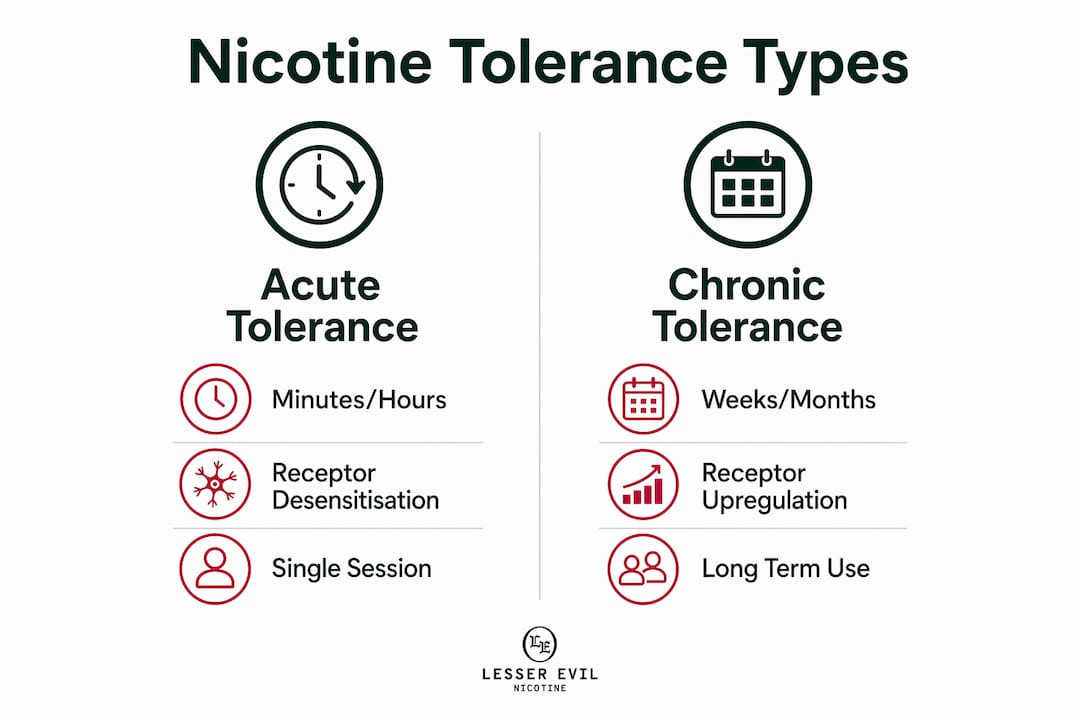
Nicotine tolerance develops through two distinct processes: acute desensitisation and chronic upregulation. Both happen in your brain’s nicotinic acetylcholine receptors, known as nAChRs, and they operate on very different timescales.

Acute tolerance: what happens in a single session
Acute tolerance involves rapid receptor desensitisation during a single use session. The first cigarette or nicotine product of the day hits resting receptors, triggering a strong dopamine release. That’s the “ahh” moment. Each subsequent dose within the same session hits receptors that are already partially desensitised, producing a noticeably weaker effect. This is why the first nicotine of the day always feels strongest.
Chronic tolerance: what builds over weeks and months
Chronic tolerance is a longer game. With repeated exposure over weeks and months, your brain responds by upregulating nAChR receptor density, meaning it grows more receptors. More receptors sound like a good thing, but most of them sit in a desensitised state. The result is that you need more nicotine just to activate enough receptors to feel anything close to the original effect.
Receptor subtypes matter here too. Receptors containing α4 and β2 subunits in the ventral tegmental area regulate reward-related behaviour and contribute directly to nicotine dependence. Genetic differences in these subtypes partly explain why some people develop tolerance faster than others.
Pro Tip: If you notice your usual nicotine product barely touching the sides, that’s chronic tolerance at work. Your receptors have adapted, not disappeared.
Here is a quick summary of how the two tolerance types differ:
| Feature | Acute tolerance | Chronic tolerance |
|---|---|---|
| Timescale | Minutes to hours | Weeks to months |
| Mechanism | Receptor desensitisation | Receptor upregulation |
| Effect on dose | Each dose within session weakens | Baseline dose becomes insufficient |
| Reversibility | Resets overnight | Reverses over 6–12 weeks |
How does nicotine tolerance affect your behaviour and consumption?
Tolerance does not stay neatly inside your biology. It reshapes how you use nicotine, often without you noticing until the pattern is well established.
Here is how tolerance typically changes nicotine consumption behaviour:
- Dose escalation. Chronic users develop more nAChRs, most of which are desensitised. The brain interprets this as a deficit, pushing you to use more frequently or switch to higher-strength products.
- The morning hit effect. After several hours of sleep, receptors partially resensitise. The first nicotine of the day activates those rested receptors and feels disproportionately strong. This is not a coincidence. It is the biology of overnight receptor recovery.
- Diminishing returns within a session. Each subsequent dose produces less effect. Many people unconsciously compensate by vaping more frequently or taking longer draws, without realising tolerance is driving the behaviour.
- Physical dependence alongside tolerance. Tolerance and physical dependence are distinct but related. Tolerance reduces the drug’s effect; dependence causes discomfort when nicotine is absent. Both develop together with regular use, which is why cutting back feels harder than it sounds.
- Heightened sensitivity to absence. As tolerance builds, the gap between “nicotine present” and “nicotine absent” widens. That gap is what makes going without feel so uncomfortable.
Understanding these patterns matters because they explain why nicotine use often escalates gradually rather than in one dramatic leap. The nicotine habit management challenge is partly about recognising these invisible behavioural shifts before they compound.
Does nicotine tolerance affect women differently?
Yes, and the difference is significant enough to warrant its own conversation. Biological sex and hormonal cycles alter how nicotine tolerance and dependence play out, and most mainstream nicotine information ignores this entirely.
Key factors that shape nicotine tolerance in women:
- Luteal phase intensity. Women experience greater withdrawal symptoms and cravings during days 25–28 of their menstrual cycle. Estradiol and progesterone fluctuations during the luteal phase directly affect the brain’s reward circuitry, amplifying the discomfort of nicotine absence.
- Hormonal modulation of reward pathways. Sex steroid hormones modulate nicotine intake differently in women compared to men. This means the subjective experience of nicotine, and the experience of tolerance, is not identical across sexes.
- Behavioural and emotional drivers. Women often use nicotine for stress and mood regulation rather than purely for the pharmacological reward. This means tolerance in women is entangled with emotional coping patterns, not just receptor biology.
- Environmental cues play a larger role. Situational triggers, such as stress at work, social settings, or specific emotional states, drive nicotine use in women more than in men. Tolerance interacts with these cues in ways that purely pharmacological frameworks miss.
- Standard approaches may fall short. Approaches that address only the pharmacological side of nicotine use may be less effective for women because they ignore the behavioural and emotional dimensions that are central to how many women use nicotine.
Pro Tip: If you track your nicotine use across your cycle, you may notice clear patterns in when cravings feel sharpest. That awareness alone changes how you respond to them.
For a deeper look at how hormonal shifts affect nicotine sensitivity, the female nicotine withdrawal guide from Lesser Evil Nicotine covers this in practical detail.
How do you manage nicotine tolerance and reduce consumption?
Tolerance is not permanent. The biology is reversible, and understanding that changes the picture considerably.
- Tolerance reverses within weeks. Receptor density returns to near non-smoker levels within 6–12 weeks of abstinence. During that window, receptors resensitise, which is why nicotine feels unusually strong after a break. That sensitivity is a sign the biology is resetting.
- A step-down approach is more tolerable. Reducing nicotine intake gradually allows receptors to adjust incrementally rather than all at once. The benefits of reducing nicotine intake are well documented, and a gradual approach tends to produce less discomfort than abrupt stops.
- Identify behavioural triggers. Tolerance is biological, but the behaviour around it is learned. Recognising which situations, emotions, or times of day drive your nicotine use gives you a point of intervention that is separate from the receptor biology.
- Consider your delivery method. Different nicotine delivery formats produce different absorption rates and peak blood nicotine levels. Sublingual nicotine gel, for example, absorbs through the oral mucosa rather than the lungs. You get the nicotine without breathing anything in.
- Patience is the actual strategy. Receptor resensitisation takes weeks, not days. Expecting tolerance to reverse in 48 hours sets you up for frustration. The biology has its own timeline, and working with it rather than against it produces better results.
Key takeaways
Nicotine tolerance is a biological adaptation driven by receptor desensitisation and upregulation, and it reverses within 6–12 weeks of reduced or absent nicotine use.
| Point | Details |
|---|---|
| Two types of tolerance | Acute tolerance resets overnight; chronic tolerance builds over weeks and requires sustained reduction to reverse. |
| Receptor upregulation drives escalation | More nAChRs develop with chronic use, most desensitised, pushing users toward higher doses. |
| Women experience it differently | Hormonal cycles amplify tolerance effects, with the luteal phase producing the sharpest discomfort. |
| Behaviour shapes tolerance too | Emotional triggers and environmental cues compound the biological picture, especially in women. |
| Reversal is possible | Receptor density normalises within 6–12 weeks of abstinence, making nicotine feel strong again after a break. |
Tolerance is more complicated than “just needing more”
Most people assume nicotine tolerance is simple: you use more, you need more. That framing misses most of what is actually happening. The receptor biology alone involves multiple subtypes, two distinct adaptation mechanisms, and a reversal timeline that most people never account for. Add in hormonal cycles, emotional coping patterns, and behavioural conditioning, and you have a picture that is genuinely complex.
What I find most striking is how often people blame themselves for escalating nicotine use when the biology was always going to push in that direction. Tolerance is not a personal failing. It is a predictable pharmacological outcome of repeated exposure. The more useful question is not “why do I need more?” but “what does my use pattern actually look like, and what is driving it?”
The gender dimension is particularly underserved. The research on luteal phase effects and hormonal modulation of reward pathways is solid, but it rarely makes it into mainstream nicotine conversations. Women deserve better than a one-size-fits-all framework built around male biology. Understanding your own biology, including how your cycle interacts with nicotine sensitivity, is genuinely useful information, not a niche concern.
Patience matters more than most people expect. Receptor resensitisation takes weeks. That is not a reason to despair. It is a reason to approach any reduction in nicotine use with a realistic timeline and some self-compassion.
— Luke McLeod
A different way to take nicotine
Lesser Evil Nicotine makes a sublingual nicotine gel that sits under your tongue and absorbs through the oral mucosa. No smoke, no vapour, no battery, no e-waste. The formulation is tobacco-free, uses natural flavours and natural sweeteners, and comes in three options: Peppermint, Black Grape, and Green Apple. A nicotine mouth spray is also in development. If you are thinking about how you take nicotine rather than just how much, the Lesser Evil Oral Mister is worth a look. It is a factual alternative to vaping or smoking, designed for adults who want to know exactly what they are putting in their body.
FAQ
What is nicotine tolerance in simple terms?
Nicotine tolerance is when your body adapts to repeated nicotine exposure and produces a weaker response to the same dose. You end up needing more nicotine to feel the same effect you once got from less.
How quickly does nicotine tolerance build?
Acute tolerance develops within a single session as receptors desensitise. Chronic tolerance builds over weeks to months as the brain upregulates receptor numbers in response to repeated exposure.
Does nicotine tolerance reverse after quitting?
Yes. Receptor density returns to near non-smoker levels within 6–12 weeks of abstinence, with receptors resensitising during that period.
Is nicotine tolerance different for women?
Women experience greater nicotine discomfort during the luteal phase of their menstrual cycle, days 25–28, due to hormonal fluctuations affecting brain reward pathways. Behavioural and emotional factors also play a larger role in women’s nicotine use patterns.
What are the signs of nicotine tolerance?
The clearest signs are needing more nicotine to feel the same effect, noticing that the first dose of the day feels much stronger than later doses, and finding that your usual product or strength no longer satisfies you.