

Vape waste environmental impact: what you should know

Disposable vapes are a genuine and growing environmental hazard, and the problem isn’t going away on its own. Each device packs non-biodegradable plastics, a lithium-ion battery, trace toxic metals, and leftover nicotine e-liquid into a single object built to be used for a few days and binned forever. A peer-reviewed scoping review confirms these devices generate persistent plastics and metal residues that leach into soil and water. Device-level mass-balance research found lithium-ion batteries make up a substantial portion of a disposable vape’s total mass, and 25.6% of recovered batteries still held a charge above 2.5 volts, which is a fire risk waiting to happen in a bin lorry.
That’s the headline. Here’s what you can do about it today:
- Never bin a disposable vape in general rubbish. The residual battery charge can spark fires in collection vehicles and sorting facilities.
- Find a battery or e-waste collection point. Many councils, retailers, and recycling depots now accept vapes separately.
- Stop buying disposables where you can. Refillable, rechargeable devices produce far less waste per use than single-use units.
- Consider a battery-free option entirely if you’re managing nicotine use and want to cut e-waste out of the equation altogether.
Key Takeaways
| Point | Details |
|---|---|
| Batteries are the core hazard | Lithium-ion cells make up a significant portion of device mass, and a substantial portion retain charge above 2.5V after disposal. |
| Recycling rates stay very low | Only an estimated 1% of disposables are formally recycled due to sealed design and e-liquid contamination. |
| Fires are a real operational cost | Residual battery charge causes collection vehicle and facility fires, driving substantial cleanup and equipment costs. |
| Policy needs multiple levers together | EPR funding, mandatory take-back points, and eco-design rules must work in combination to raise collection rates. |
| Battery-free formats remove the e-waste issue | Lesser Evil Nicotine’s oral gel has no battery and no device casing, eliminating that specific waste pathway entirely. |
Table of Contents
- What’s actually inside a disposable vape, and why it matters
- How big is the disposable vape waste problem, really
- How discarded vapes actually harm ecosystems and health
- Why partly charged batteries are a fire risk for waste crews
- Why recycling disposable vapes is so difficult
- What you can do right now to dispose of a vape safely
- What’s actually working to fix this at the system level
- Lower-waste alternatives worth knowing about
- What researchers still don’t know
- The verdict on disposable vape waste
- Why I think this problem gets underestimated
- A battery-free way to sidestep the e-waste question
- Sources
What’s actually inside a disposable vape, and why it matters
Pop one open (carefully, and not at home) and you’ll find a surprisingly complex little machine crammed into something the size of a highlighter pen. There’s a plastic casing, usually polycarbonate or nylon. Inside sits a cotton or ceramic wick, a heating coil, a small printed circuit board, an e-liquid reservoir, and a lithium-ion battery wired directly into the whole assembly with no easy way to take it apart.
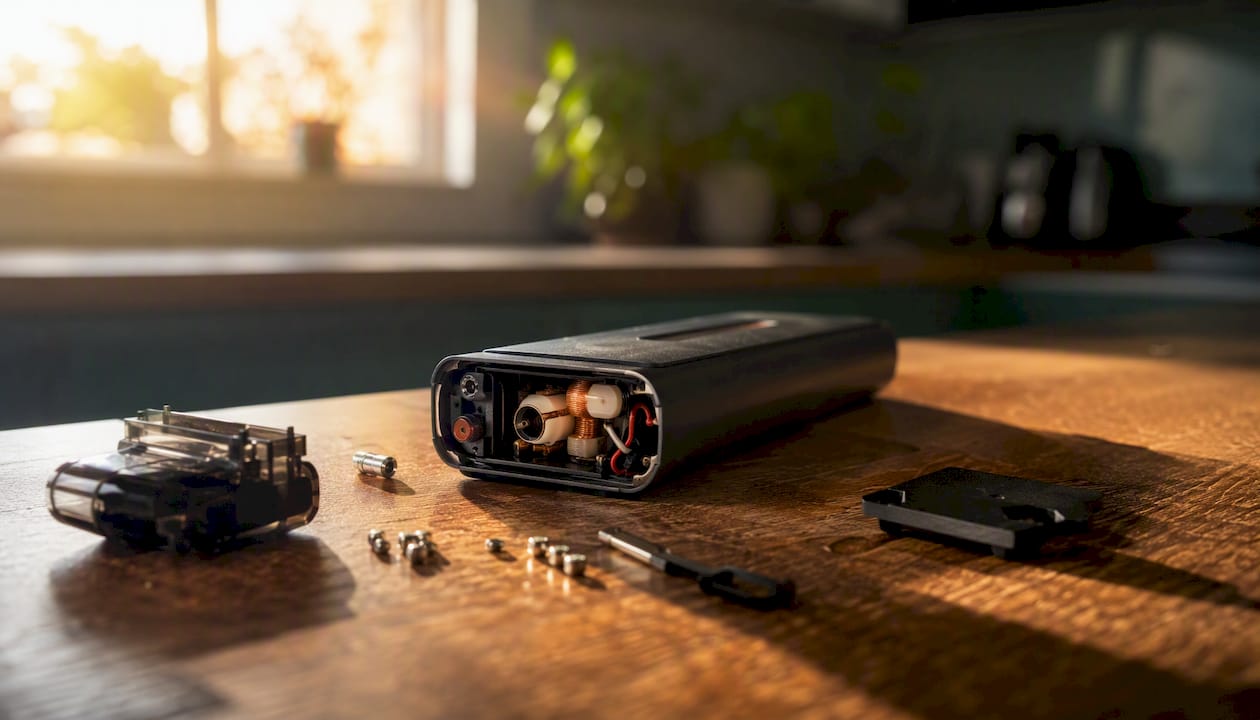
That battery is the biggest single problem. Research analysing a dozen disposable device types found batteries account for 17 to 41% of total device mass depending on the brand and model. Batteries this small still contain lithium, cobalt, and nickel, metals that require energy-intensive mining and don’t belong in a landfill.
The plastics are just as stubborn. Polycarbonate and nylon casings don’t break down in any meaningful timeframe. Left in the environment, they photodegrade into microplastics rather than disappearing. An elemental analysis of dismantled devices also detected trace amounts of arsenic, lead, and mercury alongside the expected plastics and metals, a mix that raises real questions about what happens when these fragments leach into soil or waterways.
Then there’s the e-liquid itself. Even an “empty” disposable typically retains some residue, and that residue contains nicotine salts, which are far more water-soluble than freebase nicotine, meaning they move through soil and groundwater more readily.
Here’s the quick material breakdown that matters most:
- Lithium-ion battery: 17 to 41% of device mass, containing lithium, cobalt, and nickel.
- Plastic casing: polycarbonate or nylon, non-biodegradable, breaks into microplastics over time.
- Metal components: heating coil and PCB traces containing copper, and in some devices, detectable arsenic, lead, or mercury.
- E-liquid residue: nicotine salts and flavouring chemicals that remain in the reservoir after “use.”
How big is the disposable vape waste problem, really
The scale here isn’t a rounding error. It’s a fast-growing category of consumer waste that most councils and recyclers weren’t built to handle. Growth in disposable vape sales over the past few years has outpaced almost every other single-use consumer product category, and the litter data backs that up: environmental cleanups and NGO reports increasingly flag disposable vapes as a recurring find, right alongside cigarette butts and food packaging.
What happens once someone finishes a disposable is where the real gap shows up. Survey data compiled by PIRG’s research on vape waste points to a troubling pattern: a large share of users simply drop spent devices into general household rubbish, often without realising there’s a battery inside that behaves nothing like a dead AA cell. Analysis from Eunomia’s environmental impact modelling estimates that only around 1% of single-use vapes are actually recycled in practice, which tells you almost everything about the gap between what people intend to do and what the waste system can actually process.
A few caveats worth flagging. Regional collection infrastructure varies enormously, so disposal behaviour in a city with active take-back schemes looks nothing like disposal behaviour somewhere without one. Litter counts also depend heavily on where and when a cleanup happens, so treat any single figure as a snapshot rather than a universal constant.
- Disposable vape sales have grown sharply as a share of the broader nicotine vaping market.
- Survey and litter-audit data consistently show a majority of used devices going into general waste rather than dedicated collection.
- Only an estimated 1% are formally recycled, per Eunomia’s modelling.
- Regional infrastructure gaps mean actual disposal behaviour varies widely between areas with and without take-back schemes.
How discarded vapes actually harm ecosystems and health
This is where the abstract “environmental problem” becomes concrete. There are three main pathways: chemical leaching, microplastic fragmentation, and air emissions from fires or combustion, and each one has a plausible route to harming something alive.
Leaching into soil and water. Once a device’s casing cracks (and cheap plastic casings crack fast in landfill conditions or open litter), nicotine salts and heavy metal traces start moving. The scoping review on e-cigarette environmental impacts specifically flags this as a contamination pathway into soil and waterways, with bioaccumulation in aquatic organisms a plausible downstream risk, though long-term ecological tracking data remains thin.
Microplastic fragmentation. Polycarbonate and nylon casings don’t rot. They fragment under UV exposure and mechanical stress into microplastic particles small enough for wildlife to ingest, whether that’s a fish mistaking a fragment for food or a bird incorporating plastic shards into nesting material.
Air emissions from fires. When a disposable vape’s residual battery charge ignites, and this happens more often than most people assume, it doesn’t burn cleanly. Battery fires release toxic gases and fine particulate matter. Indoor air quality studies of heavy vaping environments have recorded PM2.5 concentrations between roughly 197 and 818 micrograms per cubic metre, levels that in some settings exceed what you’d see from tobacco smoke. That’s a separate issue from waste-fire emissions specifically, but it illustrates how airborne particulate from vaping products, whether from use or from combustion in waste streams, is a real air-quality concern rather than a hypothetical one.
Picture the pathway as a simple chain: discarded device → cracked casing → leachate or fragment release → soil, water, or air → exposure route for wildlife or people. Each link in that chain has some supporting evidence. What’s genuinely missing is long-term data connecting the dots all the way through to measurable ecological harm, which the scoping review itself flags as an evidence gap rather than a settled conclusion.
- Nicotine salts and heavy metals can leach from cracked casings into soil and waterways.
- Plastic casings fragment into microplastics that wildlife may ingest.
- Battery fires release toxic gases and elevated particulate matter.
- Long-term bioaccumulation and exposure data remain limited, a gap researchers are actively trying to close.
Why partly charged batteries are a fire risk for waste crews
Here’s the bit that should genuinely alarm anyone who’s ever binned a dead-seeming vape without a second thought: it probably wasn’t dead. The device mass-balance study found that a significant portion of recovered lithium-ion batteries from disposable vapes retained a voltage above 2.5 volts, meaning roughly a quarter still held meaningful charge when they hit the waste stream.
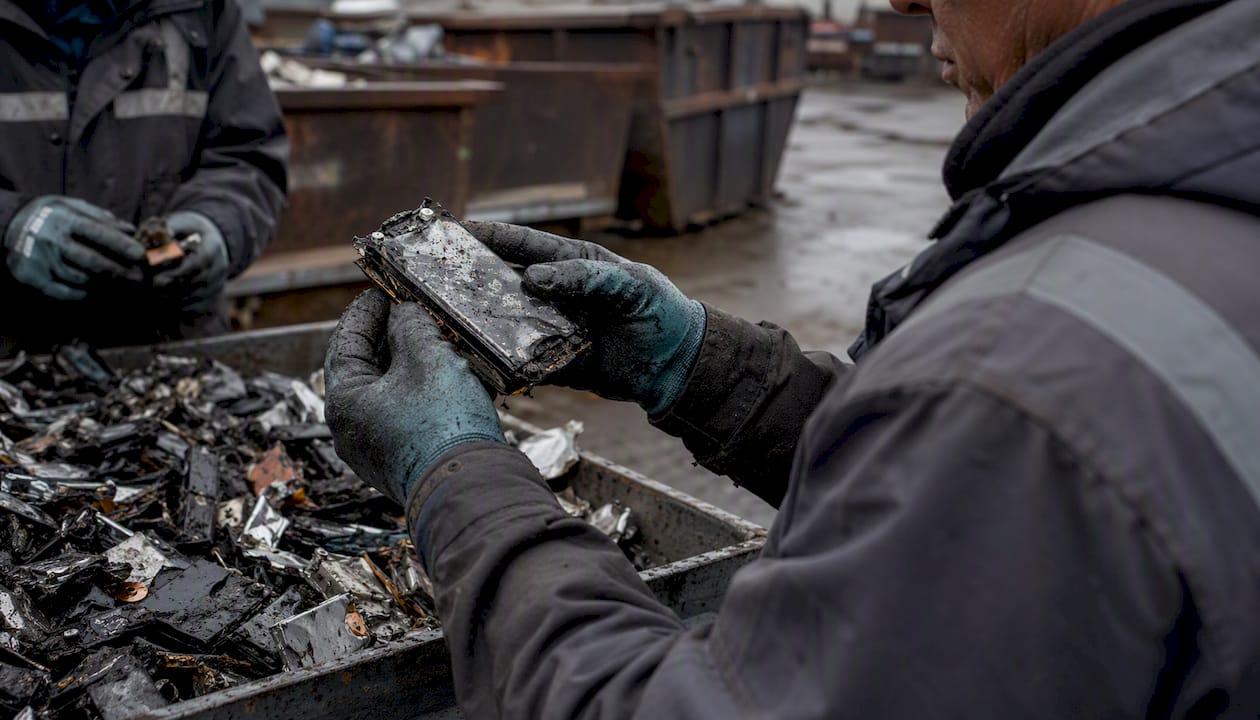
That residual charge is exactly the kind of thing that turns a bin lorry into a fire hazard. Lithium-ion cells that get crushed, punctured, or short-circuited during mechanical waste processing can ignite, and unlike a paper fire, a lithium battery fire is hard to smother and can reignite after apparent extinguishment. PIRG’s research estimates the cost exposure from these waste-facility fires runs into substantial amounts annually across the US alone, once you account for equipment damage, service disruption, and firefighting response.
Statistic callout: Roughly one in four recovered vape batteries still holds a charge above 2.5 volts, a residual power level significant enough to spark fires during collection or sorting.
What this looks like in practice:
- Collection vehicle fires: crushing during compaction ignites a punctured battery, sometimes mid route.
- Materials recovery facility (MRF) fires: sorting machinery damages battery casings, triggering ignition among mixed recyclables.
- Combustion byproducts: lithium battery fires release toxic fumes and particulate matter, a hazard for both facility workers and nearby air quality.
- Service costs: fire damage, equipment downtime, and insurance costs get passed down the waste-management chain, ultimately landing on public budgets.
Pro Tip: If you’re handling a spent disposable vape before disposal, cover the terminals with tape if they’re exposed, and never crush or compact it yourself. A “dead” vape can still hold enough charge to spark.
Why recycling disposable vapes is so difficult
Recycling sounds like the obvious fix until you actually try to do it at scale. Disposable vapes are small, sealed, and built from a mix of materials that don’t separate cleanly, which is a combination that defeats most standard recycling infrastructure.
The core problem is design, not laziness. Practitioner guidance from waste-management specialists points out that most disposables are manufactured as sealed, non-repairable units with the battery bonded directly into the casing. There’s no screw, no clip, no intended way to separate the lithium cell from the plastic housing without specialist tools, which makes manual dismantling slow and expensive relative to the scrap value recovered.
Contamination compounds the problem. Leftover e-liquid, measured in the mass-balance study at 4.4 to 10.7% of total device mass, coats internal components and complicates material sorting. Recyclers processing standard e-waste streams don’t want nicotine-soaked plastic fragments contaminating a batch.
| Material Factor | Range Found in Devices |
|---|---|
| Battery mass share | 17% to 41% of total device weight |
| E-liquid residue contamination | 4.4% to 10.7% of total device mass |
| Batteries retaining charge above 2.5V | 25.6% of recovered units |
| Estimated recycling cost per unit | 40 pence to £1 |
At an estimated recycling cost of 40 pence to £1 per unit, and with scrap material value nowhere near that figure, there’s no financial incentive pulling these devices into formal recycling streams.
- Sealed, non-removable batteries make manual dismantling costly and slow.
- Leftover e-liquid contaminates plastic and metal components, complicating sorting.
- Tiny device size means low material recovery per unit processed.
- Recycling costs routinely exceed the scrap value recovered, killing the financial case for collection.
- The fix, according to most analysts, is eco-design rules that mandate removable batteries and simpler material mixes from the outset.
What you can do right now to dispose of a vape safely
You don’t need to wait for policy to catch up before acting sensibly. Here’s a straightforward sequence for anyone holding a spent disposable vape right now:
- Check for manufacturer deactivation guidance. Some brands include instructions for discharging the device safely before disposal, usually printed on packaging or the brand’s website.
- Never puncture, crush, or throw the device in general waste. The residual charge issue applies even to vapes that look and feel completely dead.
- Store it in a cool, non-conductive container until you can drop it off properly. A cardboard box works better than a metal tin, which risks short-circuiting exposed terminals.
- Find a hazardous waste or battery collection point. Search your council’s website using phrases like “vape recycling near me” or “battery drop-off point,” or ask larger vape retailers whether they run a take-back scheme.
- Cover exposed terminals with tape if the casing has cracked or the battery contacts are visible, reducing short-circuit risk during transport.
- If no local scheme exists, hold onto it rather than binning it. A drawer full of dead vapes is safer than a bin lorry fire.
Pro Tip: Search “[your council name] battery and electrical waste collection” rather than just “vape recycling.” Councils often list vapes under general battery or WEEE (Waste Electrical and Electronic Equipment) disposal rather than a dedicated category.
Beyond safe disposal, the bigger lever is simply buying fewer disposables in the first place. Refillable, rechargeable devices generate meaningfully less waste per use because the battery gets reused hundreds of times rather than discarded after one. Battery-free formats cut the issue out entirely, which is worth weighing if e-waste is a genuine priority for you.
What’s actually working to fix this at the system level
Individual disposal habits matter, but they can’t solve a problem this size on their own. The structural fixes fall into three buckets: making manufacturers responsible for end-of-life collection, redesigning devices so they can actually be recycled, and restricting the products that cause the most waste in the first place.
Extended Producer Responsibility (EPR) schemes shift the cost and logistics of collection back onto the companies that make the devices, rather than leaving councils and taxpayers to absorb it. Take-back schemes work alongside EPR by giving consumers a specific, convenient place to return spent units. Eco-design requirements go further still, mandating things like removable batteries and simpler, more separable material combinations so devices can actually be processed once collected.
Practical recycling is undermined by unit size and contamination. Even where take-back options exist, low financial incentives and complex dismantling mean collection rates stay low without regulation forcing the issue.
That’s the core finding from Eunomia’s policy analysis, and it explains why voluntary take-back schemes alone haven’t moved the needle much. Flavour restrictions and outright sales bans on disposables have produced sharper effects in markets where they’ve been enforced, with reported sales declines following restriction announcements, though enforcement against illegal imports remains a persistent weak point.
- Low per-unit fees don’t fund real collection infrastructure. NGO modelling shows fees in the range of 0.01 to 0.03 EUR per unit fall well short of what national schemes actually cost to run.
- Illegal imports undercut legitimate compliance, meaning bans without border enforcement leave a grey market unaddressed.
- Enforcement costs money, and underfunded regulators struggle to police restrictions once they’re on the books.
- Successful schemes combine multiple levers, EPR funding, mandatory take-back points, and eco-design rules, rather than relying on any single measure alone.
Lower-waste alternatives worth knowing about
If disposable vapes are the problem, the obvious question is what to switch to instead. There are a few genuinely different categories worth understanding, each with a different waste profile.
Refillable, rechargeable vape devices cut down on plastic waste because the housing and battery get reused across many refill cycles rather than binned after each one. They still carry the residual battery risk described earlier, just spread across far fewer discarded units over time.
Modular rechargeable devices go a step further, allowing individual components (coil, battery, tank) to be replaced separately, which reduces the volume of mixed material waste generated per unit of use.
Battery-free oral nicotine formats remove the lithium-ion battery from the equation entirely. That’s where Lesser Evil Nicotine sits: our low-burn oral nicotine gel, delivered sublingually (under the tongue), has no battery, no plastics to litter, and no e-waste footprint whatsoever. Lesser Evil Nicotine is tobacco-free, uses natural flavours across Peppermint, Black Grape, and Green Apple, and involves nothing to crush, spark, or leach into soil, because there’s no device casing or cell to begin with. This is factual consumer information for adult nicotine users, not medical advice or a cessation claim.
| Format | Battery Present | Plastic Waste per Use | Main End-of-Life Hazard |
|---|---|---|---|
| Disposable vape | Yes, non-removable | High, single-use casing | Fire risk from residual charge; landfill leaching |
| Refillable rechargeable vape | Yes, reusable | Lower, reused housing | Fire risk on eventual battery disposal |
| Battery-free oral nicotine gel | No | None | None, no device to dispose of |
- Refillables reduce waste volume but don’t eliminate battery fire risk at end of life.
- Battery-free oral formats remove the lithium-ion hazard and litter risk entirely.
- Neither comparison point here is a health or cessation claim, both are waste and material comparisons only.
What researchers still don’t know
For all the device teardown data available, there are real gaps in understanding the long-term consequences of vape waste. Closing them matters for getting policy right rather than guessing at it.
The biggest open question is what actually happens to nicotine salts and microplastics once they enter soil and waterways over years rather than weeks. The scoping review is explicit that current evidence covers plausible pathways rather than confirmed long-term ecological fate. Nobody has run a multi-year study tracking bioaccumulation in a specific waterway near a known dumping site, for instance.
Human exposure epidemiology is similarly thin. There’s reasonable indoor air data on vaping’s effect on particulate levels, but far less on population-level exposure from environmental contamination specifically, as distinct from direct vaping.
Device composition data itself is inconsistent across markets, since teardown studies tend to sample specific brands in specific countries, and material formulations shift often enough that a snapshot from one year may not hold two years later.
- Long-term ecological fate: how nicotine salts and microplastics behave in soil and water systems over years, not weeks.
- Population exposure epidemiology: whether environmental contamination from vape waste produces measurable human health effects distinct from direct use.
- Standardised international teardown datasets: consistent, comparable material composition data across brands and markets, updated as formulations change.
- Battery-fire monitoring in waste systems: better incident tracking to quantify true frequency and cost, beyond the estimates currently available.
- Current research directions include expanded mass-balance teardown studies and longitudinal wildlife exposure monitoring, both flagged as priorities in the existing literature.
The verdict on disposable vape waste
The evidence points in one direction: disposable vapes are a structurally wasteful product, and no amount of individual diligence fully offsets a design that seals a lithium battery, mixed plastics, and nicotine residue into something meant to be thrown away within days.
- Device composition data confirms batteries, plastics, and e-liquid residues create genuine leaching, fire, and microplastic risks.
- User disposal surveys show most devices end up in general waste rather than proper collection, and only around 1% get recycled.
- Residual battery charge, present in roughly a quarter of recovered units, makes waste-stream fires a real and costly operational hazard.
- The most effective fixes combine consumer disposal habits with EPR schemes, mandatory take-back points, and eco-design rules requiring removable batteries.
Individual action, disposing safely and buying fewer disposables, matters, but it’s not a substitute for producer responsibility and design regulation. Both need to move together, or the waste keeps piling up regardless of how careful any one person is.
Why I think this problem gets underestimated
Most coverage of vaping’s harms focuses on what happens when you inhale, and that’s understandable. But the waste stream itself is where I think the evidence tells a more uncomfortable story, because it’s not really about individual choice at all. A device engineered to be sealed, non-repairable, and disposed of within days was never going to have a good end-of-life outcome, no matter how conscientious the person holding it happens to be.
What strikes me most is the residual battery statistic. A quarter of recovered devices still holding meaningful charge isn’t a marginal footnote, it’s a structural fire risk baked into the product category by design choices nobody outside the industry gets a vote on. I’d weigh that fact more heavily than most consumer advice pieces do, because it changes the calculus from “dispose thoughtfully” to “this category of product creates hazards that thoughtful disposal alone can’t fully neutralise.”
None of that means individual action is pointless. Quite the opposite: given how thin the formal recycling infrastructure still is, what you do with a spent device is often the only intervention standing between it and a bin lorry fire. Act on the clear safety steps now, even while the longer-term ecological research catches up.
A battery-free way to sidestep the e-waste question
Everything covered above, the sealed batteries, the fire risk, the recycling dead-end, comes back to one design choice: putting a lithium-ion cell inside a product meant to be thrown away. Lesser Evil Nicotine skips that problem structurally, because there’s no battery, no plastic casing, and no device to dispose of in the first place.

Lesser Evil Nicotine is a sublingual oral nicotine gel, applied under the tongue via the oral mucosa. It’s tobacco-free, battery-free, and made with natural flavours and natural sweeteners across three options: Peppermint, Black Grape, and Green Apple. There’s no vapour to breathe in and no cell to spark a bin fire six months down the line. This is factual product information for adult nicotine users, not medical advice, and it isn’t a cessation claim, just a different format with a genuinely different waste footprint.
If cutting e-waste out of your nicotine routine matters to you, take a look at the Lesser Evil Oral Mister and see which flavour suits you.
Sources
- A scoping review on e‑cigarette environmental impacts
- Challenging the circular economy: hidden hazards of disposable e‑cigarette waste
- Deconstructing contemporary disposable vapes: a material and elemental analysis
- Behind the bans: the environmental impacts of single‑use vapes – Eunomia