

Beat vape breath: 7 evidence backed fixes that work

Yes, vaping commonly contributes to bad breath, mainly through dry mouth and shifts in oral bacteria. The propylene glycol in most e-liquids pulls moisture out of your saliva, and less saliva means more room for odour-causing bacteria to multiply. The fix isn’t a stronger mint. It’s a proper routine, which we’ll get into below.
TL;DR:
- Dry mouth caused by propylene glycol reduces saliva flow, allowing bacteria to produce more odor-causing sulfur compounds.
- Vaping shifts the oral microbiome by altering saliva pH and increasing bacterial adhesion, which intensifies bad breath.
- Nicotine constricts blood flow to gums, masking early gum problems that can worsen breath odor over time.
- Residues from sweetened and flavored e-liquids leave deposits in the mouth that bacteria feed on, prolonging bad breath.
- Maintaining good hydration, oral hygiene, tongue scraping, and device cleanliness effectively reduces vape breath over days or weeks.
Table of Contents
- What causes vape breath smell?
- Device and e-liquid factors that make vape breath worse
- How can you prevent or reduce vape breath at home?
- Quick fixes for vape breath before a meeting or date
- When should you see a dentist about vape breath?
- The evidence and thinking behind this guide
- Do some vape flavours cause worse breath than others?
- How does vape breath compare with cigarette breath?
- Can saliva pH changes from vaping affect breath odour?
- What the evidence actually tells us
- Considering an aerosol-free alternative?
- Sources
What causes vape breath smell?
Vape breath smell isn’t really about the vapour itself. It’s about what vaping does to the environment inside your mouth, and that comes down to four overlapping problems.
Dry mouth is the big one. Propylene glycol is hygroscopic, meaning it actively draws moisture out of anything it touches, including your saliva glands. Less saliva means your mouth loses its natural rinse cycle. Saliva carries enzymes and antibodies that keep bacteria in check; when the flow drops, bacteria get a free run of the place. This condition, xerostomia, is one of the most consistently reported oral effects of regular vaping, and it’s the mechanism that ties almost everything else on this list together.
Your oral microbiome shifts. A 2025 multi-centre cross-sectional study published in Scientific Reports found that exclusive e-cigarette users and dual users of cigarettes and vapes had a higher likelihood of halitosis than non-smokers. The researchers pointed to altered saliva pH, increased microbial adhesion, and greater biofilm formation as the likely drivers. In plain terms: the bacteria that produce volatile sulfur compounds, the actual chemicals behind bad breath, find it easier to stick around and reproduce when your mouth chemistry changes.
Nicotine plays its own dirty trick. It constricts blood vessels, including the tiny ones feeding your gums. Reduced blood flow to gum tissue can mask early bleeding and inflammation, so problems brew quietly under the surface while nicotine’s numbing effect keeps you from noticing. That’s a gum health issue first, but it compounds the breath issue too: inflamed, oxygen-starved gum tissue is exactly the kind of environment odour-producing bacteria thrive in.
Flavours and sweeteners aren’t innocent bystanders. That fruity or dessert-flavoured vape juice tastes great going down, but sweeteners leave residues that cling to your tongue, cheeks and teeth. Bacteria feed on sugar residue the same way they feed on leftover food, and flavoured e-liquids often mask odour temporarily while leaving deposits behind that make the underlying smell worse once the fresh flavour fades.
Put the four together and you get a mouth that’s dry, bacterially overactive, gum-compromised, and coated in sticky residue. That combination is what people mean when they talk about vape breath smell, and here’s the short version:
- Dry mouth from PG reduces your natural bacterial defence
- Microbiome shifts increase volatile sulfur compound production
- Nicotine’s vasoconstriction can hide gum problems until they’re advanced
- Sweetened flavours leave residues that feed bacteria long after the vape is put down
Device and e-liquid factors that make vape breath worse
Your mouth isn’t the only thing harbouring bacteria. Your device is too, and a dirty one makes vape breath smell noticeably worse.
The mouthpiece is the obvious culprit. Every puff deposits a thin film of saliva, oils and condensed vapour onto it, and that film doesn’t just evaporate. It sits there, warm and moist, which is precisely the environment bacteria want. One investigation into vape hygiene found that mouthpieces can carry more bacteria than a public toilet seat, which is not a comforting image, but it makes the point: you’re reintroducing that bacterial load into your mouth with every draw.
Coils add a second layer to the problem. A coil that’s ageing or run at the wrong wattage starts to burn the wick material rather than cleanly vaporising the liquid. That burnt residue changes the aerosol’s chemistry and leaves a gunky build-up inside the tank. Once a coil produces that acrid, scorched taste, it’s already past its best, and continuing to vape on it only intensifies residue accumulation rather than settling down.
Your e-liquid choice matters just as much as your device maintenance. High-PG liquids dry your mouth out faster than high-VG blends. Heavily sweetened dessert and candy flavours caramelise on the coil over time, leaving sticky deposits that are harder to clean and easier for bacteria to colonise.
A few signals worth watching for:
- A visibly discoloured or sticky mouthpiece (rinse it daily)
- Any burnt or acrid taste on the inhale (change the coil immediately, don’t push through it)
- Visible residue or condensation pooling in the tank (wipe it down weekly)
- E-liquids with strong sweetener content if you’re already prone to dry mouth
Pro Tip: Keep a spare coil in your bag. The moment you taste that burnt edge, swap it there and then. Waiting “until it’s more convenient” is exactly how residue builds up and breath gets worse.
How can you prevent or reduce vape breath at home?
Fixing vape breath smell isn’t about one clever trick. It’s about stacking a handful of small habits that each chip away at a different mechanism. Here’s the order that actually works.
-
Sip water constantly, not occasionally. A big glass of water once an hour does less for dry mouth than small, steady sips throughout the day. Saliva production responds better to a consistent trickle than to periodic flooding, so keep a bottle within reach and treat sipping as background behaviour, not a scheduled event.
-
Brush twice daily and floss once. This sounds obvious, but vapers often skip flossing because their teeth “feel fine.” They’re not checking for food debris; they’re checking for the bacterial film between teeth that vaping’s dry conditions let flourish undisturbed.
-
Scrape your tongue every morning. The back of the tongue is where most volatile sulfur compounds actually originate, more than the teeth or gums. A cheap tongue scraper, used for ten seconds before breakfast, physically removes the bacterial coating rather than just masking it.
-
Switch to an alcohol-free mouthwash. Alcohol-based mouthwashes give a satisfying burn but dry your mouth out further, which is the last thing you need. Dental guidance consistently points toward alcohol-free formulations paired with hydration and tongue scraping as the combination that actually shifts the odour, not just covers it.
-
Chew xylitol gum between sessions. Chewing stimulates saliva flow mechanically, and xylitol specifically starves the bacteria that produce sulfur compounds, unlike regular sugar gum, which feeds them. Keep a pack near wherever you vape most.
-
Clean your device daily and weekly. Rinse the mouthpiece under warm water every day. Wipe down the tank exterior and check for residue weekly. Replace coils on a proper schedule rather than waiting for them to fail outright, and definitely the moment you taste anything burnt.
-
Space out your sessions. Chain vaping keeps your mouth in a near-constant dry state with no recovery window. Spacing draws further apart gives saliva time to partially replenish between hits, which measurably helps even without changing anything else.
Before something like a first date, an interview, or a big meeting, run the short version: rinse the mouthpiece, drink a full glass of water, scrape your tongue, chew xylitol gum for two minutes, then use an alcohol-free mouthwash rinse about fifteen minutes beforehand so the taste has settled by the time you’re talking to someone.
Pro Tip: Do the mouthwash rinse well before you need fresh breath, not right before. A rinse straight before a conversation can leave a chemical edge on your breath that’s arguably more noticeable than the problem you’re trying to fix.
Practical guidance consistently points to this same cluster of habits, hydration, alcohol-free mouthwash, tongue scraping and xylitol, as the combination reported to improve breath odour within days to weeks, not months.
Quick fixes for vape breath before a meeting or date
Sometimes you don’t have days. You have twenty minutes. Here’s what actually buys you time, and what doesn’t.
A large glass of water is your fastest lever. It won’t fully reverse dry mouth, but it dilutes bacterial concentration and gets saliva moving again within minutes. Sugar-free mints do something similar to xylitol gum, stimulating saliva mechanically, and they last roughly as long as you’re chewing or sucking on them, so budget for a top-up if the meeting runs long. An alcohol-free mouthwash rinse gives you the most immediate, noticeable freshness, typically holding for fifteen to thirty minutes before the underlying smell starts creeping back. Tongue scraping is the slowest of the four to set up but the longest-lasting, since it physically removes the bacterial film rather than temporarily suppressing it.
Here’s the catch with all of this: masking isn’t fixing. Strong mint or menthol flavours in your vape juice can make the exhale smell better in the moment, but they don’t address the dry mouth or bacterial load underneath. If anything, heavily flavoured liquids often leave more residue once the fresh scent fades, which is why people report their vape breath seeming to get worse over the course of a day even though they haven’t changed anything about how they vape.
A genuinely quick pre-meeting routine looks like this:
- Drink a full glass of water, no exceptions, even if you’re not thirsty
- Scrape your tongue if you have thirty seconds and a scraper nearby
- Chew a xylitol mint or gum for two full minutes
- Rinse with alcohol-free mouthwash about fifteen minutes before you need to talk
None of this replaces the daily routine. It buys you a window.
When should you see a dentist about vape breath?
Most vape breath smell responds to the habits above within a couple of weeks. If it doesn’t, that’s a signal worth acting on rather than ignoring.
See a dentist if you notice any of the following:
- Halitosis that persists despite two weeks of consistent hydration, brushing, flossing and tongue scraping
- Bleeding gums, especially if you hadn’t noticed pain beforehand
- Teeth that feel loose or shifted
- Mouth ulcers or sores that haven’t healed after ten to fourteen days
- White or discoloured patches on the tongue or inner cheeks
- A persistent metallic taste that doesn’t clear with rinsing
Nicotine’s vasoconstrictive effect is worth flagging to any clinician you see, because it can mask gum bleeding that would otherwise be an obvious early warning sign. Tell them you vape, how often, and for how long, even if it feels irrelevant to the appointment.
A dentist checking on this will typically look at gum pocket depth, run a basic breath odour assessment, and screen for oral thrush, which nicotine users are somewhat more prone to. Bring a note of how long you’ve vaped, roughly how often, and what flavour or PG:VG ratio you use. It sounds like overkill, but it genuinely speeds up the assessment.
The evidence and thinking behind this guide
This guide draws on peer-reviewed research alongside practical, dentist-backed guidance, brought together by Luke McLeod for Lesser Evil Nicotine. The core mechanisms described here, xerostomia, microbiome disruption, and nicotine’s vascular effects, come from a 2025 cross-sectional study in Scientific Reports and factual summaries from NZOHA and City Dental.
Lesser Evil Nicotine makes the Oral Mister, a sublingual nicotine gel spray applied under the tongue rather than inhaled. It’s tobacco-free, battery-free, and flavoured with natural Peppermint, Black Grape or Green Apple. None of that is presented here as a fix for vape breath specifically. It’s simply a factual description of a product that works differently to a vape, for readers who want to understand the options.
For related reading, Lesser Evil Nicotine has covered vaping and dry mouth in more depth, along with a breakdown of what’s actually in vape aerosol and a factual comparison of oral nicotine versus vaping.
Do some vape flavours cause worse breath than others?
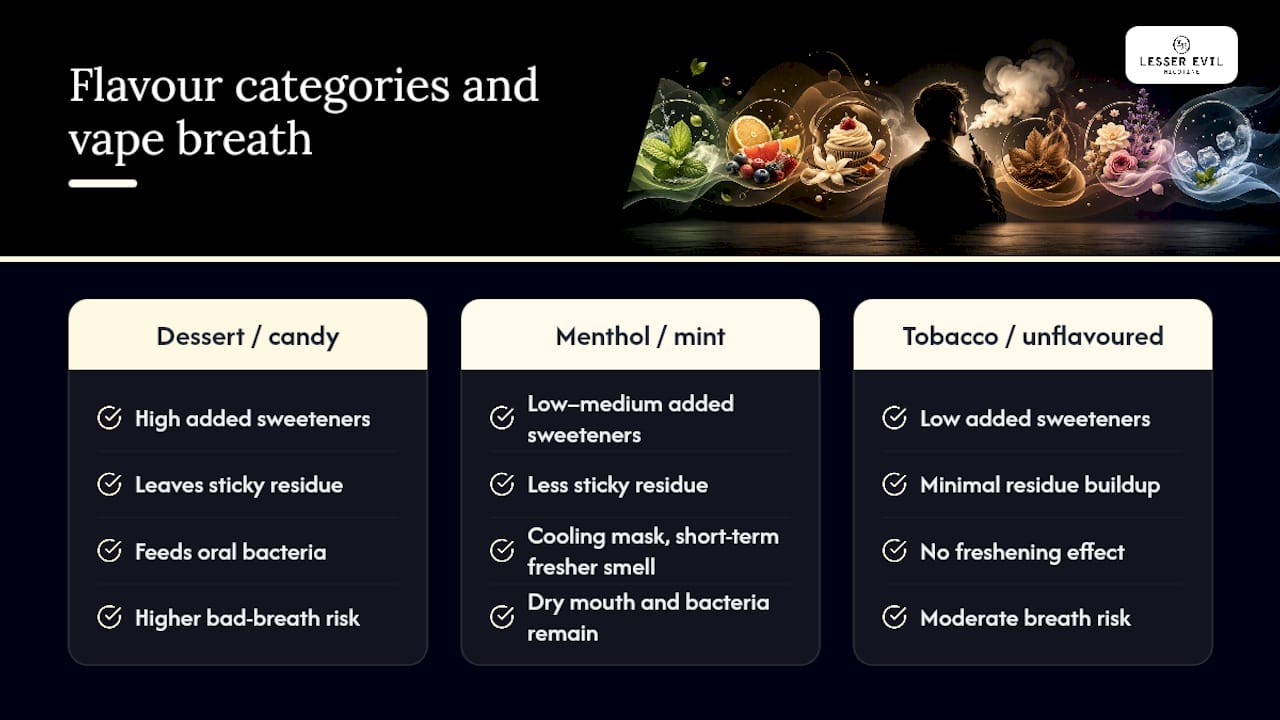
Not all vape juice is equal on this front. Dessert and candy flavours, think custard, cake batter, sugary fruit blends, tend to carry higher concentrations of added sweeteners, and those sweeteners are what caramelise onto coils and leave sticky residue behind. That residue doesn’t just sit in the tank. Traces of it end up on your tongue and cheeks with every puff, giving bacteria something extra to feed on.
Menthol and mint flavours behave differently. They create a strong, cooling sensory impression that can genuinely make your exhale smell fresher in the short term, which is part of why so many vapers gravitate toward them. But that’s a masking effect, not a fix. The underlying dry mouth and bacterial activity carry on regardless of what flavour is going through the coil.
Tobacco and unflavoured or lightly flavoured liquids sit somewhere in the middle. They typically carry less added sweetener, so there’s less residue to build up, but they don’t offer any of the temporary freshening that mint or menthol does.
If vape breath smell is a recurring problem for you, the flavour category is worth a look alongside your hygiene routine. Cutting back on heavily sweetened dessert-style liquids, or at least rinsing more diligently after using them, addresses the residue side of the equation that mint alone can’t touch.
How does vape breath compare with cigarette breath?
Cigarette smoke leaves an intense, immediately recognisable smell that clings to clothes, hair and breath because of tar and thousands of combustion byproducts. Vaping produces no smoke and no tar, so the immediate sensory experience is genuinely different.
A small 2022 pilot study comparing cigarette smokers, e-cigarette users and non-smokers found that e-cigarette users’ breath was rated as less smoky and closer to non-smokers in short-term hedonic tests. That’s a real finding, but it’s a narrow one: the study involved a small group and only measured breath at a single point in time, so it doesn’t tell us much about what happens over months or years of regular use.
That’s the nuance worth holding onto. Vaping doesn’t produce the tar-heavy, smoky odour cigarettes are known for, but it introduces its own distinct problem through dry mouth and microbiome disruption, an odour that’s less obviously “smoky” but no less real to the people around you. Neither habit gets a clean pass here. They cause bad breath through different routes, and the vape route is arguably easier to manage day to day since there’s no tar residue to work against, just dryness and bacteria, both of which respond well to the hydration and hygiene routine covered earlier.
Can saliva pH changes from vaping affect breath odour?
Saliva pH sits at the centre of a lot of what makes vape breath smell worse. Healthy saliva runs slightly acidic to neutral and acts as a natural buffer, keeping the bacterial population in your mouth in a rough state of balance. Vaping can shift that balance.
The 2025 cross-sectional study in Scientific Reports specifically identified altered saliva pH as one of the proposed mechanisms behind higher halitosis rates in e-cigarette users, alongside increased microbial adhesion and biofilm formation. When pH drifts away from its normal range, certain bacterial species that produce volatile sulfur compounds get a competitive advantage over the species that would normally keep them in check.
This is a different mechanism from dry mouth, even though the two are related. Dry mouth reduces the total volume of saliva available to do its job. A pH shift changes the chemistry of whatever saliva remains, making it less effective as a bacterial buffer even when there’s a reasonable amount of it. Together, they explain why vape breath smell can persist even in people who feel like they’re drinking enough water. Volume and chemistry are two separate problems, and a genuinely effective routine, the hydration, xylitol and tongue-scraping combination covered earlier, needs to address both.
What the evidence actually tells us
The honest picture here is more nuanced than either side of the usual argument wants it to be. Vaping isn’t the smoky, tar-laden assault on your breath that cigarettes are, and the 2022 pilot data backs that up. But treating vaping as breath-neutral is wrong too. The 2025 cross-sectional data is clear that exclusive vapers face a higher likelihood of halitosis than non-smokers, and the mechanisms behind that, dry mouth, pH shifts, bacterial overgrowth, are well understood even if the long-term picture needs more research.
Where conventional advice falls short is in treating flavour as a solution. Menthol and mint are marketed and reached for as fixes, but they’re cosmetic. They mask a problem that’s fundamentally about hydration and bacterial balance, not scent.
If you take one thing from this: prioritise the boring stuff first. Water, tongue scraping, alcohol-free mouthwash, and a clean mouthpiece will do more for your breath than any flavour switch. Get that right before you worry about anything else.
— Luke McLeod
Considering an aerosol-free alternative?
If dry mouth and bacterial build-up from vaping are wearing you down, it’s worth knowing there’s a route that doesn’t involve inhaling anything at all. Lesser Evil Nicotine makes the Oral Mister, a sublingual nicotine gel spray you apply under the tongue, where it’s absorbed through the oral mucosa rather than inhaled as vapour.
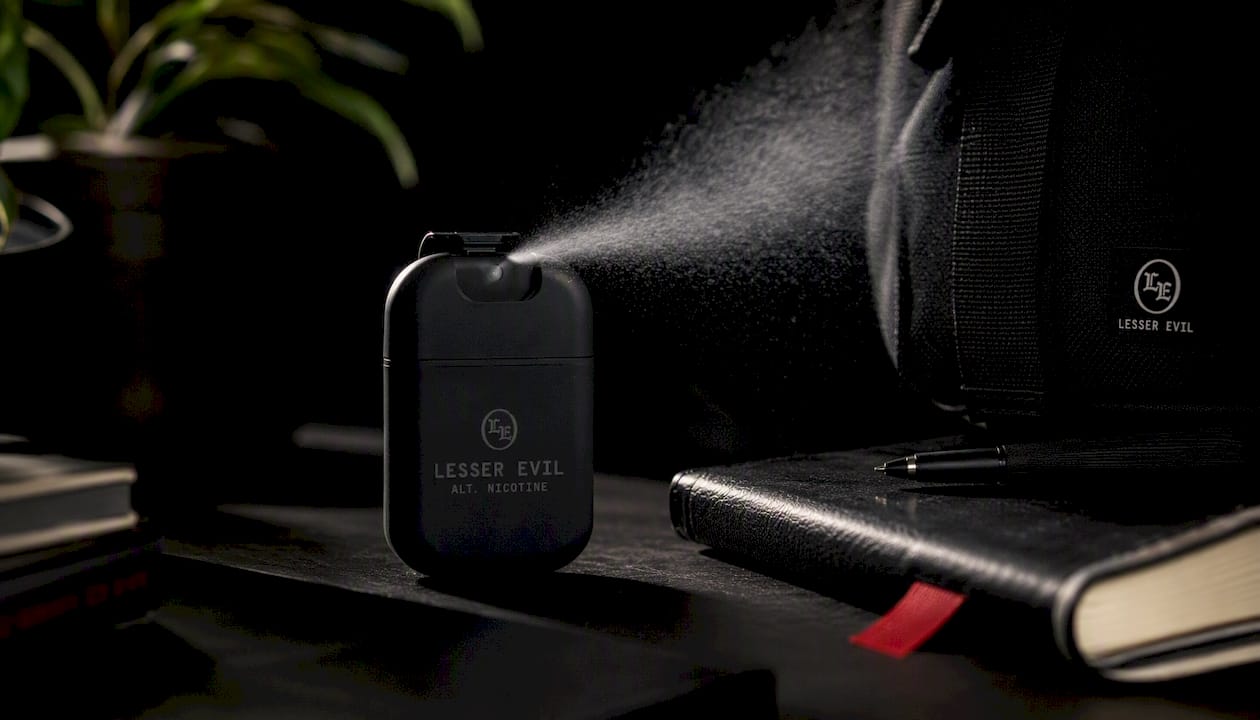
There’s no heating, no aerosol, and no battery involved, which also means no coil residue building up anywhere for bacteria to feed on. It’s tobacco-free, made with natural flavours and natural sweeteners, and comes in Peppermint, Black Grape and Green Apple. That’s a factual difference in how the product works, not a claim about health outcomes or quitting anything. If you’re curious whether a non-inhaled option might suit how you manage your nicotine use, the Oral Mister product page has the full details, and it’s worth a look before your next reorder.
This article is general information, not a substitute for advice from a qualified doctor. Consult a qualified healthcare professional about your own circumstances before acting on anything here.
Sources
- Vaping and your oral health: what you need to know | NZOHA
- Halitosis among users of electronic nicotine delivery systems in a multi-center cross-sectional study | Scientific Reports
- Oral side effects to vaping | City Dental
- Pilot study to determine differences in breath odour between cigarette and e-cigarette consumers | Scientific Reports (2022)