

5–10 min vs 20–65 min: Oral nicotine or vaping and your lungs

Oral nicotine skips your lungs entirely; vaping does not. That’s the whole trade-off in one sentence. Vaping gets nicotine into your bloodstream fast, often within minutes, while pouches and gels take longer to peak but keep the aerosol out of your chest. The Cochrane evidence on oral pouches is still thin, but the mechanics aren’t in dispute: speed of nicotine delivery versus avoiding lung exposure. Pick your priority.
TL;DR:
- Vaping delivers nicotine to the bloodstream within 5 to 10 minutes, producing a faster, more intense “hit” comparable to smoking.
- Oral nicotine pouches and gels take 20 to 65 minutes to reach peak levels, spreading nicotine exposure over a longer period with nearly as much total intake as cigarettes.
- Inhalation via vaping exposes the lungs to chemicals like aldehydes and ultrafine particles, whereas oral products have limited long-term safety data and may cause tissue irritation.
- Vaping produces visible vapor and scent, making it less discreet and mostly banned in indoor or public spaces, while oral nicotine is silent and scent-free, ideal for restricted environments.
- Hardware maintenance costs and environmental waste make vaping more expensive long-term for frequent users, whereas oral nicotine has no hardware costs but offers less ritual and slower absorption.
Table of Contents
- How oral nicotine and vaping actually get nicotine into you
- What does the pharmacokinetic evidence say about speed and dose?
- Which carries more risk: breathing it in or holding it in your mouth?
- What does actually using each product feel like day to day?
- Is vaping or oral nicotine cheaper in the long run?
- Which one actually fits your situation?
- What does Lesser Evil Nicotine actually put in its product?
- What happens if you cut back on either product?
- Where can you actually use each one without getting side-eyed?
- Does taste actually matter when you’re choosing a format?
- What’s the honest trade-off here, and how should you weigh it?
- Where the Oral Mister actually fits into this comparison
- Where to read the primary research yourself
- Sources
How oral nicotine and vaping actually get nicotine into you
The routes are completely different, and that’s why the effects feel different too.
Oral nicotine works through the mucous membranes in your mouth. A pouch sits between your gum and lip; a sublingual gel goes under your tongue. Either way, nicotine crosses the oral mucosa straight into small blood vessels, bypassing your digestive system and your lungs altogether. Vaping works the opposite way. An e-cigarette heats a liquid into an aerosol, you inhale it, and nicotine gets absorbed through the huge surface area of your lung tissue, which is why it hits so fast.
The hardware side tells its own story:
- Vaping devices need charging, coils that wear out, and e-liquid refills, plus somewhere to carry spare pods.
- Oral formats need none of that. No battery, no coil, no charging cable.
- Pouches and gel sachets are single-use and disposable on the spot.
- Vape devices require ongoing upkeep just to keep working reliably.
That maintenance gap matters more than it sounds. A vape that runs out of charge on a night out is useless. A gel sachet in your coat pocket isn’t.
What does the pharmacokinetic evidence say about speed and dose?
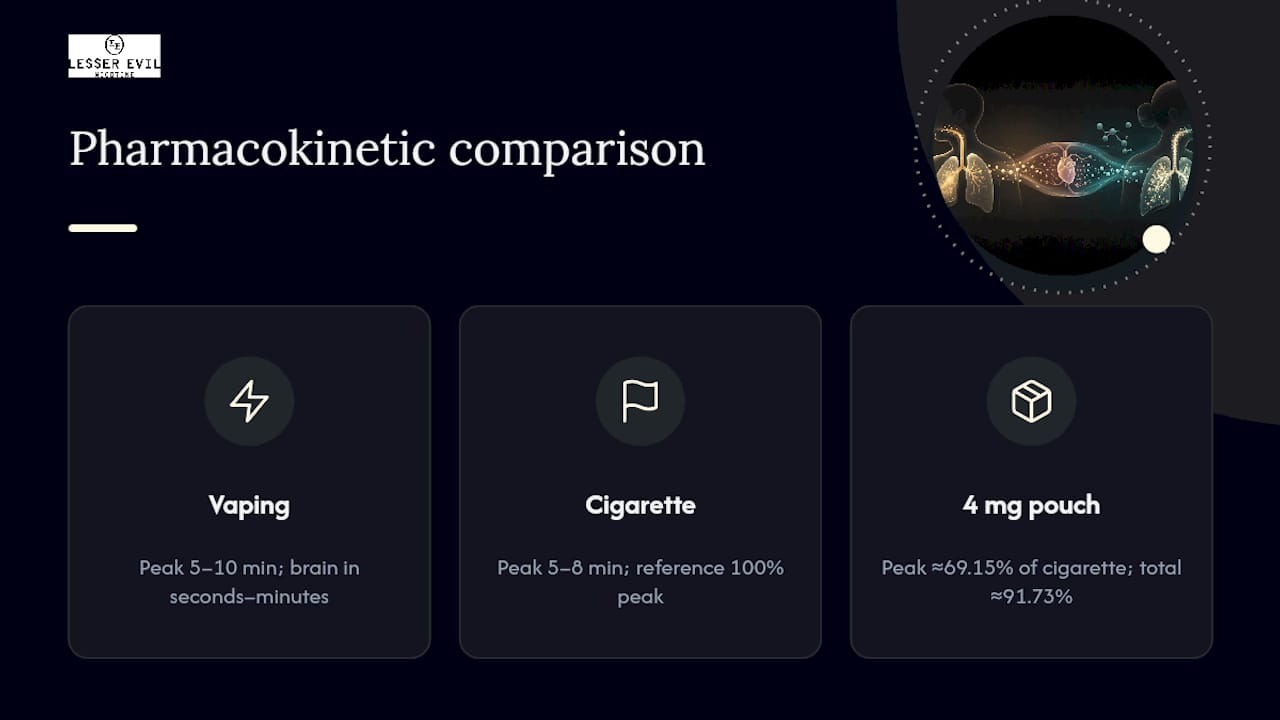
The core figures: vaping peaks in 5 to 10 minutes; oral products take 20 to 65 minutes to reach peak nicotine concentration. That gap, laid out in a pharmacokinetics review comparing pulmonary and oral routes, is the single biggest functional difference between the two categories. Vaping’s lung absorption means nicotine reaches the brain within seconds to a couple of minutes of inhaling. Oral absorption through mucosal tissue is far slower and steadier by comparison.
Speed isn’t just a number, though. It shapes how reinforcing a product feels. A fast, sharp peak is closer to what a cigarette delivers, which is partly why vaping tends to replicate the “hit” smokers are chasing more closely than oral formats do.
Total exposure is a separate question from peak speed, and this is where it gets more interesting. A systematic review and meta-analysis of nicotine pouch pharmacokinetics found that 4mg pouches delivered roughly 91.73% of the total nicotine exposure of a cigarette, despite reaching only about 69.15% of a cigarette’s peak concentration and taking 20 to 65 minutes to get there versus 5 to 8 minutes for a cigarette.
In plain terms: a strong pouch can eventually put nearly as much nicotine into your system as a cigarette, just spread out over a longer, gentler curve rather than one sharp spike. That’s a meaningfully different experience even when the running total looks similar on paper, and it’s worth knowing if you’re trying to gauge your own daily intake rather than just chasing a feeling.
Which carries more risk: breathing it in or holding it in your mouth?
The two routes create genuinely different hazard profiles, not just different sensations.
Inhalation is the one with the clearer evidence base. Vaping aerosol carries chemicals your lungs were never built to process, including aldehydes and ultrafine particles linked to airway inflammation and cardiovascular strain. Separate research on e-cigarette aerosol composition backs this up: the aerosol itself, not just the nicotine, is what lands in lung tissue with every puff. Oral nicotine simply doesn’t put anything into your airways because there’s nothing to inhale.
That doesn’t make oral products a clean bill of health. Holding a pouch or gel against the same patch of gum repeatedly can irritate the tissue, and long-term data on that kind of localised exposure is still limited.
Quick comparison of what each route is actually exposing you to:
- Vaping: aerosolised chemicals reach lung tissue directly, aldehydes and ultrafine particles are present, inhalation-linked inflammation is documented.
- Oral nicotine: no lung exposure at all, but repeated placement in one spot can irritate gum tissue over time.
- Both routes: nicotine itself carries cardiovascular and dependence effects regardless of how it gets into your system.
- Evidence gap: long-term safety data on oral pouches remains limited, and the NIDA overview of nicotine and e-cigarettes is upfront that nicotine dependence carries real costs whichever format delivers it.
None of this makes either route “safe.” It makes them different shapes of risk, and the honest answer is that neither has decades of long-term data behind it the way cigarettes unfortunately do.
What does actually using each product feel like day to day?
This is where the clinical detail turns into a lifestyle choice.
- Discretion. Oral nicotine produces no vapour, no cloud, and no smell. Vaping, even the discreet pod systems, still produces visible vapour and often a noticeable scent that lingers on clothes.
- Ritual. Vaping replicates the hand-to-mouth motion and the exhale that smokers are used to. Oral products remove that ritual almost entirely, which some people find liberating and others find they miss.
- Maintenance. A gel or pouch needs nothing beyond your pocket. A vape needs charge, coil changes, and a top-up of liquid, which turns into a small ongoing chore.
One thing worth knowing if you go the oral route: try rotating placement between the left and right sides of your mouth rather than parking it in the same spot every time, to spread out any localised irritation.
Is vaping or oral nicotine cheaper in the long run?
Cost comparisons depend heavily on how often you use either product, but the structural difference is worth knowing before you commit to either.
- Vaping has upfront hardware costs, then ongoing spend on coils, e-liquid, and eventually a replacement device when the battery degrades.
- Oral nicotine has no hardware cost at all. You’re paying purely for the pouches or gel you consume.
- Environmentally, vapes create battery and electronic waste that pouches and gels simply don’t generate.
- Cost differences matter most if you’re a heavy daily user, where hardware replacement cycles on vaping add up fastest.
If you’re an occasional user, the gap is smaller. If you’re using either product multiple times a day, the device maintenance side of vaping tends to be where the real running cost lives.
Which one actually fits your situation?
Neither route is universally “better.” It depends on what you’re solving for.
- People who lean towards vaping usually want the hand-to-mouth ritual and the fast, sharp sensory hit that’s closest to what smoking felt like.
- People who lean towards oral nicotine usually prioritise discretion, want nothing to charge or carry, and are less bothered about replicating the ritual.
- Plenty of people use both, switching depending on context, such as oral products at work and vaping at home. If that’s you, keep an eye on your combined daily nicotine intake rather than tracking each product in isolation.
Before choosing, ask yourself three things: How often am I actually reaching for nicotine? Does discretion matter more to me than the ritual? Am I trying to reduce total exposure or just change the format?
Pro Tip: If you switch between formats, note roughly how many pouches, sprays, or vape sessions you use across a full day for a week. It’s the easiest way to spot creeping intake before it becomes a habit you didn’t choose.
What does Lesser Evil Nicotine actually put in its product?
Lesser Evil Nicotine’s Oral Mister is a sublingual nicotine gel, applied under the tongue via the oral mucosa… It’s tobacco-free, battery-free, and made with natural flavours and natural sweeteners across three options: Peppermint, Black Grape, and Green Apple. There’s no charging, no coil, no vapour to breathe in.
Nothing here is positioned as a cessation aid or medical product. It’s a consumer alternative for adults who already use nicotine and want a format that doesn’t involve inhaling anything. The evidence on oral pouches generally, per the Cochrane review, is still limited, and that honesty matters more than a bold health claim ever could.
Author attribution for this piece sits with Luke McLeod, whose editorial perspective closes out the article below. The point of listing these facts plainly is simple: readers deciding between formats deserve product specifics, not marketing gloss dressed up as science.
What happens if you cut back on either product?
Reducing or stopping nicotine use, from any format, tends to bring on familiar symptoms: irritability, restlessness, trouble concentrating, and disrupted sleep for a period. These effects come from nicotine itself, not the delivery method, so switching from vaping to oral nicotine (or the reverse) won’t necessarily change how you feel if your total nicotine intake stays roughly the same.
What differs between formats is how people manage the adjustment period. Vaping’s fast onset means people often reach for it reflexively throughout the day, which can make the habit feel more automatic and harder to notice happening. Oral nicotine’s slower peak, sitting in the 20 to 65 minute range according to the pharmacokinetics data, means there’s more of a gap between using it and feeling the effect, which some people find makes their own usage patterns easier to track.
If you’re trying to manage your intake, whichever format you use, tracking frequency rather than relying on feel is the more reliable approach. A guide to nicotine habit management covers this in more practical detail, including how to spot creeping usage before it becomes the default.
Neither oral nicotine nor vaping is regulated or marketed as a stop-smoking product in the way licensed nicotine replacement therapy is, and the evidence gap on long-term outcomes for both remains genuinely open. Treat any format as a personal choice about nicotine use, not a treatment plan.
Where can you actually use each one without getting side-eyed?
This is a bigger practical factor than most comparisons admit. Public and workplace attitudes towards vaping and oral nicotine are not the same, and that difference shapes real decisions about where you reach for which product.
Vaping produces visible vapour and a detectable smell, which means it’s restricted or banned outright in most indoor public spaces, workplaces, and public transport, largely on the same footing as smoking. Even where it’s technically permitted, colleagues and strangers alike tend to notice and react to it.
Oral nicotine draws no attention at all. There’s no cloud, no scent, and no exhale to notice, which is exactly why it’s gained traction among people who need to use nicotine in settings where vaping simply isn’t an option, meetings, flights, offices, or anywhere discretion matters. A guide to discreet nicotine use in restricted environments covers specific scenarios where this distinction plays out in practice.
That said, oral nicotine isn’t universally accepted either. Some workplaces and venues have started drafting policies around visible pouch use, and social norms are still catching up to a product category that’s grown fast. The safest general rule: vaping needs a designated space; oral nicotine mostly doesn’t, but discretion is still worth practising rather than assuming.
Does taste actually matter when you’re choosing a format?
It matters more than most comparisons give it credit for, because taste is often the difference between sticking with a format and quietly going back to something else.
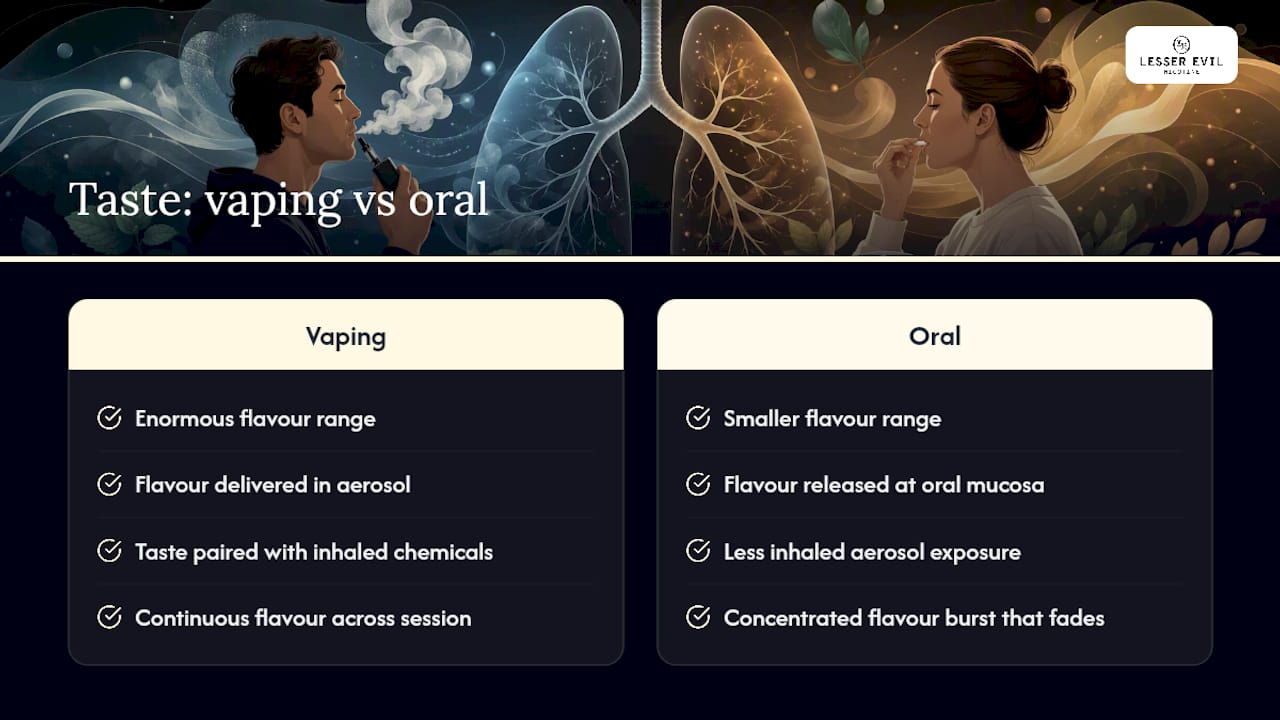
Vaping offers an enormous range of flavours, from tobacco and menthol replicas to fruit, dessert, and drink profiles, largely because e-liquid manufacturing allows near-limitless flavour engineering. The trade-off is that flavour comes bundled with the aerosol you’re inhaling, so every flavour experience is also a lungful of whatever chemicals produce that taste.
Oral nicotine flavour ranges are smaller by comparison, but flavour delivery works differently: it comes from the product dissolving or releasing against your oral mucosa rather than through combustion or heating. Lesser Evil Nicotine’s Oral Mister, for example, uses natural flavours and natural sweeteners across Peppermint, Black Grape, and Green Apple, aiming for a genuinely pleasant taste without relying on the artificial sweetness that’s become a common complaint about some pouch products on the market.
User experience differs in another way too: vaping delivers flavour continuously across a session, while oral formats tend to deliver a more concentrated flavour burst that fades as the product breaks down. Which you prefer is genuinely subjective, but it’s worth trying more than one flavour before deciding a whole format isn’t for you, since one bad flavour experience often gets blamed on the format rather than the specific product.
What’s the honest trade-off here, and how should you weigh it?
The central trade-off is simple to state and harder to sit with: vaping gives you speed and a familiar ritual, oral nicotine gives you a way to skip lung exposure entirely, and neither one erases nicotine’s underlying effects on your body.
If you use both, or you’re switching from one to the other, keep a rough tally of how much nicotine you’re actually taking in across the day. It’s easy to underestimate total intake when it’s split across two different formats with two different delivery speeds.
The evidence base here is still young. Read the primary pharmacokinetics research and the Cochrane summary yourself if you want the full picture rather than a marketing headline. Formats will keep evolving faster than the long-term data can catch up.
— Luke McLeod
Where the Oral Mister actually fits into this comparison
Lesser Evil Nicotine’s Oral Mister gives you the oral route without any of the vaping hardware discussed above: no battery, no coil, no charging cable, no vapour. It’s a sublingual gel that goes under the tongue via the oral mucosa, tobacco-free, made with natural flavours and natural sweeteners, and available in Peppermint, Black Grape, and Green Apple.
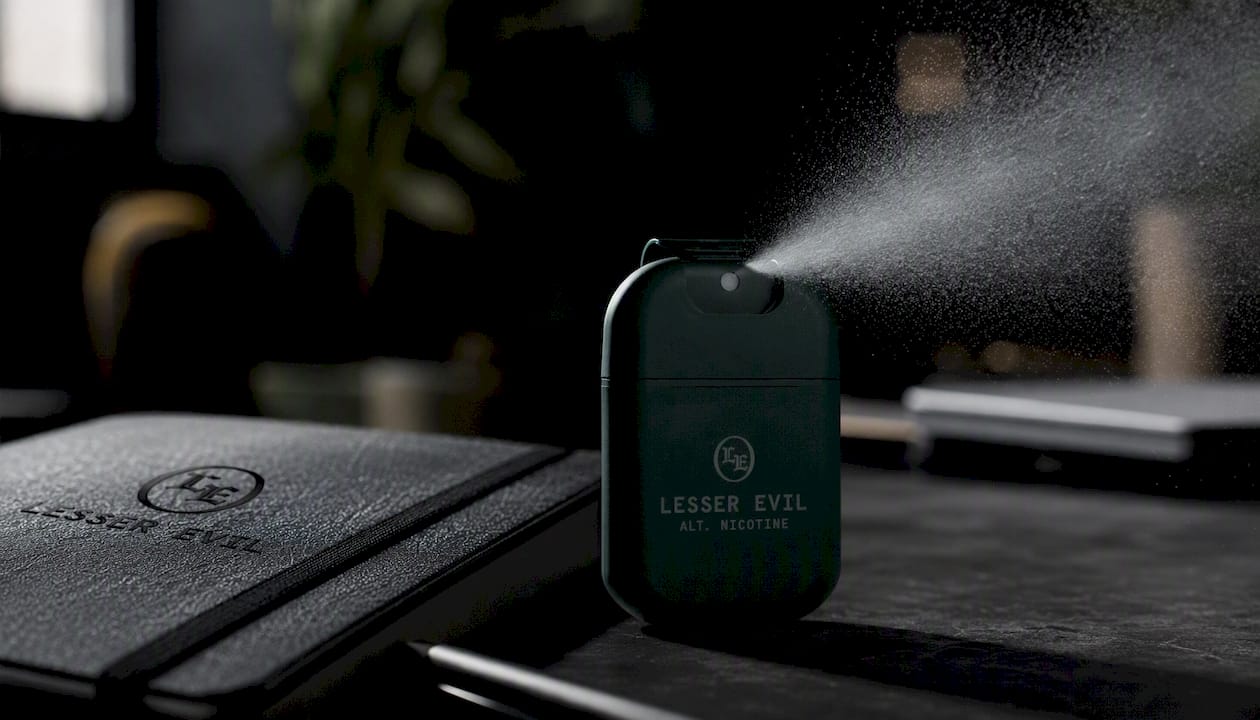
For anyone who read the practical trade-offs section and landed on “discretion matters more to me than the ritual,” this maps directly onto that profile. There’s nothing to charge before you leave the house and nothing to replace when a coil burns out, because there isn’t one. Compared with juggling a vape’s charging schedule and coil replacements, or wondering if a cloud of vapour is appropriate in the room you’re in, it’s a format built around not having to think about the hardware at all.
If that sounds like what you’re after, the Oral Mister product page has the full flavour range and ordering details. Pick a flavour, order it, and see how the sublingual format compares to whatever you’re currently reaching for.
Where to read the primary research yourself
- The Cochrane evidence review on oral nicotine pouches covers current trial data and its limits.
- The PMC pharmacokinetics meta-analysis breaks down pouch versus cigarette nicotine exposure in detail.
- The Cleveland Clinic overview explains pouch safety questions in plain clinical language.
- The NIDA research report sets out the broader picture of nicotine dependence and societal cost.
This article is general information, not a substitute for advice from a qualified doctor. Consult a qualified healthcare professional about your own circumstances before acting on anything here.
Sources
- Nicotine pharmacokinetics: pulmonary versus oral routes (PMC4749433)
- Nicotine pouch pharmacokinetics compared to smoked tobacco: systematic review and meta‑analysis (PMC12617622)
- What are the benefits and risks of oral nicotine pouches? | Cochrane
- Are nicotine pouches safer than smoking? | Cleveland Clinic