

12–15 Week Trials: Low Dose Nicotine Delivers Short Gains for Adults

Low dose nicotine, at a small amount depending on the product, can sharpen attention and reaction time for a short window in controlled studies. That’s the honest headline. What it can’t do is prove itself safe for daily long-term use. Human trials are small, short, and mostly borrowed from smoking-cessation research, so the cognitive story is promising but nowhere near settled. Dependence risk and dose creep remain the two things worth taking seriously.
TL;DR:
- Human studies on low-dose nicotine show only small, temporary cognitive boosts in attention and reaction time, with no long-term safety data available.
- Delivery method significantly influences perceived effects, with faster absorption routes like inhalation producing sharper peaks than patches, despite identical nominal doses.
- Dependence risk increases with habitual low-dose use through dose creep, especially if use becomes routine rather than occasional, even when initial effects are modest.
- Long-term health effects remain unproven because most research spans only weeks or months, making stable conclusions about decade-long daily use impossible at this stage.
- The most practical low-dose option for controlled management is tobacco-free, sublingual gel sprays like Lesser Evil Oral Mister, which avoid inhalation and are discreet.
Table of Contents
- What the research says about low dose nicotine and cognition
- How dose and delivery method change what you actually feel
- What short-term benefits and risks the evidence actually supports
- Why nicotine affects attention and memory in the short term
- Practical steps if you’re considering low dose nicotine
- Where the Lesser Evil Oral Mister fits into low-dose options
- Long-term effects and where the research still falls short
- How low dose nicotine compares with other cognitive enhancers
- Is low dose nicotine legal, and how is it regulated?
- Could low dose nicotine interact with other medications?
- How to adjust dose or step down without a rough transition
- What psychological and behavioural patterns show up with regular use
- An evidence-led view on where low dose nicotine actually stands
- Try the Lesser Evil Oral Mister instead of your usual hit
- Sources
What the research says about low dose nicotine and cognition
The evidence splits cleanly into two piles: animal work that looks exciting, and human work that looks cautious.
In mice, a 2023 preclinical study found that low dose nicotine restored NAD+ balance and improved markers of brain ageing, pointing to a possible neuroprotective mechanism. That’s a genuinely interesting signal. It’s also a mouse study. NAD+ pathways behave differently across species, and a result in rodent brain tissue doesn’t automatically translate into a benefit for a 32-year-old drinking coffee and vaping between meetings. Treat it as a reason researchers keep digging, not as proof of anything for humans yet.
Human trials tell a narrower story. Short trials using transdermal nicotine have reported small, temporary gains in attention and working memory, but the doses and durations vary a lot. One current trial protocol, listed on Clinicaltrials, titrates patches from 3.5–7 mg up to a possible 14 mg over 12 weeks to test cognitive and mood outcomes in older adults. Earlier trial work has used similarly cautious, slow titration and tapering schedules, run through registered clinical protocols rather than casual self-experimentation.
A few things stand out across this research:
- Trial doses almost always start low and increase gradually rather than jump straight to a high dose.
- Most studies run for weeks or months, so nobody has solid long-term human safety data yet.
- Systematic reviews of reduced-nicotine products suggest lower nicotine content can reduce dependence potential at a population level, while also flagging risks like compensatory use.
Pro Tip: If you’re reading trial data yourself, check the titration schedule before the headline result. A study that starts at 3.5 mg and works up over 12 weeks is telling you something about safe pacing, not just about the outcome.
How dose and delivery method change what you actually feel
A milligram number on a box means very little without knowing how the product gets nicotine into your bloodstream. Nominal dose and bioavailability are not the same thing. pH, mucosal contact time, and formulation all decide how much of that stated dose you actually absorb, and how fast.
Delivery method changes the whole shape of the experience:
- Patches release nicotine slowly through skin, producing steady, low-peak blood levels over hours.
- Gum and lozenges sit in the intermediate zone, with absorption through the cheek lining that’s faster than a patch but still gradual.
- Pouches, gels, and sprays work through oral mucosa, absorbing under the tongue or against the gum, which tends to produce a quicker peak than a patch.
- Inhalers and vapes are the fastest of all, hitting the bloodstream almost as quickly as smoking.
Clinical and review literature comparing these categories confirms that delivery route alone can change how strong a given milligram dose feels, because faster absorption tends to produce a sharper, more noticeable peak even at an identical nominal dose. This is why comparing two products purely on their printed mg figure is close to meaningless. A 4 mg patch and a 4 mg sublingual gel are not delivering the same experience, and they’re not carrying the same risk profile either.
If you want to compare products sensibly, look at the delivery method first, then the dose, then how quickly the label says effects appear.
What short-term benefits and risks the evidence actually supports
Short trials point to a handful of measurable, modest cognitive effects. None of them are dramatic, and none hold up as guaranteed.
- Attention and alertness. Several small trials report improved sustained attention on repetitive tasks, though effect sizes are generally small and vary by individual.
- Reaction time. Some studies show faster response speeds on cognitive tests, an effect that’s fairly consistent in smokers and less clear in non-smokers.
- Working memory. A few trials report short-term gains, but the research pool here is thin and mostly drawn from clinical populations, not healthy adults chasing a productivity edge.
- Dependence and dose creep. This is the pattern worth watching most closely: what starts as an occasional low dose can quietly become a daily habit, then a stronger one. Practitioner commentary on nicotine microdosing specifically flags this creep from occasional to routine use as the main practical risk, even when the acute cognitive effects genuinely show up.
- Short-term physical side effects. Nausea, dizziness, and a raised heart rate are common enough at higher low-doses, particularly for anyone new to nicotine.
- At-risk groups. Pregnancy, existing heart disease, and certain medication interactions raise the risk profile considerably, and these groups need to be far more cautious than the general trial population these studies were built around.
Population-level reviews of reduced-nicotine products back this dual picture up directly: lower nicotine content genuinely appears to lower dependence risk in aggregate, but researchers still flag unintended consequences worth watching, including withdrawal effects and compensatory use.
Why nicotine affects attention and memory in the short term
Nicotine binds to nicotinic acetylcholine receptors in the brain, acting as an agonist. That triggers a cascade: acetylcholine release increases, and dopamine and norepinephrine follow. Acetylcholine is central to attention and encoding new information, which is why the acute effects on focus are plausible rather than mysterious.
Repeated exposure changes this picture fast. Receptors desensitise with regular use, meaning the same dose produces a smaller effect over time. That’s the biological root of tolerance, and it’s also why “just a little, occasionally” behaves very differently in the brain than “a little, every day.” The mechanism itself explains why dose and delivery method matter so much for both effect and safety: a slow, steady patch dose engages these receptors very differently than a fast mucosal spike.
Practical steps if you’re considering low dose nicotine
Start at the lowest dose that does anything noticeable, roughly 1 mg for many oral products, and resist the urge to raise it just because the first hit felt underwhelming. Evidence summaries reviewing nicotine dosing are blunt about this: there’s no established optimal dose for non-smokers, so cautious titration beats guessing every time.
A few checks worth doing before you start:
- Record frequency, not just dose. Creep usually shows up in how often you reach for it, not how much.
- Avoid combining nicotine with other stimulants (caffeine included) until you know how your own body responds.
- Skip it entirely if you’re pregnant, have cardiac disease, or take medications that interact with stimulant effects. Speak to a doctor first in any of those cases.
- Buy only products clearly labelled and intended for adult use, store them away from children and pets, and check your local legal age of sale before purchasing.
- Read the label for exact mg per unit. Products vary widely even within the same category.
Pro Tip: Track use in a note on your phone for the first fortnight. Two lines a day, dose and time, is enough to spot creep before it becomes a habit rather than a choice.
For readers who want a wider view of low-harm product categories, a guide to low-harm nicotine products breaks down how pouches, patches, and gels differ in practice, and a pharmacy resource on reduced-nicotine products covers similar ground from a clinical evidence angle.
Where the Lesser Evil Oral Mister fits into low-dose options
Lesser Evil Nicotine makes the Lesser Evil Oral Mister, a sublingual nicotine gel spray used under the tongue rather than swallowed or inhaled. It’s tobacco-free and battery-free, so there’s no vapour to breathe in and no e-waste left behind.
It comes in three natural flavours and low-dose strengths, giving people a way to manage nicotine use with more precision than a cigarette or a vape pull allows:
- Peppermint, Black Grape, and Green Apple flavours, made with natural sweeteners rather than synthetic additives.
- Low-dose formulation designed for control rather than a single maximum hit.
- Discreet, device-free format that doesn’t need charging or a tank refill.
For product-specific dosing detail, the low-dose nicotine options page walks through how these strengths compare with other formats on the market.
Long-term effects and where the research still falls short
Here’s the uncomfortable gap in all of this: nobody has good long-term human data on low-dose nicotine use in isolation from smoking. Almost every large study tracking nicotine’s long-term effects on health was actually studying tobacco smoke, cardiovascular strain from combustion, or cessation-focused NRT use in people already trying to quit. Isolating nicotine’s own long-term profile from those confounders is genuinely difficult.
The trials cited earlier, including the transdermal MIND3 cognitive trial, run for weeks or months, not years. That means the current evidence base can support statements about short-term acute cognitive effects with reasonable confidence, but says almost nothing reliable about what daily low-dose use looks like after five or ten years. Receptor desensitisation and tolerance are well documented in the short term. What that means for someone using a low dose consistently for a decade is still an open question researchers haven’t closed.
This is precisely why cautious framing matters more than optimism here. A neuroprotective signal in mice is worth watching, not worth building a daily habit around. Until longer human trials exist, the honest answer to “is low dose nicotine safe long-term?” is: unproven either way, and worth treating with the same caution you’d apply to any substance affecting brain chemistry daily.
How low dose nicotine compares with other cognitive enhancers
Caffeine, prescription stimulants, and nicotine all touch overlapping neurotransmitter systems, but they’re not interchangeable, and the comparison is worth being specific about.
Caffeine blocks adenosine receptors, which is a different mechanism entirely from nicotine’s action on nicotinic acetylcholine receptors, though both end up boosting alertness through downstream dopamine and norepinephrine activity. The dependence profile differs too: caffeine tolerance builds, but withdrawal is generally milder and shorter than what’s reported with nicotine.
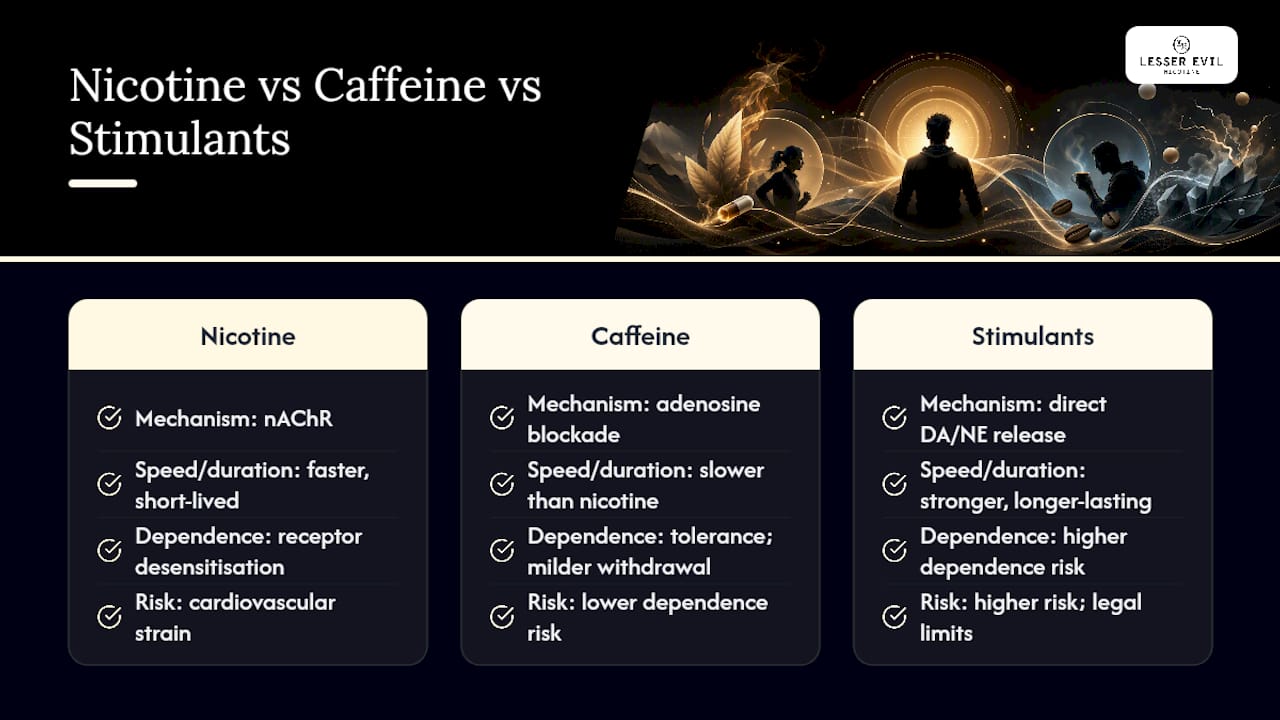
Prescription stimulants used off-label for cognitive enhancement work through more direct and sustained dopamine and norepinephrine release, producing stronger and longer effects than a low nicotine dose, alongside a correspondingly higher risk profile and legal restrictions around unsupervised use.
Nicotine sits in an odd middle position: faster acting than caffeine in some delivery forms, shorter-lived in its cognitive effects than most prescription stimulants, and with a distinct dependence pattern driven by receptor desensitisation rather than simple tolerance. None of these substances has been shown in head-to-head human trials to be a reliably superior cognitive enhancer, and stacking them, nicotine plus caffeine plus a stimulant, multiplies cardiovascular strain rather than multiplying benefit. If you’re weighing options, the delivery method and dependence pattern matter more than which substance sounds more “natural” or “clinical.”
Is low dose nicotine legal, and how is it regulated?
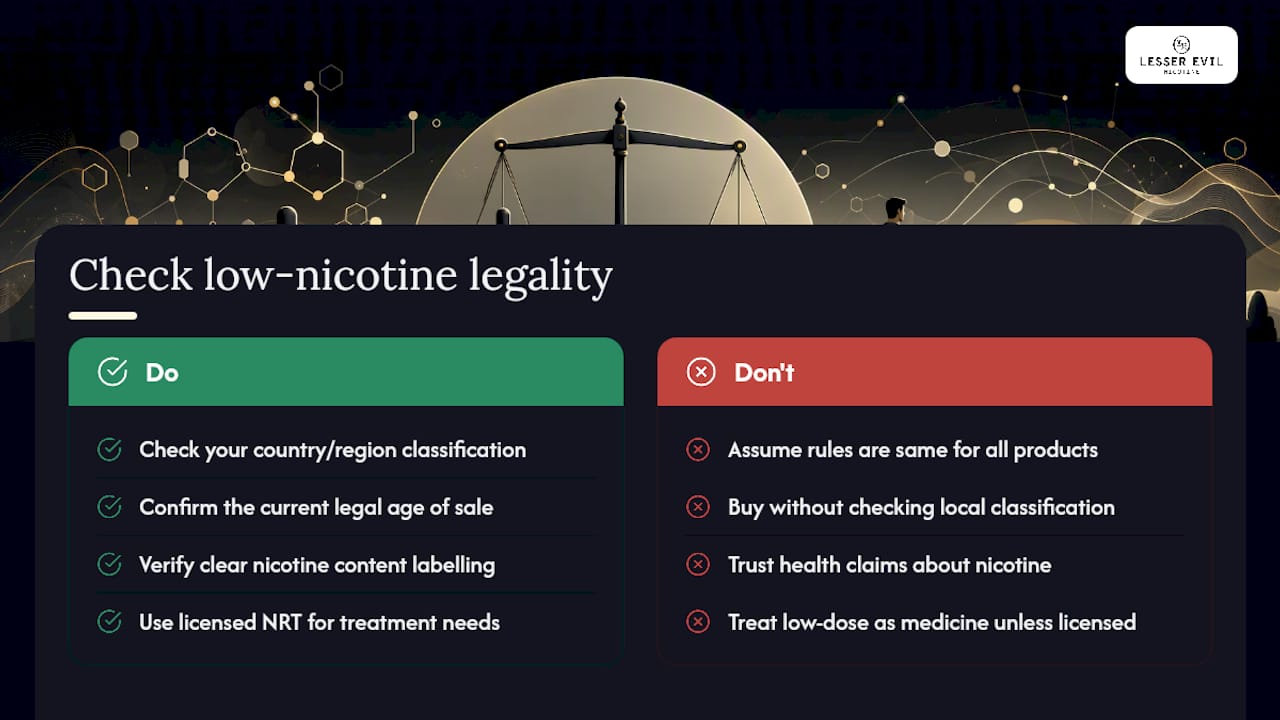
Nicotine products are legal for adult purchase and use in most markets, but the rules vary sharply by product category and region. Vapes, pouches, gums, and gels are regulated differently even within the same country, and age-of-sale restrictions apply almost everywhere nicotine products are legally sold.
What’s consistent across most regulatory frameworks is the emphasis on adult-only sale and clear labelling of nicotine content. Reduced-nicotine product research has also shaped policy discussion directly. Behavioural reviews looking at cigarettes with lowered nicotine content have found that reduced nicotine could support public health goals while also creating risks like illicit markets if not paired with accessible, legal lower-harm alternatives. That’s a policy nuance worth knowing: regulators generally aren’t trying to ban low-dose products outright, they’re trying to avoid pushing demand toward unregulated ones.
Practically, this means checking your own country’s or region’s specific classification before buying. A tobacco-free oral gel might sit under general consumer product rules in one market and under separate nicotine-specific regulation in another. Always check the current legal age of sale and product classification where you live before purchasing, and treat any product marketed with health claims attached to nicotine with real scepticism. No credible regulator currently classifies low-dose nicotine products as medicine, treatment, or cessation aids unless they’re specifically licensed as NRT.
Could low dose nicotine interact with other medications?
Stimulant interactions get most of the attention, but nicotine’s effects on heart rate and blood pressure mean it can interact with a wider range of medications than people usually assume.
Blood pressure medications are a key one. Nicotine’s tendency to raise heart rate and constrict blood vessels slightly can work against the intended effect of antihypertensives, making blood pressure harder to manage predictably. Anyone on medication for hypertension should treat this as a genuine reason to speak with a doctor before adding nicotine in any form.
Certain antidepressants and anti-anxiety medications also warrant caution, not because of a dramatic interaction, but because both nicotine and these medications affect neurotransmitter systems that overlap. Combined effects on mood, alertness, or heart rate can be harder to predict when both are active in the body. Diabetes medications are worth a mention too. Nicotine can affect insulin sensitivity in ways that aren’t fully mapped out in the current research, which makes blood sugar monitoring more important, not less, for anyone managing diabetes who also uses nicotine.
None of this means nicotine and these medications can never coexist. It means the combination deserves a conversation with whoever prescribes those medications, rather than a guess. If you’re on any regular prescription, that conversation should happen before you start, not after you notice something feels off.
How to adjust dose or step down without a rough transition
Tapering works better than stopping cold, and the practical guidance on this is fairly consistent across clinical sources and product guides alike.
The core principle: change one variable at a time. Real-world tapering data suggests that people trying to reduce both dose and frequency simultaneously tend to struggle more than those who change one variable first, for example dropping from a stronger product to a 2–3 mg option while keeping the same frequency of use, before reducing how often they use it. Trying to cut both the strength and the frequency in the same week tends to backfire.
A sensible step-down sequence looks like this:
- Identify your current typical dose and frequency honestly, without rounding down.
- Drop to the next lowest available strength while keeping frequency exactly the same for at least a week.
- Once the lower strength feels stable, start extending the gap between uses rather than cutting it abruptly.
- Reassess every one to two weeks rather than making daily changes based on how one day felt.
This mirrors the slow titration approach used in clinical trials, where doses are adjusted gradually and monitored over weeks rather than adjusted on impulse. The behavioural ritual, reaching for something at a particular moment in the day, often matters as much as the chemical dose itself, which is why abrupt changes to both at once tend to feel harder than they need to.
What psychological and behavioural patterns show up with regular use
Beyond the direct cognitive effects, low-dose nicotine use tends to develop its own behavioural rhythm, and that rhythm is often more influential than the chemistry itself.
Ritual matters enormously. The specific moment of use, a coffee break, a stressful call, a commute, becomes linked to the nicotine hit psychologically, not just physiologically. This is part of why simply lowering the dose doesn’t always reduce use: the behaviour is anchored to a trigger, not purely to the chemical need. Clinicians and practitioner commentary reviewing microdosing trends notes this directly, flagging that acute cognitive benefits can mask a slow build toward habitual, routine use that started as occasional experimentation.
Mood effects run in both directions. Some people report a short-term lift in mood alongside the attention benefits, plausibly linked to the same dopamine pathway involved in the cognitive effects. Others report irritability creeping in on days they skip a usual dose, which is a sign the behaviour has become routine rather than occasional. That shift, from “sometimes, when I want a boost” to “most days, at a specific time,” is the clearest behavioural signal worth watching for anyone using low-dose nicotine regularly. It’s a far more honest early warning sign than the cognitive benefits themselves, which tend to stay roughly the same even as the underlying pattern shifts.
An evidence-led view on where low dose nicotine actually stands
The gap between what gets said about low-dose nicotine online and what the trial data actually supports is wider than most casual guides admit. The preclinical NAD+ findings are genuinely interesting, but they’re mouse data, and the human trials sit at 12 to 15 weeks, not 12 years. Anyone treating this as a settled cognitive enhancer is reading past the caveats the researchers themselves attached.
What the evidence does support is more modest and more useful: nicotine can produce real short-term attention effects, delivery method changes how strong those effects feel, and dependence creep is the practical risk that matters most day to day. Lesser Evil Nicotine’s own position starts from that same place. This is a consumer product, not a treatment, and the responsible-use guidance built for people managing their own habit reflects that. Anyone making decisions based on health conditions or medication should talk to a doctor, not a product page, and anyone curious about the product itself can look at what it actually is rather than what it claims to fix.
— Luke McLeod
Try the Lesser Evil Oral Mister instead of your usual hit
If you’re already using vapes, pouches, or cigarettes and just want a lower-dose, tobacco-free way to manage the habit, the Lesser Evil Oral Mister gives you a discreet option without the vapour, the battery, or the tobacco. It’s a sublingual gel spray, used under the tongue, so there’s nothing to inhale and nothing to charge.

It comes in multiple strengths and flavours, allowing you to choose a dose that suits your usage. Using an oral gel instead of a vape or cigarette means you are not inhaling vaporised chemicals and the product does not require a battery.
If you’ve read this far and you’re weighing your own dose against what the research actually supports, the Lesser Evil Oral Mister product page has the specific strengths, flavours, and full product details so you can pick the one that matches how you actually plan to use it.
This article is general information, not a substitute for advice from a qualified doctor. Consult a qualified healthcare professional about your own circumstances before acting on anything here.
Sources
- Study on nicotine, NAD+ and brain ageing (PMC)
- Clinicaltrials
- Nicotine — benefits, dosage and side effects (Examine)