

1–3 mg Low Dose Nicotine Options: Discreet Device Free Gels & Sprays

Low dose nicotine options are products delivering about 1 to a few milligrams per use, giving you a milder hit than standard-strength gear. The main formats are low-strength pouches, gum, lozenges, mouth sprays, low-strength patches and device-free oral gels. Pick by two things: how fast you need the effect, and how discreet you need to be about using it.
TL;DR:
- Low-dose nicotine options deliver between 1 and 4 mg per use, with absorption speed and method varying significantly across formats.
- Patches provide the slowest, steady-effect delivery suitable for background management, while sprays and gels act fastest for sudden urges.
- When choosing a starting strength, consider your typical time to first nicotine use after waking; lower doses are enough if you wait longer.
- Combining slow-acting patches with fast-acting products like gum or sprays can help manage cravings more effectively during a quit attempt.
- Always buy regulated products from trusted sources, verify dosage information, and consult healthcare providers if you take prescription medication.
Table of Contents
- What are the different low-dose nicotine options?
- How much nicotine counts as a low dose, and how do you choose a starting strength?
- Can you combine low-dose products to manage cravings and step down gradually?
- Are low-dose nicotine options safe, and where should you buy them?
- Where does an oral sublingual gel fit among low-dose options?
- Setting realistic expectations with low-dose nicotine options
- Ready to try a device-free, low-dose option?
- Sources
What are the different low-dose nicotine options?
Every format hits your system differently, and that difference matters more than the milligram number on the packet.
Nicotine patches work on a slow-release principle. You stick one on in the morning and it drip-feeds nicotine through your skin for up to 24 hours. Low-strength patches typically sit at the bottom of a brand’s range, and because absorption is gradual, there’s no rush, no peak, just a steady background level. That’s brilliant if your goal is stopping the constant “must top up” cycle, but useless if you’re after something for a sudden urge in the middle of a meeting.
Gum and lozenges are the old reliable. Most ranges start at a low dose and increase, and both the American Cancer Society’s guidance on NRT strengths and most UK pharmacy shelves identify these as common low tiers. The catch with gum is technique. Chew it wrong (too fast, too hard) and you swallow the nicotine before your mouth’s lining absorbs it, which just gives you a sore jaw and heartburn for your trouble. Lozenges dodge that problem because you just let them dissolve, but they’re slower to notice.
Mouth sprays and inhalers are built for speed. A standard Nicorette-style mouth spray delivers about 1 mg per spray, with guidance suggesting one or two sprays for a sudden urge and a set daily ceiling. Onset is noticeably quicker than gum because it’s absorbed through the mouth’s mucous membranes rather than swallowed and processed. Inhalers work on a similar speed principle but need a device you puff on, which some people find helps mimic hand-to-mouth habit, and others find just adds another gadget to carry.
Nicotine pouches sit at the lower end of the pouch category with 2 to 3 mg options, though 2 mg is genuinely rare. Most manufacturers treat 3 mg as their practical floor, and even then, strength on paper doesn’t always match strength in your mouth. A moist “slim” pouch releases nicotine faster and hits harder than a dry mini pouch carrying the identical milligram figure, because moisture speeds up how quickly the nicotine moves into your gum tissue.
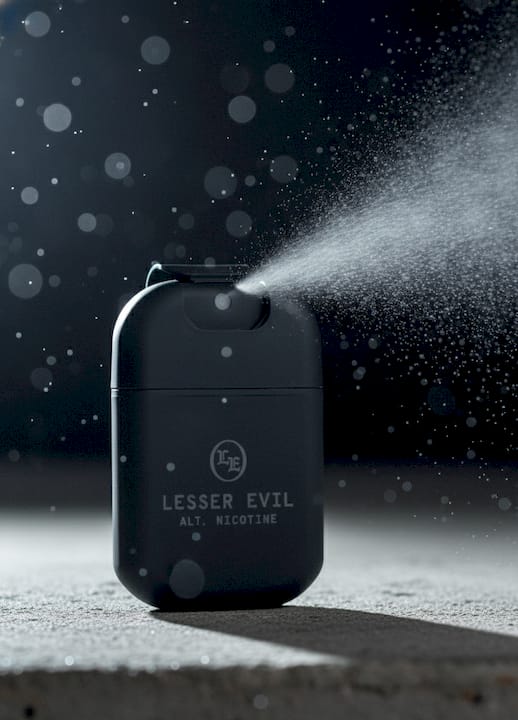
Sublingual gels and sprays are the device-free route. Rather than needing a patch, a stick of gum, or a pouch tucked against your gum, these deliver nicotine straight under the tongue through the oral mucosa. No batteries, no vapour, no chewing motion to manage in front of colleagues. That’s the appeal for anyone who wants control over dose without wrestling with a device.
Here’s how the formats stack up on the things that actually change your day-to-day experience:
- Patches: slowest onset, steadiest effect, worst for sudden urges, best for background management
- Gum: moderate onset, needs correct chewing technique, easy to under-dose or over-dose by accident
- Lozenges: moderate onset, simpler technique than gum, less visible in use
- Mouth sprays: fastest onset of the group, precise per-spray dosing, needs no chewing at all
- Pouches: moderate to fast depending on moisture level, fully discreet, strength varies more than the label suggests
- Sublingual gels: fast onset, no device or vapour, dosing precision without hardware
If discretion in public is your priority, pouches and sublingual gels win. If speed matters most, sprays edge ahead. If you want to barely think about it, patches do the thinking for you.
How much nicotine counts as a low dose, and how do you choose a starting strength?
Low dose generally means doses in the low milligram range per use. Examples include a 2 mg piece of gum, a 1 mg spray, or a pouch in a similar low range, depending on the format you’ve picked.
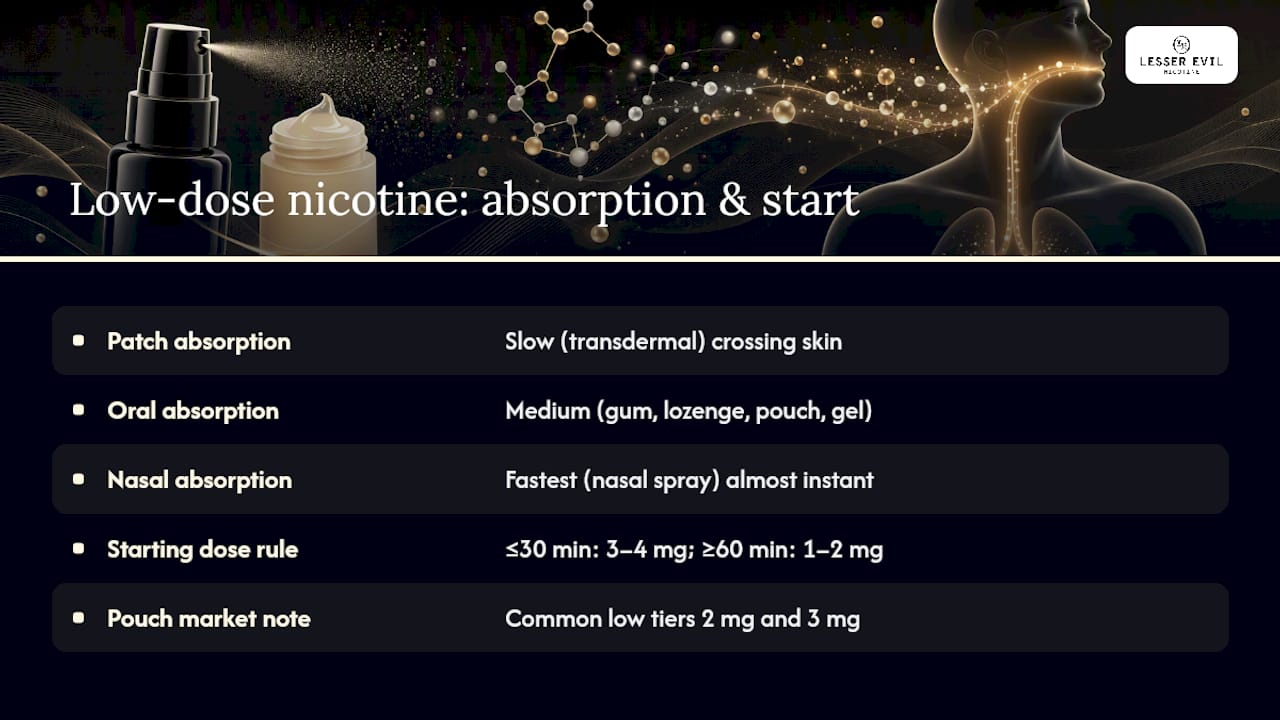
Where nicotine gets absorbed changes everything about how a “low” number feels. Transdermal delivery, through patches on skin, is the slowest of the three main pathways because it has to cross several layers of tissue before reaching your bloodstream. Oral mucosal absorption, used by gum, lozenges, pouches, sprays and sublingual gels, is faster because the lining of your mouth is thin and richly supplied with blood vessels close to the surface. Nasal delivery, used by nasal sprays available in some markets, is fastest of all, since nasal tissue absorbs almost instantly. That’s why a 2 mg pouch can feel stronger than a 2 mg patch might suggest on paper. Speed of arrival shapes how intense something feels, not just the total amount delivered.
Quick reference: matching current use to a starting low dose A rough rule used by quit services is the “time to first cigarette” test: if you typically reach for nicotine within 30 minutes of waking, start at the higher end of the low-dose bracket (3 to 4 mg gum, lozenge or pouch); if it’s usually an hour or more, the lower end (1 to 2 mg) is often enough. Someone using 15 to 20 cigarettes a day, or a pouch of similar strength several times daily, is a different starting point to someone using half that.
Clinical evidence backs the idea that reducing nicotine dose genuinely reduces exposure, not just the feeling of it. A randomised trial published in Nicotine & Tobacco Research found that substantially reduced-nicotine cigarettes combined with nicotine lozenges lowered measurable biomarkers of exposure and dependence scores compared with higher-yield products in trial conditions. That’s a controlled setting rather than real-world proof for every format, but it’s a genuine signal that dose reduction does something measurable, not just something psychological.
Market data on pouches shows the practical limit of “low” in that category: surveys of pouch products list 2 mg and 3 mg as the common low-strength tier, with 2 mg only stocked by a handful of manufacturers. If you’re shopping by milligram number alone, you’ll find fewer choices than the category’s marketing suggests.
Can you combine low-dose products to manage cravings and step down gradually?
Health services have a name for this: the slow-plus-fast model. NHS guidance on nicotine replacement therapies recommends pairing a slow-acting product, usually a patch, with a fast-acting one such as gum, lozenge or spray. The patch handles your baseline so you’re not white-knuckling through the day, and the fast-acting product mops up sudden spikes in urge without you needing to reach for something stronger than planned.
A simple staged reduction plan looks like this:
- Week one and two: keep your current product and strength, but track how often you actually use it rather than guessing.
- Week three and four: halve the frequency at the same strength. If you were using six times a day, aim for three.
- Week five onward: drop to the next strength down, keeping frequency where it landed in step two.
- Reassess every two weeks: if you’re stable at a lower strength for two weeks running, it’s usually safe to consider dropping again.
The most common pitfall is compensatory use, where you unconsciously increase how often you use a lower-strength product to chase the same effect you got from a stronger one. That defeats the entire point of stepping down. Watch frequency as closely as strength, not just one or the other.
Pro Tip: If you’re moving from higher-strength pouches or vaping to something milder, try switching formats at the same time as dropping strength. Someone going from an 8 mg pouch, four times daily, might move to a 3 mg pouch twice daily plus a 1 mg sublingual gel for in-between moments, rather than just buying a weaker pouch and using it just as often.
Are low-dose nicotine options safe, and where should you buy them?
Side effects tend to follow the format, not the dose. Patches can cause skin irritation or a mild rash at the application site. Gum, lozenges and pouches can irritate the inside of your mouth or gums with frequent use, particularly if you’re using a stronger pouch than your tissue is used to. Sprays can irritate the nasal passage if a nasal variant is used, or cause a brief throat catch with mouth sprays.
Interactions matter more than most people expect. Medsafe’s consumer guidance notes that changing how much nicotine you use, in either direction, can shift how your body processes certain medicines, sometimes altering the dose you need. If you’re on regular prescription medication, it’s worth raising nicotine product changes with a clinician rather than assuming it’s irrelevant.
“Nicotine exposure changes can alter levels or required doses of some medications,” national guidance warns, which is a good reason to mention any switch in nicotine product to whoever manages your prescriptions, even if the switch feels minor to you.
Buy regulated products from pharmacies or established retailers rather than unbranded listings with vague labelling. A quick shopping checklist before you buy:
- Confirm the exact mg per dose or per pouch, not just a strength category like “regular” or “strong”
- Check for batch or lot information on the packaging
- Look for clear, printed dosing instructions rather than relying on a website description
- Avoid anything with no listed ingredients or country of manufacture
Health New Zealand’s guidance on quitting smoking confirms that patches, gum and lozenges are widely available through the Stop Smoking Service and regulated pharmacies, which remains the most reliable route for those specific NRT categories.
Where does an oral sublingual gel fit among low-dose options?
An oral sublingual gel is applied under the tongue, delivering nicotine through the oral mucosa rather than through skin or a device. It is tobacco-free and battery-free, with a water-based, no-chemical formula available in three natural flavours.
Sublingual delivery differs from a buccal pouch (held against the gum) or a transdermal patch (absorbed through skin) mainly in speed and control. Because the tissue under your tongue is thin and vascular, uptake tends to be quicker than skin absorption, and each application is a measured dose rather than a variable release.
Factually, this fits certain use cases well:
- No vapour to breathe in: you’re not inhaling anything heated, unlike vaping
- No battery or hardware: nothing to charge, nothing that becomes e-waste
- Precision dosing per use: each application delivers a set, low amount rather than an estimated one
- Genuinely discreet: no visible device, no smoke, no chewing motion
A comparison of oral nicotine product types sets out how sublingual and buccal formats differ in more depth for readers weighing up their next move.
Setting realistic expectations with low-dose nicotine options
Progress here rarely looks like a straight line. Tolerance shifts week to week, and a strength that felt right on day three might feel too strong, or too weak, by day twenty. That’s not failure, it’s just how the body adjusts.
Track frequency, not just strength. Someone who drops from six uses a day to three, even at the same milligram strength, has made a bigger practical shift than someone who dropped strength but kept using just as often. Give any change at least two weeks before deciding it isn’t working, because early days are noisy and unreliable as a signal.
For more on managing the habit day to day, our guide to nicotine habit management covers the practical side in more depth than this article has room for.
— Luke McLeod
Ready to try a device-free, low-dose option?
There are alternative options to vapes and pouches built for people who want control without the extras. These include low-dose sublingual gels, applied under the tongue, available in multiple natural flavours.

It’s built for anyone who wants precise, low-dose use without carrying a device or worrying about who’s watching. If you’re currently using stronger pouches or vaping and want to try something with tighter dosing and nothing to charge, the Lesser Evil Oral Mister is available to order now, with full flavour and dosing details on the product page.
This article is general information, not a substitute for advice from a qualified doctor. Consult a qualified healthcare professional about your own circumstances before acting on anything here.
Sources
- A randomized trial of nicotine replacement therapy in combination with reduced‑nicotine cigarettes for smoking cessation. Nicotine & Tobacco Research. 2008.
- Quit smoking with nicotine replacement therapies (NRTs) - NHS
- Medsafe — Quitting smoking can affect your medicines (consumer guidance)