

No Battery, No E Waste: Nicotine Options for Urban Professionals

Yes, e-waste free nicotine is real, and it comes down to one design choice: no battery. Products like sublingual gels avoid the lithium cell that turns a disposable vape into hazardous rubbish, and an example of a battery-free oral nicotine product exists that follows this design. If you’re still running vapes or disposables, the immediate fix is retailer takeback or your local household hazardous waste site, not the bin.
TL;DR:
- Battery-free nicotine products like sublingual gels eliminate the electronic waste and fire risks associated with lithium batteries in vapes.
- Proper disposal involves storing devices separately, avoiding drain disposal of e-liquids, and using household hazardous waste sites or retailer takeback programs.
- Genuine eco-friendly claims depend on whether the product is battery-free, refillable, recyclable, and backed by a clear takeback or end-of-life plan, not just marketing language.
- Reusable non-battery products substantially reduce waste compared to disposables, which often contain lithium batteries, circuit boards, and hard plastics.
- Alternatives like nicotine pouches, gum, and gels offer nicotine delivery without electronic waste, making them more sustainable and discreet options for city dwellers.
Table of Contents
- What creates e-waste in nicotine products, and why it matters
- How to evaluate claims: a practical checklist for “e-waste-free” nicotine products
- Where and how to dispose of nicotine devices, batteries, and e-liquids safely
- Why the real fix is product design, not your recycling habits
- Alternatives that skip the battery altogether
- Comparing the environmental footprint: battery-free versus vapes
- What certifications and eco-labels actually mean (and don’t)
- Discreet, battery-free nicotine for people who actually live in cities
- A battery-free oral option worth knowing about
- Sources
- FAQ
What creates e-waste in nicotine products, and why it matters
Crack open a disposable vape and you’ll find the same guts every time: a lithium battery, a plastic pod, a small circuit board, and a heating coil. None of that is meant to go in a bin bag, but most of it ends up there anyway.
That’s the problem. A vape isn’t just plastic, it’s an electronic device with a battery, which puts it in the same category as a phone or a laptop when it comes to disposal. The US EPA is blunt about this: e-cigarettes contain nicotine and lithium batteries, and neither belongs in household trash or standard recycling.
Here’s what goes wrong when they do:
- Battery fires. Crushed lithium cells inside bin lorries and recycling centres have started fires, because a punctured battery can spark or combust under pressure.
- Heavy metal leaching. Circuit boards and batteries contain metals that leach into soil and water once a device sits in landfill.
- Nicotine toxicity. Residual e-liquid in tanks and pods poses a poisoning risk to wildlife and to the waste workers who handle it.
- Plastic that never breaks down. The hard plastic shells used in most disposables aren’t designed to biodegrade or separate easily for recycling.
A peer-reviewed review in PMC goes further, arguing that discarded e-cigarettes create genuinely novel environmental harms compared with traditional cigarette litter, because you’re combining chemical toxicity with electronic waste in a single throwaway product. The same research calls for extended producer responsibility and a shift toward reusable systems, rather than expecting individual consumers to solve a design problem.
The scale is the part most people miss. Recycle Your Electricals reports that recycling vapes properly could recover valuable materials like lithium while cutting the fire risk that comes from crushing batteries in general waste streams. Every disposable that gets binned instead of recycled is a small battery fire waiting to happen, multiplied across millions of devices.
Part of the reason this keeps happening isn’t laziness, it’s confusion. Packaging on most vapes gives you flavour and nicotine strength in large print, and almost nothing about how to dispose of the thing safely once it’s dead.
How to evaluate claims: a practical checklist for “e-waste-free” nicotine products
“Eco-friendly” on a vape box means almost nothing on its own. Brands slap sustainability language on packaging constantly, and most of it isn’t backed by anything you could actually check.
Genuine low-waste claims rest on a handful of concrete things, not adjectives:
- Is it battery-free? No lithium cell means no e-waste from the device itself. This is the single biggest factor.
- Is the hardware reusable or refillable? If a battery is involved, a reusable device that survives dozens of refills beats a disposable used once.
- Are the materials recoverable? Can the plastics, metals, or packaging actually be separated and recycled, or are they fused together in a way that makes recovery impractical?
- Does the brand publish a takeback or end-of-life plan? A company that tells you exactly where to return spent product is doing more than one that just says “recyclable.”
- Is the packaging itself recyclable or minimal? Even battery-free products still generate packaging waste, so check what the box and blister pack are made from.
Watch for the red flags too. Vague claims like “eco-conscious” or “sustainably made” with no mention of batteries, materials, or takeback are marketing, not information. The same PMC review notes that inconsistent or missing disposal guidance on packaging is one of the main reasons products end up disposed of incorrectly in the first place. If a brand can’t tell you what happens to its product at end of life, that silence tells you something.
Nicotine pouches are a useful example of where this gets murky: some brands market recyclable outer packaging while the pouch itself, the part with the nicotine and fibre content, isn’t recyclable at all. True circularity needs both the packaging and the product handled, not just one.
Pro Tip: Before buying, search the brand’s website for the word “recycle” or “takeback.” If you can’t find a clear answer in under a minute, the product probably doesn’t have one.
Where and how to dispose of nicotine devices, batteries, and e-liquids safely
Don’t bin a vape, battery, or leftover e-liquid. That’s the first rule, and it’s non-negotiable given the fire and contamination risks involved.
Here’s the practical sequence:
- Isolate the device first. Bag it separately from other rubbish so a punctured battery can’t come into contact with anything flammable.
- Never pour e-liquid down a drain or sink. Nicotine residue in wastewater is a contamination risk that municipal water treatment isn’t designed to filter out.
- Find a household hazardous waste (HHW) site. The EPA specifically recommends HHW collection points for e-cigarettes because of the combined battery and nicotine hazard.
- Check for retailer takeback schemes. Many vape shops and electronics retailers now accept old devices for recycling, and Recycle Your Electricals treats this as standard practice for vapes, which count as electricals under UK recycling guidance.
- Look out for scheduled collection events. Some councils run periodic hazardous waste collection days if there’s no permanent HHW facility nearby.
If nothing is available locally, don’t just hold onto it indefinitely and hope. Store devices somewhere dry, away from heat sources, and contact your local council or waste authority directly, they can usually point you to the nearest scheduled collection or authorised drop-off point.
| Situation | What to do |
|---|---|
| Disposable vape, still has charge | Bag separately, take to HHW site or retailer takeback |
| Empty vape pod or cartridge | Do not bin; check retailer takeback |
| Leftover e-liquid | Never pour down drain; dispose via HHW site |
| No local HHW facility | Store safely, contact council for guidance |
Retailers can play a bigger role here than most people realise. When a shop acts as an authorised collection point working with a licensed hazardous waste transporter, it can accept devices from the public without turning its premises into a regulated waste site, a practical middle ground the EPA’s own battery collection guidance outlines for exactly this reason.
Why the real fix is product design, not your recycling habits
Individual effort matters, but it’s not where the biggest gains come from. The most credible research on this points somewhere else entirely: extended producer responsibility, or EPR.
EPR means the company that makes the product stays responsible for what happens to it after you’re done, not just the council bin lorry. That’s the argument the PMC review on e-cigarette waste makes directly, calling for manufacturers to build in reusable systems and take‑back infrastructure rather than shipping millions of single‑use devices with no end‑of‑life plan attached.
Think about the lifecycle of a typical disposable vape. It’s manufactured, shipped, sold, used for a few hundred puffs, then discarded, usually within days. Every stage after “sold” is currently the consumer’s problem to solve, and most consumers don’t have an HHW site five minutes from their flat. That’s a design failure, not a personal one.
Products that remove the battery entirely sidestep a chunk of this problem before it starts. No battery means no lithium fire risk, no circuit board to recycle, no charging cable to eventually bin as well. It doesn’t remove every waste consideration, packaging still needs sorting, but it removes the single most hazardous component from the equation.
Brands that publish clear takeback instructions or design for reuse are doing the EPR work voluntarily, ahead of regulation catching up. That’s worth rewarding with your money, because it’s a genuinely harder and more expensive thing for a company to commit to than printing “eco-friendly” on a box.
Alternatives that skip the battery altogether
Vapes aren’t the only way to get nicotine, and most of the alternatives were never electronic in the first place. Nicotine pouches, gum, and lozenges have been around for years, and none of them involve a battery, a coil, or a circuit board.
Nicotine pouches sit between the lip and gum and release nicotine without smoke or vapour. The trade-off is the pouch material itself, as mentioned earlier, isn’t always recyclable even when the outer packaging is.
Nicotine gum and lozenges work on a similar no-battery basis, dissolving or being chewed rather than heated. Both generate packaging waste, usually foil blister packs, but nothing that carries battery fire or heavy metal risk.
Sublingual gels, like Lesser Evil Oral Mister, sit in the same battery-free category, delivered under the tongue via the oral mucosa rather than inhaled. No coil, no vapour, no charging cable.
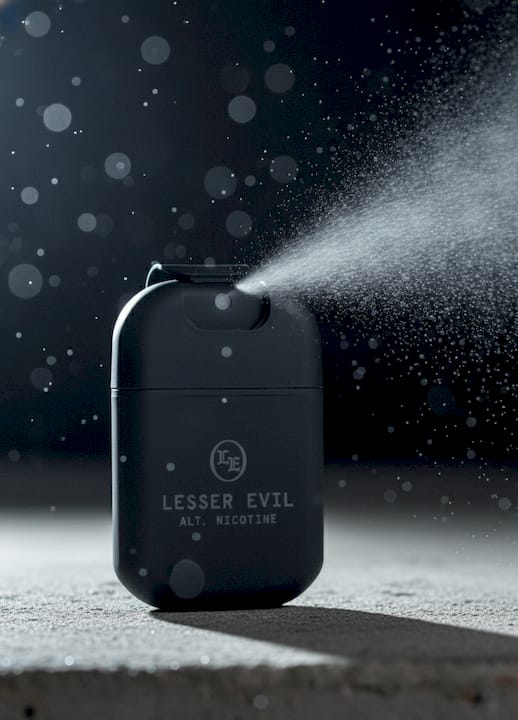
What separates these formats from vapes isn’t just convenience, it’s that the entire e-waste category (batteries, circuit boards, hard plastic housings) simply doesn’t apply to any of them. That’s a structural difference, not a marketing one, and it’s the reason this category keeps coming up whenever the phrase “e-waste free nicotine” gets searched.
Comparing the environmental footprint: battery-free versus vapes
Put a disposable vape and a battery-free oral product side by side, and the comparison isn’t close on the specific issue of electronic waste. A vape carries a lithium battery, a heating element, and often a small circuit board, three components that require specialist recycling and carry fire risk if mishandled. A battery-free format carries none of them.
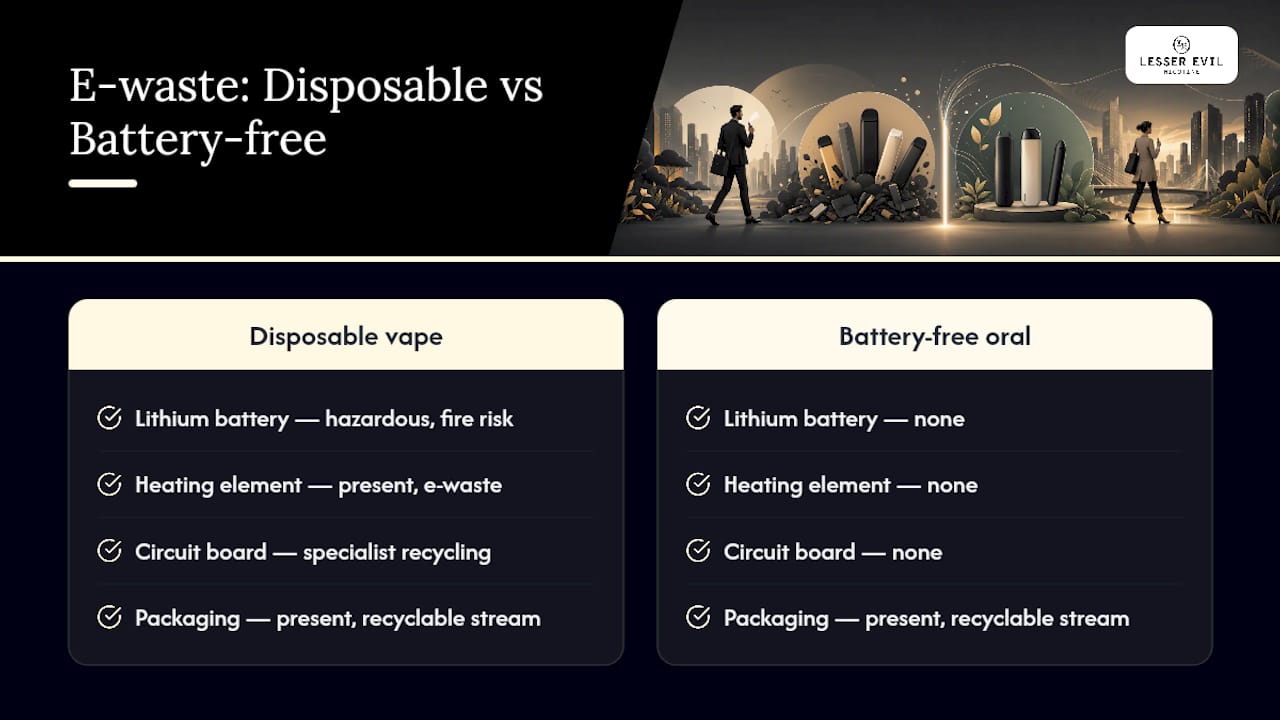
That doesn’t mean oral formats have zero environmental footprint. Packaging still needs manufacturing, transport still burns fuel, and pouches or gel containers still need proper disposal rather than littering. The difference is in severity and complexity: packaging waste is a manageable, well-understood recycling stream, while lithium battery waste is a hazardous materials problem with fire risk attached.
Reusable vape hardware, the kind you refill rather than throw away, sits somewhere in the middle. It still has a battery, so it’s still e-waste at end of life, but a device used for a year generates far less waste per puff than a disposable used for two days. The PMC research frames this exact distinction, reusable systems over disposable ones, as the more defensible design direction on environmental grounds.
The honest summary: battery-free formats remove the highest-risk waste category outright, and reusable vape systems reduce it substantially compared with disposables. Single-use vapes remain the worst option on this specific measure, regardless of what the packaging claims.
What certifications and eco-labels actually mean (and don’t)
Most nicotine products don’t carry a recognised, independently verified eco-label at all, and that’s worth knowing before you go hunting for one. There’s no universal green tick you can rely on across every brand.
What you can check instead is more specific and more useful. Look for a stated battery status, does the brand tell you plainly whether the product uses one? Look for named materials, “recyclable packaging” means little without saying which parts and how. And look for an actual takeback address or scheme, not just the word “sustainable.”
A useful practitioner-level rule: judge the system, not the slogan. That means asking whether the hardware is durable and reusable, whether there’s a real material recovery path, and whether the company has a stated end-of-life process, rather than trusting packaging claims alone. This lines up with what public health researchers have flagged about inconsistent disposal labelling across the category generally.
Retailers matter here too. A shop that accepts old devices back, working as an authorised collection point tied to a licensed hazardous waste handler, is a stronger signal than any badge printed on a box. If you’re weighing up options, our piece on nicotine product sustainability walks through the fuller framework for judging packaging, takeback, and design together.
Discreet, battery-free nicotine for people who actually live in cities
Running between meetings, the tube, and a flat with no outdoor bin storage changes how you think about waste. A vape battery isn’t just an environmental line item, it’s a specific device you now have to remember not to bin, bag separately, and carry to a collection point that’s rarely on your route home.
That’s the trade-off worth naming honestly: convenience versus what you’re left holding. A disposable is quick to buy and quick to use, but it leaves you with an object that needs specialist disposal. A battery-free oral format skips that step entirely, there’s no device to store, charge, or eventually cart off to an HHW site.
Discretion and sustainability line up more often than people expect here. Something pocket-sized with no charging cable, no vapour cloud, and no spent battery rattling around a drawer fits a working day better than a vape you have to hide charging at your desk. Packaging still counts though, and retailer takeback still matters, removing the battery doesn’t mean the responsibility disappears entirely.
— Luke McLeod
A battery-free oral option worth knowing about
If the battery is the problem, the fix is a product that never had one. One battery-free oral nicotine option is a sublingual nicotine gel used under the tongue via the oral mucosa, tobacco-free, water-based, and built without a lithium battery, coil, or circuit board.

That’s not a health claim, it’s a design fact: no battery means nothing to bag separately, nothing to carry to a hazardous waste site, and nothing that can spark a fire in a bin lorry. It is available in three natural flavours — Peppermint, Black Grape, and Green Apple — with natural sweeteners rather than synthetic additives. You still don’t breathe anything in, since there’s no vapour to inhale in the first place.
For a fuller look at how packaging and product choices stack up across the category, our guide to clean nicotine alternatives covers the wider field. To see the Oral Mister itself, including flavours and how it’s used, visit the Lesser Evil Oral Mister product page, or browse the full range at Lesser Evil Nicotine.
Sources
- Alert: Public health implications of electronic cigarette waste - PMC
- How to Safely Dispose of E‑Cigarettes: Information for Individuals | US EPA
- Recycle vapes | Recycle Your Electricals
FAQ
Is there really such a thing as e-waste-free nicotine?
Battery-free formats, including sublingual gels, pouches, gum, and lozenges, avoid the lithium battery and circuit board that make vapes classify as electronic waste. None of them are entirely waste-free once you count packaging, but they remove the highest-risk hazardous component.
Can I put a vape in my regular recycling bin?
No. The US EPA advises against binning e-cigarettes in household trash or standard recycling because of the combined nicotine toxicity and lithium battery fire risk, and recommends household hazardous waste sites instead.
What should I do with old vape batteries if I have no local recycling option?
Store them somewhere dry and away from heat, bagged separately from other waste, and contact your local council or waste authority for the nearest scheduled hazardous waste collection. Never store them loose with metal objects that could cause a short.
Are nicotine pouches actually more sustainable than vapes?
Pouches remove the battery and circuit board entirely, which eliminates the fire and heavy metal risks associated with vape hardware. The pouch material itself isn’t always recyclable, so packaging and pouch disposal still need checking on a brand-by-brand basis.
Does Lesser Evil Oral Mister produce e-waste?
No, it’s a sublingual gel with no battery, coil, or circuit board, so it avoids the electronic waste stream that disposable and rechargeable vapes create. It’s priced at $18 as a one-off purchase, available directly from Lesser Evil Nicotine.