

Discreet, All Day Smooth Nicotine for Adults with Sublingual Gel

Smooth nicotine delivery means a steady, low-irritation hit with no sharp throat scratch and no harsh chemical edge, driven mainly by protonated (salt) nicotine and non-inhaled formats like pouches or sublingual gel. The two things that decide how smooth a product feels are the chemical form of the nicotine and how it’s delivered into your mouth. Expect a slower build than a cigarette, but a longer, steadier presence once it lands.
TL;DR:
- Protonated nicotine and buffered formulations are key to achieving smoothness, reducing throat irritation and providing a gentler, longer-lasting dose.
- Nicotine pouches peak in blood concentration around 30 minutes and can carry more nicotine at that peak than cigarettes, despite taking longer to act.
- Smooth sensation is characterized by minimal throat scratch, steady build, and nicotine as the primary focus, not flavor masking or cooling agents.
- Sublingual gels offer more control and discretion, as they allow precise dosing with no waste or inhalation, unlike fixed-release pouches.
- Variability in ingredients and actual blood absorption means product strength does not reliably predict nicotine delivery, making user experience more important than labels.
Table of Contents
- What makes nicotine feel smooth in the first place?
- How fast does it hit, and what do the numbers actually mean?
- How do you spot smooth delivery when you’re actually using it?
- How do you pick strength and format for a smoother experience?
- Pouches or oral gel: which delivers smoother, more discreet nicotine?
- Why Lesser Evil built its gel around this exact profile
- Are there health and safety considerations worth knowing?
- Do ingredients and additives change how smooth it feels?
- How does smoothness compare across vaping, pouches, gum and gel?
- What actually matters once you strip away the marketing
- Ready to try a sublingual gel built around this exact profile?
- Sources
- FAQ
What makes nicotine feel smooth in the first place?
Nicotine comes in two chemical forms, and the difference between them is the whole story behind “smooth.” Free-base nicotine is the raw, more volatile form. It hits the back of your throat like a slap. Protonated nicotine, also called nicotine salt, is chemically buffered so it sits closer to a neutral pH, and that buffering is what takes the edge off. Research into nicotine forms in electronic delivery systems confirms that protonated nicotine is linked to smoother sensory effects and, in many modern formulations, better absorption as well. You get more nicotine with less burn. That’s the trade nearly every “smooth” product on the market is built around.
pH is doing a lot of the quiet work here. A more acidic, buffered formulation keeps more of the nicotine in its protonated state, which your mouth reads as gentler. Push the pH toward alkaline and you free up more of the harsher, free-base molecule, the same shift that makes old-school pipe tobacco or high-pH vape liquids bite harder.
Then there’s what’s mixed in around the nicotine itself:
- Cooling agents like menthol derivatives can mask throat irritation without actually reducing it, so a product can feel smooth while still delivering a rough dose underneath.
- Natural sweeteners soften the top notes and stop the sensation reading as purely medicinal or bitter.
- Flavour oils change perceived harshness more than actual harshness. A citrus or mint top note distracts your palate from the sting.
- Buffering agents in the base formulation are what actually shift the chemistry, not just the taste.
That last point matters. A product can taste lovely and still feel harsh if the underlying pH chemistry isn’t doing the work. Flavour is decoration. Chemistry is the foundation of nicotine acceptance.
How fast does it hit, and what do the numbers actually mean?
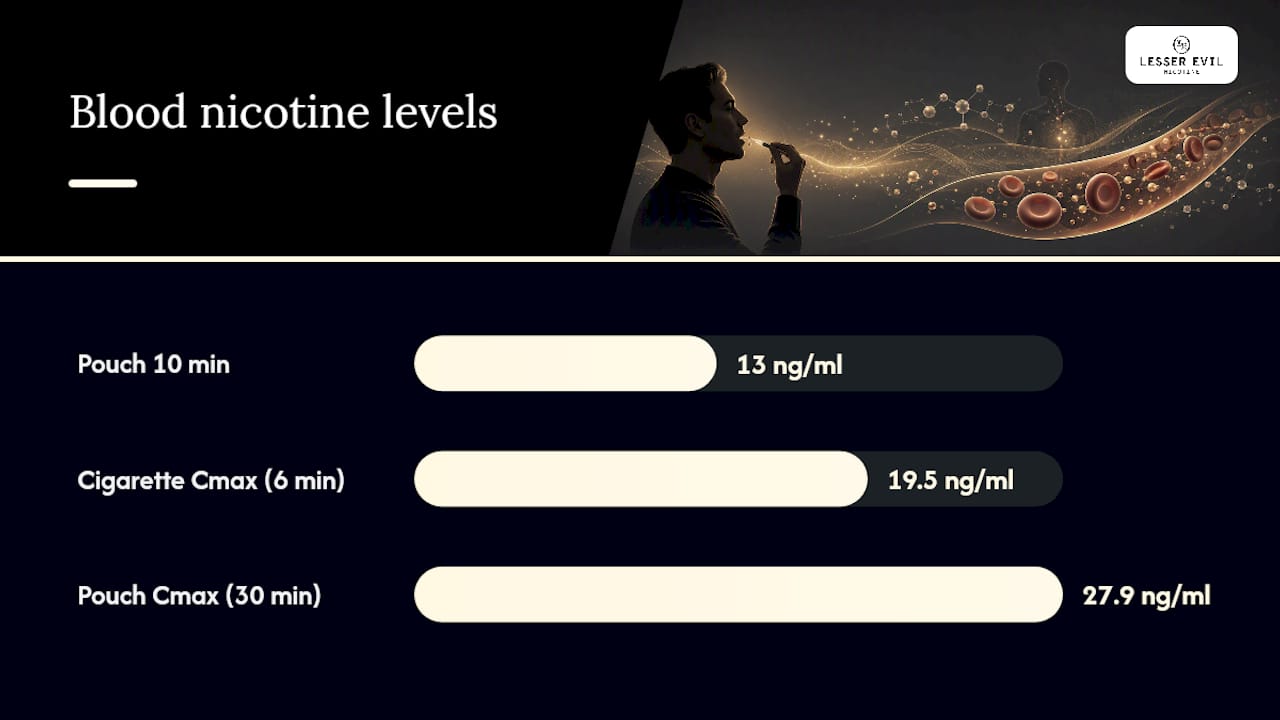
Nicotine pouches take roughly five times longer than a cigarette to peak in your bloodstream, but they can end up carrying more nicotine at that peak. A 2025 pharmacokinetic study comparing the two found cigarettes hit peak blood concentration, or Tmax, at around 6 minutes. Pouches took about 30 minutes to peak, yet reached a higher maximum concentration, or Cmax, of 27.9 ng/ml versus 19.5 ng/ml for cigarettes.
The numbers that matter for real-world use:
- Pouches reached a moderate nicotine blood concentration within about 10 minutes, despite the slower overall climb to peak.
- Full peak concentration (Tmax) arrives around the 30-minute mark for pouches, against 6 minutes for a cigarette.
- Blood nicotine stays meaningfully elevated at 60 minutes with a pouch, long after a cigarette’s effect has faded.
This is the part most people miss: the milligram number printed on a pouch tin tells you almost nothing about what actually reaches your blood. Separate research tracking multiple pouch products found wide variability in delivery. Some pouches labelled at a given strength perform close to cigarette levels; others labelled the same deliver far less. Nicotine release depends on the buffering system, the moisture content, and how the pouch is built, not just the number on the tin.
So what should you actually feel, minute by minute? At 5 minutes, not much, maybe a faint background presence if you’re using a strong product. By 10 minutes, a gentle lift starts to build, that 13 ng/ml mark. At 30 minutes, you’re at peak intensity for a pouch, roughly when a cigarette smoker would already be reaching for their next one. By 60 minutes, the pouch is still giving you a steady, tapering presence rather than the sharp drop-off you get after inhaling.
That slower curve isn’t a design flaw. One takeaway from the pharmacokinetic data is that this steadier delivery can hold off the urge to reach for another product for longer, which matters if what you actually want is all-day control rather than a fast spike.
How do you spot smooth delivery when you’re actually using it?
Smoothness has a recognisable sensory signature, and once you know what to look for, you’ll spot it within the first minute of a session.
- A low or absent throat scratch. Genuine smoothness means barely noticing your throat at all, not a burn that fades. If it stings going down, that’s free-base nicotine or an unbuffered formulation talking.
- A steady background presence rather than a spike and crash. Smooth products build gently and hold, rather than punching hard and dropping off within minutes.
- Minimal stinging or numbness at the point of contact. Some tingling under the tongue or against the gum is normal with sublingual products. Sharp numbness or a burning patch is not.
- Nicotine itself becomes the main thing you notice, not the flavour masking it. Unflavoured or lightly flavoured products strip away the distraction, so you’re left with a much clearer read on the raw sensation. Some users find this makes the product feel milder at first, simply because there’s no minty rush covering the sensation.
- Watch for genuine adverse signs. Nausea, light-headedness, or a numb tongue that lasts well beyond the session usually means the dose is too high for you, not that the product is faulty. Step down in strength rather than pushing through it.
The absence of flavour is doing real diagnostic work here, not just a stylistic choice. Once you strip out mint or fruit, you’re getting an honest read on the underlying formulation instead of a flavour-masked guess.
How do you pick strength and format for a smoother experience?
Your starting point should be your existing habit, not the strongest thing on the shelf. Someone new to nicotine altogether should start at the lowest available strength, full stop. A light smoker or occasional vaper generally does better on a low-to-mid strength pouch or a small measured dose of a sublingual gel. A regular smoker or heavy vaper switching over will usually need a mid-to-higher strength product to feel anything close to a familiar level, at least to begin with.
A few habits make the whole process smoother, quite literally:
- Run a single-session test with any new strength before committing to a full tin or bottle. Your reaction on day one tells you more than any label.
- With pouches, 20 to 40 minutes under the lip is typically where the sensation peaks and starts to plateau, so there’s little benefit in holding one much longer than that.
- With a sublingual gel or spray, dose in small increments rather than a single large application. You can always add more; you can’t take it back once it’s absorbed.
- Pair thoughtfully. Coffee and strongly flavoured drinks can clash with heavily flavoured pouches, while an unflavoured or lightly flavoured product tends to sit alongside them without a fight.
- Dispose of used pouches properly rather than leaving them anywhere. It’s a small habit, but it’s an easy one to get right.
Pro Tip: If a 3mg flavoured pouch feels weaker than you expected, try an unflavoured version at the same strength before jumping to a higher dose. The lack of cooling or fruit can make the nicotine itself far more noticeable, so what felt “too mild” is sometimes just under-flavoured, not under-dosed.
Meetings, desks, and long work stretches are where format choice really shows its value. A discreet, no-spit pouch fits under the lip and needs zero attention for half an hour. A sublingual gel or mist needs a few seconds of privacy to apply but gives you tighter control over exactly how much you’re taking in one go.
Pouches or oral gel: which delivers smoother, more discreet nicotine?
Both formats sidestep inhalation entirely, but they get there differently, and the differences matter once you look past the marketing.
A buccal pouch sits between your gum and lip for a fixed period, usually 20 to 60 minutes, releasing nicotine at a rate baked into the pouch itself. You place it once and forget about it. A sublingual gel or mist goes under the tongue, where the oral mucosa absorbs it directly, and you control the dose at the point of application rather than trusting a fixed release curve.
That distinction plays out in three practical ways:
- Onset and control. A pouch’s release rate is fixed once it’s in. A sublingual application lets you adjust how much you take in that specific session, which matters if you’re calibrating strength for the first time.
- Discretion. Both are silent and don’t require a device, but a pouch needs to sit visibly under the lip for its full duration, while a spray or gel application takes seconds and leaves nothing in your mouth afterwards.
- Waste and precision. A used pouch is solid waste you need to bin properly. A gel or mist format is battery-free by design, so there’s no e-waste question at all, and dosing can be adjusted spray to spray rather than committed to in one fixed unit.
Regulatory bodies including the FDA note that electronic and oral nicotine products vary widely in ingredients and components, which is exactly why the label alone won’t tell you how a given product will actually feel. Format and formulation both need checking, not just the milligram count on the front.
Why Lesser Evil built its gel around this exact profile
Lesser Evil Nicotine’s product is a sublingual gel, applied under the tongue and absorbed through the oral mucosa, not swallowed and not inhaled. It’s tobacco-free, battery-free, and comes in three natural flavours: Peppermint, Black Grape, and Green Apple, each built with natural sweeteners rather than synthetic ones.
The delivery mechanics line up directly with everything covered above. Applying under the tongue rather than holding a pouch in the cheek gives you finer control over how much you take in a single application, so you can calibrate dose rather than committing to a fixed-release unit for half an hour. There’s no vapour, no heated liquid, no aerosol to inhale, so the sensation you get is the nicotine and the flavour, not a cloud of anything else. Because there’s no battery involved, there’s no e-waste question either.
None of this is framed as a health claim, and it isn’t one. It’s a factual description of how the format works: precision dosing through sublingual absorption, a tobacco-free base, and a low-burn formulation designed to sit alongside the smoothness markers most users are actually looking for. It’s a consumer product built for adults who already use nicotine and want a discreet, tobacco-free option, not a treatment for anything.
Are there health and safety considerations worth knowing?
Nicotine is a stimulant regardless of format, and that’s worth stating plainly rather than glossing over. Any oral nicotine product, pouch or gel, delivers a dose your body has to process, and going in at too high a strength for your tolerance is the single most common cause of unpleasant sessions.
Nausea, dizziness, a racing heart, or persistent numbness are signs the dose is too high for you in that moment, not features of a “strong” product working as intended. Stepping down in strength or spacing out sessions resolves most of these issues. If symptoms persist or feel severe, that’s a conversation for a pharmacist or GP, not a forum post.
Product variability adds another layer worth knowing about. Because pouch delivery doesn’t scale predictably with labelled strength, two products with the same milligram figure on the tin can produce meaningfully different blood nicotine levels. That’s a reason to judge a product by how it actually feels in a session rather than by the number printed on the packaging.
These are adult nicotine products, not medicines and not cessation aids. They carry the same basic stimulant considerations as any nicotine product, and they’re intended for adults who already use nicotine and are looking for a tobacco-free, non-inhaled alternative.
Do ingredients and additives change how smooth it feels?
Buffering agents are the single biggest lever here, more than flavour, more than sweetener choice. They control the ratio of protonated to free-base nicotine in the final product, and that ratio is the main determinant of whether a session feels gentle or harsh, as the nicotine forms literature lays out clearly.
Natural sweeteners change the experience in a different way. They soften bitterness without altering the underlying chemistry, which means a well-sweetened product can taste pleasant while still delivering a rough dose if the buffering underneath isn’t right. Taste and chemistry are two separate jobs, and a good product needs both done properly, not one covering for the other.
Cooling agents deserve a note of caution. Menthol-style cooling can numb the sensation of irritation without reducing the actual irritant load, which means a heavily cooled product might feel smooth in the mouth while still delivering a harsh dose that you simply can’t feel as clearly. That’s masking, not smoothing, and it’s worth knowing the difference.
Water-based formulations without synthetic fillers tend to interact more predictably with oral tissue, which is part of why formulation transparency matters more than flavour count when you’re actually judging a product’s real smoothness rather than its marketing.
How does smoothness compare across vaping, pouches, gum and gel?
Every nicotine delivery method sits somewhere different on the smoothness spectrum, largely because each one interacts with your body through a different route.
Vaping heats a liquid and you inhale the vapour it produces. Delivery is fast because it reaches the lungs directly, but that speed comes with inhalation, meaning you’re breathing in an aerosol rather than absorbing nicotine through oral tissue. Harshness in vaping is usually tied to e-liquid pH and coil temperature rather than nicotine form alone.
Nicotine gum relies on chewing to release nicotine, and the release is uneven, dependent on how hard and how often you chew. It can taste bitter if chewed too aggressively, since that releases nicotine faster than the mouth’s lining can comfortably absorb it.
Lozenges dissolve slowly and release nicotine at a gentler, more even rate than gum, generally landing closer to the “smooth” end of the spectrum because there’s no aggressive mechanical action forcing the release.
Pouches and sublingual gels, as covered earlier, both rely on oral mucosal absorption with no inhalation involved, which is the single biggest reason they tend to land on the smoother end for users who find inhaled formats harsh.
The consistent pattern across all of these: methods that avoid inhalation and lean on a well-buffered, protonated nicotine base tend to produce the smoothest reported sensations, while speed of delivery and mechanical harshness (heat, chewing force, aerosol) are the main things that work against smoothness.
What actually matters once you strip away the marketing
Most nicotine marketing sells smoothness as a taste problem, solved with mint or fruit. It isn’t. It’s a chemistry and delivery-route problem, and the flavour is doing far less work than the label wants you to believe. The genuinely useful lever is protonated nicotine and non-inhaled delivery, and everything else, cooling agents especially, is decoration that can mask a rough underlying dose rather than fix it.
If you’re testing what actually suits you, run one product, one strength, one session at a time. Judge it on throat feel and how the sensation builds over the first 30 minutes, not on the marketing copy. And keep the frame honest: this is a consumer nicotine product for adults who already use nicotine, not a treatment, cessation aid, or health product. Use it as an alternative to smoking or vaping if that’s your reason for trying it, and let the actual sensation, not the label, tell you if it’s working.
— Luke McLeod
Ready to try a sublingual gel built around this exact profile?
Everything this article has covered, protonated nicotine, buffered formulation, non-inhaled absorption, is exactly what Lesser Evil Nicotine’s sublingual gel is built on. Instead of holding a fixed-release pouch under your lip for half an hour, you get a few seconds of discreet application and direct control over your dose, with no battery, no vapour, and nothing left over to throw away afterwards.
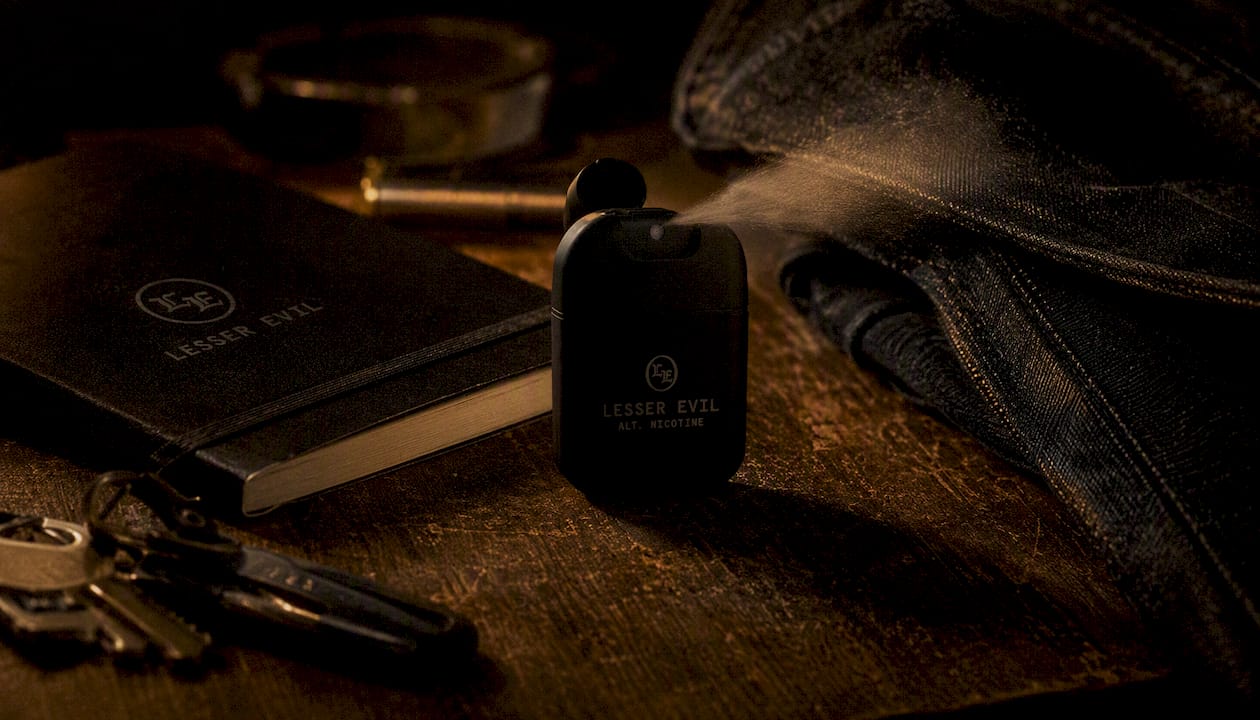
The gel comes in three natural flavours—Peppermint, Black Grape, and Green Apple—with natural sweeteners, and it is tobacco-free. If you want to see how it fits into your own routine, the Lesser Evil Oral Mister is available as a one-off order, or you can browse the full range at the Lesser Evil Nicotine Mouth Spray store to compare flavours before deciding.
Sources
- Nicotine delivery from and user reactions to nicotine pouches compared to cigarettes | Psychopharmacology
- Nicotine forms: why and how do they matter in nicotine delivery from electronic cigarettes? - PMC
- Nicotine delivery from and user reactions to nicotine pouches compared to cigarettes
- E‑Cigarettes, vapes, and other electronic nicotine delivery systems (ENDS) | FDA
FAQ
What is the healthiest nicotine delivery method?
There’s no single format proven to be the “healthiest,” since all nicotine products carry the basic stimulant effects of nicotine itself. Non-inhaled formats such as pouches and sublingual gels avoid the inhalation of vaporised or combusted material entirely, which is a factual difference from smoking or vaping, though this doesn’t make them health products or treatments.
Is 20 pouches a day a lot?
Twenty pouches in a day would mean near-constant nicotine exposure across most waking hours, which is considerably more than most regular users report. What counts as too much depends heavily on pouch strength and individual tolerance, so it’s worth judging by how you actually feel rather than a fixed number, and speaking to a pharmacist if you’re using significantly more than you intend to.
Can dentists tell if you use nicotine pouches?
Dentists can sometimes spot signs associated with regular pouch use, such as localised gum irritation or discolouration where a pouch is habitually placed, though this varies by frequency and individual sensitivity. It isn’t a definitive test, and mild, occasional use may show no visible signs at all.
Do any delivery services deliver nicotine pouches or oral nicotine products?
Availability depends on the retailer and your local regulations, so it’s worth checking directly with the seller rather than assuming nationwide delivery. Lesser Evil Nicotine sells its sublingual gel directly through its own online store, with current pricing and delivery details listed on the product page.
Why does a pouch take longer to feel than a cigarette?
Pouches rely on absorption through the oral mucosa rather than the lungs, which is a slower route into the bloodstream than inhalation. Studies show pouches reach peak blood concentration around 30 minutes in, against roughly 6 minutes for a cigarette, though pouches can ultimately reach a higher peak level once they get there.