

Stop Pouch Burn in Under a Minute for Nicotine Pouch Users

Pouch burn is a local chemical irritation caused by alkaline pH, nicotine strength and where you park the pouch against your gum. The fix is immediate: pull the pouch, rinse with cool water for 30 seconds, and skip that spot for the next day. A mild sting is normal and settles quickly; anything that lingers, spreads, or looks like a sore needs a proper look from a clinician.
TL;DR:
- Using lower nicotine strength and rotating placement across different gum zones can significantly reduce the risk of pouch burn.
- Pouch products with higher alkalinity, moisture, and strong flavoring agents like menthol and cinnamon tend to cause more oral irritation.
- Immediate steps like removing and rinsing the pouch with cool water, avoiding alcohol rinses, and resting the area promote faster healing.
- Signs of serious tissue damage include non-healing ulcers, bleeding, or gum recession, requiring prompt dental or medical evaluation.
- Switching to alternative nicotine delivery methods like sublingual gels may prevent irritation caused by high pH, moisture, and pouch design.
Table of Contents
- What causes pouch burn?
- Is that a normal tingle or a warning sign?
- Fastest ways to relieve pouch burn right now
- How to stop pouch burn before it starts
- When pouch irritation needs a professional opinion
- How formulation choices change the chemistry behind the burn
- What actually works, in order
- A low-burn option worth trying
- Sources
- FAQ
What causes pouch burn?
The sting comes down to chemistry, not bad luck. Most pouches are alkaline, and that raised pH shifts nicotine into its “freebase” form, the version your body absorbs fastest through the mucosal lining of your mouth. Faster absorption feels stronger, but it also means more contact time with delicate gum tissue that was never built to handle it.
Strength plays its own role. A pouch loaded with more nicotine per gram, or one that’s noticeably wetter, tends to sting harder and longer than a drier, lower-dose one. Moisture helps the chemicals move into tissue, so a soggy pouch is basically handing irritation a lift.
Flavour chemicals pile on top of that. Regulatory reviews point to pH adjusters and flavouring compounds as recurring culprits behind oral irritation in nicotine pouch products. Some common offenders:
- Cooling agents (mint, menthol, WS3 analogues): trigger cold-sensing receptors that can register as a burning sting rather than a fresh chill.
- Cinnamon and spice compounds: cinnamaldehyde is a known irritant even outside nicotine products.
- High-alkalinity boosters like sodium carbonate, added to speed up nicotine release.
- Strong sweetener blends that mask the taste of a higher pH, so you don’t notice how harsh the product actually is until your gum does.
Then there’s the boring stuff: a torn pouch pocket leaking loose powder straight onto tissue, or leaving one pouch in for two or three hours because you forgot it was there. Neither is exotic. Both wreck your gums just the same.
Is that a normal tingle or a warning sign?
Most pouch burn is nothing to worry about, but knowing the difference between “normal” and “get it checked” matters more than any other piece of advice here.
- The first few minutes: a light tingling or warmth under the pouch is expected, especially with anything above a low-strength product.
- Within 10 to 20 minutes: the sensation should plateau or fade slightly as your mouth adjusts to the placement.
- After removal: any lingering sting should ease within an hour once you’ve rinsed and left the tissue alone.
- Within a day or two: if you rotate away from the spot, minor redness or soreness typically clears on its own, in line with how most chemical-contact oral lesions resolve once the irritant is removed.
Warning signs are a different story. White patches that don’t wipe away, open ulcers, unexplained bleeding, or gum that looks like it’s pulling back from the tooth are not “just pouch burn.” Stop using that spot, and don’t just wait it out.
Fastest ways to relieve pouch burn right now
Speed matters here, so tackle these in order rather than jumping straight to painkillers.
- Remove the pouch immediately. Every extra minute it sits there is more freebase nicotine soaking into irritated tissue.
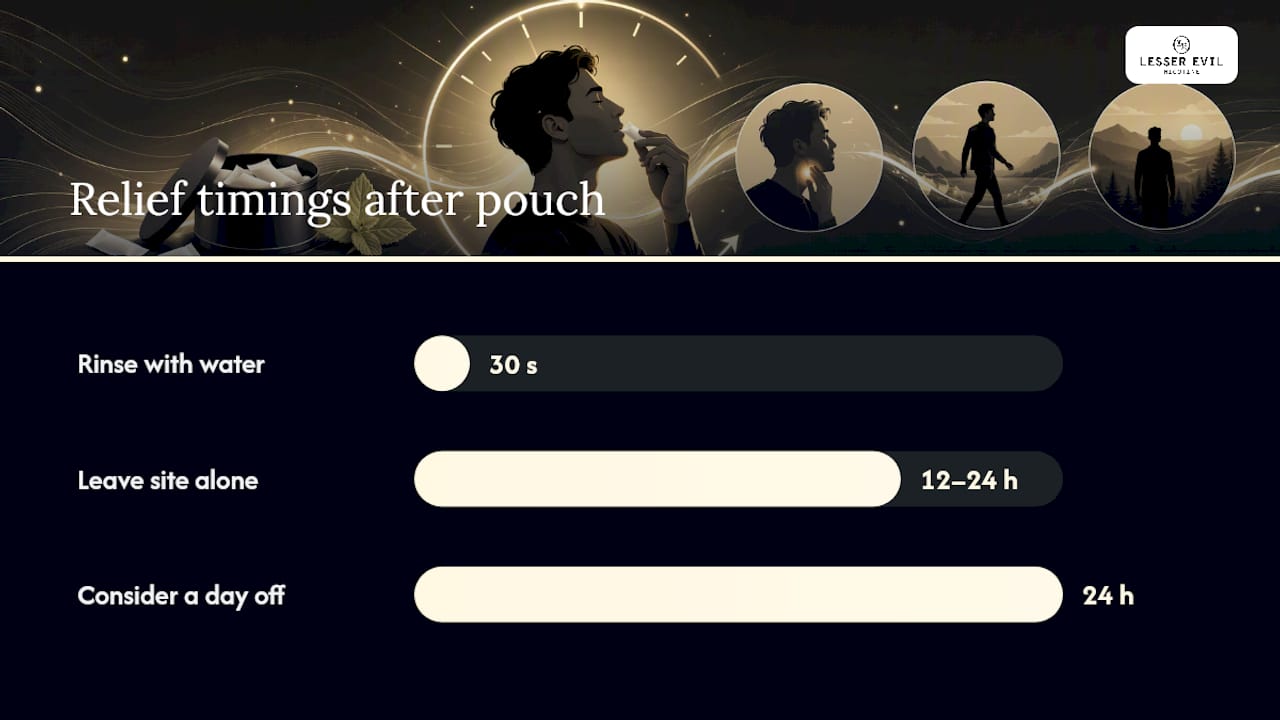
- Rinse with cool water for about 30 seconds. Cool water calms the tissue and physically flushes out residue; don’t swap it for anything harsher.
- Skip alcohol-based mouthwash and acidic rinses (citrus juice, vinegar-based drinks) while the area is inflamed. Alcohol dries out mucosa that’s already compromised.
- Drink water regularly. Saliva has a natural buffering effect on your mouth’s pH, and dehydration blunts that.
- Leave the site alone for 12 to 24 hours. Placing another pouch on the same spot before it’s settled just restarts the irritation cycle.
- Consider a short break entirely if the burn was more than mild. A day off costs you nothing and lets tissue properly recover.
For pain that’s more than a nuisance, a standard over-the-counter analgesic like paracetamol or ibuprofen, taken as directed on the packet, is reasonable. Topical numbing gels can help too, but they’re a comfort measure, not a fix for the underlying irritation.
Pro Tip: Keep a small bottle of water on you specifically for rinsing after a pouch comes out. Reaching for whatever’s nearby, fizzy drinks, coffee, energy drinks, often makes the sting worse rather than better.
If the pain keeps building instead of settling, or you notice a lesion spreading rather than shrinking, stop using pouches on that site and get it looked at. Don’t wait for it to become a bigger problem.
How to stop pouch burn before it starts
Prevention beats treatment every time, and none of this requires giving anything up. It just means using pouches with a bit more technique.
- Start at a lower strength than you think you need. Oral absorption through gum tissue behaves differently to inhaled nicotine, so a strength that felt “fine” when vaped can feel much harsher as a pouch, largely because it sits against one patch of tissue for far longer than a puff ever does.
- Rotate placement across four zones: upper-left, upper-right, lower-left, lower-right. Giving each patch of gum a full rest between uses is one of the most consistently recommended fixes in practical user guidance for reducing local irritation.
- Choose flavour carefully if you’re sensitive. Heavy mint, extreme cooling blends, and cinnamon-forward flavours are more likely to sting than simpler, single-note options. Natural flavour choices tend to be gentler on tissue than synthetic cooling agents pushed to their limit.
- Cap your session length. Long sessions mean long chemical contact. Shorter, more frequent use tends to beat one marathon pouch sitting in for hours.
- Space sessions out. Give any single spot proper recovery time rather than reloading it the moment the last one comes out.
Pro Tip: If you’re switching from vaping to pouches, don’t match your old nicotine intake exactly. Pouch chemistry hits differently, and dropping down a strength or two while you learn your tolerance saves your gums a rough introduction.
When pouch irritation needs a professional opinion
Most pouch burn is a non-event that clears in a few days. A short list of signs means it’s time to book a dental or medical appointment rather than wait it out:
- A lesion that hasn’t healed after two weeks
- Bleeding you can’t explain by anything else
- Visible gum recession at the placement site
- Pain that’s severe, or getting worse rather than better
A dentist or GP will typically ask about product type, strength, and how long you’ve been using that placement, then examine the tissue directly. For a straightforward contact lesion, healing usually falls in line with how minor burns and contact injuries recover, generally within a couple of weeks. Before you go, jot down the product name, strength, roughly how long the sore has lasted, and where in your mouth it sits. That saves time and gets you a faster, more accurate read.
How formulation choices change the chemistry behind the burn
Luke McLeod, who covers oral nicotine formulation for Lesser Evil Nicotine, has spent time picking apart why some products sting more than others. The short version: it’s rarely just “nicotine strength.” It’s pH, moisture, and what’s riding alongside the nicotine.
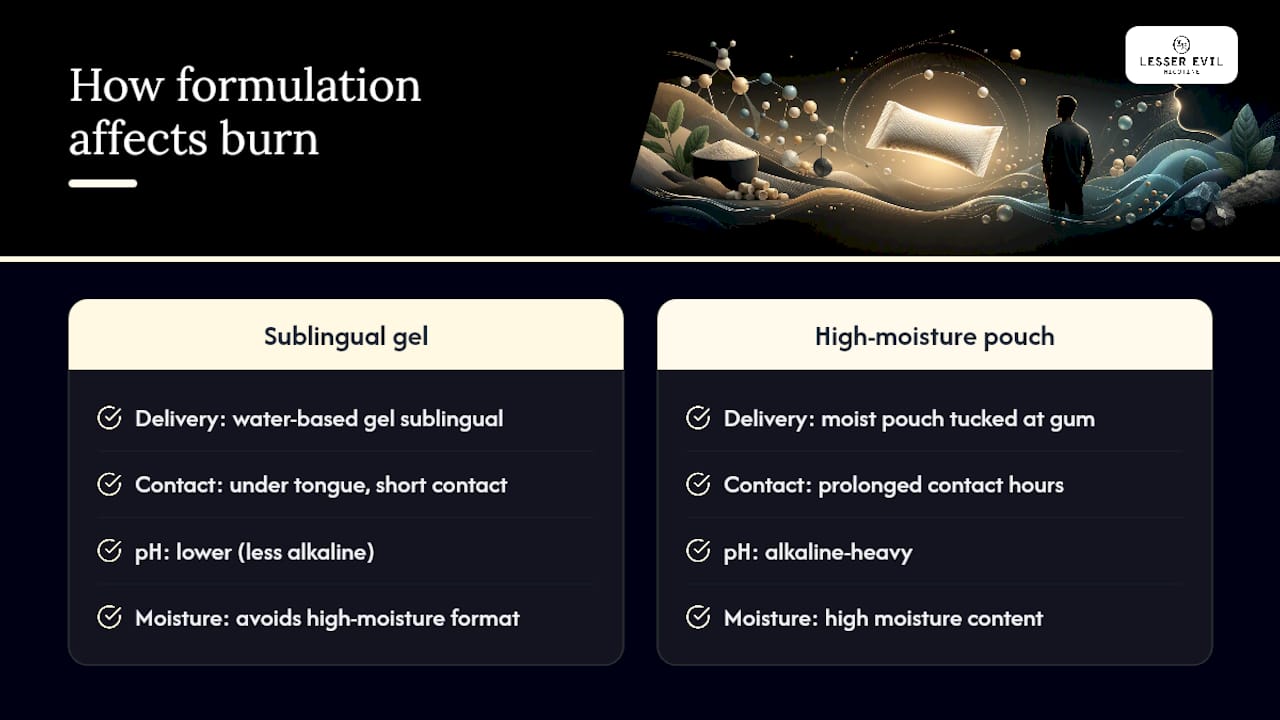
A water-based gel delivered sublingually, under the tongue rather than tucked against the gum for hours, changes the contact profile entirely. An oral sublingual gel product uses this approach: tobacco-free, battery-free with natural flavours across Peppermint, Black Grape, and Green Apple, built around a lower per-dose nicotine exposure than many pouches on the shelf. None of that makes it a treatment for anything. It’s simply a different delivery matrix, one that avoids the alkaline-heavy, high-moisture pouch format that tends to drive the sting in the first place.
What actually works, in order
If you take one thing from this article, take this: remove and rinse first, rotate placement second, step down strength third. In that order, because that’s the order of speed. Removing a pouch and rinsing kills the immediate sting in under a minute. Rotation prevents the same patch of gum getting hammered day after day. Dropping strength is the slower fix, but it’s the one that stops the problem showing up at all.
Most people who get burned repeatedly are making one of three mistakes: parking every pouch in the same spot, reaching for the strongest mint flavour when their mouth is already sensitive, or starting at a strength built for a habit they don’t actually have yet. Fix those three habits and the vast majority of mild pouch burn simply stops happening.
— Luke McLeod
A low-burn option worth trying
If you’re tired of babysitting sore gums every time you use a pouch, there’s a different route worth knowing about. Lesser Evil Nicotine’s Oral Mister skips the pouch format entirely, using a sublingual gel instead of a pocket sitting against your gum for hours at a stretch.

It’s tobacco-free, battery-free, and made with natural flavours and natural sweeteners across Peppermint, Black Grape, and Green Apple, so there’s no vapour to breathe in and no e-waste to think about. The lower per-dose nicotine exposure and different delivery matrix mean less prolonged chemical contact with one patch of gum tissue, the exact factor behind most of the irritation covered in this article. It’s not a cure for anything, and it’s not framed as one; it’s simply a different way to get your nicotine without the pouch-shaped sting. If your gums have had enough, check out the Oral Mister and see whether it suits your routine better than what you’re using now.
This article is general information, not a substitute for advice from a qualified doctor. Consult a qualified healthcare professional about your own circumstances before acting on anything here.
Sources
- PMCID article on oral nicotine absorption and mucosal effects
- Federal Institute for Risk Assessment: health-risk assessment of nicotine pouches
- Nicotine pouch user guide (NHS/Health partners document)
- Mayo Clinic: burns — diagnosis and treatment
FAQ
Does pouch burn ever fully go away?
Yes. Mild pouch burn from a single session typically settles within a day once you rinse, avoid the spot, and let the tissue rest, and most minor chemical-contact lesions clear within days to two weeks once you stop re-exposing the area.
Is it safe to spit out or swallow pouch residue?
Spitting out excess saliva while using a pouch is the more common approach and avoids extra nicotine intake; there’s no medical requirement either way, but if irritation is already present, minimising extra contact with saliva pooling near the site helps.
Which pouches or products cause the least burn?
Products with lower alkalinity, lower per-dose nicotine, and simpler flavour profiles tend to sting less, since pH adjusters and strong flavouring agents are the main irritants identified in regulatory reviews. A sublingual gel format sidesteps the pouch-specific mechanism altogether.
Do sores from nicotine pouches heal on their own?
Most do, provided you stop placing pouches on the affected tissue. If a sore hasn’t improved after two weeks, or it’s bleeding, spreading, or unusually painful, see a dentist or GP rather than waiting it out.