

Nicotine Gel Shelf Life for Adults: 3–6 Months After Opening

An unopened bottle of oral nicotine gel spray typically stays stable for a few years when stored properly, similar to other oromucosal sprays. Once opened, treat it more conservatively: a few months is the sensible window, depending on the pump and preservative system. The one rule that matters most: keep the cap on tight, store it at room temperature, and keep it away from heat, light, and damp.
TL;DR:
- Nicotine gel stability depends heavily on water content, formulation ingredients, and packaging design, which influence oxidation, separation, and shelf life.
- Proper storage involves keeping the bottle in a cool, dark place at room temperature, sealed tightly, and away from heat, light, and humidity to maintain quality.
- Signs of degradation include color change, phase separation, pump issues, and unusual smell or taste, prompting immediate disposal and seller contact.
- Once opened, the practical shelf life drops to about three to six months due to oxygen exposure and pump actuation, requiring careful handling and timely use.
- Using larger quantities beyond the in-use period or storing in heat and humidity accelerates product breakdown and reduces effectiveness.
Table of Contents
- What determines nicotine gel shelf life?
- How should you store an unopened nicotine gel bottle?
- What are the signs your nicotine gel spray has degraded?
- How long does nicotine gel last once opened?
- Buying, travel, and everyday storage for daily use
- What Lesser Evil’s formulation means for shelf life
- How should you dispose of expired nicotine gel?
- What handling mistakes shorten nicotine gel shelf life?
- Does air exposure reduce nicotine gel potency?
- A short note on sensible use and less waste
- Where to buy the Lesser Evil Oral Mister and check storage details
- Sources
What determines nicotine gel shelf life?
The shelf life of a nicotine gel spray isn’t arbitrary. It comes down to a handful of formulation and packaging choices working together, or falling apart.
Water content sits at the centre of it. Get that ratio wrong and you get phase separation, the gloopy layering you sometimes see in old cosmetics. Patent disclosures on nicotine gel stability show that products engineered this way resist mass change across a wide humidity range, from 10% to 60% relative humidity.
Mucoadhesive polymers do double duty. Ingredients like alginate or xanthan gum aren’t just there to help the gel cling under your tongue. They form a physical scaffold that locks nicotine molecules in place, which slows both volatility and separation over time, according to formulation research on nicotine stabilisation. Think of it as the difference between a loose liquid and a set jelly: one evaporates and separates far more easily than the other.
A few other factors that quietly shape how long your gel stays usable:
- Antioxidants and pH tuning slow the rate at which nicotine oxidises, a chemical process that changes its smell, colour and strength.
- Packaging headspace (the air gap inside the bottle) controls how much oxygen the gel is exposed to every time you open it.
- Pump and valve design affects whether air and bacteria can sneak back into the container between uses.
- Heat, light and humidity each accelerate degradation through a different route: heat speeds up volatility, light drives oxidation, and humidity invites microbial growth.
Pro Tip: If your gel spray came with a printed batch code, that number often tells the manufacturer more than the date alone. Keep it visible on the bottle rather than scrubbing it off.
How should you store an unopened nicotine gel bottle?
Storage rules exist because they map directly onto the chemistry above. Follow these in order of importance:
- Keep it between 15°C and 30°C. This is the sweet spot where oxidation slows down without the gel freezing or overheating. Freezing can wreck the gel matrix; leaving it on a sunny windowsill in summer does the same thing from the other direction.
- Leave it in the original closed container. The bottle is designed with a specific headspace and seal. Decanting it into another pot, even briefly, exposes the gel to more air and light than it was engineered for.
- Avoid direct sunlight entirely. UV exposure accelerates the oxidation that eventually turns a clear or lightly tinted gel yellow or cloudy.
- Stay out of the bathroom. It’s the obvious spot for a lot of daily products, but bathrooms run humid and warm, which is exactly the combination that shortens shelf life and raises contamination risk, a point echoed in Mayo Clinic’s storage guidance for oromucosal nicotine products.
- Note the container material. Glass resists gas exchange better than most plastics over long periods, though a well-sealed plastic bottle with a tight pump still performs perfectly well for the shelf life most brands specify.
A bedroom drawer, a desk cupboard, or a cool cabinet away from a radiator all work better than a bathroom shelf or a car glovebox.
What are the signs your nicotine gel spray has degraded?
Your senses are the fastest test you have. Trust them before you trust the calendar.
- Colour change: a shift towards yellow, brown, or a cloudy appearance signals oxidation.
- Phase separation: liquid pooling or weeping at the top or bottom of the gel means the water:glycerol balance has broken down.
- Pump problems: clogging, a weak spray, or actuations that feel inconsistent point to either dried residue or contamination inside the valve.
- Smell or taste shift: a sour, sharp, or simply “off” note compared with a fresh bottle usually means the preservative system has failed.
Pro Tip: If you’re unsure whether a change is normal batch variation or genuine degradation, compare it against a newly opened bottle side by side. A real difference in colour or texture is easy to spot once you have something fresh to compare it with.
If any of these signs show up, stop using that bottle and get in touch with the seller rather than trying to “use it up anyway.” It costs you nothing to ask, and it’s the safest call.
How long does nicotine gel last once opened?
There’s a real difference between the unopened expiry date and the practical, in-use window once the seal is broken. Manufacturers usually treat these as two separate figures. Oromucosal spray leaflets commonly cite an unopened shelf life of around three years, alongside a much shorter in-use guidance of about six months after first opening, according to the SmPC for a comparable oromucosal spray.
That gap exists because opening the bottle changes everything. Priming the pump pushes air into the headspace that wasn’t there before, and every subsequent actuation lets a little more oxygen and moisture in. Metered spray pump specifications show how tightly these devices are engineered around a fixed dose per actuation, and that precision only holds up if the pump mechanism stays clean and unclogged.
A sensible, conservative approach:
- Treat three to six months after first use as your practical cut-off, leaning towards the shorter end if you carry the bottle around daily.
- Wipe the nozzle after use rather than letting residue build up around the tip.
- Avoid touching the actuator with wet or unwashed fingers, which is one of the simplest ways contamination gets introduced.
Buying, travel, and everyday storage for daily use
Most of the shelf life conversation is really about avoiding two mistakes: buying more than you’ll use in time, and leaving a bottle somewhere too hot or too exposed.
- Buy to match your in-use window. If you’re using one bottle every few weeks, there’s little point stockpiling six months of stock that will hit its practical cut-off before you get through it.
- Travelling? Keep the bottle in an insulated pocket rather than a bag left in direct sun, and check the cap is fully seated before you pack it, since pressure changes on flights can occasionally loosen a poor seal.
- Purse or pocket carry. Avoid leaving it in a hot car on a summer day, even for twenty minutes on the dashboard. That kind of heat spike does more damage than weeks of normal room-temperature storage.
- Run a monthly check. Look at colour, smell, and how the pump feels. If nothing has changed, carry on. If something has, don’t second-guess it.
Pro Tip: Keep your gel spray in the same pocket or compartment every day. Consistent handling makes it much easier to notice when something about the bottle suddenly feels or looks different.
What Lesser Evil’s formulation means for shelf life
Author Luke McLeod writes on nicotine product formulation and harm-reduction alternatives for Lesser Evil Nicotine, and the same principles that govern any sublingual oromucosal product apply here.
The Lesser Evil Oral Mister is a water-based, tobacco-free sublingual gel spray, delivered under the tongue rather than through the skin. It’s battery-free, which means there’s no e-waste to think about alongside the usual storage questions, and it comes in three natural flavours: Peppermint, Black Grape, and Green Apple.
The mucoadhesive and low-water strategies described in nicotine gel formulation patents, the kind that keep a gel from separating or drying out are the same class of engineering choices that determine how any oral gel product ages on your shelf. For the exact expiry date or batch code on your own bottle, always check the printed information on the packaging or the product page itself rather than relying on a general rule of thumb.
How should you dispose of expired nicotine gel?
Once a bottle has passed its practical in-use window or shows clear signs of degradation, the right move is straightforward disposal, not experimentation.
Don’t pour it down the sink or flush it. Nicotine, even in a low-dose gel formulation, is still an active ingredient, and washing it into wastewater isn’t the responsible route. Most local councils treat this the same way as other small consumer chemical products: it belongs with household hazardous waste rather than general rubbish or recycling.
A few practical steps:
- Check whether your local council or waste authority runs a household hazardous waste collection point, many do, and small nicotine-containing products are usually accepted there.
- Keep the bottle in its original container until disposal, since the packaging itself is designed to prevent leaks and accidental exposure.
- Never leave an expired or degraded bottle somewhere a child or pet could get to it. The pump mechanism can still deliver a dose even after the gel inside has started to break down.
- If your area has a pharmacy take-back scheme for unused medicines and consumer nicotine products, that’s often the simplest option.
The goal is simple: get the product out of circulation without creating a new problem in the process. A bottle that’s past its usable window isn’t dangerous sitting sealed in a drawer, but it shouldn’t be poured, binned loose, or left lying around once you’ve decided it’s done.
What handling mistakes shorten nicotine gel shelf life?
Most degradation isn’t caused by manufacturing faults. It’s caused by ordinary daily habits that quietly stack up.
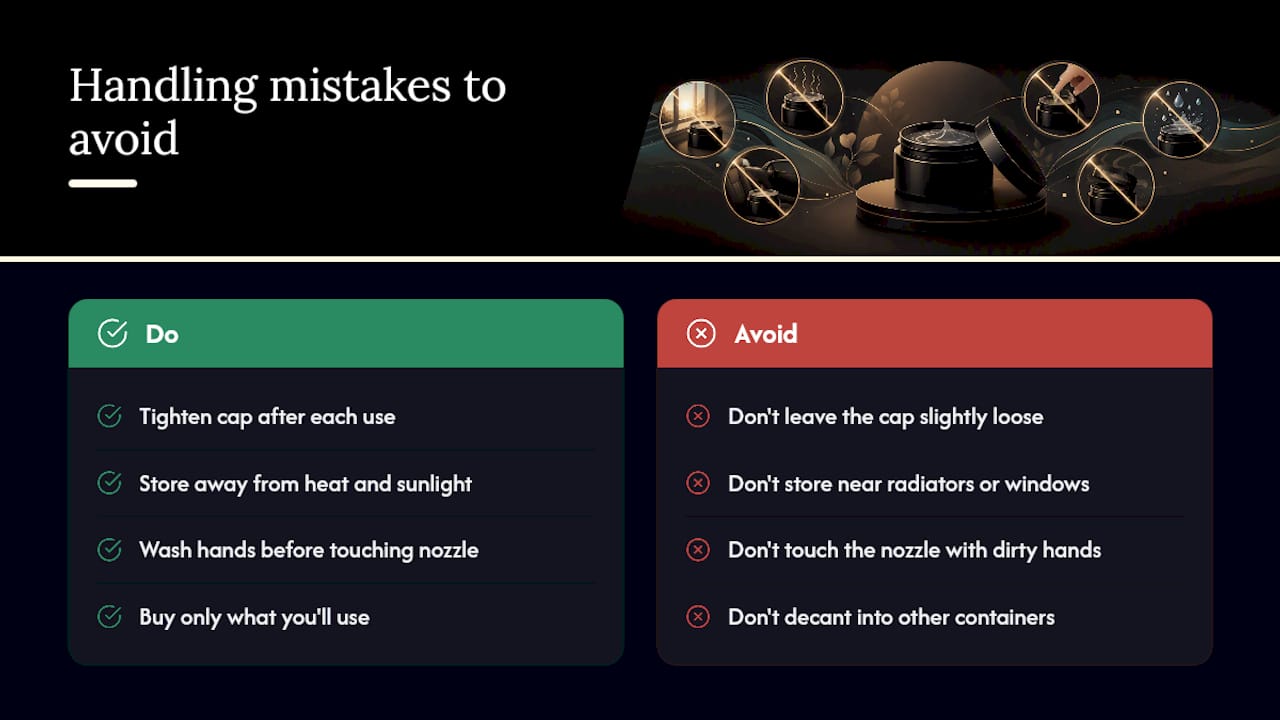
Leaving the cap slightly loose is the biggest one. Even a partial seal lets in enough air over weeks to accelerate oxidation, and you won’t necessarily notice until the colour or smell shifts. Storing the bottle upright versus on its side rarely matters much, but storing it near a heat source, on a windowsill, next to a radiator, in direct sun through a car window, matters a great deal.
Touching the nozzle with unwashed hands is another common slip. It introduces bacteria into a device that’s meant to stay clean between actuations, and over enough uses that can affect both hygiene and how consistently the pump performs.
Buying more product than you’ll realistically get through inside the in-use window is a mistake of a different kind: not degradation exactly, but waste. A bottle that sits unused for eight months isn’t dangerous, but you’re unlikely to get the same performance from it as one used within a few months of opening.
Finally, decanting gel into a different container, whether for travel or convenience, breaks the seal integrity the original packaging was designed around. It might seem like a small shortcut, but it’s one of the fastest ways to shorten a product’s useful life.
Does air exposure reduce nicotine gel potency?
Every time you use a spray pump, a small amount of air enters the bottle to replace the gel that’s been dispensed. That’s simply how the mechanism works, but it means the headspace inside the bottle grows with every use, and so does the surface area exposed to oxygen.
Oxygen is the main driver of nicotine oxidation in these formulations. It’s a gradual process rather than an instant one, so a few uses won’t noticeably change anything. But repeated opening over weeks or months means the gel inside is fighting a slow, cumulative battle against oxidation that a freshly sealed bottle simply isn’t dealing with.
This is exactly why in-use shelf life guidance sits so far below unopened shelf life. A product rated for roughly three years sealed might only be recommended for three to six months once opened, not because the chemistry suddenly changes at the moment of opening, but because air exposure compounds with every actuation from that point forward.
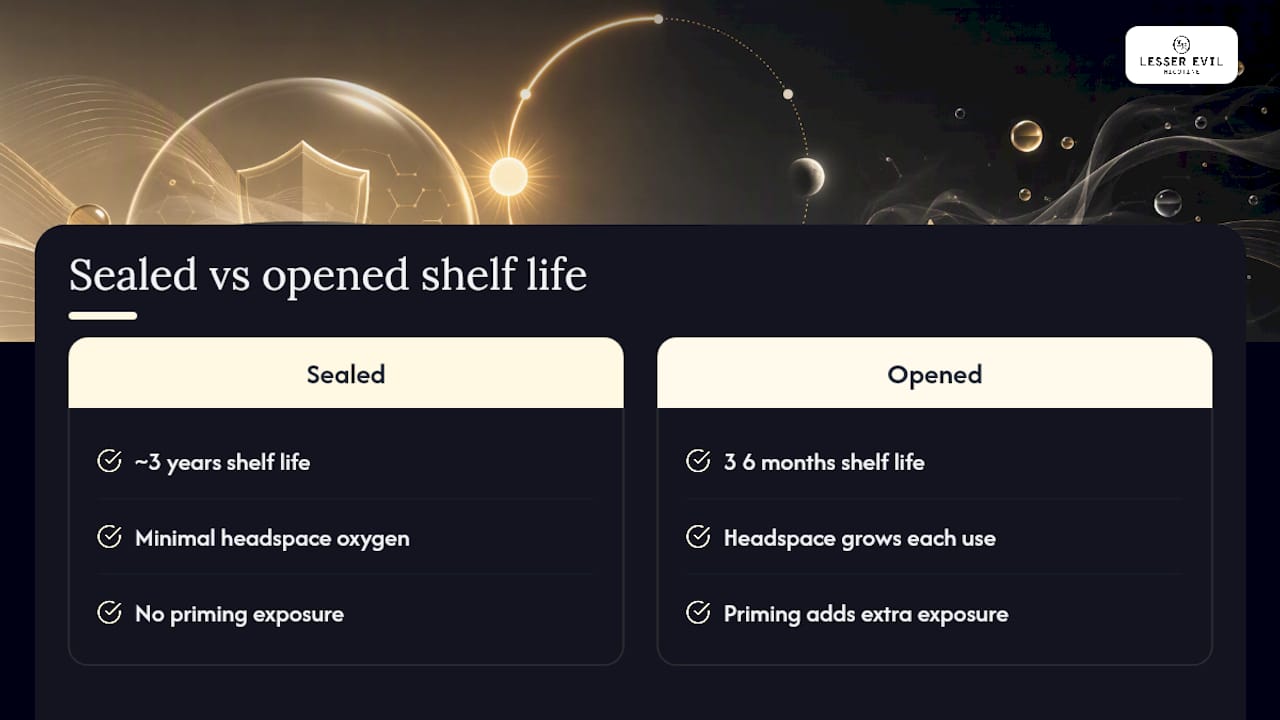
Priming the pump on first use adds a small amount of extra exposure too, since a few actuations are typically needed to get a consistent dose flowing. It’s a necessary step, but it’s another small reason why the clock effectively starts ticking faster the moment you first press down.
A short note on sensible use and less waste
Buy what you’ll realistically get through inside that opened shelf life window, not what looks like a good bulk deal. Store consciously: room temperature, sealed, out of the sun, and you’ll rarely have to think about degradation at all.
Smaller, more frequent purchases beat one big stockpile that sits half-used in a hot car for months. And there’s a genuine sustainability upside worth naming: a battery-free design means no e-waste stacking up alongside the usual packaging, which is one less thing to feel guilty about binning.
When in doubt, check the batch code and don’t second-guess a bottle that’s clearly changed.
— Luke McLeod
Where to buy the Lesser Evil Oral Mister and check storage details
This article covers a tobacco-free, battery-free sublingual gel spray available in three natural flavours: Peppermint, Black Grape, and Green Apple, with expiry and batch information printed on the packaging.

If you’re ready to try it, the Lesser Evil Oral Mister product page has full details on the formulation and what to expect from daily use. Before you start, take thirty seconds to check the printed expiry date or batch code on the box against the storage guidance in this article, room temperature, sealed, away from heat and light, so your bottle performs the way it’s meant to from the first spray through to the last. For a broader look at how this fits alongside other nicotine formats you might already be using, the types of nicotine replacement products guide is worth a read. Visit the product page now to see current availability and place your order.
Sources
- Nicotinell Rapid Relief 1 mg/spray oromucosal spray, solution - SmPC
- Nicotine (oral route, oromucosal route) - Mayo Clinic
- Patented nicotine gel humidity stability disclosures
- DailyMed: NICOTROL NS (nicotine spray) metered spray details