

Handling nicotine cravings on a long commute

The fastest way to survive a nicotine urge mid-commute is a three-step sequence you can run in under two minutes: label it (“that’s a craving, it will pass”), regulate with four to six slow breaths, then execute a discreet replacement for a brief period. That’s it. Most urges peak and ease within minutes — your only job is to outlast the wave.
Four replacements you can use right now on any commute:
- Sip cold water — something to do with your hands and mouth, immediately.
- Peppermint lozenge or gum — strong flavour cuts through the urge fast.
- Oral nicotine gel — a sublingual gel like the Lesser Evil Oral Mister sits under the tongue, tobacco-free and battery-free, no vapour involved.
- Change your audio — swap to a new podcast or playlist mid-track to break the mental loop.
Pro Tip: Try the 5-4-3-2-1 grounding technique: name five things you can see, four you can hear, three you can feel. It takes about 30 seconds, works safely while driving or on public transport, and pulls your attention out of the urge.
Key takeaways
Managing nicotine urges during long daily travel comes down to three things: a repeatable in-moment sequence, a pre-packed commute kit, and a phased plan for the journey itself.
| Point | Details |
|---|---|
| Use the three-step sequence | Label the urge, take four to six slow breaths, then execute a discreet replacement for a brief period. |
| Pack your commute kit before you leave | Water, gum, a lozenge, and an oral nicotine gel in immediate reach — not buried in your bag. |
| Phase long drives into start, middle, and end | Each phase has a different psychological driver; a short tactic for each one reduces overall urge intensity. |
| Urges peak and pass within minutes | The first 28 days are the hardest; after that, urges become less frequent and shorter. |
| Lesser Evil Oral Mister | A sublingual, tobacco-free, battery-free nicotine gel that fits discreetly into any commute kit. |
Table of Contents
- Why do nicotine cravings hit harder on a long commute?
- What commute triggers are worth tracking?
- What can you actually do when an urge hits mid-transit?
- How do you stop the commute triggering you before you even leave?
- How do you handle a commute that goes on for hours?
- Where can you get help in New Zealand?
- How long do nicotine urges actually last?
- The commute is the hardest part — and also the best place to practise
- Something different for your commute kit
- Sources
Why do nicotine cravings hit harder on a long commute?
Urges are the brain’s response to a learned cue. Every time you smoked in the car or on the platform, your brain filed that context — the route, the smell, the time of day — as a trigger. Now the context alone fires the signal, even without nicotine. That’s the habit loop at work, and the initial weeks are commonly the most intense period for frequent, strong urges.
Commutes amplify this for a few specific reasons:
- Repetition — the same route, same time, same cup holder. Your brain runs the script automatically.
- Boredom and dead time — sitting in traffic or waiting for a bus leaves the mind looking for stimulation.
- Stress pairing — the post-work commute often carries the day’s tension, which historically got “resolved” with a cigarette.
- Environmental cues — the smell of exhaust, a cigarette butt on the pavement, a dairy or petrol station you always stopped at.
Two quick examples of how this plays out: you put on the same playlist you always played while smoking, and the first track alone triggers the urge. Or you pull out of the work car park and your hand moves toward the cup holder out of pure muscle memory. Neither is a failure of willpower. Both are conditioned responses, and both can be interrupted.
What commute triggers are worth tracking?
Not all triggers are equal. Some are background noise; others reliably produce an urge every single time. The ones worth planning for:
- Route hotspots: the petrol station you always stopped at, a particular intersection where traffic backs up.
- Sensory cues: the smell of someone else’s smoke at a bus stop, tobacco displays in a dairy window.
- Time-of-day associations: the 8:15 AM departure, the post-work drive home.
- Boredom windows: long stretches of motorway, waiting at a level crossing.
- Stress spikes: a difficult call before you leave, heavy traffic.
- Coffee stops: the flat white and a cigarette pairing is one of the most persistent conditioned links.
Spend one week keeping a quick note on your phone — just the trigger and the intensity, 1–10. You’ll see a pattern within three or four days. Retail exposure during travel — passing shops and tobacco displays — is an under-appreciated driver of impulse urges, so note which stops put you in front of those displays.
Pro Tip: Pick your top two triggers from the log and build a specific plan for each one. A general plan for “all cravings” is much weaker than a targeted response to “the BP station on Hutt Road.”
What can you actually do when an urge hits mid-transit?
Tactics vary by how you’re travelling. Safety comes first, always.
If you’re driving
- Label the urge out loud or silently: “craving, it’ll pass.”
- Take four slow breaths — exhale longer than you inhale. This is safe at the wheel and calms the physiological urgency before you do anything else.
- Keep hands busy: grip the wheel, sip water, place a lozenge.
- Postpone the decision by 10 minutes. Set a mental timer. The urge will almost certainly have eased by then.
If you’re a passenger, on a bus, or on a train
More options open up. Change your seat if you’re near a trigger (a door you always exit through, a window you always looked out of). Do a sensory reset: swap your audio, take out gum, or use an oral nicotine gel. The National Cancer Institute recommends delay-and-distract tactics as an effective immediate response, and public transport gives you more room to execute them.
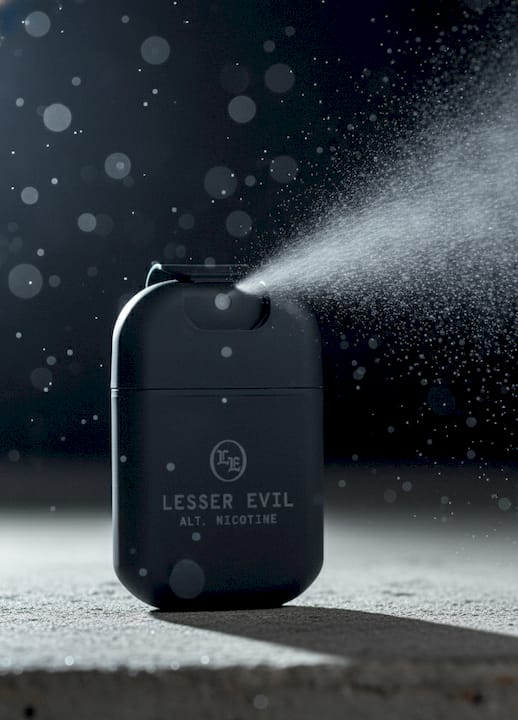
Here’s a quick comparison of discreet options for use on the move:
Pro Tip: If you’re driving, keep your replacement in the cupholder or door pocket — not the glovebox. If you have to reach for it, you won’t use it at the right moment.
How do you stop the commute triggering you before you even leave?
Pre-commute planning is where most people leave easy wins on the table. Evidence-based quit plans consistently show that identifying triggers and placing realistic substitutes in reach before the urge arrives dramatically improves in-moment outcomes.
A practical pre-departure checklist:
- Remove smoking cues from your vehicle: empty the ashtray, bin the lighter, clean the cabin smell.
- Fill a water bottle and place it in the cupholder.
- Pack a small commute kit: gum, a lozenge or two, your oral nicotine gel.
- Queue a specific podcast or playlist you only use for commuting — a new audio association breaks the old one.
- Occasionally take a different route to avoid your highest-risk hotspot, particularly in the first few weeks.
The cognitive principle here is simple: if the replacement is in reach, you’ll use it. If it’s buried in your bag, you won’t. Pre-commitment does the heavy lifting so you don’t have to rely on willpower at the worst moment. For managing nicotine urges at work and during travel, the same pre-planning logic applies.
Pro Tip: Pick one realistic replacement action — a sip, a piece of gum, or a gel — and practise it every time you start the car for two to three weeks. You’re building a new script to replace the old one. Repetition is the mechanism.
How do you handle a commute that goes on for hours?
Long commutes need a phased approach. Splitting a drive into phases reduces urge intensity because different parts of the trip amplify different psychological drivers.
- Start phase (first five minutes): Set your audio before you move. Take one slow breath. This primes the new script before autopilot kicks in.
- Middle phase: Schedule sensory switches — swap the podcast at the halfway point, take a sip of water every 20 minutes, do a brief stretch at a rest stop. Boredom is the main driver here, so keep the stimulus varied.
- End phase: Build a new arrival ritual. A short walk, a specific song, a cold drink — something that signals “commute done” without the old reward cue.
Track your progress with a simple phone note: date, trigger, what you did, how it went. After two or three weeks you’ll see which tactics are working and which need swapping. Lapses happen. They’re data, not verdicts. Nicotine habit management research consistently shows that all-or-nothing thinking after a slip is the biggest predictor of giving up the plan entirely — so note it, adjust, and keep going.
Where can you get help in New Zealand?
You don’t have to figure this out alone. New Zealand has solid, free support:
- Te Whatu Ora / Smokefree NZ — local guidance, resources, and links to stop-smoking services across the country.
- Quitline NZ — call 0800 778 778 or text 4006. Advisers can help you build a personalised plan, including advice on clinical options your GP can prescribe. You can call during a commute if you’re a passenger.
- Your GP — for personalised advice on NRT or prescription options, a GP appointment is the right move when urges are interfering with work or driving safety.
Contact a professional if urges are repeatedly intense enough to distract you while driving, or if your current plan hasn’t shifted things after three to four weeks. That’s not failure — it’s the right time to add clinical support to the behavioural tactics you’re already using.
How long do nicotine urges actually last?
Single urges typically peak and ease within minutes. The NHS guidance and NCI resources both describe urges as short-lived, with the first 28 days being the most frequent and intense period.
The practical rule: an urge rarely lasts longer than 10 minutes at full intensity. Delay the decision by 10 minutes, and the physiological peak will almost always have passed.
The “urge surfing” approach — treating the urge like a wave, watching it rise and fall without acting on it — is a well-established behavioural technique. You don’t fight the wave; you ride it. After the first month, most people report urges becoming less frequent and shorter. By three months, many describe them as occasional and manageable rather than constant.
For further reading: the NHS quit-smoking pages, NCI withdrawal fact sheet, and Smokefree.gov’s quit plan tool all provide evidence-backed timelines and step-by-step plans.
The commute is the hardest part — and also the best place to practise
Luke McLeod’s perspective
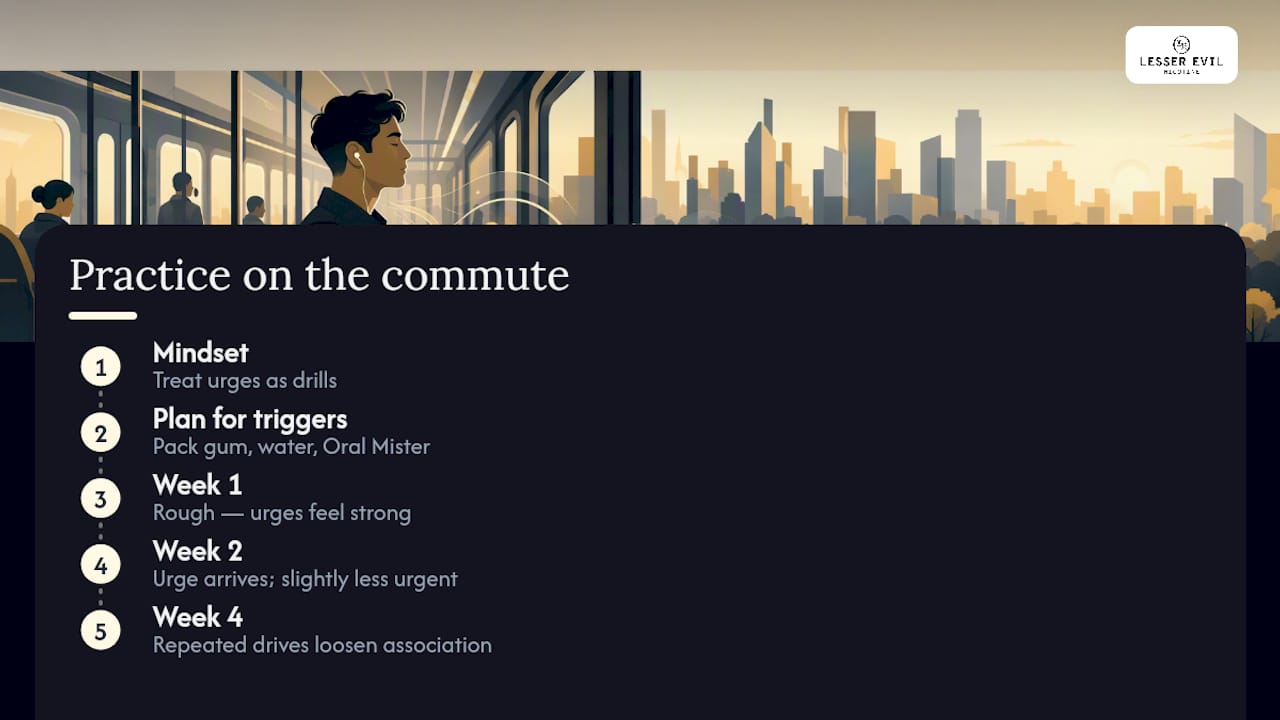
Here’s what most quit guides miss: the commute isn’t just a high-risk window. It’s actually the best place to build the new habit, because it’s so predictable. Same time, same route, same triggers — which means same opportunity to practise the replacement, day after day.
The people who struggle most are those who treat every urge as a crisis. The ones who make progress treat it as a drill. You know the trigger is coming at the BP station. You know the post-work drive is going to be hard on a stressful Tuesday. So you plan for it specifically, not generically.
The first week is rough. The second week, you notice the urge arriving but it feels slightly less urgent. By week four, you’ve driven that route without smoking enough times that the association starts to loosen. That’s not willpower — that’s repetition doing its job. Quit stories consistently show that targeted substitutions combined with tracking over weeks are what actually shift persistent driving habits.
For commuters who want a discreet, tobacco-free option that doesn’t involve breathing anything in, the Lesser Evil Oral Mister is a sublingual nicotine gel — no battery, no vapour, no e-waste. It’s a consumer product, not a medicine. But it fits neatly into a commute kit alongside gum and water, and it’s there when the wave hits hard.
Something different for your commute kit
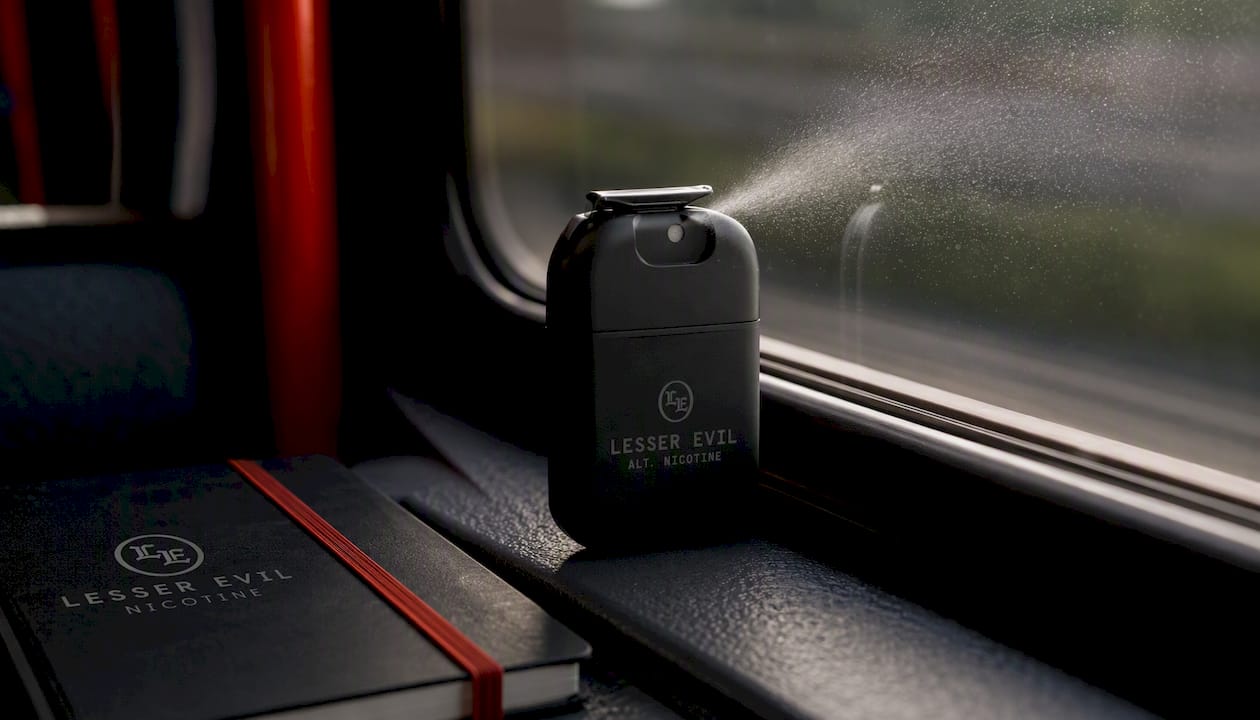
If you’re done breathing in chemicals and want something genuinely discreet for the road, the Lesser Evil Oral Mister is worth a look. It’s a sublingual nicotine gel — sits under the tongue, no vapour, no battery, no tobacco. Three natural flavours: Peppermint, Black Grape, and Green Apple. Tobacco-free, with natural sweeteners. It fits in a pocket, works silently on a bus or in a car, and produces no e-waste. Not a medicine, not a patch, not a pouch — just a cleaner way to handle the moment when the urge hits and you need something in reach. Order directly at Lesserevil.
Sources
- Understand your smoking triggers and cravings — NHS
- Tips for coping with nicotine withdrawal and triggers — National Cancer Institute (NCI)
- Te Whatu Ora (Smokefree NZ)
- Smokefree
This article is general information, not a substitute for advice from a qualified doctor. Consult a qualified healthcare professional about your own circumstances before acting on anything here.